It was an ordinary day. Searching the files of LancasterOnline, reading newspapers from the 1800s. Since Lancaster Newspapers inventoried and digitized all their newspapers dating back to the late 1700s, I have enjoyed reading the news from different periods in the history of Lancaster, Pennsylvania. Since I am a subscriber to the print edition of the daily newspaper, I also have the chance to check out the digital issues each day. And...the digital newspaper is updated several times a day which gives me up-to-date history of my community. I also have the chance to search their archives which is very interesting. Looking up relatives from the past, athletic teams I may have played on as a child and young boy and events that influenced myself and the city since the late 1700s. The original newspapers were mostly 4 pages in length which were set in metal type, by hand, and printed on the Ben Franklin press that is on display in their museum.
Lancaster Intelligencer from April 11, 1837. Click on images to enlarge them.
Today I picked out a few dates and began reading some of the news and stories on life in 1837 and 1888. The story from Tuesday, April 11, 1837 came from the 4-page Lancaster Intelligencer which had an Old English masthead. A 6-column newspaper which looked to be perhaps 10 point type in order to accommodate the 6 columns. A bit hard to read, but that may have been because the original paper that they digitized was very light in color due to the ink getting lighter over age. One of the stories I found on the back page was titled "Man and Wife". I have posted it below so you can attempt to read it for yourself. A rather unusual story that told about life in Lancaster in 1837. I really had a hard time believing that it was a real story, but as I searched the rest of the paper, it seems that all the stories were fact and not fiction. Read for yourself the story which is rather hard to read due to the printing being rather worn. Remember to click on image to enlarge it.
Story titled MAN AND WIFE
The second newspaper I explored was the Lancaster Intelligencer from Friday, June 15, 1888. The paper had one more column than the first one I read, but seemed to be easier to read since the type was darker. Still seemed to be in 10 point type, but it may have been 12 point. The paper cost 2 cents and had news, advertisements and stories in it much like the other paper I read. I chose a story from the back page to share with you that was titled, "The Bones Should Be interred". It is about a new candy factory being built over the site of an old cemetery and finding the human remains of those buried in the graveyard.
The Lancaster Intelligencer with its logo.
Read it and see what they did! Both newspapers had very interesting news articles, but it was the stories that seemed to be a bit more than just news that made reading it much more interesting. Do we have articles in our newspapers today such as these? I don't think so unless you live in an area where you get a newspaper only every week or so. I also realize that many readers don't have the chance to subscribe to a newspaper, and for you...I am truly sorry that you don't have the chance to explore your town and surrounding area by reading about it. Too many newspapers are finding it not profitable to print a paper anymore and are closing. So sad to see the history of a city or town not being documented for the sake of history. It was another extraordinary day in the life of an ordinary guy.
It was an ordinary day. Reading an online article that told about the five things you never knew about the Civil War. I must admit there are more than five things I don't know about any war, since I was never a good student in any history class I ever took both in high school and college. History just never interested me...until about 20 years ago when I began to write this blog. I have learned more world, national and local history in the past 20 years than I had in the 55 years before that. Not only learned more, but I actually joined the Lancaster Historical Society so I could visit their library and display rooms to see what I missed in the first two-thirds of my life. I recently read quite a bit about the Civil War on a trivia website I enjoy visiting from time to time. The Civil war began in 1861 and ended in 1865. Why is it that so many wars lasted 4 years? The Civil War set Americans against Americans, and it affected everyone in the United States. The Battle of Gettysburg occurred about 50 miles from my hometown in Lancaster, Pennsylvania. When Carol and I travel to visit our daughter and her family that live in neighboring Maryland, we travel West along the old Route 30. Every town along the way has memorial signs along the road telling of the Civil War. The Civil War was between the United States (the Northern States) and the 11 Southern States. It was the deadliest war on American soil with 620,000 deaths which was about 2% of the total population. And, it all started due to uncompromising differences between the Northern States, who were mainly free, and slave states over the position of the national government to disallow slavery in the territories that had not yet become states. Lancaster's own James Buchanan was President of the United States before the war began and it seems as if he did nothing to try and stop the war. He is called our nation's worst President because of that.
President Abraham Lincoln visiting the troops.
In the 1860 election, Abraham Lincoln ran on a pledge to block the institution of slavery in the new territories. In retaliation, a Confed- erate States of America was created by seven Deep South states that separated from the Union. It was feared that a Confederate secession would lead to the dissolution of the United States and divide our country into two countries. In the course of the war, 385 battles took place. Many of those battlefields have since been developed and turned into housing developments and shopping malls. Veterans and concerned citizens are trying to identify all battlefields and mark them with plaques for the sake of history. The bloodiest battle of the Civil War took place in Gettysburg, Pennsylvania with 51,112 casualties. 23,049 Northern soldiers were killed and 28,063 Southern soldiers died. The battle ran from July 1 to July 3 of 1863. Battles in Chickamauga, Georgia (34,624 deaths); Chancellorsville, Virginia (30,099 deaths); Spotsylvania, Virginia (27,399 deaths); Antietam, Maryland ( 26,134 deaths); the Wilderness, Virginia (25,416 deaths); and the Battle of Second Manasas, Virginia (25,251 deaths) were the deadliest battles of the war.
General Robert E. Lee leads his troops into battle.
The article I was reading on the trivia site said the reasons for the deaths were: musketry (50.6%); cannons (5.7%); pistol/ buckshot (1.2%); saber (0.2%); bayonet (0.2%) and unknown (42.1%). As I read those numbers, I wondered how, and why, someone would take the time to tally up all the deaths and how they occurred. Was it just for history's sake? The total number of soldiers who fought for both sides was 2,128,948 for the North and 1,082,119 for the South. I have stated earlier that about 620,000 died, but a more recent study said that perhaps it was as high as 850,000. The soldiers naturally got paid for their service with white union soldiers getting $13 a month while black union soldiers got $7 a month. Confederate soldiers were paid $11 a month. At times there wasn't enough money to pay the soldiers, so they might have gone months without pay. The Confederates called a truce in April of 1865 and the United States allegedly prevailed. Did the war mean anything? At times I believe it did, but at other times it looks as if it did nothing to stop the divide between the whites and the blacks. I could write here that only time will tell, but time seems to mean nothing anymore. Many people still believe the war has never ended. Is it not why we are still fighting today? It was another extraordinary day in the life of an ordinary guy.
It was an ordinary day. Viewing a dozen or more of my favorite sites and came across two very different topics, but also very similar. One topic was how iconic brands got their logos while the other was how companies got their name. Both were fun to read as well as guessing whom they might have been. I thought I would share some of what I discovered as an extra read for you today. Hope I have been keeping you busy reading during our time at home during the current crisis. The Nike swoosh is easily recognizable all over the world. It was designed by a design student at Portland State University in 1971. At the time, co-founder of Nike, Phil Knight, hired Carolyn Davidson to work for his company Blue Ribbon Sports in the late 1960s. He had her design a logo to show speed while she was a student at Portland State. She presented him with five potential designs, one of which was the Nike swoosh. At first he wasn't too keen on the design, but liked it the best of the five designs. He paid Carolyn $35 for the design. When Blue Ribbon Sports renamed their company Nike, the swoosh became their logo. Luckily for Carolyn, she was gifted a portion of Nike stock and a gold swoosh ring for her contribution to Nike's success.
The Apple logo was designed as a tribute to Alan Turing, an early leader in artificial intelligence research. He deciphered German codes during WWII and was the first man to plant the technological seeds for the contemporary computer. One day Alan bit into an apple which was laced with cyanide and died. Steve Jobs and Steve Wozniak, founders of Apple, realized how important Alan was to the company that they used the apple with the bit missing as their logo. Now, that's one story about how the logo come about; but it's not true. Another story tells about Apple's logo being taken directly from the Bible; again, not true. A third story tells about the apple falling on Sir Isaac Newton's head, leading him to figure out the concept of gravity; another mis-truth. The design actually came from a man named Rob Janoff. The image of the apple needed the bite taken out of it to show it was an apple and not a cherry, thus the logo. The name did come from Steve Jobs who happened to be on a fruit diet and while visiting an apple farm decided he wanted his logo to be an apple.
The Starbucks logo was a collaborative effort between Terry Heckler and Gordon Bowker. Bowker wanted his artisan coffee to show a sense of adventure of Seattle's maritime history. It was based on "Moby Dick" and the first mate of Captain Ahab, Mister Starbuck. Heckler designed the 1970s logo with a mermaid in mind, complete with some rather realistic anatomical details on her chest and a forked tail, set upon a brown background. In 1992 it was toned down a bit and changed to bright green with the mermaid's hard covering her private parts. In 2011 the Starbucks was removed form the logo altogether so all that remains is the green mermaid.
Lego company got their name based on a simple meaning. Lego is simply a derivation of the Danish phrase for play good: "Leg got." It seems that it is as simple as that. Boy, did it work!
eBay got their name due to trying to register an email account and finding that 68 others had already used the name they wanted. Not sure what that name might have been, but founder Pierre Omidyar changed the name site to Echobay after his consulting firm. Once again that name had been taken so he shortened it to eBay.
Reebok was named to signify freedom and elegance. At the end of a hard day at work and heading out for a jog may take you back to something primal and liberating. What else signals freedom and elegance? Well, the word "antelope", which is what the name Reebok is derived from. The Afrikaans word for "antelope" is "rheebok."
Pepsi is either the only acceptable soft drink or the bane of humanity. Just ask my wife who thinks Pepsi is the best soda. The name goes back to the Coke-Pepsi rivalry. When Pepsi was founded in 1904, Caleb Davis Bradham sought to offer a healthier beverage without the stimulants of Coke. Pepsi was actually sold in a drug store in North Carolina as "Brad's Drink." They renamed it Pepsi which was derived from the word "Dyspepsia" which means indigestion. The drink was alleged to have medicinal properties so "Pepsi" was born.
Häagen-Dazs reminds you of a rosy-cheeked Danish girl churning butter in sun-kissed fields with happy cows roaming on the horizon. Hey, I would buy something like that. But, it seems it was a mom and pop shop in the Bronx and means absolutely nothing. Yes, it means absolutely nothing! Mom and pop made up the word to make the ice cream sound foreign and luxurious. And, it worked.
The previous eight products and companies are some of the most recognizable in the world and have been named or received their meaning by some of the most unusual methods. But, at times it may be best to keep it simple. Seemed to work in the case of all of the above. it was another extraordinary day in life of an ordinary guy.
It was an ordinary day. Re-reading an article that was published in The Daily New Era dated Saturday, August 15, 1914. The title of the article was "THE HISTORY OF BASEBALL IN LANCASTER". I have been interested in the sport of baseball since my birth. I have played the sport, coached the sport, and watched the sport for over 75 years and still enjoy a good game of ball whether it be Little League, High School, College or professional baseball. I have written about it many times in the close to 4,000 stories I have published since I began this blog Wednesday, September 2, 2009. But...I never tire of baseball, much to the chagrin of some of my readers and family members. One day, a few weeks ago, I was searching the archives of the Lancaster Newspaper and came across the story I mentioned above and after printing it, read it and put it aside until I had more time to read it more carefully. What got my attention when I finally re-read it was the small sub-title that read: "Dating Back To Time Of The Old Ironsides." Found out the baseball grounds in Lancaster at that time were on the grounds between the Pennsylvania and Reading Railroad round house. The land was known as the Ironsides grounds and a number of teams played their games there. In 1880 a number of gentlemen thought it was time to begin professional baseball in Lancaster so they somehow obtained a plot of ground at the corner of Charlotte Street and Harrisburg Pike. A baseball club known as Old Ironsides played ball there against visiting clubs for four years until it became too costly to continue.
The teams that played there were the Phillies, Metropolitans of New York, the famous St. Louis Browns, which was managed by Charles Comiskey, and the Ironsides from Lancaster. How come I never knew about this until I was 75 years old? Then along came another team called "Lancaster" in 1884 or '85 and Lancaster found it couldn't support two professional teams so the Old Ironsides disbanded. Lancaster played their games at McGrann's Park which was close to where Carol and I raised our three children in Grandview Heights. How come I never heard of the park until I was 75 years old? Well, after a year I suppose someone ran out of money and the team disbanded. There were a few memorable players who played on those two Lancaster teams during those years. Guy by the name of John Hofford was the first man to demonstrate the curve ball in Lancaster.
John Hofford
He went to the Kansas City team in the American Association. And then there was Harry Pyle who was considered one of the best "twirlers" in the minor leagues and went to the Chicago Club. But he ran into trouble when they made a rule that you were obliged to keep both feet on the ground when you delivered the ball to the plate and that put a crimp into Pyle's effectiveness and he was useless after that. Another great Lancaster player, "Billy" Higgins, one of the best second basemen who ever played in this city, and perhaps in the big leagues, went to the Boston Nationals. The story went on to name a few others who managed to "move up the ladder" before coming back to Lancater where they died.
Connie Mack
What an ending for those couple of guys! Then in the early 1890s Asa Bentley brought his Altonna team here to play in the State League which led to a team in the Atlantic League. Several names were listed and they were said to have "played their last game here before dying." One player, Joe Yeager, was purchased by Brooklyn of the National League from Lancaster in the nineties, but when the American League expanded he jumped to Detroit where he gave up pithing for the infield. Another from that team went with Connie Mack for a number of years. A fellow by the name of Jimmy Sheckard became the manager of the Cleveland American Association club.
Jimmy Sheckard
He was a twirler on the local team. Then in 1899 professional baseball in Lancaster stopped once again. Five years later a fellow by the name of Thomas Feeley brought a semi-pro team to the Rossmere grounds, but that only lasted several months. One of those players, Bris Lord, ended up signing with Connie Mack and the Philadelphia Athletics where he went from being a twirler to the outfield. The 1914 article went on to tell of quite a few players who made their way through Lancaster and went on to play at the major league level for various teams, some that are no longer in existence. In 1905 Lancaster entered the Tri-State League and names of many of the players were mentioned in the story, but being that the story I read was posted in the August 15, 1914 Daily New Era, the history of professional baseball in Lancaster ended at that time for me. I attempted to locate other later stories, but haven't been successful as of this time. It was another extraordinary day in the life of an ordinary guy.
It was an ordinary day. Wondering how many of those reading my story today will recognize where I got the title for today's story. Came from the wife of one of my favorite cowboys, Roy Rogers. Roy was a cowboy star while I was growing up in the 40s and 50s. And, a cowboy star very seldom killed anyone but the bad guy. The cowboy star may fight the bad guy but never take advantage of him. You gained the victory over your rival by being a "Good Guy." Now, that was Roy Rogers!
LDub with my Roy Rogers chaps, gun, rope,
holster and cowboy hat. Roy was tops! My
chaps have "Roy Rogers" printed on them.
Mom made me wear a black hat and I hated it.
I never once saw Roy kiss a girl on TV. Same goes for marrying a girl on his show. Heavens...he was married to Dale Evans. So, when he rode off into the sunset at the end of his shows, he did it alone. That's what a good cowboy did. I was considered at the time a member of the cap-pistol set. Others like myself, as well as the boys who wore brightly checkered shirts hanging down outside their pants, were Roy's followers on his TV show. As a young boy I never knew Roy to do anything wrong. He was one of my TV heroes. He along with Wild Bill Hickok, The Lone Ranger and Tonto, The Cisco Kid and Poncho, Davey Crockett and Hopalong Cassidy filled my afternoons, Saturdays and Sundays with thrill after thrill as they defeated the bad guys and rode off into the sunset. But, Roy was always my all-time hero when he rode Trigger onto the scene to save the day. And, he really was a cowboy in real life. I recently read an article about Roy and his career struggles and real life relationships. He was born on November 5, 1911 in Cincinnati, Ohio.
Roy and his brother with their instruments.
His real name was Leonard Slye. I had a hard time thinking he was anyone other than Roy Rogers in his life. A year after he was born, his Dad and brother built a houseboat and took the family up the Ohio River to Portsmouth. The family bought a plot of land on which to build a house, but when the river flooded, they just moved the houseboat onto the property. Then in 1919 the family moved to Lucasville, Ohio and Roy (just can't call him Leonard) was able to have a horse. It was at this time in his life that he became an entertainer when he got a mandolin and began singing for the family. His family was poor so he had to drop out of school to work with his dad at a local shoe factory.
A very young Roy Rogers. Always
wore a white hat so you would know
he was a good guy.
Then in 1931 the family moved to California where Roy sang and yodeled with "The Rocky Mountaineres" on local radio. Two years later he married Lucile Ascolese who was one of his admirers. The relationship didn't last long and they divorced in 1936. Later that year he married Grace Wilkins after she baked a pie for him! Roy then formed a new group called The Pioneers Trio and when they appeared on a radio broadcast, the announcer decided he liked "The Sons of the Pioneers" better since they all looked so young. Then in 1935 he began appearing in minor film parts. Three years later he auditioned to be the next big "singing cowboy" star. In 1938 he debuted in "Under Western Stars." In 1941 he and Grace adopted a little girl, Cheryl Darlene, when they found they couldn't have one of their own. Two years later they had one of their own, Linda Lou.
An early photo of Roy Rogers and Dale Evans.
And, in 1945 Roy Jr. was born, but complications from the birth killed Grace. During one of Roy's films he met a young woman by the name of Dale Evans, whom he married in 1947. For 16 straight years, Roy was one of the top western actors in film. I remember Roy the best when he made a move from film to TV on "The Roy Rogers Show." On the show he was a cattle rancher who brought justice to the town where lived. His wife, Dale Evans was also in the show. His show was a hit from 1951-1957, while I was in elementary and Jr. High School. The other star of the show was his horse Trigger. After '57 he began to fade into the sunset but that was OK with me, since girls and cars replaced Roy as my main center of interest in life. Roy made his final ride into the sunset on July 6, 1998. He brought me many childhood memories as well as a pretty neat western outfit. It was another extraordinary day in the life of an ordinary guy.
Dale Evans and Roy Rogers
A younger Roy with Trigger.
Color film gave people a chance to see Roy and Trigger in full color.
It was an ordinary day. Sun was shining brightly as I pulled into the parking lot of the Railroad Museum of Pennsylvania in Strasburg. Cold January day, but I had plans for a special visit with a former student. The lot was empty and after checking my watch, realized I was a bit too early. Backed the car from between the white lines and headed a quarter-of-a-mile east to a place I had wanted to visit for years...The Red Caboose Motel.
Sign at entrance to the Red Caboose Motel
I had passed the place over a hundred times and always said to myself that I must stop sometime and take a few photos...so, I guess today is the day. Headed east from the Museum and in a few minutes pulled into the parking lot. "Lancaster County's Red Caboose Motel offers a little bit of train history tucked away among the peaceful Amish farms of Strasburg, PA" it says in an online advertisement for the motel and today I am going to see exactly what goes on at the place.
The Red Caboose Motel lobby.
It was back in 1969 that Don Denlinger placed a bid of $100 on nineteen 25-ton N-5 cabooses (yes! that's how it's spelled) that were being sold as surplus from the Pennsyl- vania Railroad. Six months later he was the proud owner of 475 tons of steel railroad cars that followed the rest of the train down the tracks. The web page for the motel says that "Hard work, sweat, perseverance and prayer paid off and the official grand opening and open house was on Mother's Day 1970."
One of many rows of cabooses.
During summer months I have always noticed many people walking around the grounds of the motel with the myriad of cabooses in the background and wondered if it was something I might want to try. Grabbed my Nikon and got out of my car for a trip around the grounds. I had read that tens of thousands of travelers, rail enthusiasts and even locals have stayed at this place since it opened, and hopefully I would be able to snap a few photos of the place today.
An Open House sign sat outside this caboose.
Four years ago the Prickett family bought the motel from the original owner, Donald Denlinger, and operate it along with the Casey Jones' Restaurant which happens to be two Pennsylvania Railroad P-70 coaches that were built in the 1920's. The kitchen for the restaurant is a box car that connects the two coaches. Originally, Don had painted all the cabooses red, but today they vary in color depending upon the railroad line they represent.
Interior of caboose. Bed, bathroom and double bunk on
the left with table and chairs and double bunk on right.
The oldest caboose is from 1898. The grounds sport a few rows of tracks that hold the many cabooses with space between them for patrons to park their cars. I began to document each caboose until I realized that was just going to be impossible and who would want to look at all those photos anyway. After about a dozen cars I just enjoyed looking at the cars and the different logos on them until I came to a car that had a sign in front that declared "Open House."
Another row of motel cabooses.
Walked up the steps and into a motel room that at one time might have visited more states than I had ever seen. Entered into a very small area that had a double bed on the left with a few chairs and table on the opposite side and a TV on the wall. I assumed it was the master bedroom and living quarters. Directly behind the bedroom was a very small bathroom with a mirror outside the bathroom door.
Outside of the restaurant cars.
The rear of the car had bunk-beds on either side which would hold a total of four people. Above me were windows that gave light to the room. A phone and a light or two added necessary evening light to the room. If you suffer from claustrophobia and have a couple or three very active children, this isn't your dream vacation spot to stay, but for something totally out of the ordinary, you'd love it. After my photo shoot was over I found my way to the nearby farmers field where I managed to find a few weeds to feed to the resident alpacas. A few minutes later I was back once again, standing at the front desk at the Railroad Museum waiting to visit with my former student. It was another extraordinary day in the life of an ordinary guy.
It was an ordinary day. Reading about the birth of America's first highway known as the Philadelphia and Lancaster Turnpike and later renamed the Lincoln Highway.
Advertisement for buying
shares in the highway.
Ground was first broken in 1792 for a roadway that was touted as the first "engineered" road in the nation. Engineered meant that it was surveyed, graded and paved with packed gravel stones for its entire length which was from the town of Columbia, Pennsylvania, which is located at the western most terminus, to Girard Avenue in the Parkside neighborhood of Philadelphia. Its total length was 73.33 miles, but was 62 miles from Lancaster to Philadelphia. The new road was too expensive for the Commonwealth of Pennsylvania to build so it was built by a private company known as The Philadelphia and Lancaster Turnpike Road Company. The cost was $465,000 or about $9.5 million today. Shares of the "Company of the Lancaster and Turnpike Road" were first issued on March 16, 1795.
A toll stop leading to the Philadelphia and Lancaster Turnpike.
I found a listing for shares in the Phila- delphia & Lancaster Turnpike Company dated May 24th, 1796 that were listed for $100 and could be paid in three monthly installments. The new turnpike had "Toll Gates" that were placed approximately every 10 miles, but many driving on the road took side roads to circumvent the gates. People who did so were at the time known as "shunpikes."
This photograph shows the highway looking west in 1929.
There were those that were exempt from paying tolls such as anyone who live along the turnpike, anyone passing from one part of a farm to another, anyone on their way to a funeral, anyone on their way to church, anyone engaged in military service or on their way to vote in an election. Eventually the turnpike was absorbed into the transcontinental route known as the Lincoln Highway or in Lancaster County as Route 30.
The tourist attraction known as the Amish Farm and House.
The highway was formal- ly dedi- cated to President Abraham Lincoln with several statues of Lincoln placed along its eventual total 3,389 mile length. Along the highway in Lancaster County sat the SkyVue Drive-in Theater which opened on Tuesday, May 23, 1950. It was one of my favorite places to allegedly watch an outdoor movie. It eventually was torn down to make room for Lancaster's first Outlet Mall in 1985.
The Highway today.
The mall became competition for the tourist dollars with the Amish Farm & House along what by this time was known as Route 30 instead of the Lancaster to Philadelphia Highway. Today Tanger Outlet Center sits in the spot once occupied by the Outlet Mall. If you have ever driven the once gravel stone turnpike, now paved Lincoln Highway, or Route 30, you probably have no idea what it must have looked like when it first traversed Lancaster County. Hard to think it was the very first turnpike or highway in our nation. It was another extraordinary day in the life of an ordinary guy.
It was an ordinary day. Reading a variety of things online and came across a children's book titled "Farmer Herman and the Flooding Barn" which was written by Jason Weber, the national director of foster care initiatives at Christian Alliance for Orphans, and was illustrated by 344 people!! So, what's the story behind this book? The story began in 1988 in a small Nebraska farm town known as Bruno. Mr. Herman Ostry and his family had a barn that needed to be moved out of the way of flood waters.
The barn on Mr. Ostry's property that was to be moved.
After obtaining quotes from various contrac- tors, he realized that moving the barn wasn't going to happen. Then one night at supper he joked to his family, "I'll bet if we had enough people we could pick up that barn and carry it to higher ground." His son Mike took the idea seriously and thought about what his dad wanted to do and came up with a plan. He counted the boards and timber in the barn and estimated the barn's weight at 16,640 pounds. Then he began welding a grid of steel tubing together which brought the total weight to almost ten tons.
344 people moving the barn.
Mike's system provided a handhold for 344 people, which meant each person would be lifting about 55 pounds. It just so happened that the little town of Bruno was planning its Centennial Celebration that same summer and the planning committee decided to make the moving of Herman Ostry's barn a part of the official celebration. On July 30, 1988, local TV cameramen were on hand, along with 4,000 spectators. 344 volunteers lifted the barn in unison, walked the barn 115 feet to higher ground in three minutes and deposited it in a new location. So how did that all happen? Did Mike really figure in the full weight of the barn accurately including nails and hardware? And, how about the metal pipe grid? Wasn't there a group of people who wanted to try tractors and front-end loaders? And, where did the 344 volunteers come from. What if one of those people hurt themselves and sued Herman.
Another photo showing the movers.
And what if some moved in the wrong direction. But, Herman's barn got moved because Nebaskans know if one person is in need, everyone else will show up in a heartbeat to help out. They don't argue, they don't complain. They cheerfully get the job done and then they have a beer and gather at someone's house to play a few rounds of sheepshead, whatever that might be! At times Nebraskan farmers look more like the church than the church does. I guess the Bible verse 1 Peter 3:8 tells the story...Above all, be of one mind. Be sympathetic, love as brothers, be compassionate and humble. So, where does this Jason Weber guy, the author of the children's book, come into the story? Well, he was in Lincoln, Nebraska one day for a conference and decided to drive to Bruno to meet with the Ostry's and see the barn. He wanted to ask them if he could turn their story into a book to raise money to help foster children.
Herman autographs a copy of the book.
Herman said, "Go for it, and if it touches even a little bit and cheers children up, what more could you ask for?" Weber also had the idea of having each of this 344 people who helped move the barn to draw one element - perhaps a cat, boot, goat, etc. - and have an illustrator use all those images in the book. He asked Mrs. Ostry if she could draw a sun. Weber than said to Mr. Ostry, "You know there's some people that think it's crazy to get 344 people to illustrate a book." Mr Ostry replied, "Yeah, that's what they told me too. but sometimes you have to do something a little bit crazy to get something done." Chris Dorvak, Herman Ostry's married daughter, and two of her children contributed drawings as did "Duck Dynasty star John Luke Robertson and the Christian band, Jars of Clay. So, for those reading my story today, just about anything is possible if you set your mind to it. Just ask Mr. Ostry! It was another extraordinary day in the life of an ordinary guy.
It was an ordinary day. Told my wife I'd be back in a bit and headed down the street to view the automobile show that was sponsored by Thorn Hill Vineyards store in the Foxshire Plaza along the Fruitville Pike in Lancaster, Pennsylvania. The show featured a collection of classic beauties from members of the Horseless Carriage Club. The owners of the cars traveled from 13 states to the event which is sponsored by the Susquehanna Valley Club. States represented in the show today were Washington, Oregon, California, Maine and Pennsylvania. The owners of the Thorn Hill Vineyard had a 1923 Hupmobile and offered complimentary rides in the grand touring convertible. To be a member of the Horseless Carriage Club, your automobile must be a gas, steam or electric motor vehicle built or manufactured prior to January 1, 1916.
The logo of the Horseless Carriage Club of America.
So, all the cars in the show today are over 100 years old. There were more than 30 cars that lined the parking lot of the Plaza and everyone was remark- able! I did have my favorite, only because I knew the gentleman who owned it and it was the only truck in the display which had a Lancaster connection. I walked to the Plaza about 1:00 PM and was disappointed that there were no cars on the parking lot, but as I turned to head home I heard the horn of the first car. Heading north on Fruitville Pike, after a show in the morning hours at Landis Valley Farm Museum, was the line of cars that drew many looks and honking horns from passing motorists.
A few of the over 30 cars in the Horseless Carriage show.
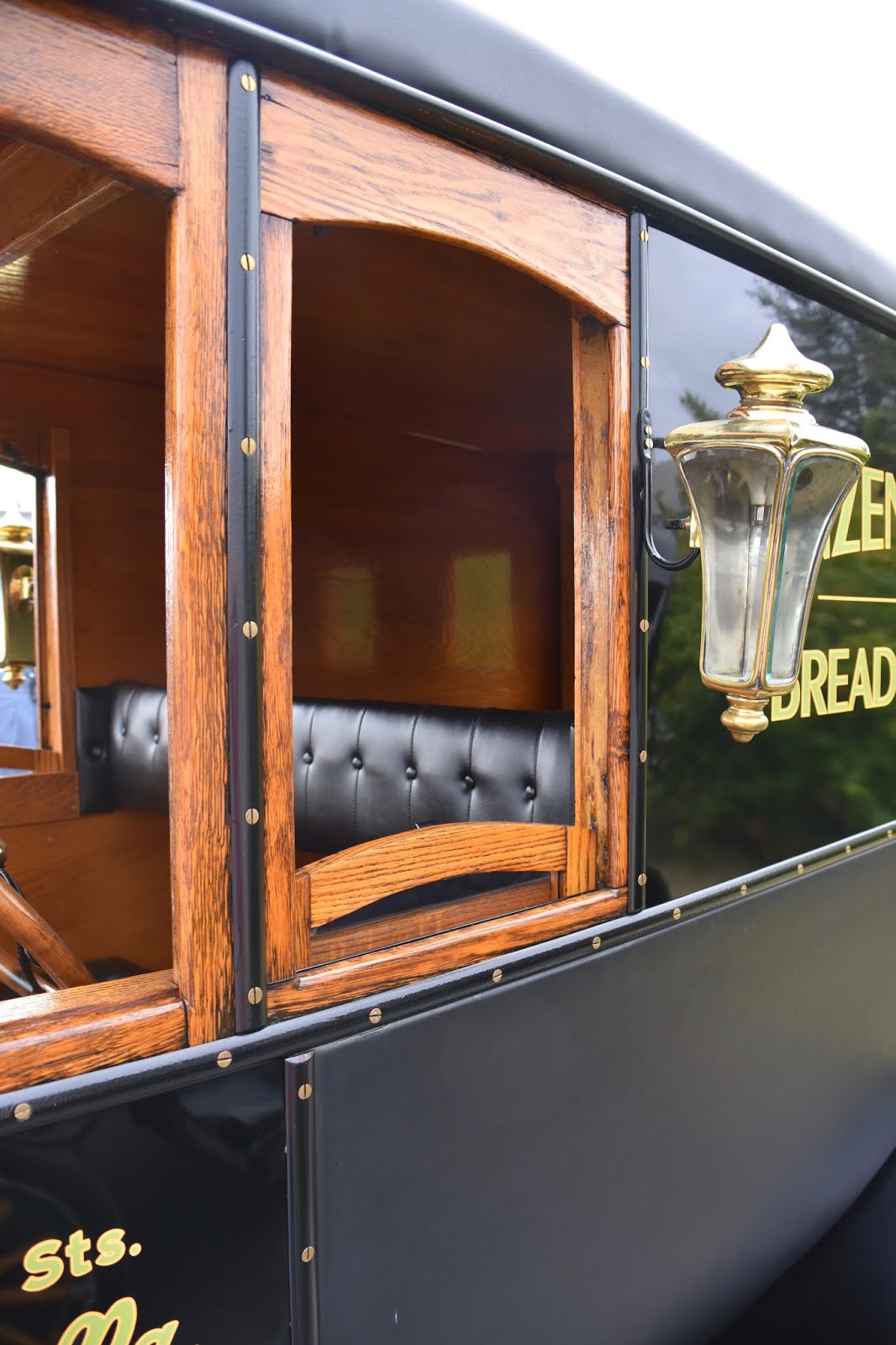
One by one they lined the parking lot until the last one arrived; a 1915 Ford panel truck owned by Tom Schell who lived about a block from me in Grandview Heights when we both lived in the area. Tom has owned the truck for about 10 years and was responsible for the paint job that read "Gunzenhauser's Bread & Cakes" on the rear compartment with "Prince & Clay Sts., Lancaster, Pa." on the cab's doors. The white tires were spotless and contrasted beautifully with the black wooden spokes and small center cap that read "Ford Made in USA". The interior of the truck featured a black leather seat and oak paneling throughout the cab. The interior was spotless and the lanterns on the cab contrasted nicely with the brass trim on the radiator. Got to talk to Tom and he told me that most of the restoration of the truck was done before he purchased it, but he had the final painting of the truck done. A few photographs of Tom's truck and a few cars follow. It was another extraordinary day in the life of an ordinary guy.
The 1923 Hupmobile taking a visitor on a ride around the parking lot.
The rear push-down window of the 1915 Ford truck and a side lantern show the special touches Tom made to his truck.
Sitting at the end on one of the rows of automobiles.
The white rubber tire with black spokes and brass hubcap. Did you know that the main ingredients in tires keep the tires white, not black. Carbon black is almost always added to improve tire wear. These tires were made with the carbon black added, thus they are a natural white.
Interior of the truck shows wooden panels with black leather seat. Foot pedals have a clutch and brake on the left and right with the gas pedal in the middle.
Rear view of the truck with the gold lettering, rear tail light on the left and wood trim.
Tom as he pulls into the parking lot of the Plaza.
Gil in his 1912 Buick.
Head lights have an extra band of brass on them. The wooden body shows in this photograph.
The metal gear on the wooden wheel is what makes the speedometer work.
The rear of a 1910 Chalmers Detroit sports a basket where a trunk would be in today' cars/
Beautiful interior on the Chalmers Detroit horseless carriage.
The grill tells the model of the automobile. Pin-stripping on the fenders adds class.
A 1908 Ford Model "T" with exposed rear seat. Perhaps the precursor to the rumble seat.
Better view of the rear seat and single lamp on the rear of the automobile.
The happy owners of the Model "T".
One of my favorites was this 1911 Locomobile.
The rear of the Locomobile. The paint with pinstripping was remarkable. You can see the single rear brass lantern inside the two spare tires.
The upholstery of the Locomobile was luxurious.
Side view of the Locomobile. One of the largest cars in the show.
Another favorite was the 1909 Pierce Arrow.
The wheels had an extra layer of brass along the edge of the spoked wheel.
Rear view of the Pierce Arrow.
Closer look at the interior of the Pierce Arrow. Notice the name on the entrance to the seating compartment. Brass lantern on the side is very interesting.
The logo and radiator of the 1916 Willys Overland made in Toledo, Ohio. This automobile just made it under the date of being eligible for the club.