Extraordinary Stories

1944 (1) Act of kindness (12) Acting (2) Adoption (4) Adventure (766) Advertisement (6) Africa (1) Aging (14) Agriculture (47) Airplanes (9) Alphabet (5) American Red Cross (1) Americana (116) Amish (43) Ancestry (5) Ancesty (2) Animals (43) Anniversary (4) Antigua (10) Antiques (14) Apron (1) architcture (1) Architecture (36) Art (175) Art? (8) Arts and Crafts (69) Athletics (6) Automobiles (40) Awards (7) Banking (2) Barn raising (2) Baseball (103) Basketball (3) Batik (1) Beaches (89) Becoming A Citizen (1) Bed & Breakfast (2) Bee Keeping (6) Beer & Breweries (2) Bikes (3) Birds (9) Birthdays (34) Blindness (1) Blogging (5) Bookbinding (5) Books (12) Boxing (2) Brother Steve (12) Buisiness (3) Business (5) Canals (1) Cancer (14) Candy (30) Caribbean Islands (9) Caribbean Villas (15) Cats (5) Caves (1) Census (1) Chesapeake Bay (61) Children (28) Chocolate (4) Christmas (57) Church Adventures (122) Cigars (1) Circus (3) Civil Rights (8) Civil War (6) Classic Cars (7) Climate Change (5) Clubs (1) Coin club (2) Coins (1) Collections (73) Comedy (3) Comic Books (5) Commercials (1) Comnservation (2) Conservation (41) Covered Bridges (3) Craftsmanship (12) Creamsicle the Cat (11) Crime (16) Crisis (312) Cruise Travel (6) Crying (1) Culture (4) Dancing (1) Danger (16) Daughter Brynn (58) Daughter-In-Law Barb (7) Death (5) Death and Dying (65) Destruction (2) Donuts (1) Downsizing (2) Dunking (5) Easter (3) Eavesdropping (1) Education (48) Energy (15) Entertainment (165) Entrepreneurial (62) Ephrata (1) Etchings (1) Eternal Life (4) Facebook (5) Factories (4) Fads (6) Family (261) Farming (37) Father (42) Father Time (68) Favorites (88) Firefighting (1) Flora and Fauna (28) Fond Memories (490) Food and Cooking (171) Food and Drink (111) Football (16) Forgetfullness (3) Former Students (10) Framing (30) Friends (359) Fruits and Vegetables (3) Fun (4) Fundraiser (6) Furniture (1) Games (7) Generations (3) Gifts (1) Gingerbread houses (1) Giving (8) Globes (1) Golf (3) Good Luck (2) Graduation (1) Grandkids (136) Grandparents (3) Grandview Heights (29) Great service (3) Growing Old (8) Growing Up (187) Guns (2) Handwriting (3) Hat Making (2) Hawaii (49) Health and Well Being (61) Health Care (4) Health Hazards (110) Heartbreak (7) Heroes (26) High School (142) History (777) HO Railroading (4) Hockey (4) Holidays (134) Home construction (7) Horses (2) Housing (3) Humorous (71) Hurricanes (1) Ice and Preservation (2) Ice Cream (8) Inventions (34) Islands (4) Italy (12) Jewelry (3) Job Related (62) Just Bloggin' (56) Just Wondering (19) Juvenile Diabetes (5) Labor (3) Lancaster County (542) Law Breakers (8) LDubs In-Laws (3) Lefties (1) Libraries (1) Life's Lessons (175) Lightning (1) Lists (72) Lititz (18) Locomotives (1) Lodging (1) Love (4) Magazines (2) Magic (1) Maps (2) Marching (2) Market (5) Medical (161) Memories (28) Middle School (3) Milk (2) Minorities (1) Money (3) Mother (54) Movies (6) Mt. Gretna (1) Music (118) My Brother (19) My Wife (260) Neighbors (7) New Year's Day (5) Newspapers (4) Nicknames (2) Nuisance (3) Obsolescence (5) Occupations (2) Old Age (1) oldies (1) Pain and Suffering (12) Panama Canal Cruise (13) Parish Resource Center (14) Patriotism (3) Penmanship (1) Pets and Animals (99) Photography (220) Pizza (1) Plastic (2) Playing Trains (2) Poetry (2) Politics (27) Polution (3) Postal Service (2) Predators (2) Presidents (11) Pride (4) Printing (81) Protesting (3) Public Service (65) Questionnaire (1) Quilts (1) Race relations (6) Rain (1) Reading (4) Records (2) Religion (10) Retirement (4) Revolutionary War (3) Robotics (1) Rock & Roll (4) Rodents (2) Saints (4) Sand (1) Scouting (2) Sex (1) Shakespeare (1) Shelling (2) Shopping (24) Simple Pleasures (122) Slavery (6) Small Towns (4) Smoking (1) Snickedoodle (1) Snow (1) Son Derek (27) Son Tad (33) Son-In-Law Dave (27) Soup (1) Spices and Herbs (1) Sports (139) Sports and collectibles (1) Spring Break (1) St. James (2) St. Martin/Sint Maarten (306) Stained Glass (3) Stone Harbor (4) Story-Telling (26) Stragers (2) Strangers (4) Strasburg Railroad (1) Stress (3) Stuff (4) Suicide (2) Sun (1) Surfing (1) Tattoos (4) Teaching (49) Technology (90) Television (6) Thanksgiving (2) The Arts (6) The Beach House (62) The Flag (1) The Future (5) The Shore (78) This and That (23) Timekeeping (7) Tools and Machines (25) Tours (2) Toys and Games (31) Track & Field (1) Tragedy (8) Trains (19) Transportation (18) Travel (16) Trees (2) Trending (2) TV Favorites (23) Underground Railroad (10) Unit of Measurement (1) USA (2) Vacation and Travel (545) Vehicles (80) Vison and Eyesight (2) War (14) Watches and Watchmaking (5) Weather (48) Weddings (3) White House (1) Wisdom (3) Yearbooks (12) York County (3)
Showing posts with label Ice and Preservation. Show all posts

Monday, February 4, 2019

The "Working On The River - The Ice Man: Part II" Story

Mr. Lynn Smoker's collection of ice harvesting tools.
It was an ordinary day.  I was greeted at the front door of the Columbia Crossing River Trails Center by a very nice young girl who told me where to find the display on "Ice Harvesting on the Susquehanna River."  In no time I was standing in front of the display that was primarily the collection of Mr. Lynn Smoker.  My story today will be a visual one, but before I begin the photographs I took of the display, I should tell you a few items that may be helpful.  The state of Pennsylvania ranked third in production of ice with Maine and New York ahead of them.  Harvesting ice on the Susquehanna River was a big industry at one time.  The little town of Columbia, PA, where Columbia Crossing River Trails Center is located, is about 90 miles from Philadelphia and at one time was considered the crossroads to the west.  So, ice harvesting was big in this neck of the woods.  
The frozen Susquehanna River can be seen in the distance.
It usually began in mid-January on the Susque- hanna with the harvested ice lasting into August or September.  The workers who harvested the ice had to be strong since they would have to carry two 50-pound blocks of ice up several floors in the ice house whjich was along the river.  The ice would be packed in sawdust to keep it cold.  When it was needed it would go out into the community which included people's homes as well as local businesses.  Agriculture and meat-packing plants used ice for preservation of their products.  The home icebox was a popular item in the home and had a place for a block of ice in it to keep items cold.  Ice was not cheap and cost the buyer about 10% of their annual income.  Natural river ice harvesting eventually gave way to artificial ice where the ice was frozen in controlled areas like small ponds or in mechanized cooling units.  About a half-mile from my childhood home in Lancaster was a factory known as Consumer's Ice Company where they made ice that replaced ice harvested on the Susquehanna River.  Follow along as I show you parts of Mr. Smoker's collection of tools and items used in harvesting ice.  It was another extraordinary day in the life of an ordinary guy.


These are tools used to check the depth of the ice.  The ice needed to be between 6" and 9" thick so both men and horses would not be in danger of falling through.  The hand drill on the right was used to bore a hole in the ice and the tool in the center was used to place in the hole.  It had a lip on the bottom which would be hooked to the bottom of the ice. A mark was placed on the top of it for depth and the rule would be used for measuring the thickness of the ice.  Click on photos to enlarge them.
If there was heavy snow on the ice, it would be removed with an ice scraper to shave off the snow. 
These are saws from Mr. Smoker's collection.  They would be used to saw through the ice along lines that were marked in a checkerboard style pattern. 
Eventually plows were used instead of the saws.  This photo shows the plows cutting along the marked lines, through the ice.  The horse drawn ice plow dates back to the 1890s.
This shows a hand plow.
This is known as breaking out and is done with hook chisels and breaking bars.  The tools are used to break off large pre-cut ice pieces so they can be piked to the ice house.
A selection of ice hooks from Mr. Smoker's collection.
Another way to get the ice to the ice house is on wagons.
The ramps were used to get the ice into the ice house.
The lift was another way to get the ice into the ice house.
Men would wear spikes on their boots while walking on the ice.
The horses would wear horseshoes with spikes on them.
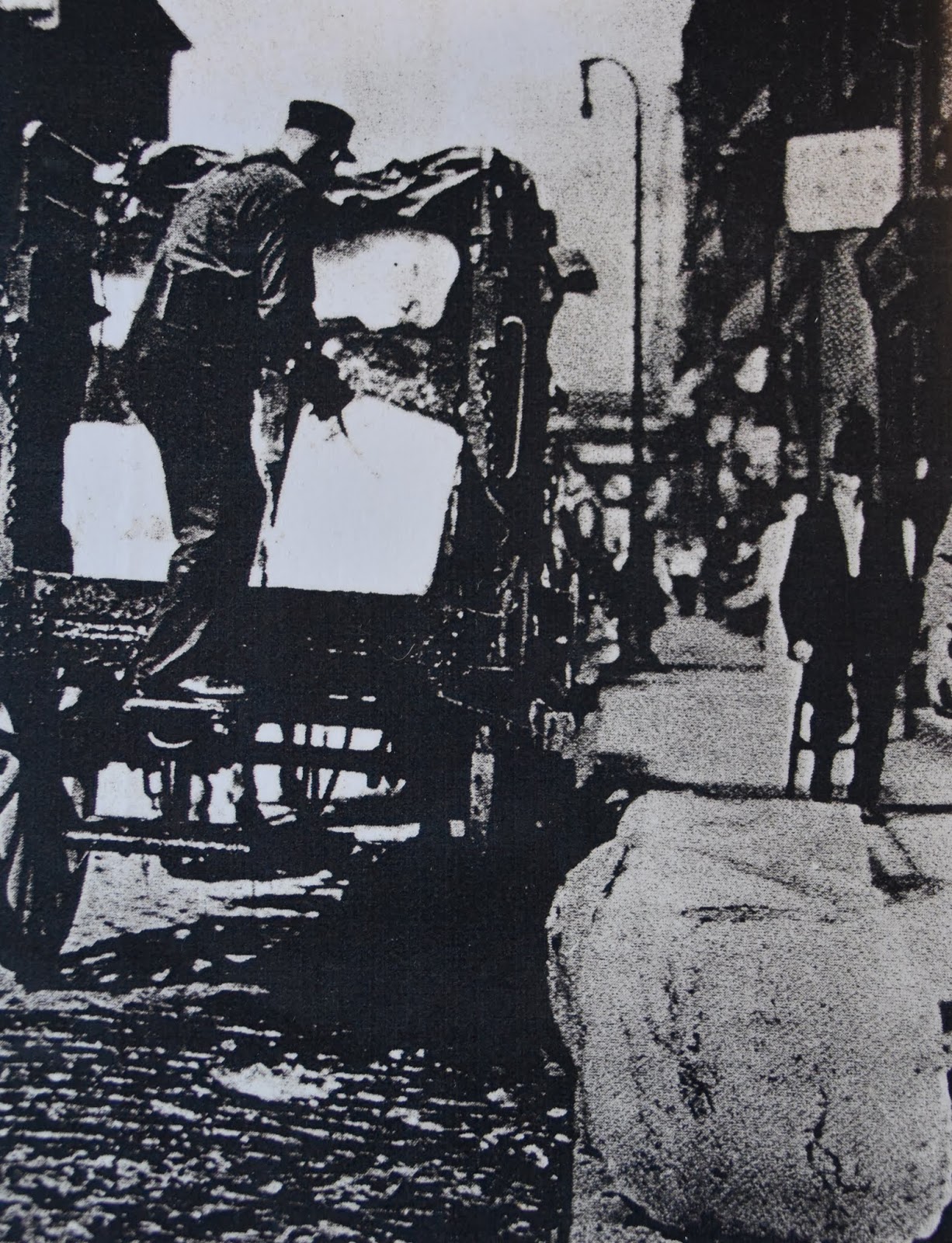
The ice man making deliveries in neighborhoods.
Another ice wagon making deliveries.  
Ice Axes and hatchets were used primarily in the ice houses as well as on the ice wagon to split blocks of ice before weighing them.  
This reminded me of an illustration from Saturday Evening Post.
The tools of the ice man included a handheld saw, ax, and pick for breaking down ice for each household.  Ice men also carried a scale to weigh the ice, but career ice men were skilled at estimating ice weight.
Customers would display this in their window if they needed ice.  It would tell the iceman what quantity of ice was needed.  Ice was sold by the pound with the cost in Lancaster around 1900 being 35 cents per 100 pounds.  
The iceman or the customer could use tools to shave or chip the ice.
Mr. Smoker's collection of ice shavers and chippers.
Ads showing cold-storage cupboards and refrigerators.
Another ad showing upscale ice boxes.  Looks like you could even sit on them.
This photo and the next are ice boxes that belong to Mr. Smoker.
Ice boxes were manufactured for home use to be opened on the floor.  Only a small block of ice and a few perishables could fit in such a box.  The ice boxes here were only affordable to wealthy American households between the 1840s and 1870s.  By the turn of the twentieth century almost every home had an icebox that could hold a substantial amount of food.

Sunday, February 3, 2019

The "Working On The River! - The Ice Man: Part I" Story

Foreword:  I'm standing in the Columbia Crossing River Trails Center in Columbia, Pennsylvania.  As a student in high school I knew very little about the little town along the Susquehanna River known as Columbia, except for the fact that they traditionally had a top-notch basketball team.  Always seemed to beat our high school team until five years after I graduated and my brother, Steve, became a senior and he and his teammates finally beat the team from along the river.  Today, the quaint little river town is the perfect model of "Small Town America."  The more I explore this town I feared as a teenager, the more I discover how much they influenced the building of our nation.  The next three day's stories will deal with those that worked on what is known as the 16th largest river in the United states and played a major role in the start of our nation.

It was an ordinary day.  Standing in the display area of the Columbia River Trails Center, with my camera in hand, taking photographs of history.  The current exhibit at the center is called "Ice Harvesting On The Susquehanna River."  Deals with the time in history when refrigeration was a big problem for the majority of the population.  I can still remember going on vacation as a young boy to a small beach in Maryland known as Crystal Beach. My mom and dad, brother and myself, along with my Aunt Lillian and cousins Judy and George would spend two weeks every summer in a small cottage at Crystal Beach where we played in the sand, went swimming in the upper Chesapeake Bay and had some the most memorable times of our lives.  And, I can still remember the ice man that made a few stops each summer so we could get a block of ice or two to put in the icebox that was on the rear porch.  Only way we could keep our food and drinks cool in the hot summer weeks was by buying the blocks of ice.  Well, today I am finally getting a chance to see how that ice was harvested for our use.  The display in the Columbia Crossing River Trails Center comes from the vast collection of Mr. Lynn Smoker. a local historian.  The display contains ice tools from small ice picks to large ice plows, to signs that home owners would put in their window.  
And, not just one of each.  This gentleman has a huge collection which he began in 2005.  Most of the pieces in the collection are from the 19th century, since the 1880s were the peak of the ice industry.  The harvest on the nearby Susquehanna River usually began in mid-January, provided the ice was at least 6 inches thick and safe to walk on without cracking it.  To be able to have heavy equipment or horses on the ice, the ice needed to be at least 8 inches thick.  A hole was needed to start the process.  The hole was drilled in the ice and a tool was placed into the hole,  The hook on the end of the tool would catch on the bottom of the hole and someone would mark the depth on the tool.  After the tool was removed, a rule was used to check the thickness of the ice.  If it was a  suitable depth, the ice was cleared of debris and snow and a crisscrossed pattern was place on the ice.  
A variety of ice harvesting tools.
Workable units of ice were usually 25 to 50 pounds blocks.  Modern day clothing didn't exist so wool was the choice for winter weather.  At times the weather was brutal so the job was not for the weak or faint of heart.  The blocks were moved to the ice houses which lined the shore and packed in sawdust to keep it cold.  When needed it was delivered to households and local businesses.  Agricultural and meat-packing plants were other customers of the ice to keep their products fresh.  Ice boxes were the fridges of today and they held the blocks of ice to help refrigerate the home owner's food.  The harvested ice usually lasted until the end of the summer months, depending on the amount harvested and the thickness of the ice on the river.  
Ice chunks line the Susquehanna River last year.
Many of the people who worked to harvest the ice were the same people who farmed the land, since they didn't have as much to do in the winter months.  The ice delivery man had to be strong since he was lifting up to 50 pound blocks of ice all day long.  To keep your home in ice for that amount of time usually cost about 10% of your yearly income.   Eventually ice farms were used to freeze water in a controlled environment.  This ice was usually cleaner than river ice.  For those that couldn't afford an ice box and the cost of ice drank warm drinks and shopped more often so their food wouldn't spoil.  The display at the Center showed samples of everything from the saws used to cut the ice to the ice boxes used to keep it cold in your home much like the ice box I remembered from my summer vacations when I was a young boy.   Eventually most all households had electricity installed and purchased refrigerated cooling units, thus eliminating the ice harvesting.  Tomorrow I will take you on a visual tour of Mr. Smoker's vast display that I had the chance to view and photograph.  It was another extraordinary day in the life of an ordinary guy.