It was an ordinary day. Trying to think what our country might have looked like before the first Europeans explored the "New World." I'm sure it didn't resemble what our country looks like today. There were no highways, no high-rise buildings and no automobiles. For thousands of years before anyone arrived by boat and stepped foot on the "New World," North America was occupied by the various tribes of aboriginal people. These inhabitants were mostly nomadic and moved from one location to another depending upon their food and shelter needs. For about 2500 years, the area where I now live in Lancaster County, Pennsylvania was inhabited by a group of people known today as the "Shenks Ferry Native Americans." They disappeared around 1500 A.D. and by the time the first Europeans arrived in the area, it was occupied by a variety of diverse groups. As they moved from location to location, they took the name of the place where they settled. As an example, those living along the Piscataway Creek were referred to as Piscatways" until they began to migrate and where then known as the "Conoy." To go along with all the names of the different groups, or tribes, the various European settlers translated the Native American tribal names into their own vernacular. The league of nations was called "Five Nations" by the English and "Iroquois" by the French. So what exactly was the league of nations? Well, those living in what at the time was New York and Canada, were the Onondagas, Oneidas, Mohawks, Cyugas and Senecas. Sometime in the mid-1400s, the five groups formed a league of nations called the "Haudenosaunea" or "People of the Longhouse." The Council of 50 chiefs governed the league, but each tribe maintained its own language and territory with none being superior than the other. In 1722, refuges from the Tuscarora tribe joined the league and it was renamed "The Six Nations." The head village of these tribes was at Onondaga which was just south of Syracuse, New York. Along the eastern seaboard of New Jersey and Eastern Pennsylvania lived the Leni Lenape who were made up of groups of related clans with similar languages. They spoke primarily Unami and Munsee and were considered matrilineal or gaining their lineage through their mother's kin. When the English settled in the area, they named the river after the first governor of Virginia, Thomas West who was the third Baron De Le Warr. The English called the river the Delaware. In 1624 the Dutch founded their colony and named it "New Amsterdam." The Lenape began selling furs to the Dutch. The English colony of Pennsylvania was founded in 1682 by William Penn who made a treaty with the Lenape under the famous tree at Shackamaxon to live in peace as long as the river flows. But, Penn's sons didn't follow their father's policy and began to take land from the Lenape. During the French and Indian War, the Lenape sided with the French since they said they would return their land to them if they won. After the French lost, the Lenape began to move west to the Ohio Valley. Another tribe, the Shawnee originated in the Ohio Valley which at the time included Pennsylvania and Virginia. In 1698, 60 Shawnee families from Georgia applied to the Susquehannocks for permission to settle hear the Pequea Creek in what today is Lancaster County. They named their town Pequehan. They remained there about 34 years until their chief abdicated and Lakundawanna was elected his successor and they emigrated to Ohio. The Conoy originally settled along the Piscataway Creek near the Potomac River. In 1704 William Penn welcomed them to his province and they moved along the Susquehanna at a place called Conejohela which today is known as Long Level in York County. They later moved to the other side of the river along the Coney Creek and called their settlement Conoytown in what today is Donegal Township. Finally, the Susquehannocks occupied a town with a stockaded fort on the Susquehanna River at the foot of Turkey Hill in what today is Manor Township. They had close to 600 warriors. In 1608, Captain John Smith left Jamestown and sailed up the Chesapeake Bay and eventually encountered a hunting party of Susquehannocks. Smith said they were much larger and muscular than most native Americans. Eventually, when skeletons were found along the river, their size was documented being much larger than most Native Americans. In 1658 a group of English Quakers explored the wilderness along the Susquehanna River looking for a place to settle. They met the Susquehannocks and asked to buy some of their land, but by this time the Susquehannoks were busy with a war against the Five Nations. After losing the war they moved up river to Turkey Hill and became known as the Conestogoes which meant "place of the immersed pole." Today it is Manor Township. The Conestogoes dwindled until they were a small remnant of twenty people. They were eventually exterminated by a band of Scots-Irish vigilantes in Lancaster in December of 1763. I have written about the massacre in the past. Type: "Indian Massacre in Lancaster" in the small white box, top left, to read that story. I posted it Friday, June 7, 2013. I often wonder what the eastern part of the United States might look like today had all these tribes and explorers lived peacefully way back then. It was another extraordinary day in the life of an ordinary guy.
Showing posts with label History. Show all posts
Showing posts with label History. Show all posts
Saturday, March 27, 2021


Monday, March 8, 2021
The "Caribbean Connection With Alexander Hamilton" Story
It was an ordinary day. Reading my daily online copy of The Caribbean Journal when I came upon a rather interesting article titled, "Alexander Hamilton's Forgotten Caribbean Island." I assume that the majority of those reading this story recognize the name Alexander Hamilton who was an American statesman, politician, legal scholar, military commander, lawyer, banker and economist. He also was one of the Founding Fathers of the United States.
With that being said, Alexander Hamilton seems to have recently brought the Caribbean island of Nevis to the forefront a few years ago after the Broadway hit "Hamilton" opened. Seems that Alexander Hamilton was born in Nevis and lived there until the age of nine. He also spent a number of years living on the Caribbean island and United States territory, St. Croix, one of the US Virgin Islands. The island of Nevis remains the core of his Caribbean legacy, but recent research also shows that the island of St. Eustatius, commonly known as Statia, was also part of Alexander's childhood. The two islands are only 35 miles apart. A local island historian, Walter Hellebrand, the director of the St. Eustatius Monuments organization, began a study of the records from the island at the Dutch National Archives in The Hague and found that James Hamilton, Alexander's father, along with his wife, Rachel Faucette, and their two sons were part of the island's history, at least in the years 1763, 1764 and 1766. Mr. Hellebrand's study was called to a halt about a year ago when the COVID-19 virus struck the island. It is now somewhat assumed that the Hamiltons lived on St. Eustatius for a few years. At the time, Statia had a close relationship with the early United States and actually the island was the first to acknowledge American independence in saluting the American brig called the Andrew Doria. Seems Alexander was born out of wedlock. Another historian, Michael E. Newton, author of Discovering Hamilton, said that Alexander's father fled from British St. Kitts to Dutch St. Eustatius to excape his debtors. Alexander's mother had already served jail time on St. Croix for an extramarital affair. But, on the island of St. Eustatius, it didn't seem to be that big a deal so the Hamiltons were attracted by the island's opportunities and anonymity. And, St. Eustatius was a short flight from the much larger Sint Maarten. Until Mr. Hellebrand is able to continue his studies, we really don't know how long Alexander Hamilton and his family resided in the Caribbean. I did read about all the adventures Alexander had while being part of the United States Government. During my reading about Alexander's life, I came upon so many facts that I had never learned before about Alexander and what he was able to accomplish in his lifetime. But, there was one incident I found most interesting. It was Hamilton's duel with his nemesis Aaron Burr. The duel began at dawn on July 11, 1804, along the West Bank of the Hudson River on a rocky ledge in Weehawken, New Jersey.
The duel happened very close to the duel that claimed the life of his son Philip in 1801. Lots were cast for the choice of position and which "second" should start the duel. Both were won by Hamilton's "second" who chose the upper edge of the ledge for Hamilton facing the city to the east, toward the rising sun. The "seconds" measured the paces for Hamilton and Burr. The shot rang out and the Vice President had shot Hamilton, delivering what proved to be a fatal wound. Hamilton's shot broke a tree branch directly above Burr's head. Neither of the "seconds" could determine who fired first. Burr's shot hit Hamilton in the lower abdomen above his right hip. The bullet ricocheted off Hamilton's second or third rib, fracturing it and causing considerable damage to his internal organs. The same surgeon who had tended Hamilton's son year's earlier tended to him, but Hamilton died 31 hours later on July 12, 1804. Alexander Hamilton was buried in the Trinity Churchyard Cemetery in Manhattan, New York. My wife and I have traveled many times in the past 20 years to various places in the Caribbean, but I had never heard the story about Alexander Hamilton being born on Nevis or living on any other island in the Caribbean. But, perhaps most people living in the Caribbean may not have ever heard about it either. No one living today was born at the time Alexander Hamilton would have lived there. It was another extraordinary day in the life of an ordinary guy.
 |
| Alexander Hamilton |
 |
| The duel between Alexander Hamilton and Aaron Butt. |
The duel happened very close to the duel that claimed the life of his son Philip in 1801. Lots were cast for the choice of position and which "second" should start the duel. Both were won by Hamilton's "second" who chose the upper edge of the ledge for Hamilton facing the city to the east, toward the rising sun. The "seconds" measured the paces for Hamilton and Burr. The shot rang out and the Vice President had shot Hamilton, delivering what proved to be a fatal wound. Hamilton's shot broke a tree branch directly above Burr's head. Neither of the "seconds" could determine who fired first. Burr's shot hit Hamilton in the lower abdomen above his right hip. The bullet ricocheted off Hamilton's second or third rib, fracturing it and causing considerable damage to his internal organs. The same surgeon who had tended Hamilton's son year's earlier tended to him, but Hamilton died 31 hours later on July 12, 1804. Alexander Hamilton was buried in the Trinity Churchyard Cemetery in Manhattan, New York. My wife and I have traveled many times in the past 20 years to various places in the Caribbean, but I had never heard the story about Alexander Hamilton being born on Nevis or living on any other island in the Caribbean. But, perhaps most people living in the Caribbean may not have ever heard about it either. No one living today was born at the time Alexander Hamilton would have lived there. It was another extraordinary day in the life of an ordinary guy.
Tuesday, September 15, 2020
The "Lancaster's Pioneer Ice Cream Maker" Story
It was an ordinary day. Checking out the LNP Sunday newspaper when I came across a story about a company in Lancaster known as Marrow Ice Crean Company. I have lived in the city of Lancaster, Pennsylvania for 76 years now and have never heard of this company. And, to top that off, I lived right next to it for a few years as a child when I lived on East Orange Street.
The company was founded by George Brayton Marrow who opened his ice cream business in 1880 in a corner store at North Plum and East Orange Streets on the east side of the city. When he first opened his business he would arise daily at 4:00 AM to drive his buggy team into Lancaster County so he could buy fresh milk and eggs which he used to make his ice cream. His ice cream was known throughout the area as "Marrow's Ice Cream." He eventually moved his business to 425 East Orange Street which was on the corner of Orange and Sherman Street, in his confectionery shop directly across the corner from my childhood home on the second floor of a corner barbershop. George was in the ice cream manufacturing business for 74 years and was the oldest ice cream manufacturer in the state.
His confectionery shop became a popular spot for Sunday strollers who walked out East King Street and returned to town by way of East Orange Street. They almost always stopped for refreshments at Marrow's Ice Cream shop. George was also known to haul his ice cream around the city in a wagon drawn by his trusty horse Princess. When I lived near his store as a child, he had become associated with the Hershey Creamery Co. of Harrisburg and eventually served as director and vice-president of the Hershey firm until his death. Mr. Morrow was a big fan of the Philadelphia Athletics and at the age of 90 got to meet Connie Mack who was 85 at the time. They met at Shibe Park for the opening of the 1948 baseball season.
Mr. Marrow had attended A's games in Philadel- phia for about 40 years and tried to see them at least once a week. Mr. George B. Marrow was born in Strasburg, PA on March 20, 1858 and became an apprentice as a youth in the confectionery business of Samuel Demuth. He later worked for George Erisman on North Queen Street and East Grant Street, next to what became the Woolworth Store in downtown Lancaster.
He loved to collect and refinish antiques in his yard at 535 E. King Street. A few pieces which he had restored were displayed in his yard and drew the admiration of passers-by. One piece was a fountain of a little boy and girl while the other was a wooden figurehead from a ship once owned by a local man. He was also one of the oldest members of the Lancaster Lodge #134, BPO Elks as well as a member of the Moose, Odd Fellows, Knights of Pythias and the Artisans as well a a member of the Grace Lutheran Church. He died at the age of 96 and was considered a pioneer in the ice cream manufacturing business. Oh yeah, he was also a neighbor of the Woods' family at one time. I'm sure I must have eaten a few Marrow ice cream cones as a child. It was another extraordinary day in the life of an ordinary guy.
The following advertisements were published in Lancaster newspapers. Click on images to enlarge.


 |
| George Brayton Marrow |
 |
| 425 East Orange Street was the home of Marrow's Ice Cream Shop. |
 |
| The Ice Cream Shop to the right and my home until I was school age to the left. We lived on the 2nd floor. |
 |
| His home at 535 E. King Street |
The following advertisements were published in Lancaster newspapers. Click on images to enlarge.


Sunday, September 13, 2020
The "New Jersey Offers A Wealth Of History" Story
It was an ordinary day. We have been traveling to the Jersey Shore since our children were small back in the mid-1970s. Traveled to Sea Isle City for a few years and then decided to head to Ocean City, since the kids preferred the boardwalk experience. Since they are grown with children of their own, we have spent time in Stone Harbor and Cape May. All the towns have a different feel to them and all are enjoyable places to rent a house for a week or two during the summer or early fall. I recently read an article in "Travel Trivia" about New Jersey that told me a bit more about the state other than visits to the shore during the summer. Thought I would share some of the really neat features about New Jersey so you too can appreciate the state that became the 3rd State of the Union on December 18th, 1787.
The state has a rich history in the field of sports. The first organized baseball game in the United States was played at Elysian Field in Hoboken, New Jersey on June 19, 1846. Alexander Cartwright organized the first game and developed the basic rules for baseball in 1945 and founded the Knickerbocker Baseball Club of New York.
The players traveled to Hoboken to practice for their first official game in October between the Knicker- bockers and the New York Nine. The NY Nine crushed the Knicker- bockers 23-1 in four innings. The first professional basketball game was also played in New Jersey on November 7, 1896 at the Trenton Masonic Temple between a team from Brooklyn YMCA and a team from Trenton YMCA . The league paid each player $15 except the star player, Fred Cooper, who received $16. Six teams formed the National Basketball League (NBL) two years later. Today it is known as the NBA. The first college football game took place at New Jersey College on November 6, 1869 between New Jersey College (later known as Princeton University) and Rutgers. There were about 100 spectators at the game which was won by Rutgers by the score of 6-4. The rules were far different than what we know as college football today. This game served as the genesis for the NCAA and NFL. Another neat feature about New Jersey is that they have almost 800,000 acres of farmland. Perhaps that's why they are known as "The Garden State."
They have the most productive agricultural land in the United States based on having the highest dollar value per acre. As we travel to the beach every year we pass farm after farm that is filled with different fruits and vegetables. The State ranks as a top 10 producer in items such as cranberries, blueberries, peaches, peppers, spinach, cucumbers, squash and tomatoes.
New Jersey also has more horses per square mile than any other state in the union. The state offers tax breaks and subsidies to farmers who breed horses and offered prize money for horse races. On our trips to the shore we pass the Cow Town Rodeo which has fields of horses that can be seen from the road. Napoleon Bonaparte's brother lived near Bordertown, New Jersey. Joseph Boneparte purchased Point Breeze and refurbished the home on the 1,800 acre property. He lived in New Jersey until 1839 when he returned to Europe where he died five years later. The official colors of the NJ flag are called buff and dark blue. The colors were chosen when New Jersey adopted its flag in 1896. The state chose those colors since George Washington had chosen the same colors for his regiments during the Revolutionary War.
New Jersey is known as the "Crossroads of the American Revolution." Major war battles occurred in New Jersey and George Washington spent more time in the state than any other location. Washington's famous crossing of the Delaware River on Christmas night of 1776 played a big part in colonists escaping British Rule. Today you too can cross the Delaware and walk through the Old Barracks Museum in Trenton and visit the nearby Trenton Battle Monument. And, finally, when you are ready to leave New Jersey and need to refill your gas tank, remember that New Jersey is one of two states in the country that will not allow you to pump your own gas. The state, along with Oregon, prefer to put others to work pumping gas for you. It does offer jobs to many people who reside in those two states. New Jersey is a beautiful state and we love their beaches. And, it's only about three hours from our home in Lancaster, Pennsylvania. But...this year our family decided to cancel our yearly trip to the Jersey Shore to avoid gettin ill. Maybe next year, if all is well once again along the Jersey Shore. It was another extraordinary day in the life of an ordinary guy.
 |
| New Jersey was the 3rd State in The Union on December 18, 1787, |
 |
| The first organized baseball game was played in New Jersey. |
 |
| New Jersey if rich in farmland. |
 |
| The state has more horses per square mile than any other state. |
 |
| New Jersey is known as the "Crossroads of the American Revolution. |
Tuesday, September 8, 2020
The "Love Is In The Air!" Story
It was an ordinary day. Reading new entries on "The Lancasterian" Facebook page when I came upon a really neat picture postcard that showed a panoramic view of Lake Luzerne, NY.
As I searched a bit more I found that the picture was on the front side of a post card which carried a very interesting note from a girl named Beth. She sent the post card to a Miss Marie Strantz who lived at 561 Love Lane Street in Lancaster, Pennsylvania. Her note was dated Sunday Eve., 3-13-'10. She wrote: I rec'd your card return many thanks glad to hear from you. I am still corresponding with H.M. Can't say what the results will be. Had you said something to him because he started to send cards to me. I believe you did or he never would have come out some time. Ans. sooner. Send my love. Beth.
So, who are the characters in this love affair? First, I did a bit more snooping and found that Love Lane was in the Cabbage Hill area of the city of Lancaster. Love Land was located to the south west of the center of the city, but had it's name changed to Fairview Avenue sometime around 1915. The first houses along Love Lane appeared in the mid-1800s. A fellow by the name of Jim did some searching in the 1875 atlas and found two properties owned by a Strant family along the middle part of Love Lane. Could they have been the same as the Strantz family? I found no one who had any idea why the street, or lane, was named as it was. And no reason was given for it's change to Fairview Ave. A former neighbor of mine, Gretchen, who lived in the Grandview Heights area of Lancaster when I lived there, did some searching on Ancestry and found that a Marie Strantz lived at 560 Love Lane with her parents and six siblings. Her father was a soap maker and she was 17 years old in 1910 when she received the post card from her friend Beth. Marie worked as a carder at the local cotton mill as did many others who lived in the Cabbage Hill area of Lancaster. Gretchen also wrote that if she has the correct woman, Marie, she married a Mr. Edward Greenawalt and they had a son Wilmer who was born in 1924 and was killed August of 1944 in France. Marie died at the age of 59 of a stroke and breast cancer. Now, getting back to the post card...Beth, the writer of the post card, more than likely lived in Manheim, PA, since the card was postmarked Manheim. Beth wanted to share the news about her correspondence with H.M. who had begun sending cards to her. Beth wondered if Marie had said something to him that prompted the correspondence. Was Beth a secret admirer of H.M? Did Marie tell him of Beth's interest? If only someone could have found just one more post card so we would have been able to answer a few of these questions. Isn't history interesting and fun.? Could this have been the story line of a TV soap opera? Must have been, since one of the characters in the soap opera lived on Love Lane Street. It was another extraordinary day in the life of an ordinary guy.
 |
| The front of the picture postcard |
 |
| The opposite side of the picture postcard |
Saturday, September 5, 2020
The "When Baseball Was Free Of Problems...Allegedly!" Story
It was an ordinary day. Reading a story titled "The Thrill Of Baseball" which was fist published as an editorial in The Saturday Evening Post on October 13, 1908. In 1908, the game of baseball was so different than it is today. There were no cheating scandals, players were smaller in stature, there were no drugs and only whites played the game of professional baseball.
The superior edition of the game, which is played today, has made many needed changes to make the game more interesting, dynamic and available to all good players no matter what color, race, or religion they may worship. But, with the updated version of the game are some unwanted items such as drugs and cheating, but it sadly is a part of our universal society today. The song, "Take Me Out to the Ball Game", was a big hit in the early days of the game and the following editorial was part of the Saturday Evening Post. I have printed it as it appeared so you can see how important the game of baseball was at the time. It was another extraordinary day in the life of an ordinary guy.
In an imperfect and fretful world, we have one institution which is practically above reproach and beyond criticism. There is no movement afoot to uplift it, like the stage, or to abolish it, like marriage. No one claims that it is vulgar, like the newspaper, or that it assassinates genius, like the magazines. It rouses no class passions, and, while it has magnates, they go unhung with our approval.
This one comparatively perfect flower of our sadly defective civilization is, of course, baseball - the only important institution that the United States regards with a practically universal, uncritical, unadulterated affection. The fact doesn't fit any theory, for baseball is somewhat of a trust and monopoly and is operated with an eye to the gate receipts.
The strength of baseball is simply that it gets results. Politics bores, the newspaper irritates, the drama frequently, at best, leaves you in doubt as to whether you have had a pleasant evening, a cold in the head takes the perfume from the rose of matrimony. But there is no doubt, no bar, no discount upon the thrill of the double play, or the deep joy of the three-bagger.
"Our One Perfect Institution, " Editorial, October 31, 1908.
 |
| Jackie Robinson was the first African American major league baseball (MLB) player. Jackie Robinson is credited with breaking MLB's color barrier in 1947. However, back in 1881 in the American Associaton, a major league at the time, Moses Walker and his brother Welday Walker played for the Toledo Blue Stockings. |
In an imperfect and fretful world, we have one institution which is practically above reproach and beyond criticism. There is no movement afoot to uplift it, like the stage, or to abolish it, like marriage. No one claims that it is vulgar, like the newspaper, or that it assassinates genius, like the magazines. It rouses no class passions, and, while it has magnates, they go unhung with our approval.
This one comparatively perfect flower of our sadly defective civilization is, of course, baseball - the only important institution that the United States regards with a practically universal, uncritical, unadulterated affection. The fact doesn't fit any theory, for baseball is somewhat of a trust and monopoly and is operated with an eye to the gate receipts.
The strength of baseball is simply that it gets results. Politics bores, the newspaper irritates, the drama frequently, at best, leaves you in doubt as to whether you have had a pleasant evening, a cold in the head takes the perfume from the rose of matrimony. But there is no doubt, no bar, no discount upon the thrill of the double play, or the deep joy of the three-bagger.
"Our One Perfect Institution, " Editorial, October 31, 1908.
Sunday, August 30, 2020
The "Memories Of Milton S. Hershey: Part II - Mt. Joy, PA" Story
It was an ordinary day. I have written a few times about one of Lancaster's most prominent residents, Milton S. Hershey. Mr. Hershey began his love affair with chocolate as a young boy when he worked at 48 1/2-52 W. King Street in downtown Lancaster.
It was in 1887 that he founded The Lancaster Caramel Company in the 300 block of Church Street in downtown Lancaster and eventually sold it in 1890 when he began the small town that bears his name; Hershey, Pennsylvania. It was in 1894 that he founded Hershey Chocolate Company and introduced the Hershey Bar the following year.
His town of Hershey was situated close to the Dauphin-Reading Turnpike, thus making it easy for receiving his shipments of sugar and cocoa beans from the ports of New York and Philadelphia. All of his plans were developed according to his master plan for success. Wasn't long before he had constructed homes for workers as well as a new mansion near the plant for he and his wife.
He was a visionary that wanted the best for himself as well as his employees. But, for as many times as I have read stories about him and his master plan, I never once knew that he had opened a plant in Lancaster County in an old brick building at East Donegal and South Jacob Streets in nearby Mount Joy, Pennsylvania. I recently read an article in The Lancaster newspaper with a headline that read "Milton Hershey's local connections found in Mount Joy." The story was written by "The Scribbler" aka Jack Brubaker.
He said that Harold and Hellen Keller recently showed him a plaque, high on a wall of an old brick building that houses an auxiliary Donsco operation next to the company's headquarters in Mt. Joy. The tiny plaque read: "On this site and in this building Milton S. Hershey operated a caramel factory from about 1892 to 1898. Seems the Mount Joy Chamber of Commerce placed the plaque on the building in 1972, putting it high enough so no one would vandalize it.
Perhaps that's why very few knew that Mr. Hershey every had a candy operation in a place other than Lancaster and Hershey. Mr. Keller thought it was about time that the world knew about Mr. Hershey's factory in Mount Joy, so he notified Mr. Brubaker who in turn wrote his story for The Lancaster Newspaper. So, how come the city of Lancaster doesn't have any neat plaques just like Mt. Joy does? Mr. Hershey lived at 222 S. Queen Street in Lancaster when he had his factory in the 300 block of Church Street. Why not a plaque on one of those locations. One good reason might be that his home on Queen Street was torn down years ago to make way for a grocery store, but I'm not sure about the Church Street location. Perhaps a plaque could tell of Hershey's factory in Lancaster as it does in Mt. Joy and in the town of Hershey, PA. Who want's to be in charge of this idea? Maybe me? It was another extraordinary day in the life of an ordinary guy.
 |
| Lancaster Caramel Factory on Church Street. |
 |
| Milton Hershey can be seen with his town of Hershey, PA. |
 |
| Hershey Chocolate Factory in Hershey, Pennsylvania. |
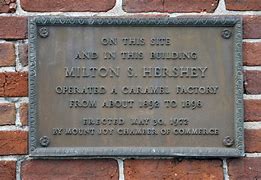 |
| The plaque located in Mount Joy. Click to enlarge. |
 |
| Hershey's caramel factory in Mount Joy, PA |
Saturday, August 29, 2020
The "Memories Of Milton S. Hershey: Part I - Cuba" Story
It was an ordinary day. Just printed out a story I found online telling about chocolatier Milton S. Hershey and his coconnecton to the Cuban town now known as Camilo Cienfuegos. I recently read about his connection to the little town of Mount Joy in Lancaster County, Pennsylvania, but had no idea he had connections in Cuba. It was in the little town, on the northern coast of Cuba, that Mr. Hershey built a sugar refinery to supply sugar for his growing chocolate empire in Hershey, Pennsylvania. The town dates back to 1916 when Mr. Hershey first visited Cuba for the first time and decided to buy a sugar plantation and mill on the island to supply his growing chocolate empire in Pennsylvania.
It was on land east of Havana that he built a large sugar refinery and an adjoining village and named it Hershey, Cuba. The village was modeled after the town he was in the process of building in Hershey, PA. The houses were for his workers and their families. The Cuban village would eventually have about 160 homes made of wooden planks and built along a grid of streets, each with a small yard and front porches just as the homes he had built in Hershey, PA for his workers at his chocolate factory.
The small Cuban town also had it's own rail line, a public school, a medical clinic, shops, a movie theatre, a golf course, social clubs and a baseball stadium where the local Hershey-sponsored team played their home games. The factory was one of the most productive refineries in all of Cuba as well as one of the best in Latin America. It was the envy of all who lived in Cuba. Mr. Hershey wanted the best for his workers so they would give him the best work performance they could. His company owned all the properties in the village and made all the home repairs and maintained the public utilities.
Mr. Hershey knew how to keep his workers happy and productive. Recently, a Mr. Pedro Gonzalez Bernal, a life-long resident of the village and a radio journalist, whose father worked as a conductor on the rail line that Mr. Hershey had built to connect the refinery with the port of Matanzas, said that the town was a world apart from the rest of Cuba. But, at the time there was also racial segregation throughout the small town with black workers assigned the smallest homes on the farthest edge of town. Three years after Mr. Hershey died in 1945, Hershey Company sold the Cuban plant and village along with Hershey's other Cuban holdings. When Fidel Castro came to power in 1959, the refinery was nationalized and the town was renamed Camilo Cienfuegos after one of Castro's commanders.
With Hershey's death and Castro coming to power came changes and all home owners in the town were now responsible for their own homes and the baseball stadium was demolished. But the sugar refinery remained among the backbones of the economy of Cuba. But the Cuban sugar industry declined after the collapse of the Soviet Union, its principal sponsor. Eventually Mr. Hershey's sugar refinery was closed in the early 2000s when many of the sugar plants were closed by the government. Cuba did find jobs for the workers and even sent some to school to train for jobs with many going into the tourism industry. Recently, most of the sugar factory's buildings have been demolished, but the homes still remain with residents trying to keep them up even though they have very little help doing so. Mr. Hershey would be rolling over in his grave if he knew what had happened to his grand experiment he had instituted in Cuba. It was another extraordinary day in the life of an ordinary guy.
 |
| Hershey's Sugar Refinery in Hershey, Cuba |
 |
| Some of the homes in Hershey Village, Cuba |
 |
| The train line that was built to get the sugar to ports. |
 |
| Remains of the baseball stadium. |
Wednesday, August 19, 2020
The "Women Voting Rights Are A Century Old!" Story
It was an ordinary day. Reading about the 100th Anniversary of the 19th Amendment to the United States Constitution which was ratified on August 18, 1920. The 19th Amendment gave women in the United States the right to vote. That is...it gave White women the right to vote! Many feared that if voting rights would be asked for all races, it would be more difficult to get the amendment passed. Susan B. Anthony and Elizabeth Cady Stanton occasionally delved into "ugly racist rhetoric" that prioritized "educated, virtuous White women over Black women. Activist Sojourner Truth, a former slave, broke with Stanton to include women of every color. But, even after the Amendment was ratified, poll taxes and other obstacles made it almost impossible for
African American women to vote, especially in the South. It wasn't until the passage of the 24th Amendment and the Civil Rights Act of 1964 that millions of African Americans were able to vote. Here in Lancaster, Pennsylvania, Marianna Gibbons Brubaker, the second wife of Lancaster Newspaper columnist Jack Brubaker's great-grandfather, Oram David Brubaker, opposed the right of women to vote. A bit of background about Marianna would tell you that she was a member of the family that operated the Underground Railroad station in Bird-in-Hand, Pennsylvania. The family helped to transport over 1,000 runaway slaves north to freedom. Marianna was a graduate of Millersville Normal School and became a teacher. She was a founding member of Lancaster's NAACP and a leader of the Women's Christian Temperance Union. She was a Quaker who believed in equality for all women, but wasn't an advocate of woman's suffrage. Jack Brubaker thought she just had to be for equality of women in all things, but not so. He did check the archives of the local newspaper and found that she did vote in the November 2, 1920 election when woman could finally vote! Marianna was always opposed to women voting, but voted since Mrs. Leah Cobb Marion, our W.C.T.U. State Treasurer was running for U.S. Senator, and she decided to vote for her, only. It was always a mystery to Jack why his relative was against women voting when she was always for women equality. Another related story about the woman's suffrage movement was from October 30, 1756 when a widow named Lydia Taft used her husband Josiah's proxy vote to help decide whether the town of Uxbridge, Massachusetts, would increase its contributions to the French and Indian War. Seems that Lydia was a the first woman in colonial America to cast a vote. The Suffrage movement began in full force following the first Seneca Falls Convention in 1848. It was at this event that a public call was made by Frederick Douglass to allow women to vote. During the next decade conventions would begin to pick up steam for the movement until the Civil War began. After the war some women weren't confident that the advancement of both African Americans as well as women to gain voting rights could be pursued. Then in 1869 Susan B. Anthony and Elizabeth Stanton created the national Woman Suffrage Association based on the idea that the 15th Amendment be opposed until it included woman's right to vote. Anthony was arrested in 1872 for voting in the presidential election and fined $100. Then in 1910 in the state of Washington, women slowly began making inroads toward meaningful change nationwide. WWI helped create change as women filled roles of men who had gone to fight in the war. In 1918 President Woodrow Wilson praised the suffrage movement which helped push the 19th Amendment toward the finish line.
 At the time, 36 states had to ratify an amendment before it passed, and on August 18, 1920, Tennessee voted 49 to 47 to accept and fully allow women to legally vote. The following day in Lancaster "The Daily New Era," headline read "Tennessee Ratifies Suffrage Amendment By Vote of 49 To 47 And Women Have Right To Vote In Every State At All Elections." It's been over 100 years now since the 19th Amendment to the Constitution was ratified. An important piece of legislation in the history of the United States. It was another extraordinary day in the life of an ordinary guy.
African American women to vote, especially in the South. It wasn't until the passage of the 24th Amendment and the Civil Rights Act of 1964 that millions of African Americans were able to vote. Here in Lancaster, Pennsylvania, Marianna Gibbons Brubaker, the second wife of Lancaster Newspaper columnist Jack Brubaker's great-grandfather, Oram David Brubaker, opposed the right of women to vote. A bit of background about Marianna would tell you that she was a member of the family that operated the Underground Railroad station in Bird-in-Hand, Pennsylvania. The family helped to transport over 1,000 runaway slaves north to freedom. Marianna was a graduate of Millersville Normal School and became a teacher. She was a founding member of Lancaster's NAACP and a leader of the Women's Christian Temperance Union. She was a Quaker who believed in equality for all women, but wasn't an advocate of woman's suffrage. Jack Brubaker thought she just had to be for equality of women in all things, but not so. He did check the archives of the local newspaper and found that she did vote in the November 2, 1920 election when woman could finally vote! Marianna was always opposed to women voting, but voted since Mrs. Leah Cobb Marion, our W.C.T.U. State Treasurer was running for U.S. Senator, and she decided to vote for her, only. It was always a mystery to Jack why his relative was against women voting when she was always for women equality. Another related story about the woman's suffrage movement was from October 30, 1756 when a widow named Lydia Taft used her husband Josiah's proxy vote to help decide whether the town of Uxbridge, Massachusetts, would increase its contributions to the French and Indian War. Seems that Lydia was a the first woman in colonial America to cast a vote. The Suffrage movement began in full force following the first Seneca Falls Convention in 1848. It was at this event that a public call was made by Frederick Douglass to allow women to vote. During the next decade conventions would begin to pick up steam for the movement until the Civil War began. After the war some women weren't confident that the advancement of both African Americans as well as women to gain voting rights could be pursued. Then in 1869 Susan B. Anthony and Elizabeth Stanton created the national Woman Suffrage Association based on the idea that the 15th Amendment be opposed until it included woman's right to vote. Anthony was arrested in 1872 for voting in the presidential election and fined $100. Then in 1910 in the state of Washington, women slowly began making inroads toward meaningful change nationwide. WWI helped create change as women filled roles of men who had gone to fight in the war. In 1918 President Woodrow Wilson praised the suffrage movement which helped push the 19th Amendment toward the finish line.

Monday, August 17, 2020
The "The Historic Camelback Locomotive" Story
It was an ordinary day. Reading my LNP newspaper and as I turned to pages 2-3 I saw it right away. There on the top of page three read..."NEXT STOP, OHIO!" Story told about a circa-1903 Camelback locomotive that has been part of the local Strasburg Railroad Museum fleet since 1962 and operated along the railroad's line until 1967. It was recently sold to the Age of Steam Roundhouse Museum in Sugar Creek, Ohio. Had to give my friend Jere a call and ask him about it since he worked part-time at the Strasburg Railroad for quite a few years. He remembered it and said it wasn't used that much since it was a different type of engine than Strasburg used to transport passengers on their scenic tours of Amish Country. Since the article said that the engine arrived in 1962 at the railroad, I pulled up the newspaper's archives and checked to see if I could find anything about its arrival in 1962.
Sure enough, an article dated Friday November 9, 1962 told of its arrival in Strasburg. A part of the story read...The Camel-Back Locomotive was the last of its kind and came into the local railroad yard with it wildly sounding a shrill "toot-toot" and black smoke pouring in a graceful flame from its 59-year-old stack. The first camelback was a 4-6-0 and built in early 1877. It proved a success since the rule cost savings were about $2,000 a year back then. More were built in the following years, but today there are only three that remain. From its entrance into Lancaster it traveled to Strasburg where it will be put into service pulling ancient cars filled with tourists on the Strasburg Railroad. The locomotive was built in 1903 in the shops of the Burnham-Williams Corp. and is called a "camel back" because the cab is directly built over the boiler with the engineer sitting on the right, and the fireman located to the rear proving that "cab over engine" is not a new concept in vehicles. The "Old 1189" first went to work for the Reading Railroad until it was sold in 1940 to the E. Brooks Iron Works at Birdsboro, PA. The locomotive weighed 50 tons, ate coal like a demon from its tender which carries a capacity load of six tons, and develops a 200-pound thrust pressure in its 3,500-gallon boiler. Officials of the Strasburg Railroad said that some reconditioning work would be done on the engine to bring it up to Interstate Commerce Commission safety standards and that it would probably go into service on the Strasburg line in the spring.
Today's newspaper article said that the Camelback locomotive was transported to Sugar Creek, Ohio in three sections, with the cab trucked out a few days ago and the tender loaded on a separate trailer yesterday. The Ohio museum bought the locomotive in a sealed-bid auction this past July. The price was not disclosed, but it is one of three that remain today. It is named Camelback due to the hump created by having the engineer's cab on top of the boiler. Jere remembered it well, but told me it wasn't the type of locomotive the Strasburg Railroad used much since it was designed to be a switch locomotive in a freight yard. While at Strasburg, it was on display at the adjacent Railroad Museum of Pennsylvania. Since it was still in working condition, the Strasburg Railroad though it best to sell it. I remember seeing it at the museum a few months ago when I went to visit with a former high school student of mine who volunteers at the museum. I'm sure the Ohio Railroad Museum will be happy to add the unusual locomotive to their collection. It was another extraordinary day in the life of an ordinary guy.
 |
| Photo of the 1903 Camelback Locomotive as seen in the 1962 Lancaster Newspaper. |
 |
| Preparing to move it from Strasburg's Railroad Museum of Pennsylvania to it's new home in Sugar Creek, Ohio. |
 |
| Another view of a 1903 Camelback locomotive. I'm not sure if this is the same engine that was just sold by the Strasburg Railroad, but it is one of three that still exist. |
Sunday, August 16, 2020
The "The Start Of The Railroad Through Lancaster, Pennsylvania" Story
It was an ordinary day. The woodcut titled "Railroading In Old Lancaster" on page 12 of the Lancaster New Era from Monday, July 19, 1920 showed Downtown Lancaster with a railroad car from the Lancaster & Columbia Railroad coming across the bottom of the sketch. The article was part of the "Travels In Old Lancaster" column which is a series of historic facts and illustrated with reproductions of rare photographs, drawings and woodcuts. Pretty neat to look South on North Queen Street toward center city and the Courthouse which at one time stood in the center of Lancaster, Pennsylvania.
The story that went with the sketch talked of the large eight-wheel train car that passengers can now take via the Lancaster & Columbia Railroad. The fast and comfortable rail car is not excelled by any other in the United States. It now takes only two days to make the journey from Lancaster to Pittsburgh, PA. But, after reading the next sentence of the story, I realized it wasn't meant to be for 1920. The story about the new train was from an advertisement in the Lancaster Examiner of eighty years before that, in 1840. "Back in those days Lancaster was the most important inland city in the Union and had a population of 8,000. The rail line was said to be the most costly and valuable public line ever made in the United States. The city of Lancaster paid for most of the construction of the part that ran from the bridge on the Big Conestoga through the city along the right of way now used by the Pennsylvania Railroad (as of 1840). In the woodcut that was featured in the article, the station would have been found in the North American Hotel, where the Brunswick now stands (in reference to 1920). Close by the locomotive in the woodcut stood the "Pioneer Hotel" and directly south where the drug store looms up, once the Museum, was the car office. It was in 1831 that the railroad was brought to Lancaster after several meetings yielded a petition to the Pennsylvania Legislature for and on behalf of the citizens of Lancaster, to alter the present route of the railroad so as to make the City of Lancaster a point according to the directions of he act of General Assembly. It was in 1934 that the fight was won and at a council meeting on October 3, 1834, 'it was resolved by both councils that a committee be appointed to wait on the governor at Columbia and invite him to the hotpitalities of the city.' According to the files of the Lancaster Examiner the Governor was 'waited on' and the whole party took a trip to Philadelphia on a car drawn by one of the old engines, 'John Bull.' It was during the World's Fair in 1893 that the 'John Bull' passed through Lancaster once again under its own power to Chicago where it made one of the most interesting of the exhibits." In the same newspaper of July 19, 1920 was an article by "The Scribbler." Many of my stories in the past have referenced Jack Brubaker who is today's "The Scribbler" in the Lancaster Newspaper. The 1920 Scribbler wrote of "Getting Up" in the morning and how aggravating it can be. "But, it's nicer to lie in bed" he tells his readers. He then goes on to tell of Samuel Clemens and how he wrote of rising early to see the sun rise. He also said that if Samuel Clemens would have had the chance to rise early in Lancaster County, he would have made the Garden Spot his permanent residence. "He would have enjoyed the rattle of wagon taking the milk to the creamery, the crowing of the roosters, the lowing of the cows, the barking of the dogs, the crying of the baby in the next house, the scream of the whistle of a distant locomotive, the jolting racket of the heavy team taking the grain to the mill for chopping, the morning songs of the birds and the laughter and chatter of the children would have banished sleep from the city dweller no matter how drowsy. And, once awake the sting in the nostrils from the smoke of the fresh-made fire in the kitchen and the appetizing odor of the morning meal would have spurred even the lazy Mark Twain into dressing. Samuel Clemens would have loved the Red Rose county had he been able to visit our town." "The Scribbler" has been a part of our newspaper since the early 1900s and the stories of today are just as intresting as they were back then. It was another extraordinary day in the life of an ordinary guy.
 |
| A woodcut showing North Queen Street, looking South, after the completion of the Lancaster & Columbia railroad. Click to enlarge. |
Monday, August 3, 2020
The "Cowboys From The Past" Story
It was an ordinary day. Checking out all my favorite online sites as I watch one of my favorite old-time westerns, Wagon Train, on Me-TV. Just love all the old cowboy shows from my youth and at last have found a TV channel that features many of them. If you have read my blog in the past, you probably know that I have featured a few of my favorite cowboys over the years. Well, today I found a few questions on an online site that deal with cowboys and knew I had to try to answer the questions that were featured. So...if you were fascinated with TV cowboy stories in the 1950s and 60s, see how well you do on the following questions.
- Which cowboy, born Henry McCarty, died at the age of 21? The cowboy whose real name was Henry McCarty, was known to most young boys as Billy the Kid. He was born in the Irish slums of New York City and moved to Kansas, and then New Mexico with his mother. She died of tuberculosis when Henry was young leaving him an orphan at the age of 14. He was arrested and put on death row seven years later, but that's not how he died. Seems he escaped the jail where he was awaiting to be put to death and after a manhunt, was shot to death by Sheriff Pat Garrett in Fort Sumner, New Mexico.
- Which sharpshooter eventually married a fellow marksman after beating them in a shoot-off? Tough question with an unusual answer. Seems that Annie Oakley was pitted against Frank Butler in a shooting contest when they were young. She beat him by hitting 25 out of 25 targets while he had only 24 out of 25. The shooting match was arranged in the late 1800s and Annie and Frank were then married for 50 years. Their relationship was immortalized in the musical "Annie Get Your Gun." They both died three weeks apart in 1926.
- Which frontiersman created a stage show about the Wild West that lasts for 30 years? It all began in 1883 when Buffalo Bill Cody began an out-door extravaganza that highlighted the life in the Wild West. He named his show the "Wild West, Rocky Mountain and Prairie Exhibition." After that show he toured with another show known as "Buffalo Bill's Wild West Show" which was an outdoor, circus-like event. After years in the United States it toured Europe where one of his patrons was Queen Victoria. That show lasted for 30 years.
- Which cowboy rose to fame after having his shooting skills memorialized? All began during a gunfight in 1861 when Wild Bill Hickok shot three men who were trying to kill him during a gunfight. But, it wasn't until six years later that the tale of his gunfight was sensationalized in "Harper's New Monthly Magazine." The article brought fame to the cowboy and a special place in history. But, Wild Bill was killed a few years later during a gunfight in Deadwood, South Dakota.
- Which cattleman has a trail named after him that goes through both Mexico and Colorado? This is a tough one since I had never heard of Charles Goodnight and Oliver Loving who blazed a trail from Texas to Wyoming which is now known as the Goodnight-Loving Trail. The trail was created as a herding trail from Texas through Colorado and helped both make quite a profit moving cattle into new territories.
- Which famous Wild West cowboy was raised Mormon? Ever hear of a guy named Butch Cassidy. I love his movie with the Sundance Kid. Well, Butch was born into a Mormon family in Beaver, Utah. The family farmed and raised cattle. But, Butch left home to work on other ranches to help raise money for his family. At the age of 13 he committed his first crime when he stole a pair of overalls from a store. He had every intention to return with the payment later, but the store owner had him arrested. That may have been the first event that turned him into a criminal. Seems that his time as a Mormon didn't do him much good.
Well, how'd you do partner. Did you get at least one right. Being that I was a make-believe cowboy as a child and watched every cowboy show on TV, I thought I knew just about everything about every cowboy and cowgirl, but I only got the question about Annie Oakley right. Gonna have to watch ME-TV some more, so I am. It was another extraordinary day in the life of an ordinary guy.
Sunday, August 2, 2020
The "A Survivor Of The Mauthausen Concentration Camp" Story
Foreword: Reading a comment posted on this blog about a story I wrote on Thursday, March 5, 2020 titled "The St. Maarten's Holocaust Survivor - Lionel Romney (1912-2004)." The comment was written by Jose Pedro and read: Another Spanish speaking black man who also was in Mauthausen and also saved his life was Carlos Grey Molay. If he had written a book about this adventure he would have become a millionaire. Every now and then I will do research on what someone has written to me and turn it into a story to share, and in this case I was very interested in what Mr. Pedro had written to me. Did quite a bit of research and the following tells the story of Carlos Gray Molay, aka Carlos Greykey.
It was an ordinary day. Reading about one Mr. Carlos Greykey who was born in Barcelona, Spain in 1913. His parents were originally from Fernando Poo, Equatorial Guinea, a Spanish colony at that time. To support Carlos and his brothers and sisters, his mother cleaned houses in the affluent district of Barcelona. I found no mention of his father in any account about Carlos. Carlos went to the local University where he studied medicine before joining the military coup d'état in 1936. Carlos joined the troops fighting the putschists (a German word meaning push, used to mean an attempt to overthrow a government by force) and eventually sought refuge in France where he continued the fight against the European fascist regimes by participating in the French war effort against Nazi Germany. The French finally surrendered to the German Nazi forces and Carlos suffered the same fate as several thousand Spaniards and was taken prisoner and taken to a detention camp.
Eventually he was transferred in 1941 to Mauthausen concentration camp. He arrived at the camp on June 21, 1941. He was quickly spotted among the rest of the Spanish prisoners because of the color of his skin. Black people were considered inferior therefore, dangerous objectives of the Nazi regime and dangerous corrupters of Arian blood. But, Carlos answered the official's questions in German which was the main reason he wasn't sent immediately to the gas chamber. Germans weren't used to seeing people of color. They dressed him in a red suit and made him a bellhop who served at the table of one of the leaders of the Spanish underground communist organizations in Mauthausen. He was made fun of, but at least it saved his life. Carlos Greykey was assigned prisoner number 5124 and was identified with a triangle with the letter "S" (Spanish) reserved for political prisoners and activists. Carlos spoke Spanish, Catalan, German, English and French which probably saved his life more than once. He was the server of the field commander, Franz Ziereis and was in charge of the lodge and cloakroom of the SS officer's club. He also waited on Heinrich Himmler at the camp in 1941. He was introduced to Himmler as "a black Spanish living in Spain." He survived thanks to the protection of is compatriots who hid him and camouflaged him until the liberation of Fields. After liberation he managed to head to France where he remained the rest of his life and where he was naturalized French years later. It is believed that he settled in Seine where he married and had two sons and a daughter. According to his daughter, her father was a dancer in a cabaret and later became an electrician. From 1977 until his death, he was a member of the National Alliance for Democratic Restoration, a group opposing the dictatorship in Equatorial Guinea. He died in France in 1982. Mauthausen was one of the worst of the Nazi concentration camps, which eventually was liberated by the American 11th Armored division on May 5, 1945. To have been a black man and have survived this camp is more than remarkable! It was another extraordinary day in the life of an ordinary guy.
It was an ordinary day. Reading about one Mr. Carlos Greykey who was born in Barcelona, Spain in 1913. His parents were originally from Fernando Poo, Equatorial Guinea, a Spanish colony at that time. To support Carlos and his brothers and sisters, his mother cleaned houses in the affluent district of Barcelona. I found no mention of his father in any account about Carlos. Carlos went to the local University where he studied medicine before joining the military coup d'état in 1936. Carlos joined the troops fighting the putschists (a German word meaning push, used to mean an attempt to overthrow a government by force) and eventually sought refuge in France where he continued the fight against the European fascist regimes by participating in the French war effort against Nazi Germany. The French finally surrendered to the German Nazi forces and Carlos suffered the same fate as several thousand Spaniards and was taken prisoner and taken to a detention camp.
 |
| Carlos Greykey dressed in his bellhop outfit in Mautheusen. |
Monday, July 27, 2020
The "Shot Through The Heart With An Arrow!" Story
It was an ordinary day. Just finished my third trip around Lancaster Cemetery searching for the pyramid-shaped grave that is said to hold the remains of Lt. Cornelius Van Camp who fought in the Battle of Wichita Village in 1858 and died when he was shot through the heart by a Comanche Indian. No matter how hard I searched I finally gave up and drove from the cemetery before they closed the gates and made me a permanent resident. Van Camp was born in Lancaster in 1833 and attended what is now Franklin & Marshall College. He then went to West Point Military Academy were he was an 1855 graduate.
He was appointed a 2nd Lieutenant in the Second Cavalry Regiment and served as a topographical officer and adjutant. It was in October of 1858 that he died suddenly when shot with the arrow by a Comanche Indian. His regiment, under the command of Major Van Dorn, traveled from Texas into the Wichita Mountains of the Indian Territory which today is in Oklahoma. The regiment came upon a band of hostile comanches and charged them. Van Camp was one of the first to enter the Indian camp and was the first killed. Several dozen Indian warriors were left on the battlefield. His body was buried where it fell, but was eventually returned to Lancaster in March of the following year to the home of his parents who lived on the southwest corner of Penn Square in downtown Lancaster, PA. His body eventually laid in State on the second floor of Fulton Hall (today's Fulton Theatre) on North Prince Street until March 16th when a funeral was held for him.
The Fencibles Military Unit along with Franklin College students and family members led an honorary procession to Lancaster Cemetery and fired three salutes. Over 3,000 people crowded into the cemetery for the 3:00 PM service. Now, if there had only been better communications before the battle when Van Camp was killed, he might have lived a longer life. I recently read about the attack in a Lancaster Newspaper story written by Jack Brubaker, "The Scribbler" where he tells that Indian Chief Buffalo Hump had just completed preliminary peace talks with military representatives. Van Dorn, not knowing this because of poor military intelligence, charged the Comanches when they came upon them in the fog at daybreak, and massacred 56 Comanche men and two Comanche women. Four soldiers died in the battle including Cornelius Van Camp. History can't be changed, but in this instance it might have been best if it could have been. It was another extraordinary day in the life of an ordinary guy.
 |
| Lt. Cornelius Van Camp |
 |
| Entrance into the Lancaster Cemetery |
Tuesday, July 21, 2020
The "You Had To See It To Believe It!" Story
It was an ordinary day. Traveling on Pennsylvania Route 324, south of Lancaster, looking for a building that is known as the "mosaic building." I have read about the building a few times in the Lancaster Newspaper and even talked about it with friends a few times, but never once did I see the building that is on RT. 324 on the way to a small area known as Marticville, PA. The air temperature had hit 100 degrees about an hour ago, so my windows are closed and the air conditioner is on full force. I rounded a turn in the 100 block of Marticville Road and in the center of the road were bright red cones. In a few seconds I saw a sign for a car show and thought of stopping when I saw an entire row of Vettes, but I continued on my way. By now a few drops of rain were falling from the sky and I wondered if the convertibles at the car show were putting their tops in place. About two minutes later I rounded a curve in the 200 block of Marticville Road and there to my left was the building for which I was searching.
Looked to be perhaps a gas station at one time, but without the pumps. Or maybe it was just a resident's large garage with parking in front of it. I pulled to the side of the building and grabbed my camera. I did remember reading that the garage is on private property, so I looked for someone I could ask if they would mind if I could take photographs of the very unusual tiles on the front of about half of the building.
It was then that I recalled the story in the newspaper written by Jack Brubaker, known to most of us as "The Scribbler." He said visitors should please look and then leave. I called out my "Hello" with no response. "The Scribbler" reported that about 90 years ago a Mr. George Johnson took up an unusual hobby. The Lancaster man surrounded cement blocks with molded ceramic pieces and glass fragments.
Throughout these concrete blocks he would post what appeared to be postcards of United States Capitol buildings. A few blocks were also said to have included money. Then in the summer of 1958 Mr. Johnson gave many of these cement blocks to a Mr. James Booth who used them to build the front of his garage along Route 324. They still remain just about the same, but for the money taken from the blocks that at one time had coins and bills on them. When nobody replied to my calls I admired the concrete blocks, snapped a few photos to share and got back in my car to heading North on Marticville Road. I wish to thank "The Scribbler" for the information he wrote in his weekly column which drew my attention to the point that I had to see the place for myself. And, I wasn't disappointed. It was another extraordinary day in the life of an ordinary guy.
 |
| The front of the garage along Marticville Road. Click to enlarge. |
 |
| A closer view of a section of the building. |
 |
| Another view of the garage wall. |
 |
| Photo of what I assume to be a U.S. President, but I'm not sure which one. |
 |
| The Arkansas Capitol Building in Little Rock. |
 |
| North Dakota Capitol Building in Bismarck. |
 |
| Portraiture of President George Washington. |
 |
| Wisconsin Capitol Building in Madison. |
Subscribe to:
Posts (Atom)