Extraordinary Stories

1944 (1) Act of kindness (12) Acting (2) Adoption (4) Adventure (766) Advertisement (6) Africa (1) Aging (14) Agriculture (47) Airplanes (9) Alphabet (5) American Red Cross (1) Americana (116) Amish (43) Ancestry (5) Ancesty (2) Animals (43) Anniversary (4) Antigua (10) Antiques (14) Apron (1) architcture (1) Architecture (36) Art (175) Art? (8) Arts and Crafts (69) Athletics (6) Automobiles (40) Awards (7) Banking (2) Barn raising (2) Baseball (103) Basketball (3) Batik (1) Beaches (89) Becoming A Citizen (1) Bed & Breakfast (2) Bee Keeping (6) Beer & Breweries (2) Bikes (3) Birds (9) Birthdays (34) Blindness (1) Blogging (5) Bookbinding (5) Books (12) Boxing (2) Brother Steve (12) Buisiness (3) Business (5) Canals (1) Cancer (14) Candy (30) Caribbean Islands (9) Caribbean Villas (15) Cats (5) Caves (1) Census (1) Chesapeake Bay (61) Children (28) Chocolate (4) Christmas (57) Church Adventures (122) Cigars (1) Circus (3) Civil Rights (8) Civil War (6) Classic Cars (7) Climate Change (5) Clubs (1) Coin club (2) Coins (1) Collections (73) Comedy (3) Comic Books (5) Commercials (1) Comnservation (2) Conservation (41) Covered Bridges (3) Craftsmanship (12) Creamsicle the Cat (11) Crime (16) Crisis (312) Cruise Travel (6) Crying (1) Culture (4) Dancing (1) Danger (16) Daughter Brynn (58) Daughter-In-Law Barb (7) Death (5) Death and Dying (65) Destruction (2) Donuts (1) Downsizing (2) Dunking (5) Easter (3) Eavesdropping (1) Education (48) Energy (15) Entertainment (165) Entrepreneurial (62) Ephrata (1) Etchings (1) Eternal Life (4) Facebook (5) Factories (4) Fads (6) Family (261) Farming (37) Father (42) Father Time (68) Favorites (88) Firefighting (1) Flora and Fauna (28) Fond Memories (490) Food and Cooking (171) Food and Drink (111) Football (16) Forgetfullness (3) Former Students (10) Framing (30) Friends (359) Fruits and Vegetables (3) Fun (4) Fundraiser (6) Furniture (1) Games (7) Generations (3) Gifts (1) Gingerbread houses (1) Giving (8) Globes (1) Golf (3) Good Luck (2) Graduation (1) Grandkids (136) Grandparents (3) Grandview Heights (29) Great service (3) Growing Old (8) Growing Up (187) Guns (2) Handwriting (3) Hat Making (2) Hawaii (49) Health and Well Being (61) Health Care (4) Health Hazards (110) Heartbreak (7) Heroes (26) High School (142) History (777) HO Railroading (4) Hockey (4) Holidays (134) Home construction (7) Horses (2) Housing (3) Humorous (71) Hurricanes (1) Ice and Preservation (2) Ice Cream (8) Inventions (34) Islands (4) Italy (12) Jewelry (3) Job Related (62) Just Bloggin' (56) Just Wondering (19) Juvenile Diabetes (5) Labor (3) Lancaster County (542) Law Breakers (8) LDubs In-Laws (3) Lefties (1) Libraries (1) Life's Lessons (175) Lightning (1) Lists (72) Lititz (18) Locomotives (1) Lodging (1) Love (4) Magazines (2) Magic (1) Maps (2) Marching (2) Market (5) Medical (161) Memories (28) Middle School (3) Milk (2) Minorities (1) Money (3) Mother (54) Movies (6) Mt. Gretna (1) Music (118) My Brother (19) My Wife (260) Neighbors (7) New Year's Day (5) Newspapers (4) Nicknames (2) Nuisance (3) Obsolescence (5) Occupations (2) Old Age (1) oldies (1) Pain and Suffering (12) Panama Canal Cruise (13) Parish Resource Center (14) Patriotism (3) Penmanship (1) Pets and Animals (99) Photography (220) Pizza (1) Plastic (2) Playing Trains (2) Poetry (2) Politics (27) Polution (3) Postal Service (2) Predators (2) Presidents (11) Pride (4) Printing (81) Protesting (3) Public Service (65) Questionnaire (1) Quilts (1) Race relations (6) Rain (1) Reading (4) Records (2) Religion (10) Retirement (4) Revolutionary War (3) Robotics (1) Rock & Roll (4) Rodents (2) Saints (4) Sand (1) Scouting (2) Sex (1) Shakespeare (1) Shelling (2) Shopping (24) Simple Pleasures (122) Slavery (6) Small Towns (4) Smoking (1) Snickedoodle (1) Snow (1) Son Derek (27) Son Tad (33) Son-In-Law Dave (27) Soup (1) Spices and Herbs (1) Sports (139) Sports and collectibles (1) Spring Break (1) St. James (2) St. Martin/Sint Maarten (306) Stained Glass (3) Stone Harbor (4) Story-Telling (26) Stragers (2) Strangers (4) Strasburg Railroad (1) Stress (3) Stuff (4) Suicide (2) Sun (1) Surfing (1) Tattoos (4) Teaching (49) Technology (90) Television (6) Thanksgiving (2) The Arts (6) The Beach House (62) The Flag (1) The Future (5) The Shore (78) This and That (23) Timekeeping (7) Tools and Machines (25) Tours (2) Toys and Games (31) Track & Field (1) Tragedy (8) Trains (19) Transportation (18) Travel (16) Trees (2) Trending (2) TV Favorites (23) Underground Railroad (10) Unit of Measurement (1) USA (2) Vacation and Travel (545) Vehicles (80) Vison and Eyesight (2) War (14) Watches and Watchmaking (5) Weather (48) Weddings (3) White House (1) Wisdom (3) Yearbooks (12) York County (3)
Showing posts with label Books. Show all posts

Sunday, August 11, 2019

The "The Demise Of The Local Bookstore: Part III - The First Book" Story

It was an ordinary day.  Reading information that tells what was the first item printed as well as when was the first book printed in the American Colonies.  They are two different answers since Johannes Gutenberg is given credit for printing the first item when he printed the Gutenberg Bible in the 1450's.  It was around 1439 in the city of Mainz, Germany that Mr. Gutenberg created the European movable type press.  He also developed the first oil-based ink that was more durable than the previously used water-based ink.  
Johannes Gutenberg's Bible
When he printed the Gutenberg Bible he began the European printing age.  The first copies of the Bible sold quickly to monasteries, university and wealthy individuals all over Europe.  It was in 1456 that Johannes borrowed money from Johann Just in order to pursue his Bible project.  Gutenberg went into debt and Just was given control of Gutenberg's workshop.  Gutenberg managed to start a second print shop and began printing the Bibles in another town in 1459.  The Gutenberg press made mass production possible for the first time in history.  By the early 1500's there were about half a million books that had been mass produced on a wide range of topics.  
Pages from the Gutenberg Bible
The printing press is given credit for making the Renais- sance, the Scientific Revolution and the Protestant Reforma- tion possible.  Martin Luther printed his Ninety-Five Theses for distribution.  Today there are 49 surviving copies of the original Gutenberg bible.  It is believed that he printed about 180 Bibles.  Gutenberg may not have been a very successful businessman, but he is thought to be one of the most influential people in history.  Now, there are those who think that The Epic of Gilgamesh, which is the oldest-known written story that can be called a book, is the first book.  It was written sometime prior to the 18th century B.C. on clay tablets.   But, Gutenberg's Bible, printed on a moveable-type printing press, is still the first book in the world.  
The Bay Psalm Book by Stephen Daye
As far as the first printed book in the American Colonies, that would have to be the Bay Psalm Book that was printed in 1640 by Stephen Daye who was the first printer of the Massachusetts Bay Colony in Cambridge, Massachusetts.  The original copy is owned by The John Carter Brown Library at Brown University and is one of 11 copies of the first edition known to exist and one of only four perfect copies.  
This is the cover of the first Bay Psalm Book
This copy of the book is in its original binding with the title page signed by principal editor, Richard Mather.  Stephen Daye printed the book on a press that had been imported to the colonies in 1638 by the Reverend Jesse Glover.  For the colonies, to have an actual printing press meant they were not wholly dependent upon outside sources.  The press was imported about 20 years after the Mayflower arrived in the New World.  Of the 11 first edition copies of the Bay Psalm Book that are in existence, only five are in complete condition with four of those considered "perfect" copies.  The Old South Church in Boston had two copies.  Whether you consider Johannes Gutenberg the father of printing or Stephen Daye, both played an important part in the many books that fill the shelves of bookstores all over the world.  And, to me, digital books, which I enjoy on my Kindle, will never replace the printed word which was developed years ago.  It was another extraordinary day in the life of an ordinary guy.

Saturday, August 10, 2019

The "The Demise Of The Local Bookstore: Part II - The First Book Store" Story

It was an ordinary day.  Reading a few stories about the start of bookstores in not only the United States, but the world.  If you Google something you can be sure you will find page after page of reading material about just about any topic you can imagine.  Well, I learned that the first bookstore in the world was opened in 1732 in Lisbon, Spain.  It was known as Livraria Bertrand and is located in the District of Chiado.  
The Livraria Bertrand Book Store
It holds the Guinness World Record as the oldest contin- uously-operating bookstore in the world.  It was started by a gentleman by the name of Pedro Faure who opened the store along Rua Direita do Loreto in hopes of creating an intellectual center in the city.  In 1755, his son-in-law, Pierre Bertrand, who ran the bookstore, was faced with a dilemma.  An earthquake struck Lisbon and destroyed much of the city.  Son-in-law Pierre was forced to operate the bookstore from the chapel of Nossa Senhora das Necessidades.  
Interior of the store.
Then in 1773, Bertrand  reopened the bookstore in a shop in the old Pombaline downtown quarter, in the district of Chiado.  Many prominent Portuguese authors congregated with friends and acquaintances at the bookstore which became the center of the city's important historical events.  Livraria Bertrand may have been the first bookstore in the world, but the first bookstore in the United States opened only thirteen years later (1745) in a shop known as the Moravian Book Shop in a 15,000 square foot location on Main Street in downtown Bethlehem, Pennsylvania which is about a two hour drive from my home in Lancaster, PA.  
The Moravian Book Shop in Bethlehem, PA
The keeper of the shop was Samuel Powell who was the keeper of the Bethlehem Inn and took the advice of his Moravian bishop and began importing and distributing books.  In 1755, the new business was going by the name Bethelhemer Bücher Shop and had more than 5,000 books, mostly religious in nature.  The shop moved to Arch Street in Philadelphia for two years before returning to the same shop in Bethlehem in 1858.  The store took its current name of Moravian Book Shop in 1905.  Over the years it has expanded many times, taking over neighboring buildings, thus giving the store a few front doors.  Not long ago the Moravian Book Shop opened a second location in nearby Allentown, PA.  
The storefront is actually several buildings together
with multiple door fronts.
So, just how does this happen when many bookstores have been closing in the past few years.  One of Lancaster's biggest booksellers, Walden Books closed a few years ago at Park City Center due to poor sales.  About 2007 the economy did affect the bookstore in Bethlehem, but being that Bethlehem is known as the Christmas City, they sold quite a few Moravian stars which helped bring in income to the book store.  
The Moravian Star is a big seller at the bookstore.
Then along came the Kindle, Barnes & Noble and Amazon and took a toll on the bottom line.  The Moravian store sells from presses such as Graywold and Soho which help bring in customers.  That, and the candy counter, gift area and regional gifts help keep the bookstore afloat.  If you ever travel to Bethlehem, make an effort to stop in the Moravian Book Shop and buy a book or two.  If you can't find one you like, at least buy a pound of one of your favorite candies.  It was another extraordinary day in the life of an ordinary guy.  

Sunday, April 28, 2019

The "Dare I Write This Story?" Story

It was an ordinary day.  Snow had already covered our back deck making it impossible for the birds and squirrels to find needed feed.  Inside I was getting antsy for something to do other than go out and shovel the mess, so I opened the top of our antique desk we have in our dining room and began to explore the many items we have placed in it over our married lifetime together.  One item popped up that I had remembered from my childhood.  
My old children's book with my favorite fairy tales.
The children's book titled "A PATCH-WORK QUILT of FAVORITE TALES", with its tattered edges, drew my attention.  The book held a copyright of MCMXXXIII (1933) by M. A. Donohue & Co. and was printed in the United States of America.  The initial paragraph began with "A patchwork quilt of favorite tales is dedicated to every boy and girl.  As I read the opening paragraph I was shocked.  It began with: This little book, like the story-tellers of old, brings you tales of the adventures of children and of our four-footed friends, in the garden barnyard and forest.  It tells the story of lovable Peter Rabbit and his thrilling experiences in the garden with Mr. McGregor; of Little Black Sambo and his incident with the tigers who nearly took his new clothes; Whoa!  Wait, what did I just read?  My mom and dad, as well as my grandmother, read this to me and my brother many times based on the condition of the cover of the book.  
Explanation of the book.  Click to enlarge.
I opened the book to page 17 and there was a drawing of a small black child holding an umbrella with Little Black Sambo spelled out on the bottom right of the page.  The entire eight page illustrated story featured Little Black Sambo in his pretty clothes with a beautiful green umbrella as he visited the forest where four tigers took his clothes and umbrella from him.  They were jealous of each other and grabbed each others tails and chased each other around a tree.  They turned into a pool of butter which Sambo took home so his mother could make pancakes for his family.  His mother, father and he all had yellow pancakes, the color of the tigers.  Little Black Sambo ate a hundred and sixty-nine, because he was so hungry.  I do remember listening to this fairy tale many times long ago, along with all the other stories in the book.  Did my parents know that the book was extremely racist?  I'm not sure and can never ask them now.  
The beginning of the book.
I do know that my dad had several African American friends and took me to play baseball at the other end of town where I was one of four or five white children on the team.  He would go through the black neighborhood before each game picking up my team members in our big station wagon.  My coach, one of dad's friends, was black.  Mom and dad never talked about the difference of color and therefore I though it to be normal.  When I began to coach, I went back to the same neighborhood to recruit players for the team.  To this day I too have African American friends who I see all the time.  But I, like you, have heard, and perhaps experienced, the many problems in our society today related to race.  But, opening up my old book today really opened my eyes, for you see after I "Googled" the fairy tale to find how much my book might be worth and read all the comments about it, I was amazed.  
The beginning of the eight pages of Little Black Sambo.
The children's book was written and illustrated by Scottish author Helen Bannerman in 1899.  The book was an immediate success in England and was published in the United States the following year.  It's success led to many imitations of it which used vulgar pictures and words which were symbolic of black-white relations.  The book's popularity coincided with the crystallization of Jim Crow laws.  Blacks were denied basic human rights, discriminated against in the labor force, barred from many public schools and libraries, harassed at voting booths and subjected to physical violence.  Then along comes this fairy tale called Little Black Sambo.  Did Helen Bannerman really mean this book to be racist?  I guess we will never know.  I'm sure my parents didn't think that when they bought me the book of fairy tales.  The book itself didn't cause riots, but it did enter America during a period of strained and harsh race relations.  Therefore, I guess it was another insult in the daily lives of African Americans.  I continued to read more about the fairy tale and found the anti-Little Black Sambo movement started in the 1930s and continued until the 1970s.  Black educators and civil rights leaders tried to get the book banned from public libraries and elementary schools.  In the 1940s and 50s the book was dropped from many lists of "Recommended Books."  By the 1960s the book was seen as a remnant of a racist past.  Then in the mid-1990s the book came back once again into the spotlight with both whites and black rereading the original book.  Was it entertaining?   Both agreed it was, but there was still little agreement as to whether it was racist.  I certainly don't want to cause another debate with my children's book, so it will once again go back in the desk where I found it.  I will not discard it since it is, and will forever be, a piece of American history, be it good or bad.  It was never read to my children or my grandchildren and will remain that way.  Last thing I want is to cause pain and suffering for anyone.  After I am gone, someone will once again find the book and decide for themselves what to do with it.  It was another extraordinary day in the life of an ordinary guy.

Thursday, April 4, 2019

The "Real Books, Made Of Paper" Story

It was an ordinary day.  Spent a few hours in front of my desktop iMac working on the Manheim Township Middle School 2019 yearbook.  After that long a time staring at the screen, even though it is rather large, and listening to all the annoying pings, I was so glad not to have to look at it anymore. For a long time!  For the majority of the population of the world, this is probably a daily routine for you.  How can you do it?  Hard on the eyes?  It just has to be and soon there will be a specific eye malady with a name something like "Ping In Screen Syndrome" (PISS).  I work on the yearbook for hours to make a salary that I will eventually use to head to a Caribbean Island where I will relax on a white sand beach with aqua water in front of me.  And, I will read a book to relax!  Maybe a couple books, depending on how long we stay in paradise and what might pass by me on the beach that deserves a look.  And...I know it makes no sense...the book I read will me on my Kindle.  I used to read real, honest to goodness paper books years ago, but as I aged I found it harder to see the type size that is used for paperback novels.  
What's your choice?  Real books or an e-reader?
So, I found that I can enlarge the type font and change the type style to suit my eyesight.  It makes reading so much more enjoyable when you can see the words on the page without squinting.  I've had a Kindle for at least a dozen years, buying my second one before a vacation in 2018.  At first it just didn't seem right, not having a paper book to be able to turn the pages.  I had a really neat book mark that was my constant friend from book to book.  All of a sudden it was put to rest.  At first, when I got my second Kindle, I had trouble finding where I had stopped reading the day before.  So, I made sure I always stopped at the end of a chapter.  When you read James Patterson quite a bit, you know that it only takes a minute or two to read a chapter.  I have read of a few avid readers who have given up their Kindle, since they long for paper pages after spending hours at a time viewing a computer screen where they work.  At times I feel guilty not switching back to paper books, since both my sons are pressmen who are responsible for the printed word.  They rely on people to read printed material to keep their jobs.  I do read the daily morning newspaper while at home, but when on vacation I rely on my laptop to get the daily local news. But, I like to save stories from time to time and find it easier to take a scissors and cut them out than have to cut and paste and then send the job to the printer.  In 2010 the founder of MIT Media Lab predicted that e-books would overtake the printed book in 5 years.  But, guess what.  In 2015, e-book sales dropped 11%.  My biggest concern about reading e-books is the fact that I have to order them online.  As soon as I do that, someone is tracking what I am reading, for a day or two later, I get a notice telling me I may like to read this author or that author.  And, I just may give one of them a try.  But, I hate that nothing is just for me anymore.  Everyone knows my every move.  If I could find some of my favorite authors in large print books, I may give it a try.  Only problem could be the size and weight of the book due to the larger sized type. So, until someone can come up with a way for me see the type easier without special glasses, I will order my books online and use my Kindle.  The biggest advantage is that I only need a small pocket in my suitcase to hold my Kindle.  My wife knows that and always has a half dozen paperbacks sitting next to my suitcase for me to pack, since her suitcase is already packed with a dozen other paperbacks.  At least she is keeping our sons employed.  It was another extraordinary day in the life of an ordinary guy.

Sunday, December 16, 2018

The "A Good Read Is Always A Great Gift" Story

It was an ordinary day.  Searching for a few gifts to add to my Christmas list.  Reading some of the memoir written by Rose Zar, a jewish survivor of World War II.  Her story is unbelievable!  
When Rose was 19 years old, the Nazis invaded her native Poland.  At the urging of her father, who told her to save herself by hiding "in the mouth of the wolf", Rose managed to go underground to get false papers and secretly change her identity to maid and nanny for of all people, a Nazi SS Colonel.  Rose chose a totally different route than many others in her ghetto in Piotrkow, Poland when the Nazis entered by grabbing her suitcase and forged passport and left her family behind.  For most of the next three years she became a Roman Catholic named Wanda Gajda.  Before the war began she had obtained a teaching certificate, but was forced to find menial jobs to survive.  She ended up working as a nanny for an SS commander as she did exactly what her father had advised, hide in plain sight in the home of a Nazi commander as "Fraulein Wanda."  
Rose Zar
Then in 1983 she wrote her memoir and once again used her father's advice by titling it "In the Mouth of the Wolf."  The book was written with Eric A. Kimmel and won the Association of Jewish Libraries' book Award and is now being used to teach about the Holocaust in schools across the United States.  Every Christmas I usually ask for a few books to read and may get a few added to my Kindle.  After reading a few reviews  about "In the mouth of the Wolf" I have placed in on the top of my list, but believe I would enjoy the hardbound book rather than on my Kindle.  It would me more of a collectible for me that way rather than just a fun read on my Kindle.  I do have a few other items on my list such as gift certificates for car washes and glass supplies for my stain glass projects, but the Rose Zar book will be a good read.  Might even be something that you, my readers, would enjoy.  It was another extraordinary day in the life of an ordinary guy.

Saturday, April 8, 2017

The "Fun With Dick And Jane" Story

It was an ordinary day.  Began like this ... "A long time ago in a galaxy far, far away.... a young boy picked up a book written by Elson-Gray and read ... See Dick Run!  Page two was similar ... See Jane Run!  Wow, you mean you don't remember that?  How can that be!  That's exacty how I learned to read.  The main characters in the book were Dick and Jane with a supporting cast of characters which included Baby, Mother, Father, Spot the dog, Puff the cat and Tim the teddy bear.  You have to remember them!!  The books relied on the whole word or sight reading method as well as repetition.  Over and over again.  Dick and Jane; Dick and Spot; Jane and Puff; etc, etc. And, the phrases like: Oh, see.  Oh, see Jane.  Funny, funny Jane.  
The early illustrations were primarily done by artists Eleanor Campbell and Keith Ward, while Robert Childress began doing the illustrations in the 1950s and Richard Wiley took over the illustrations in the 1960s.  Yep, they used these books into the 1960s.  It wasn't until the 60s that Black characters and characters from other races and cultures were placed in the books.  Then, just like that, the books disappeared when phonics began to be used as a more effective method of gaining literacy.  But, it was about ten years before that Rudolf Flesch criticized the Dick and Jane series in his book Why Johnny Can't Read.  Well, I had to Google the Fun with Dick and Jane book and found they are going for close to $50.  Wonder what ever happened to all those books we read at Brecht Elementary School years ago.  Boxes and boxes of books that probably were burned or found a home in the dump.  The original characters in the book were devised by Zerna Sharp, a former teacher.  She came up with a core cast that were easy to remember.  Worked, didn't it.  At least with me.  Although she didn't write any of the books, her cast of characters were used.  Ist grade books contained about 300 words while by the time students reached 3rd grade they were given 1000 more words and 4000 more by 6th grade.  
The books were said to use the "look-say" method to teach reading since they would stress:  Look, Spot. Oh, look, look Spot. Look and see. Oh, see.  Repetition, repetition, repetition!  By 1950 about 85 million American first graders plowed though Dick and Jane readers.  Then along came aforementioned Rudolf Flesch who claimed that the average Russian 4th grader commanded a vocabulary of nearly 10,000 word while American children had mastered only 1,800 at that level.  So, Dick and Jane bit the dust, so to speak.  Along came Theodore Seuss Geisel who began writing his Cat in the Hat and other stories.  Finally Dick and Jane were dead.  That is until people began to ask ... What ever happened to Dick and Jane.  Well, friends, they are going for $50 on eBay.  Get one before they are all gone.  Now, my next story will have to be ... "What ever happened to cursive writing?"  Remember that?  It was another extraordinary day in the life of an ordinary guy.

Monday, March 27, 2017

The "The Hardcopy Book Vs. The EBook" Story

It was an ordinary day.  Carol is telling me about the book she is reading which I bought her for Christmas.  Book by Jodi Picoult which is one of the best books she has ever read.  And ... the book is a real honest to goodness book.  One that came off a printing press.  Since both our sons work in the printing trade, we both appreciate the fact that she enjoys paper books.  But, I must admit, I'm not a help in that category, since I have a Kindle and love it.  I can go on vacation and have a dozen or so books loaded on my Kindle which weighs about a pound while Carol might have eighteen paperback books that take up more space in our luggage than our beach noodles do.  So why do I prefer the Kindle over a hand-held paperback or why does Carol enjoy the feel of a real book instead of an electronic instrument in her hand.  A few years ago when the eReaders were introduced I thought that might be the end of the printed book, but the more I read, the more I find that the hand-held book is making a comeback and is preferred by more readers than the eBook.  My reasons for loving my Kindle are: Simple to buy a book; I can change the size of the type if I care; I can put it in a plastic baggie and don't have to worry about getting it wet; and the books cost less to buy.  Carol tells me that her reasons for having a real book are: She can hold the book and turn the pages; she can put an actual bookmark in the book when done reading; You can share them with others for no charge; and you look neater reading a real book.  So far we are even-steven!  Then I began looking online to find out what are the other reasons for one or the other.  Seems that the print books might edge the eReaders in reasons to buy one over the other.  Some reasons one way or the other are: Print books are great to share, as Carol said; eBooks take up less space. Print books are for life; You can read an eBook in the dark if you happen to have that feature on your reader. You can write in the margins of a print book or underline a sentence; Wait a minute - I can underline on my Kindle. Print books have jackets so you can see what others are reading; eBooks open up to where you finished reading and you don't have to worry about losing your bookmark. Reading a real book makes the story seem more real; Using an eBook eliminates having to cut down trees to make paper. Yes, but using the earth metals to make eBooks can be more harmful due to toxic metals and the energy needed to make the eBooks; Etc., Etc., Etc.  I guess you get the idea by now that we all have our reasons why we like one over the other.  Will we ever really agree with each other.  Nah!  But, that's OK. At least if the hard copy book returns to prominence in the future, my sons will benefit!!  It was another extraordinary day in the life of an ordinary guy. 

Wednesday, May 4, 2016

The "Please get rid of your gum and get your paper and pencil ready" Story

It was a ordinary day.  Carol was visiting with a friend so I had the TV to myself.  Doesn't happen very often during the day, so I pulled up the menu and found a show that was about the top discoveries that changed mankind.  Interesting show, but what really got me was when they hit the top five on the list.  It was like going back in time and teaching my Graphic Arts class all over again.  So I'll give you the five important discoveries in reverse order and make sure you remember them, since I may quiz you at a later date.(#5) The development of Cuneiform writing.  I remember teaching about Cuneiform writing and how it was perhaps the beginning of the written word in civilization.  The name comes from the Latin word cuneus meaning "wedge" owing to the wedge-shaped style of writing.  
  1. In cuneiform, a carefully cut writing implement known as a stylus is pressed into soft clay to produce wedge-like impressions that represent word-signs, known as pictographs, and later phonograms or "word-concepts" which is closer to our modern day understanding of a word.  The system was first developed by the ancient Sumerians of Mesopotamia around 3500-3000 BCE (Before Christian Era).  The earliest cuneiform tablets were pictorial but eventually developed into more complex word representations.  One no longer had to struggle with the meaning of a pictograph, since one could now read a word-concept using characters.  The characters used were greatly reduced over time from about 1,000 to 600.  Makes our alphabet of 26 letters seem small.  Cuneiform writing is certainly not easy to read and takes someone skilled with patience to accomplish the job.  
  2. (#4)  The Moon Rock was listed as the 4th most important discovery in civilization.  Rocks brought back from the moon on either a US expedition of one by a Soviet expedition have been measured by radiometric dating techniques.  
    They have ranged in age from 3.16 billion years to up to 5.3 billion years old.  The oldest ages of rocks from the Earth are between 3.8 and 4.28 billion years old.  Rocks from Earth and similar to Moon rocks in some regards, but very different in others.  When the first specimen of rocks was opened, it was said that the atmosphere was hushed and expectant.  The scientists were clad in surgeon's gowns and caps and carrying gas masks for use in case they should be exposed to any moon dust.  It was determined that moon rocks and dust hold no threat to life on earth and how no fossil life, living organisms and not organic material.  Much was determined about the moon by using the rocks that were brought back to Earth.  I Googled "Moon Rocks" and found you could bid on them on eBay.  
  3.  (#3)  So here's another topic that I covered in my Graphic Arts class in high school.  The discovery of the Rosette Stone.  It is reported that this stone is the Code Book of the universe.  It was discovered at Rosette in 1799 by Napoleon's army and proved the key to deciphering Egyptian Hieroglyphs.  
    The person who found it was Pierre Francois-Xavier Bouchards, a French officer of engineers.  It was sent to the Institut d'Egypte in Cairo and then taken to London in 1802.  While at the British Museum it was described as a priestly decree affirming the cult of 13-year-old Ptolemy V.  It tells of an agreement between Egyptian priest and the pharaoh on March 27, 196 B.C. and names honors bestowed on Macedonian Pharaoh Ptolemy V Epiphanes.  The stone itself is inscribed with a decree issued at Memphis, Egypt.  It appears in three scripts : the upper text is Ancient Egyptian hieroglyphs, the middle portion Demotic script and the lowest Ancient Greek.  Since it says basically the same thing in all three scripts, it is said to provide the key to modern understanding of Egyptian hieroglyphs. 
  4. (#2) The importance of Coinage.  The earliest coins appeared simultaneously in two places; China and western Asia Minor in the late seventy century B.C.  
    Whether they were invented by the Ionian Greeks or by the neighboring Lydians will probably never be known, but it was the Greeks who spread coinage throughout the Mediterranean.  The use of the barter system eventually came to an end with the discovery of coinage in the world.  Metals nowadays serve the main purpose of money in the form of coins.  
  5. (#1)  And, the most important discovery that changed mankind was the Bible.  It changed the course of history and was used in not only Christianity, but in Judaism and Islam.  Skeptics claim that the Bible has been changed, however, it is important to define the terms that apply to the source of our English Bible.  Autographs were the original texts written either by the author's hand or by a scribe under their personal supervision and could be changed if not understood by the writer of the document.  
    Manuscripts were the first printed documents that didn't arrive until 1456 with the invention of movable type which was attributed to Johann Gutenberg.  He produced the first printed Bible in Latin.  Up until that time the Bible was hand copied onto papyrus, parchment or paper.  You can easily see how some things could be changed by the monks and scribes who did the hand copying.  Translations also could have caused some changes when the Bible was translated in to different languages from the original Hebrew and Greek.  The first English translation was by John Wycliffe in 1380 and was prepared from the Latin Vulgate.  Heavens, I had Latin in school and I'm positive that I translated many of the words differently than they really were.  
So, these are the five events or discoveries that allegedly changed the world.  Whether you agree with it or not, they certainly were important.  And, I think I found a very interesting TV channel that I will be watching again.  It was another extraordinary day in the life of an ordinary guy.

Monday, March 28, 2016

The "Forgetful Disease" Story

It was an ordinary day.  Can't find what I did with my glasses.  I know I took them off a few seconds ago so I could begin typing this story, but can't remember where I put them.  Now, for many, it's no big deal when you can't remember something, but for others it can be devastating.  For me ... well I seem to be able to always find my glasses, but … I often wonder.  I'm sure most of you have heard of dementia.  Just in case, it is a general term for a decline in mental ability severe enough to interfere with daily life.  Memory loss is one example of dementia with Alzheimer's being the most common type of dementia.  When my mother and father reached their mid-80s I could see they were more forgetful, but not to the point that it totally interfered with their daily life.  Dad's memory remained fairly strong until his death at age 87 while mom tended to repeat herself many times, not realizing she was doing it.  She did enjoy doing word search until she died at the age of 90.  Recently, in the local paper, there was a story about a fellow who, at the age of 57, was diagnosed with Alzheimer's disease.  
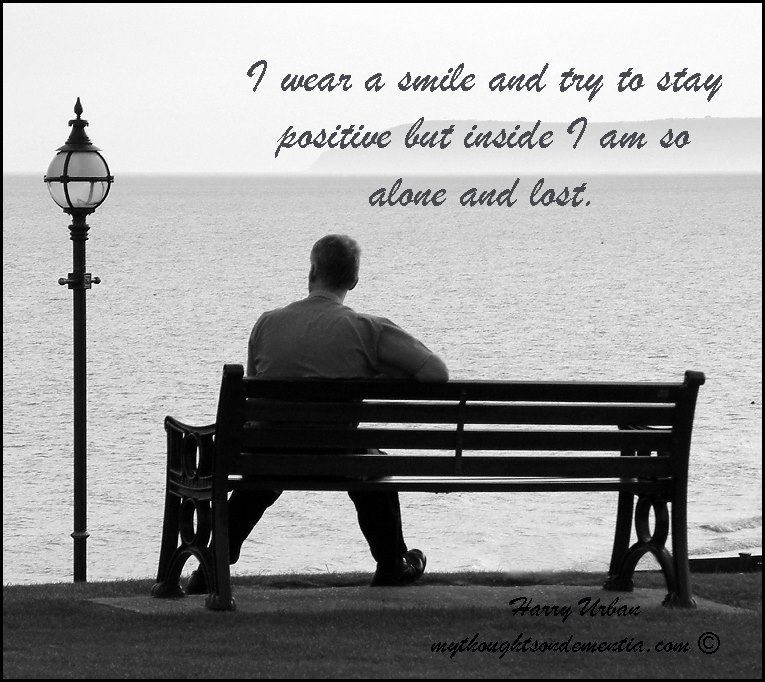
A visual from Harry Urban's website.
He knew he had it, but knew he couldn't stop it from happening.  He knows what his future will hold, but doesn't know if he will ever realize it when it happens.  Harry Urban has several Forget Me Not groups on Facebook as well as talking at nursing homes with people who also have dementia.  Every couple of months he goes to the local hospital where he addresses those who are just now finding out they have Alzheimer's.  He writes a blog that you can visit here: http://www.mythoughtsondementia.com/index.html.  (I found the link may not work at times, but you can copy and paste it to reach the blog)

As for me,  I think often what it would be like to experience dementia.  It only drives me harder to keep my mind active and participate in as many new and exciting experiences as possible.  I find laughter is the cure for so many things in life and try to practice it often.  Today I was making a visit to our local library and as I walked into the building came face to face with a slim children's activity book titled "The Unforgettable Adventures of Grandma's Cape."  
Cover of Activity Book written by Joel Kroft
and illustrated by student Gabrielle Hoffman.
One of our local retirement communities partnered with the Pennsylvania College of Art & Design to produce a children's activity book geared to teach them about an issue that could perhaps affect one or more of their grandparents.  The activity book tells the story of a child's relationship with a grandparent and how it changes because of the "forgetting disease."  Grandparents are held in such high regard and a life-changing disease such as Alzheimer's can be hard for a young child to understand.  The activity book is meant to help with understanding the disease for the child.  
One of the inside sections.  Click on to enlarge.
The author of the booklet was Joel Kroft and senior Gabrielle Hoffman was chosen as the illustrator.  The story deals with Grandma who at times forgets about her cookies in the oven and often looks scared and sad.  She had to go to see some doctors and the little boy in the story asked her if she wanted his cape.  That made her smile.  The booklet tells children how the brain can be changed by dementia and how they can help Grandma cope.  Neat book for children ... and I found that I enjoyed it also.  None of us know if or when we may at some time be diagnosed with a debilitating disease such as Alzhemer's, so we just have to live our lives to the fullest while we can.  I know I'm trying to take my own advice!  It was another extraordinary day in the life of an ordinary guy.   


Friday, January 22, 2016

The "Photography In His Blood" Story

It was an ordinary day.  July 4, 1978 and the newspaper had just arrived.  There on the front page of the paper was a photo of my daughter, Brynn, who had just turned four years old that day.  It was a few days before that Richard Hertzler had made a visit to our home on Janet Avenue to take the photo for the Lancaster New Era.  Richard started as a photographer for the Lancaster Sunday News in 1972, following in his father's footsteps at the newspaper.  O. Henry Hertzler had been a photographic icon at the newspaper for years.  He had won numerous awards for photographic journalism.  After about six months of working for the Sunday News, Richard joined the staff of the Lancaster New Era, the evening newspaper for the city and county of Lancaster, Pennsylvania.   He worked alongside his father for two years before his father's death in 1975.  Richard took up right where his father had left off, documenting the news and environment of historic Lancaster County.  At first Richard, or Rick, used film as his medium to give readers of the newspaper a glimpse into the news and images of the county, then he used a digital format to convey the same items to the readers.  Over the last 40 years he has taken thousands of photographs for the area's largest circulation daily newspaper.  
Richard Hertzler's new book on Lancaster County, PA.
Then, in 2014, Rick and the Lancaster Newspaper decided to make a book that featured some of the best of Rick's work taken during his tenure at the newspaper.  The resulting 15" x 11" coffee-table book is amazing.  The cover of the book lists the title as: "My Lancaster County" is a collection by photojournalist Richard Hertzler.  I had ofter wanted to stop at the newspaper office on West King Street and buy a copy, but never did.  Finally, this past Christmas, my son Tad, who works for Inteligencer Printing where the book was printed, bought a copy of it for me.  I have looked through it multiple times admiring the artistic work that fills it's pages.  I have shared it with everyone who visits and they too think it features a beautiful collection of Lancaster County scenes.  I hope in the near future to stop at the newspaper office and have Rick sign my copy of the book.  Will have to take the photo of Brynn with me to see how well his memory may be of past assignments.  Should be fun.  It was another extraordinary day in the life of an ordinary guy.

Friday, June 26, 2015

The "Shot Down Big Time" Story

Stuart Woods, relative of Tiger Woods as he claims.
It was an ordinary day.  Just received an email from one of my favorite writers, Stuart Woods.  It was in 1991, while looking for a few novels to take on vacation with me, I found a book titled New York Dead by Stuart Woods.  Thought to myself any book written by a guy who has the same last name as me has to be fantastic so I bought a hard-back copy to take with me.  After reading the first two words …. Elaine's late ….. I couldn't put the book down.  The main character in the novel was a fellow by the name of Stone Barrington who was an ex-cop.  Well, that was almost 15 years ago and since that first novel I have read just about everyone that Stuart Woods has written.  Book series with characters such as ex-chief-of-police Holly Barker, lawyer Ed Eagle and security expert Rick Barron have found a place on my bookshelf as well as on my Kindle.  Stuart Woods, along with James Patterson, has filled my vacation time with countless hours of entertainment as I bask in the Caribbean and New Jersey beach's sun.  After reading my last Stuart Woods novel, Unnatural Acts, featuring Stone Barrington, I checked out all the info at the end of the book and found I can email Mr. Woods.  That's exactly what I did after reading all his notes about what to do and what not to do in your email.  He tells his fans not to send any attachments to their emails since he will not open them.  If I want to point out mistakes in his book, don't send them to him.  He gives an address if you wish to buy TV or movie rights to his books.  And, don't send him any ideas for books; he has plenty of his own ideas and if you have an idea, write the book yourself.  My email I sent told him where I live and that I enjoy all his characters he writes about in his books.  Told him he was the inspiration for how I start each story on my blog which I write daily.  It was an ordinary day ….. much like he began many of his novels in the Stone Barrington series with ….. Elaine's late ….. came about because of Stuart Woods.  (If you have read my stories for years, you probably know that the inspiration for my blog was the movie "Julie and Julia").  I also suggested in my email to Mr. Woods that we may be related to one another.  We are both in the prime of our life, we both enjoy writing and we both share the same last name.  Well, he returned my email in 22 minutes telling me thanks for all the kind words, but he didn't think we were related since he took his stepfather's name and he has no Woods relatives, except, of course, cousin Tiger.  Cute!!  Shot down by one of my favorite authors.  Oh well, I still will purchase his books since I love his characters and the way he writes.  And, "Best Regards" to you also, Stuart.  It was another extraordinary day in the life of an ordinary guy.  


Saturday, June 20, 2015

The "Reading Between The Lines" Story

The Franklin & Marshall College field house
It was an ordinary day.  Reading one of the four Journal of the Lancaster County Historical Society phamplets that I just bought at the Friends of the Lancaster Public Library's book sale held at Franklin & Marshall College's field house.  Place is immense and the entire athletic floor is covered with table after table of books, vinyl records, LPs, CDs, DVD's and VHS tapes.  
This young girl came prepared for shopping big!
The library is hoping to raise $90,000 this year and will have to sell quite a few items, since most paperback books go for 50 cents. The fundraiser first began in 1956 when the American Association of University Women (AAUW) sold books in the basement of the Lancaster Public Library on North Duke Street in downtown Lancaster and raised $154.  The AAUW ran their final book sale in 1994 and raised $47,000 before turning over the reigns to the Friends of the Lancaster County Library the following year.  
Boxes of LP's for sale
The amount raised continued to grow with $90,000 raised last year.  This year there are 3,000 boxes of books for sale with each box holding approximately 40 books.  There are also 7,000 LPs for sale this year.  Paperback books cost 50 cents while hardback books go for $2.00.  Speciality books are all marked with a price inside the cover.  The journals I bought were all $2.00 while my wife purchased a few hardbacks and a few paperback novels. We visited the book sale on the second of three days during the early afternoon figuring there would be fewer patrons.  
A young Amish boy shops for just the right book.
Parking lot at the college was more than half filled with approxi- mately 200 or so patrons viewing the tables of items for sale.  The most expensive book for sale this year was "A Murder in Paradise," written by deceased Lancastrian Richard Gehman.  The hardcover book had a price tag on it of $275 and is about the 1950 murder of Marian Louise Baker by Edward Gibbs who was a WWII veteran and Franklin & Marshall College student.  We visited and walked the aisles for over an hour, I took a few photos and after paying for our purchases, we headed back to the car.  I'm sure my journals will help me in writing a few stories for future publication.  It was another extraordinary day in the life of an ordinary guy.