Extraordinary Stories

1944 (1) Act of kindness (12) Acting (2) Adoption (4) Adventure (766) Advertisement (6) Africa (1) Aging (14) Agriculture (47) Airplanes (9) Alphabet (5) American Red Cross (1) Americana (116) Amish (43) Ancestry (5) Ancesty (2) Animals (43) Anniversary (4) Antigua (10) Antiques (14) Apron (1) architcture (1) Architecture (36) Art (175) Art? (8) Arts and Crafts (69) Athletics (6) Automobiles (40) Awards (7) Banking (2) Barn raising (2) Baseball (103) Basketball (3) Batik (1) Beaches (89) Becoming A Citizen (1) Bed & Breakfast (2) Bee Keeping (6) Beer & Breweries (2) Bikes (3) Birds (9) Birthdays (34) Blindness (1) Blogging (5) Bookbinding (5) Books (12) Boxing (2) Brother Steve (12) Buisiness (3) Business (5) Canals (1) Cancer (14) Candy (30) Caribbean Islands (9) Caribbean Villas (15) Cats (5) Caves (1) Census (1) Chesapeake Bay (61) Children (28) Chocolate (4) Christmas (57) Church Adventures (122) Cigars (1) Circus (3) Civil Rights (8) Civil War (6) Classic Cars (7) Climate Change (5) Clubs (1) Coin club (2) Coins (1) Collections (73) Comedy (3) Comic Books (5) Commercials (1) Comnservation (2) Conservation (41) Covered Bridges (3) Craftsmanship (12) Creamsicle the Cat (11) Crime (16) Crisis (312) Cruise Travel (6) Crying (1) Culture (4) Dancing (1) Danger (16) Daughter Brynn (58) Daughter-In-Law Barb (7) Death (5) Death and Dying (65) Destruction (2) Donuts (1) Downsizing (2) Dunking (5) Easter (3) Eavesdropping (1) Education (48) Energy (15) Entertainment (165) Entrepreneurial (62) Ephrata (1) Etchings (1) Eternal Life (4) Facebook (5) Factories (4) Fads (6) Family (261) Farming (37) Father (42) Father Time (68) Favorites (88) Firefighting (1) Flora and Fauna (28) Fond Memories (490) Food and Cooking (171) Food and Drink (111) Football (16) Forgetfullness (3) Former Students (10) Framing (30) Friends (359) Fruits and Vegetables (3) Fun (4) Fundraiser (6) Furniture (1) Games (7) Generations (3) Gifts (1) Gingerbread houses (1) Giving (8) Globes (1) Golf (3) Good Luck (2) Graduation (1) Grandkids (136) Grandparents (3) Grandview Heights (29) Great service (3) Growing Old (8) Growing Up (187) Guns (2) Handwriting (3) Hat Making (2) Hawaii (49) Health and Well Being (61) Health Care (4) Health Hazards (110) Heartbreak (7) Heroes (26) High School (142) History (777) HO Railroading (4) Hockey (4) Holidays (134) Home construction (7) Horses (2) Housing (3) Humorous (71) Hurricanes (1) Ice and Preservation (2) Ice Cream (8) Inventions (34) Islands (4) Italy (12) Jewelry (3) Job Related (62) Just Bloggin' (56) Just Wondering (19) Juvenile Diabetes (5) Labor (3) Lancaster County (542) Law Breakers (8) LDubs In-Laws (3) Lefties (1) Libraries (1) Life's Lessons (175) Lightning (1) Lists (72) Lititz (18) Locomotives (1) Lodging (1) Love (4) Magazines (2) Magic (1) Maps (2) Marching (2) Market (5) Medical (161) Memories (28) Middle School (3) Milk (2) Minorities (1) Money (3) Mother (54) Movies (6) Mt. Gretna (1) Music (118) My Brother (19) My Wife (260) Neighbors (7) New Year's Day (5) Newspapers (4) Nicknames (2) Nuisance (3) Obsolescence (5) Occupations (2) Old Age (1) oldies (1) Pain and Suffering (12) Panama Canal Cruise (13) Parish Resource Center (14) Patriotism (3) Penmanship (1) Pets and Animals (99) Photography (220) Pizza (1) Plastic (2) Playing Trains (2) Poetry (2) Politics (27) Polution (3) Postal Service (2) Predators (2) Presidents (11) Pride (4) Printing (81) Protesting (3) Public Service (65) Questionnaire (1) Quilts (1) Race relations (6) Rain (1) Reading (4) Records (2) Religion (10) Retirement (4) Revolutionary War (3) Robotics (1) Rock & Roll (4) Rodents (2) Saints (4) Sand (1) Scouting (2) Sex (1) Shakespeare (1) Shelling (2) Shopping (24) Simple Pleasures (122) Slavery (6) Small Towns (4) Smoking (1) Snickedoodle (1) Snow (1) Son Derek (27) Son Tad (33) Son-In-Law Dave (27) Soup (1) Spices and Herbs (1) Sports (139) Sports and collectibles (1) Spring Break (1) St. James (2) St. Martin/Sint Maarten (306) Stained Glass (3) Stone Harbor (4) Story-Telling (26) Stragers (2) Strangers (4) Strasburg Railroad (1) Stress (3) Stuff (4) Suicide (2) Sun (1) Surfing (1) Tattoos (4) Teaching (49) Technology (90) Television (6) Thanksgiving (2) The Arts (6) The Beach House (62) The Flag (1) The Future (5) The Shore (78) This and That (23) Timekeeping (7) Tools and Machines (25) Tours (2) Toys and Games (31) Track & Field (1) Tragedy (8) Trains (19) Transportation (18) Travel (16) Trees (2) Trending (2) TV Favorites (23) Underground Railroad (10) Unit of Measurement (1) USA (2) Vacation and Travel (545) Vehicles (80) Vison and Eyesight (2) War (14) Watches and Watchmaking (5) Weather (48) Weddings (3) White House (1) Wisdom (3) Yearbooks (12) York County (3)
Showing posts with label Factories. Show all posts

Tuesday, September 4, 2018

The "Blown To Pieces!!" Story

Foreword:  Between 1902 and 1906 the Pennsylvania Railroad (PRR) built a low-grade railroad line from Morrisville, Pensylvania to Colonia, New Jersey.  The Atglen and Susquehanna Branch was part of that system.  The branch was built by the PRR to relieve congestion on the Philadelphia to Harrisburg Main line as well as the railroad's Columbia & Port Deposit line.  The line was designed for freight service since it minimized the grade profile of the track.  My story today deals with the building of that line and the tragedy that happened one day during the construction of the low-grade line. It was one of the worst days in the history of Lancaster County.

It was an ordinary day.  That was until the newspaper headlines from all over the country screamed, "BLOWN TO PIECES"; "ELEVEN PERSONS BLOWN TO ATOMS"; "EXPLOSION KILLS ELEVEN".  
The dynamite factory that detonated killing eleven workers.
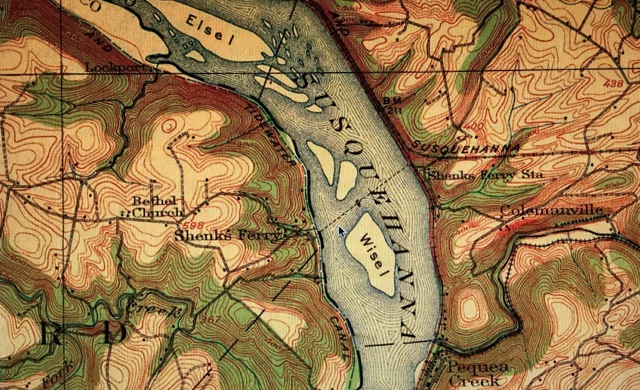
The date was June 10, 1906 and all this happened in southern Lancaster County, Pennsyl- vania the day before.  The accident happened a few minutes before 1:00 PM when a dynamite factory in Bausman's Hollow, near Shenk's Ferry, exploded.  The explosion was so loud that it could be heard 15 miles away in the town of Lancaster.  It broke windows about a mile away.  
Map of the area where the factory was located along the Susquehanna.
The accident was, and still remains to this day, one of he most horrible in the history of Lancaster County.  The victims were literally torn to pieces, spewing body parts throughout the trees over a hundred yards away.  For the next few days the search for body parts was carried out.  Two of the unidentified victims had just left the factory with a load of dynamite when the plant blew up in a great cloud of smoke.  When the smoke cleared there could be found little of the wagons, horses or men who worked at the factory.  
This photo shows the construction of the Low Grade line.
The plant consisted of twelve buildings and all were destroyed but a remote structure in which seven girls were at work. They survived!  The factory was owned by C.B. McAbee & Co. of Pittsburgh who manufactured explosives for use in the construction of the Pennsylvania Railroad Low Grade Line.  People living nearby attempted to search for workers, but there were few in the plant, or outside, that had not been blown to bits.  
This is the marker at the site which I was unable to locate.
The remains of these people they gathered and placed in soap boxes.  Trying to identify those killed was impossible. The one person who was identified was done so because of a scar on the severed wrist that was found.  Five men did survive, but were badly injured.  The factory was in the forest near where a new railroad line was being built.  In order to build the line they had to blast through tons of rock.  The factory was also supplying dynamite for a dam that was being built along the Susquehanna River.  
This monument is located in the Colemanville
Church cemetery.  Click to enlarge.
One survivor, John Gebhart, ended up wearing a metal plate in his head for the rest of his life.  His brother, Ben, was luckier.  He was supposed to be working that day, but took off to go fishing.  That was the best fishing trip he ever took.  Many of the men who were killed lived in nearby Colemanville in Conestoga Township.  All 11 killed were buried a couple of miles away from the site at the Colemanville United Methodist Church.  The body parts of ten of the men were placed in one common grave while the one man who was identified was buried in a separate grave.  There is no way anyone can tell for sure where the factory was located that fateful day, since there was no remaining trace of any of the main structures.  
I searched for the single headstone and this was the
 only one I could find that showed a 1906 burial date.
His age would be consistent with the others who died.
A local resident placed a sign, about 10 years ago, where he thought the site might have been.  That still remains today along with the markers at the church.  The reason for the explosion has remained a mystery to this day.  The headlines described the event in awful clarity.  Lancaster County will never forget those who died that terrible day over 100 years ago.  All that remains today are the two tombstones that do little to tell the tale of the lives of those who were killed that day.  It was another extraordinary day in the life of an ordinary guy.

Sunday, March 11, 2018

The "Baron Henrich Wilhelm Stiegel: His Stories - Part I" Story

It was an ordinary day.  Traveling north along Main Street, known to many as SR72, in the town of Manheim.  My first knowledge of this street was when my best friend Bill moved to Manheim after second grade.  Boy did I miss him!  But, that is not the gist of my story today; the town of Manheim is the real story.  The town got its name from a guy by the name of Baron Henrich Wilheim Stiegel, known to those who live in Lancaster County, Pennsylvania as Baron Henry William Stiegel.  Actually the title of Baron is disputed by many, since he never signed his name that way.  On August 31, 1750 Stiegel, his widowed mother and brother Anthony arrived from Cologne, Germany on the ship "Nancy" in Philadelphia.  Henry found his first job working for the Stedman brothers who were successful merchants in Philadelphia.  Two years later he became associated with Jacob Huber, an ironmaster in a Northern Lancaster County furnace, as a clerk.  Mr. Huber's furnace was built in 1750 in Brickerville, PA where he made cast iron from ore that came from the nearby Cornwall mines.   While working with Huber, he became acquainted with Mr. Huber's daughter Elizabeth and shortly after married her.  Steigel's wife had two daughters, Elizabeth and Barbara.  In 1757 Steigel purchased Huber's furnace property which at the time was one of the largest and oldest furnaces in the New World.  He tore the old furnace down and built a new one which he named after his wife Elizabeth.  Elizabeth Township, where the furnace was located, was named after the furnace.  He eventually moved his family from Philadelphia, where they had been living, to a large house that was near Elizabeth Furnace.  The following year his wife died leaving him with two small children, but the following year he married Elizabeth Holtz from Philadelphia and she bore him a son in 1760.  Steigel began to make stoves at Elizabeth Furnace and by 1760 the furnace was hugely successful with 75 men employed and 25 tenant houses nearby for some of them to live.  The furnace lands covered 900 acres, much of it wooded.  Then in 1762, his old friends, the Stedmans, and he bought 729 acres on the north bank of the Chickies Creek.  By the end of the year he has surveyed his tract and divided it into lots with streets and alleys.  The town of Manheim was born.  
Drawing of Stiegel's house at Market Square and East High St.
Stiegel and his wife were the first to build  a house on the northeast corner of Market Square and East High Street.  He realized that his town would not grow unless it had some industries, so in 1765 he began to build a glass factory on the northwest corner of Stiegel and Charlotte Streets.  The factory took three years to build and it was so large that a four-horse team could turn around in it and come out the same entrance.  
Latest image of Elizabeth Furnace.
At the time it was the only glass factory in the country and he brought skilled glass blowers from Europe to work in the factory.  They made vases, sugar and finger bowls, salts, flasks, pitchers, tumblers, wine glasses, toys and various other products in a variety of colors.  In 1769 the Stedmans sold their shares in Manheim to Isaac Cox who in turn sold them to Baron Stiegel.  By 1770 he was the sole owner of the town of Manheim.  Soon after he moved his family from the Elizabeth Furnace site to his new mansion in the center of Manheim.  Follow along tomorrow while I tell you the tale of his demise.  It was another extraordinary day in the life of an ordinary guy.

Saturday, March 3, 2018

The "Were We Duped? Story

It was an ordinary day.  There on the front page of Lancaster's LNP Always Lancaster morning newspaper was the headline: "ORIGIN STORY - Feds: Bollman Hat marketing tack was misleading."  It was back on November 27, 2016 that I wrote a story about my brother Steve and I making a visit to the Bollman Hat Company which is located in Adamstown, Pennsylvania.  
The Bollman Hat Company in Adamstown, Pennsylvania.
We had a great visit.  Had a chance to meet Don Rongione, president and CEO of Bollman Hat Co. who talked to us and told us that every piece of clothing, from his underwear to his Bollman hat had been made in America.  Now I'm finding out that he may have been fibbing.  Story in he newspaper tells of Bollman Hat Co. settling a federal complaint alleging it falsely and deceptively implied that all of it products are made in America when in reality, they aren't.  Naturally Bollman denies the allegations by the Federal Trade Commission.  
Logo in question.
At issue was Bollman's use of their marketing phrases, "American Made Matters," "Choose American," and "Made in USA since 1868."  The FTC said that consumers such as Steve and I could have concluded that all Bollman products are made in the United States.  That's exactly what we concluded, since that's what he told us.  Just happens not to be true.  As for me..."Say it ain't so Don!"  The FTC was able to prove that in many instances Bollman's products are totally imported while in others there are significant inputs to their products from overseas.  Therefore the representation that they are American Made is false or misleading.  And...I agree!  
Mr. Don Rongione, company President and CEO.
Mr. Rongione said the issue seems to come from the "American Made Matters" logo on their website.  Duh!  Seems that "American Made Matters" is a campaign that he started in 2009 and other companies could join the campaign if they met certain standards and claim the same thing...for a price.  Evidently Mr. Rongione shouldn't have been using his own logo.  He said that he never suggested that every branded and private label product that Bollman Hat Co. produced was made in their factory.  Now, he is right when he says this.  He never said that all the products they sell were made in Adamstown, but I'm sure that most everyone on the tour that Steve and I were on assumed they were made there.  I think we might have been duped.  
One of the product lines at the factory.
But, to be fair, what we did see being made were top notch quality.  And, the workers were fantastic artisans.  The newspaper story did say that the CEO pointed out the company imports their straw hat bodies, known as blanks, then shapes, stiffens and dyes the hats at Adamstown.  Those hats are labeled "made in the USA of globally sourced materials."  70% of their hats styles are imported or finished products.  Since the complaint, their website took down the "American Made Matters" logo.  That was the logo or seal that the FTC was critical of in the past.  Mr. Rongione countered that his logo never said all hats were totally made in the USA.  I can see both sides of the story and hope there can be a satisfactory outcome for both sides.  The Bollman Hat Company is the USA's oldest hat manufacturer, having been founded 150 years ago and owned by the employees, and I hate to see it struggle due to logo wording.  It was another extraordinary day in the life of an ordinary guy.   

Sunday, April 9, 2017

The "Heating The Country In Columbia, Pennsylvania" Story

Site of what was once the Keeley Stove Company.
It was an ordinary day.  Diving through the riverfront town of Columbia, Pennsyl- vania looking for the remains of the Keeley Stove Company.  Streets run parallel to the Susquehanna River and carry numbers beginning with 1st Street running along the river.  Keeley Stove filled the space between 2nd and 3rd streets and occupied the block between Maple and Linden Streets.  
A postcard show the Keeley Stove Co. in Columbia, PA.
All that remains of the once great stove company is a series of garage units.  Keeley Stove began in 1843 as the Yeager Hunter Stove Company in Spring City, Montogomery County.  After several owners, it was destroyed by fire in 1856, but was rebuilt by the people of the town in 1860 on the same site and was known as the Spring City Stove Company.  Eventually, in the spring of 1881 Oliver Keeley bought the business.  Unfortunately, the business was once again destroyed by fire a few months later.  
A catalog page showing the Pilot Stove.
So, Mr. Keeley continued operations across the river in Royersford.  But, in January of 1882, he as killed in a train accident at the age of 36.  His estate eventually sold the company to a group of investors in Columbia, PA.  Keeley Stove Company continued to operate in Spring City until a new factory could be built in Columbia.  By February of 1883 Columbia had a new factory along the banks of the Susquehanna and five years later were producing 20,000 stoves a year.  They manufactured Columbian stoves, ranges, furnaces and hot water specialties.  The company had its ups and downs in ensuing years as it adopted newer technologies and dealt with unionization of its work force, but finally closed in 1948.  
A receipt for a stove from The Keeley Stove Company.
And today, as I searched the landscape for the remains of the factory, I came up empty except for the rows and rows of garages.  One of the mainstays of the Keeley Stove Company was the Pilot Stove.  It was a cast iron pot belly stove that was offered for sale for $26.00 and for 75 cents extra you could have the bootrails nickel coated.  
A restored cast iron pot belly Pilot Stove.
The stove had an extra door that was used just for poking the charred wood.  Potbelly stoves were cast-iron wood-burning stoves that were round with a bulge in the middle that resembled a fat man's pot belly.  They were designed to heat large spaces and were often found in train stations and one-room schoolhouses.  The flat top of the stove allowed for cooking of food or the heating of water.  Columbia is about twenty minutes from my home in Lancaster and its hard to believe it took me 72 years to realize that one of the biggest manufacturing plants in the USA used to be nearby.  It was another extraordinary day in the life of an ordinary guy.