Extraordinary Stories

1944 (1) Act of kindness (12) Acting (2) Adoption (4) Adventure (766) Advertisement (6) Africa (1) Aging (14) Agriculture (47) Airplanes (9) Alphabet (5) American Red Cross (1) Americana (116) Amish (43) Ancestry (5) Ancesty (2) Animals (43) Anniversary (4) Antigua (10) Antiques (14) Apron (1) architcture (1) Architecture (36) Art (175) Art? (8) Arts and Crafts (69) Athletics (6) Automobiles (40) Awards (7) Banking (2) Barn raising (2) Baseball (103) Basketball (3) Batik (1) Beaches (89) Becoming A Citizen (1) Bed & Breakfast (2) Bee Keeping (6) Beer & Breweries (2) Bikes (3) Birds (9) Birthdays (34) Blindness (1) Blogging (5) Bookbinding (5) Books (12) Boxing (2) Brother Steve (12) Buisiness (3) Business (5) Canals (1) Cancer (14) Candy (30) Caribbean Islands (9) Caribbean Villas (15) Cats (5) Caves (1) Census (1) Chesapeake Bay (61) Children (28) Chocolate (4) Christmas (57) Church Adventures (122) Cigars (1) Circus (3) Civil Rights (8) Civil War (6) Classic Cars (7) Climate Change (5) Clubs (1) Coin club (2) Coins (1) Collections (73) Comedy (3) Comic Books (5) Commercials (1) Comnservation (2) Conservation (41) Covered Bridges (3) Craftsmanship (12) Creamsicle the Cat (11) Crime (16) Crisis (312) Cruise Travel (6) Crying (1) Culture (4) Dancing (1) Danger (16) Daughter Brynn (58) Daughter-In-Law Barb (7) Death (5) Death and Dying (65) Destruction (2) Donuts (1) Downsizing (2) Dunking (5) Easter (3) Eavesdropping (1) Education (48) Energy (15) Entertainment (165) Entrepreneurial (62) Ephrata (1) Etchings (1) Eternal Life (4) Facebook (5) Factories (4) Fads (6) Family (261) Farming (37) Father (42) Father Time (68) Favorites (88) Firefighting (1) Flora and Fauna (28) Fond Memories (490) Food and Cooking (171) Food and Drink (111) Football (16) Forgetfullness (3) Former Students (10) Framing (30) Friends (359) Fruits and Vegetables (3) Fun (4) Fundraiser (6) Furniture (1) Games (7) Generations (3) Gifts (1) Gingerbread houses (1) Giving (8) Globes (1) Golf (3) Good Luck (2) Graduation (1) Grandkids (136) Grandparents (3) Grandview Heights (29) Great service (3) Growing Old (8) Growing Up (187) Guns (2) Handwriting (3) Hat Making (2) Hawaii (49) Health and Well Being (61) Health Care (4) Health Hazards (110) Heartbreak (7) Heroes (26) High School (142) History (777) HO Railroading (4) Hockey (4) Holidays (134) Home construction (7) Horses (2) Housing (3) Humorous (71) Hurricanes (1) Ice and Preservation (2) Ice Cream (8) Inventions (34) Islands (4) Italy (12) Jewelry (3) Job Related (62) Just Bloggin' (56) Just Wondering (19) Juvenile Diabetes (5) Labor (3) Lancaster County (542) Law Breakers (8) LDubs In-Laws (3) Lefties (1) Libraries (1) Life's Lessons (175) Lightning (1) Lists (72) Lititz (18) Locomotives (1) Lodging (1) Love (4) Magazines (2) Magic (1) Maps (2) Marching (2) Market (5) Medical (161) Memories (28) Middle School (3) Milk (2) Minorities (1) Money (3) Mother (54) Movies (6) Mt. Gretna (1) Music (118) My Brother (19) My Wife (260) Neighbors (7) New Year's Day (5) Newspapers (4) Nicknames (2) Nuisance (3) Obsolescence (5) Occupations (2) Old Age (1) oldies (1) Pain and Suffering (12) Panama Canal Cruise (13) Parish Resource Center (14) Patriotism (3) Penmanship (1) Pets and Animals (99) Photography (220) Pizza (1) Plastic (2) Playing Trains (2) Poetry (2) Politics (27) Polution (3) Postal Service (2) Predators (2) Presidents (11) Pride (4) Printing (81) Protesting (3) Public Service (65) Questionnaire (1) Quilts (1) Race relations (6) Rain (1) Reading (4) Records (2) Religion (10) Retirement (4) Revolutionary War (3) Robotics (1) Rock & Roll (4) Rodents (2) Saints (4) Sand (1) Scouting (2) Sex (1) Shakespeare (1) Shelling (2) Shopping (24) Simple Pleasures (122) Slavery (6) Small Towns (4) Smoking (1) Snickedoodle (1) Snow (1) Son Derek (27) Son Tad (33) Son-In-Law Dave (27) Soup (1) Spices and Herbs (1) Sports (139) Sports and collectibles (1) Spring Break (1) St. James (2) St. Martin/Sint Maarten (306) Stained Glass (3) Stone Harbor (4) Story-Telling (26) Stragers (2) Strangers (4) Strasburg Railroad (1) Stress (3) Stuff (4) Suicide (2) Sun (1) Surfing (1) Tattoos (4) Teaching (49) Technology (90) Television (6) Thanksgiving (2) The Arts (6) The Beach House (62) The Flag (1) The Future (5) The Shore (78) This and That (23) Timekeeping (7) Tools and Machines (25) Tours (2) Toys and Games (31) Track & Field (1) Tragedy (8) Trains (19) Transportation (18) Travel (16) Trees (2) Trending (2) TV Favorites (23) Underground Railroad (10) Unit of Measurement (1) USA (2) Vacation and Travel (545) Vehicles (80) Vison and Eyesight (2) War (14) Watches and Watchmaking (5) Weather (48) Weddings (3) White House (1) Wisdom (3) Yearbooks (12) York County (3)
Showing posts with label Timekeeping. Show all posts

Saturday, June 6, 2020

The "Having The Best Time Of Your Life" Story

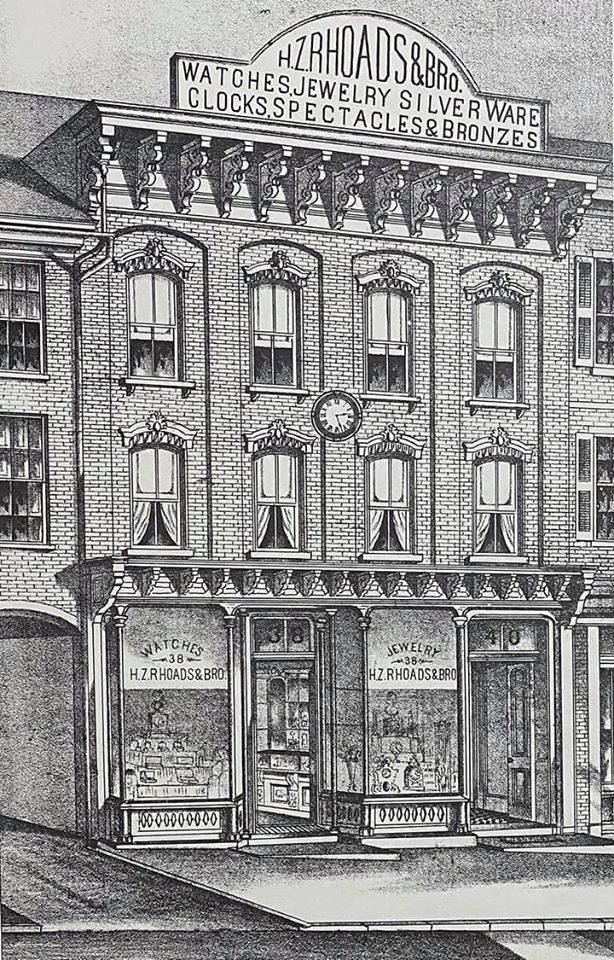
The H.Z. Rhodes & Bro. Store on W. King St.
It was an ordinary day.  Standing in the first block of West King Street with my Nikon, trying to figure how to take a photograph of the second-oldest public clock in the city of Lancaster, Pennsylvania.  Between the second and third floors of 38 West King Street sits a beautiful clock that has been keeping time for Lancastrians since the late. 1800s.  Story began on October 12, 1861 when Henry Zahm Rhodes began a jewelry business on the north side of West King Street in partnership with a Mr. C.J. Gillespie.  Nine months later Mr. Rhodes bought the other half of the business from Mr. Gillespie.  In 1868 Mr. Rhodes went into partnership with his brother Charles and the two of them bought the old "Lamb Hotel" on the south side of West King Street.  The following year they converted the hotel into a jewelry store and moved across the street into their new jewelry store.  
The store today is Max's Eatery.
Mr. Rhodes continued his jewelry business at that location until 1896 when he retired.  By 1903, the property was occupied by Metzger & Haughman who were dry-goods merchants.  Eventually the store became the John H. Troup Music House and was run by the family of "Route 66" songwriter and "Emergency" TV show star and actor Bobby Troup.  Bobby lived in Lancaster a short time before heading to California for a life in show business.  In December of 1924 the Troup store carried Brunswick Christmas records for 75 cents each and in 1928 you could buy an Ampico Symphonique baby grand piano for $1,300.  And, to top all that off, you could tell the time when you walked out the door of the store and look up at the beautiful clock.  Today, Max's Eatery fills the store with good treats from great burgers to cheesy tots to adult drinks.  
Lancaster's First Courthouse taken with a camera obscura.
And...the clock is as beautiful as ever, which you can see by the photo- graph.  But, where is the oldest clock if the one atop Max's Eartery is the second oldest.  That one sits atop Lancaster's iconic Courthouse on the corner of East King Street and North Duke Street.  
Lancaster current courthouse with the city's oldest clock.
Lancaster's first courthouse was built of brick in 1739 in the center of the city.  It, too, had a clock atop it, and was the home of the United States for one day on September 27, 1777.  In June of 1784 that Courthouse burned to the ground and was replaced in 1884 with the Soldier's and Sailor's Monument that sits on that site today.  Lancaster's current courthouse was opened on August 25, 1852.  
Hamilton Watch which is now The Watch Tower Apartments.
Atop the building sat a cupola that rose from the roof and featured a bell tower which carried a clock on all four sides.  Lady Justice sits atop the bell tower.  That clock is the oldest timepiece in the city of Lancaster.  It was made by Lancaster clockmaker John Eberman, Jr. who had a shop in Lancaster.  Now, there are a few other timepieces spread around the city of Lancaster that are memorable to me, though they aren't as old as the other two you just read about.  
Bowman Jewelry Store and School of Watchmaking.
There was a large clock that sat atop Hamilton Watch which is located on Columbia Ave. on the outskirts of the city.  That beautiful building still remains in Lancaster and has been converted into luxury apartments.  The clock is still in position to keep it's residents on time.  The final clock I remember was on the corner of East Chestnut Street and North Duke Street.  It sat on the corner wall of Bowman's Jewelry Store and School of Watchmaking.  Large clock that no longer keeps time since the building is unoccupied at present.  My father graduated from Bowman's School and became a watchmaker at Meiskey's Jewelry Store a block from Bowman's.  I'm sure many cities and towns have memorable timepieces for all to see, but I'm fairly certain they aren't quite as old as the few that dot the city of Lancaster.  It was another extraordinary day in tne life of an ordinary guy.

One final view of the second oldest clock in Lancaster


Thursday, February 28, 2019

The "We're Lagging Behind By 0.2422 Days" Story

It was an ordinary day.  Last day of February which happens to be a Thursday this year.  Next year this month will have a 29th day which we will need to keep the atomic clock in sync with...well...time.  Everyone knows that a year lasts 365 days.  Check your calendar if you're not sure.  But, every four years we add a day to make sure we match up with a true year which is how long it takes the Earth to complete one orbit around the sun.  New year will be a leap year and allow a birthday celebration for everyone who was born on February 29th.  A solar year is 365.2422 days in length.  That lag of 0.2422 days might seem small, but over time it adds up.  If we wouldn't have leap years, our seasons would eventually be mixed up with snow in the summer and beach trips in the winter.  But, is that all that bad?  Might be easier for Santa to make his deliveries without having to worry about his sleigh getting stuck in the snow.  If our calendar had never added a leap day, after three centuries January 1 would come in autumn.  After six centuries it would land in summer.  Happened in Rome in the 1st century BCE (before common era) when the calendar had slipped a full two months out of alignment with the seasons.  So, in 46 BCE, Julius Caesar declared that the current year would last 445 days in order to bring the calendar back into alignment with the seasons.  So what happened to everyone's birthday that year?  And, what happened to those who were born during those 80 days that were never to be again?  Boy, I would certainly complain if it were me who was born on one of those days.  Well, some Romans were upset and they referred to this happening as the longest year in history and called it annus confusionis.  The new calendar that Caesar instituted is known as the Julian calendar which adds a day every four years.  So, that made each year 365.25 days long.  That's still not the same as the solar year, so by the 16th century the error had added 10 extra days.  In response, Pope Gregory XIII replaced the Julian calendar with the "Gregorian" one which introduced the modern schedule of leap days.  So, to make this correction, October 4, 1582 was followed by October 15 and said that everyone born on those 11 days that were missed could celebrate their birthday on the 15th.  Now, you know I made that up, right?  So, when will we lose a few more days to make sure we don't have snow in August?  I'm sure none of us will be around to see that.  A few other Ancient people did try and make some different changes to keep the seasons in line with the calendar.  The Hindu, Chinese and Hebrew calendars added leap months to keep pace with the seasons.  Persian astronomer Omar Khayyam measured the length of the year as 365.24219858156 days and devised an elaborate leap-year schedule to match it.  36 years ago Russian math historians Adolph Yushkevich and Boris Rosenfeld analyzed Khayyam's scheme and deemed it superior in accuracy to the Gregorian calendar.  So, now what will we do?  Well, the new figures show our current calendar is accurate to one day in 3,333 years so that means we have until sometime around the year 5000 to decide whether to declare an extra leap day.  And, if you happened to be born on that day, you would die before you were one year old.  One more thing to consider is the leap second.  On 27 occasions since 1972, the International Earth Rotation and Reference Systems Service (did you know we had one of these) has added an extra "leap" second into the length of a day.  Seems that needed to keep the atomic clock in sync.  The last leap second added was on December 31, 2016. I've lived almost 75 years now and I never knew that! And, to top that, another second will be added on June 30, 2020...maybe!  No one is sure yet, except the time police.  I just hope I'm on a beach somewhere when that happens.  It was another extraordinary day, plus a second, in the life of an ordinary guy.

Sunday, January 27, 2019

The, "So Why Do We Do It?" Story

It was an ordinary day.  Trying to figure our how and why the state of Kansas could or would want to opt out of using daylight saving time. The states of Arizona and Hawaii are the only two states that have done so since Congress standardized the system in 1966.  Being that Hawaii isn't part of the continental United States, it may be easier than it is for Arizona and maybe Kansas.  For those not familiar with the event known as daylight saving time, at 2:00 a.m. on Sunday, November 3, 2019 the majority of the residents of the United States turned the clock back an hour to begin using Standard Time.  In my house, Carol and I had to turn the alarm clocks back, the microwave and oven clocks and the clocks on our cars.  The TV, since we have cable network, automatically goes back an hour, but someone must do that even though I don't have to do it.  Why do we do that?  One reason is so children walking to school or waiting on a school bus in the early morning wouldn't have to do so in the dark.  Granted, it gets darker an hour sooner, but by then the children were home from school.  Since it happens in the Fall every year, it is known as falling back.  
Then, on Sunday, March 10, we in the United States, except for Hawaii and Arizona, will turn the clock ahead an hour and begin Daylight Saving Time once again.  Allegedly, that all began as a way to help farmers have more time in their fields during the summer growing season.  But, that's really not true, since Daylight Saving Time actually began in the U.S. and in many European countries during World War I.  At that time, in an effort to conserve fuel needed to produce electric power, Germany and Austria began saving daylight at 11:00 p.m. on April 30, 1916, by advancing the hands of the clock one hour until the following October.  Quite a few other countries followed their lead and began saving daylight, thus Daylight Savings Time was begun 100 years ago.  So, how does one state in the Continental United States, and now maybe two, make it work when they stop changing the clock and use Standard Time year 'round.  I don't know.  My wife, Carol, and I have been traveling to the island of St. Martin for almost 20 years now in April.  When we board the plane we do so in Daylight Savings Time.  When we reach the the island of St. Martin we are in another time zone, but since they don't celebrate Daylight Savings Time, our time is the exactly the same time as their time.  But, while we in the U.S. in April have an extra hour of daylight, those in St. Martin are in the dark sooner.  As an example: in April at 6:00 p.m. it is still daylight in Pennsylvania where I reside, while in St. Martin it is dark.  The change in time zone as well as not having Daylight Saving Time is the reason.  No big deal, since St. Martin begins daylight an hour earlier and is a great time for a stroll on the beach.  At least we don't have to change our phones, watches and travel clocks when we get there.  But, how will that work for those living in Kansas when they are the only state to stay on Standard Time?  It will really throw off their schedule!  TV programing will be totally different.  "Jeopardy" will begin for everyone else in their time zone at 7:00 p.m. while for those in Kansas it will begin at 8:00 p.m.   The 11:00 p.m.

Evening News broadcast will begin at midnight.  Suppose you live on the border between Nebraska and Kansas.  During Daylight Saving Time while in Nebraska you may be getting up when it is just getting light while those in neighboring Kansas will have had breakfast already and be on their way to work.  Can you imagine the problems for someone who lives on the border and works across the border in another state.  There are studies that say changing times twice a year are costly as well as hard on your health.  It was reported that the day after the time changes there are increased hospital admissions for heart attacks.  Maybe Arizona and Hawaii really do know better!  If the entire United States would all go together and agree to use one time zone or another, it might work, but having different states with different time zones would be terrible.  Anxious to see what Kansas decides to do.  It was another extraordinary day in the life of an ordinary guy.  

Tuesday, July 24, 2018

The "Is It Really Time To Get Up?" Story

It was an ordinary day.  Looking at the alarm clock next to the bed, wondering if I should get out of bed or just close my eyes for another few minutes.  Clock registered 7:15 am, but I knew it really wasn't that time since I had set it 10 minutes ahead of time to make sure I was never late in getting up.  Few minutes later Carol had turned on the TV and it said 7:18 am.  Now, am I supposed to believe the TV or my clock next to me?  And why is it that when the power goes off at my house and when it comes back on again the clock next to me picks up from the time it was when the power went off while the TV has advanced to the time it really should be?  Has to do with the laws of physics and the atomic clock I found out.  Some time ago I wrote about the magazine I had subscribed to for a few years, Wired.  Eventually, I couldn't understand most of the stories in the magazine so I stopped subscribing to it; except they continued to send me the digital edition for free.  Well, I actually understood a recent digital story titled "These Physicists Watched A Clock Tick For 14 Years Straight."  Had to do with gathering 12 of the most accurate clocks around the world and watch them tick.  
A cesium fountain clock at
the National Institute of Standards
and Technology which is one of
the most accurate clocks in the world.
A group of physicists began to monitor these clocks at the National Institute of Standards and Technology in Boulder, Colorado on November 11, 1999.  That's over close to 500 million seconds ago.  They found that the ticking of the clocks illustrates one of the most fundamental principles in the law of physics: no time or place in the universe is special since it's one of the basic ideas in Einstein's theory of general relativity.  Much the same as throwing a ball in the air today and having it land the same as it did a few days ago.  For you see...the laws of physics don't change!  If you watch an atomic clock tick today it will be the same tomorrow since these clocks are some of the most precise machines ever invented, since they don't rely on the swing of a pendulum or the vibrations in a quartz crystal, but following the stead beat of an atom.  They won't lose or gain a second in tens of millions or years.  And, evidently the clocks that report time on the TV are based on the atomic clock.  Therefore, from 1999 until today when I looked at the TV screen and saw the time on the screen, it is in perfect harmony with the atomic clocks in Boulder, Colorado.  And, it all has to do with the laws of physics.  At least that's what the article I read in my free digital issue of Wired says.  But, since I never could understand most of their print magazine stories, maybe I got this all wrong.  And, that's exactly why I set my alarm clock 10 minutes ahead so I won't be late getting up and missing something important I'm supposed to do.  That is unless the power goes out and spoils my idea!  It was another extraordinary day in the life of an ordinary guy.

Thursday, June 22, 2017

The "The Work Of A Master Craftsman" Story

Grandmothers's clock which stands in Hal and
Jeannie's home in Lancaster County.
It was an ordinary day.  Carol and I have been invited to the home of Hal and Jeannie for an evening meal as well as a viewing of Hal's latest creation which he just completed for one of his three adult daughters.  A few years ago Hal told each of his three daughters that he would like to build a piece of furniture for them.  All they needed to do was tell him what they wanted and he would take it from there.  One daughter selected a grandfather's clock much like the one Hal had made for his home some time ago. His next daughter asked for an entertainment unit for her home.  And, his third daughter asked him for a grandfather's clock much like his first daughter, but taller since her home had nine-foot ceilings. I should tell you that Hal and I taught high school together for over thirty years; Hal teaching wood and metal lab as well as drafting courses while I taught photography and graphic arts.  Hal is a skilled craftsman who is very meticulous and precise in just about every thing he does.  
The seven-foot grandfather's clock that
Hal built for his daughter.  Notice that
the top of the clock is slightly taller than
the floor joists in his home.  The clock
will have to be tipped carefully to be
able to remove it from his workshop.
A few years ago he built an entire set of wooden bee hives for a new hobby he was beginning.  After seeing what Hal had constructed and what others were using, the comparison was remarkable.  Hal selected the proper type of wood and made the most perfect joints to construct his bee hives.  I'm sure there weren't many bees in the country who had a better place to live than those bees at Hal's house.  So, as I began my descent into his basement workshop, I knew that I would see something spectacular!  And, I wasn't disappointed!!  The most beautiful seven foot grandfather's clock I had ever seen.  Wasn't too long ago that I visited the National Watch and Clock Museum in nearby Columbia, Pennsylvania and no where in the museum did I see anything that could top the clock I was standing in front of in Hal's basement workshop.  Hal spent the next half-hour telling me how he constructed the clock and all the problems he encountered and how he solved them.  He first started with a set of plans that were purchased from Klockit.  He then searched for the best cherry lumber that could be found in Lancaster County.  It had to have just the perfect grain with no warping or twisting to them.  Next came ... well, I think I'll just show you some photos of the rest of it.


Hal began each shop session by turning on his clock so he could tell how many hours it took to build the grandfather's clock.  He began working on the clock January 4 of this year and spent 343 hours on it's construction.
Hal points out the moulding that was both interesting and tedious to make. 
Here is a sample of how Hal glued three pieces of wood together after he had created the shapes he wanted.
This is one of the router bits he needed to purchase in order to form the moulding for the clock's bonnet.
A pattern Hal made to help him create the openings in the side access panels.
A view of the side access panel that is partially removed so you can see the face of the clock.
The center part of the fluted column mouldings was made by gluing three strips of wood together with paper between them, turning the moulding on the lathe and then breaking it apart.  The bottom part was made with a router.
This is a tool inherited from his father that he used to place the small brads in the mouldings that hold the beveled glass in place.
If you look closely, about halfway between the top and bottom of the photo, you can see one of the metal brads that was put in place by the tool above.
On the right side of the clock's face can be seen these settings: Silent (remains silent), 4/4 Silent (chimes only on hour), Whitt. (Whittington chimes), St. Mich. (St. Michael chimes) and Westm. (Westminster chimes).  You may choose any one of the settings on this clock movement.  The clock has 8 chime rods that can produce just about any melody within an octave range that doesn't require flats or sharps. 
On the other side of the clock face is "On" (chimes are activated at all times) and "Night Off" (chimes are activated except for hours between 10:00 PM and 7:00 AM)
The phases of the moon will rotate in the face as the clock runs.  Around the moving moon dial is a brass dial that runs from 1 to 29.  These numbers represent the days of the moon's cycle around the earth.  A full moon cycle is 29 1/2 days.
The decorative locking hardware is displayed in this photograph.
The clock was stained with a slight red cherry stain which was rubbed on and then four coatd of Minwax Tung Oil Finish was applied. After sanding with 400 grit abrasive paper, and polishing with 0000 steel wool, a coat of wax finished the job.
The proud craftsman locking the door on the beautiful grandfather's clock he just finished.
This plate gives the name of the craftsman who built the clock.  Hal mounted it behind the center cross piece of cherry wood so you would have to open the door to see the plate.  He doesn't feel he needs to have his name displayed on the outside of the case, but he truly is a master craftsman.
There are many other features that I could attempt to explain to you, but I tried to show you some of the craftmanship that Hal built into the clock that will soon stand in his daughter's home in Lancaster.  It was another extraordinary day in the life of an ordinary guy.

Friday, March 31, 2017

The "A Trend Setter Before My Time" Story

Juvenile Diabetes Research Foundation bracelet.
It was an ordinary day.  The headline in the newspaper caught my eye: "Mens wrists not just for watches anymore."  Tried to remember how long ago I gave up wearing a wristwatch for four reasons, (1) made marks on my arm when I sweated, (2) wasn't cool to wear a watch, especially when my iPhone was a pocket away with the time of day, (3) most of my male friends wore wristwatches and could tell me the time and (4) time doesn't really matter much since I'm retired.  Can't believe the newspaper actually posted a story telling the public that men are giving up wearing watches, since it isn't an acceptable accessory on a powerful man's wrist anymore.  Wow, I've been chic for years now and didn't realize it.  But, what should I be wearing on my wrist?  Story said I should be wearing a bracelet made of beads, leather, sterling silver or even a plastic "remembrance band."  A few years ago I wore a blue JDRF bracelet for about half a year and I still have a plastic bag full of them in case I decide to don the bracelet once again.  
A few of my necklaces I have draped across
my wife's wedding portraiture on my dresser.
JDRF are the initials for Juvenile Diabetes Research Fund and I was wearing it since my oldest granddaughter has Type I Diabetes.  Instead of wearing the bracelet, my wife and I began to make donations to JDRF which is probably the reason I was given the bracelet in the first place.  Now, for me, being chic and in style goes farther than wearing something on my wrist.  I enjoy wearing a necklace which to me is more trending than something on my wrist.  I have been making purchases of necklaces for over 15 years which I enjoy wearing when going out for lunch or dinner as well as when vacationing in the Caribbean.  
LDub with his necklace and ... a watch!
The necklaces are made with beads, leather and even small sea shells.  My wife at times claims I'm trying to be a hippie dude from back in the 1970's, and maybe I am, but I still like the look of a necklace with flair that draws attention away from all the loose skin I have on my aging neck.  And, in case you didn't realize it, my photo that appears on this blogspot site to the right of this story, and has been there since I began writing stories in 2009, features a photo of me with a really neat necklace around my neck.  Betcha didn't know that, did you?  Click on my photo in this story to enlarge it and you can see it.  It was another extraordinary day in the life of an ordinary guy. PS - You'll also see that I'm wearing my wristwatch! How uncool is that!!

Thursday, December 8, 2016

The "Time And Time Again: Part I - The Museum" Story

Upon entering the town of Columbia, I was greeted with
this mural. Click on images to enlarge them.
It was an ordinary day.  Sitting in the National Watch and Clock Museum Theater watching an interesting ten minute video about "Time".  Happen to be the only one in the theater on this overcast and rainy day.  The museum is located in Columbia, Pennsylvania, about twenty minutes from my home in Lancaster.  Have been meaning to visit the museum for years, but never found the time (pun intended).  The beautiful majestic stone pillars in the front of the building are an omen as to what one will find inside the doors of the museum.  This museum is dedicated solely to horology or the science and art of timekeeping and timekeepers.  The National Watch and Clock Museum was founded in 1977 by the National Association of Watch and Clock Collectors and featured less than 1,000 items.  
The National Watch and Clock Museum in Columbia, PA
Today the museum is consider- ably larger and has at least 12,000 items which show and tell the complete history of time- keepers from non-mechanical devices such as sun-dials and hour-glasses to the atomic clock.  Some of the displays are interactive and some are immense such as the Monument Clocks.  My friend Jerry is a miniature railroad fan so I enjoyed the Railroad watches collection.  There are timepieces from nations all over the world.  Asian timepieces from Japan and China, European clocks from Germany, France and the Netherlands and technological items from Russia all line the shelves and display cases in this museum.  Pocket watches, Regulators, Novelty clocks, car clocks, Military clocks, alarm clocks, and even James Bond's wristwatches hold prominent places in this museum.  
The gift shop at the museum
The place is huge!  I arrived at approxi- mately 1:30 pm and I was worried I wouldn't be able to see everything in the museum by closing at 4:00 pm.  As it was, I tired before closing time and will make an effort to return and finish those parts of the museum that I missed.  It was truly an impressive display of everything horological and not to be missed.  You are allowed to take non-flash photographs of everything except one special display that I assume changes from time to time (another intended pun).  I will share with you today and over the next two days a few photographs of the many areas of the museum, but by no means will I touch upon the immense quantity and astounding quality of clocks and watches that can be seen at the museum.  It is truly a museum that displays the entire history of timekeeping.  It was another extraordinary day in the life of an ordinary guy.


This large upright sundial is made of stone and has a brass gnomon.  There is a face carved at the top of the dial and the date "1639" is carved along the front of the base.  One of the earliest methods of timekeeping.
Sandglasses were occasionally constructed of a frame with multiple glasses, each measuring a different amount of time.  In this example, the four glasses measure fifteen, thirty, forty-five and sixty minutes, respectively. The size of the opening in the center allows for different amounts of sand to escape.
In 300 AD astronomers were using a compact, hand-held instrument called an astrolabe to observe the altitudes and positions of celestial bodies.  This instrument became popular among the astronomers of medieval and Renaissance Europe.
Scholars theorize that the primary purpose of the Antikythera mechanism was to use gears and dials to exhibit the position of sun and moon in accordance with the phases of the moon.
This is an Egyptian Clepsydra reproduction from 1400 B.C.  The sides of the vase are adorned with hieroglyphics around three bands.  When in use the clepsydra would be filled with water and as the water flowed out thorugh a small hole near the bottom of the device, the interior dotted lines provided a means of determining how much time had passed by observing the diminishing water level.
This table clock is from around 1660.  It has a brass fusee, spring-driven movement and crown verge escapement.  The iron case is extensively inlaid with silver and depicts allegorical and mythological themes.  The three dials indicate time, day of month and day of the lunar moon.  
This is a Renaissance Clock.  It is a small, highly ornamental clock.  The small size and delicacy of Renaissance clocks necessitated smaller clock movements and the spring-drive mechanism was invented.
This is a tall-case or longcase clock.  Also known as a floor clock or grandfather clock which is a tall, freestanding, weight-driven pendulum clock with the pendulum held inside the tower of the clock.  The case often featured elaborately carved ornamentation with a decorated clock face.   The clock in the center was made by John Eberman, Jr. who worked on North Queen Street in Lancaster, PA from 1772 to 1807.  It has a 30-hour movement.  I must have examined over 50 of these beautiful clocks from all over the world.
A shelf clock from around 1830 made by Henry Ober of nearby Elizabethtown, PA.  These clocks are weight-driven and has an eight-day clock movement.  The case is cherry wood with mahogany veneer on the door.
A pocket watch from 1896.  This Swiss watch was donated to the museum by Ambassador Donald C. Johnson.
This 1890 Cuckoo Clock is from Germany.  The hunting motif was a common one on German Cuckoo clocks.  This clock has a carved walnut case with a thirty-hour brass movement which strikes the hour on a gong as well as the famiiar cuckoo birdcall. When every 15 minutes passes in the museum, the place comes alive with sounds from around the world.
An 1880 Picture Clock from Munich, Germany.  Reverse painting on the glass was used to create the beautiful dial on the clock.  It has a thirty-hour movement with steel pivots and brass gears.
This is a shelf clock from Plymouth, Connecticut, c. 1822. Clocks such as this were known as Salem Bridge clocks.   
This pocket watch was made in Lancaster, PA at Hamilton Watch Company in 1935.
This is an advertisement from the 1830s.  The first railroads had a need for controlling train movements and used systems based upon time.  Each railroad defined their own "Standard Time."  Train crews used imported watches until American-made 11 or 15 jewel watches became available in the 1850s and 1860s.  The watches were improved to 17 or more jewels in the 1890s.  Railroad time systems disappeared after radio-controlled timekeeping took over in the 1990s.
An advertising board from 1900 which is advertising for pocket watches used by train personnel.  The ad is for the Rockford Watch Co. in Illinois.
This is the working mechcanism of the E. Howard Tower Clock produced in Boston, MA.  The company manufactured their No. 2 Tower Clock in two models.  One was called the Striker and featured a seven-foot dial with bells weighing 2,500 pounds.  The other was the Special and had an eight-foot dial and 3,500 pound bells.  The one shown is for the Striker.  The list price for this particular clock was $775.
This clock tower was made by Lancaster clockmaker John Eberman Jr.  He had a shop in Lancaster from 1772 to 1807 where he made tallcase movements as well as the one on the top of the Lancaster County Courthouse shown here.  Only three of his tower clock movements still exist; The movement in this courthouse, which is in the Museum's permanent collection, the movement in the Moravian Church in Nazareth, PA, and the partial movement in the Moravian Church in Lititz, PA which was destroyed by fire with a few of the pieces of the clock still remaining.
I enjoyed this display of James Bond quartz watches from movies during the years 1973 to 1995.