Extraordinary Stories

1944 (1) Act of kindness (12) Acting (2) Adoption (4) Adventure (766) Advertisement (6) Africa (1) Aging (14) Agriculture (47) Airplanes (9) Alphabet (5) American Red Cross (1) Americana (116) Amish (43) Ancestry (5) Ancesty (2) Animals (43) Anniversary (4) Antigua (10) Antiques (14) Apron (1) architcture (1) Architecture (36) Art (175) Art? (8) Arts and Crafts (69) Athletics (6) Automobiles (40) Awards (7) Banking (2) Barn raising (2) Baseball (103) Basketball (3) Batik (1) Beaches (89) Becoming A Citizen (1) Bed & Breakfast (2) Bee Keeping (6) Beer & Breweries (2) Bikes (3) Birds (9) Birthdays (34) Blindness (1) Blogging (5) Bookbinding (5) Books (12) Boxing (2) Brother Steve (12) Buisiness (3) Business (5) Canals (1) Cancer (14) Candy (30) Caribbean Islands (9) Caribbean Villas (15) Cats (5) Caves (1) Census (1) Chesapeake Bay (61) Children (28) Chocolate (4) Christmas (57) Church Adventures (122) Cigars (1) Circus (3) Civil Rights (8) Civil War (6) Classic Cars (7) Climate Change (5) Clubs (1) Coin club (2) Coins (1) Collections (73) Comedy (3) Comic Books (5) Commercials (1) Comnservation (2) Conservation (41) Covered Bridges (3) Craftsmanship (12) Creamsicle the Cat (11) Crime (16) Crisis (312) Cruise Travel (6) Crying (1) Culture (4) Dancing (1) Danger (16) Daughter Brynn (58) Daughter-In-Law Barb (7) Death (5) Death and Dying (65) Destruction (2) Donuts (1) Downsizing (2) Dunking (5) Easter (3) Eavesdropping (1) Education (48) Energy (15) Entertainment (165) Entrepreneurial (62) Ephrata (1) Etchings (1) Eternal Life (4) Facebook (5) Factories (4) Fads (6) Family (261) Farming (37) Father (42) Father Time (68) Favorites (88) Firefighting (1) Flora and Fauna (28) Fond Memories (490) Food and Cooking (171) Food and Drink (111) Football (16) Forgetfullness (3) Former Students (10) Framing (30) Friends (359) Fruits and Vegetables (3) Fun (4) Fundraiser (6) Furniture (1) Games (7) Generations (3) Gifts (1) Gingerbread houses (1) Giving (8) Globes (1) Golf (3) Good Luck (2) Graduation (1) Grandkids (136) Grandparents (3) Grandview Heights (29) Great service (3) Growing Old (8) Growing Up (187) Guns (2) Handwriting (3) Hat Making (2) Hawaii (49) Health and Well Being (61) Health Care (4) Health Hazards (110) Heartbreak (7) Heroes (26) High School (142) History (777) HO Railroading (4) Hockey (4) Holidays (134) Home construction (7) Horses (2) Housing (3) Humorous (71) Hurricanes (1) Ice and Preservation (2) Ice Cream (8) Inventions (34) Islands (4) Italy (12) Jewelry (3) Job Related (62) Just Bloggin' (56) Just Wondering (19) Juvenile Diabetes (5) Labor (3) Lancaster County (542) Law Breakers (8) LDubs In-Laws (3) Lefties (1) Libraries (1) Life's Lessons (175) Lightning (1) Lists (72) Lititz (18) Locomotives (1) Lodging (1) Love (4) Magazines (2) Magic (1) Maps (2) Marching (2) Market (5) Medical (161) Memories (28) Middle School (3) Milk (2) Minorities (1) Money (3) Mother (54) Movies (6) Mt. Gretna (1) Music (118) My Brother (19) My Wife (260) Neighbors (7) New Year's Day (5) Newspapers (4) Nicknames (2) Nuisance (3) Obsolescence (5) Occupations (2) Old Age (1) oldies (1) Pain and Suffering (12) Panama Canal Cruise (13) Parish Resource Center (14) Patriotism (3) Penmanship (1) Pets and Animals (99) Photography (220) Pizza (1) Plastic (2) Playing Trains (2) Poetry (2) Politics (27) Polution (3) Postal Service (2) Predators (2) Presidents (11) Pride (4) Printing (81) Protesting (3) Public Service (65) Questionnaire (1) Quilts (1) Race relations (6) Rain (1) Reading (4) Records (2) Religion (10) Retirement (4) Revolutionary War (3) Robotics (1) Rock & Roll (4) Rodents (2) Saints (4) Sand (1) Scouting (2) Sex (1) Shakespeare (1) Shelling (2) Shopping (24) Simple Pleasures (122) Slavery (6) Small Towns (4) Smoking (1) Snickedoodle (1) Snow (1) Son Derek (27) Son Tad (33) Son-In-Law Dave (27) Soup (1) Spices and Herbs (1) Sports (139) Sports and collectibles (1) Spring Break (1) St. James (2) St. Martin/Sint Maarten (306) Stained Glass (3) Stone Harbor (4) Story-Telling (26) Stragers (2) Strangers (4) Strasburg Railroad (1) Stress (3) Stuff (4) Suicide (2) Sun (1) Surfing (1) Tattoos (4) Teaching (49) Technology (90) Television (6) Thanksgiving (2) The Arts (6) The Beach House (62) The Flag (1) The Future (5) The Shore (78) This and That (23) Timekeeping (7) Tools and Machines (25) Tours (2) Toys and Games (31) Track & Field (1) Tragedy (8) Trains (19) Transportation (18) Travel (16) Trees (2) Trending (2) TV Favorites (23) Underground Railroad (10) Unit of Measurement (1) USA (2) Vacation and Travel (545) Vehicles (80) Vison and Eyesight (2) War (14) Watches and Watchmaking (5) Weather (48) Weddings (3) White House (1) Wisdom (3) Yearbooks (12) York County (3)
Showing posts with label Lititz. Show all posts

Sunday, June 16, 2019

The "Lititz Olden Days Observance: Part I - The Craftsmen" Story

The 1792 Johannes Mueller House on Main Street in Lititz, PA.
It was an ordinary day.  Parked the Mirage on Broad Street in Lititz and headed to Lititz's new History Festival.  It was back in 2013 that Lititz gained national notoriety when it was picked by Budget Travel Magazine as "America's Coolest Small Town." The award was given to a town with a population of 10,000 or less that had a certain quality that set it apart from all the rest of the smallest towns in the United States.  Lititz, Pennsylvania has a population of 9,369 and is located in Lancaster County, PA.  It was founded in 1756 by members of the Moravian Church, and for the next century only Moravians were allowed to live in Lititz.  It eventually was incorporated in 1888.  Linden Hall School for Girls dates back to 1746 and the Brethren's house on the campus of the Moravian church, served as a hospital during the American Revolutionary War.  I have written about the church, Linden Hall as well as the Brethren's house in the past.  The town occupies 2.3 square miles.  So, what else could the town do to draw tourists?  How about a History Festival?  
So, that's what the members of the Historical Foundation decided to hold!  And, as soon as I walked a few blocks east on Main Street after parking my car, I came upon the beautiful Johannes Mueller House.  Mr. Mueller was the town dyer when he built his home on Main Street in 1742.  It made the perfect place to hold the first ever Lititz Historical Festival.  I walked in the main door and was greeted by a few women dressed in Colonial garb who directed me to the rear of the house where a variety of artisans told of the methods used during the American Revolutionary era.  Crafts I saw included weaving, spinning, rug braiding, tin-smithing, ceramics, basketry, soap making and blacksmithing.  There was even a gunsmith on hand and an authentic Conestoga Wagon in the alley behind the house.   The house itself is meticulously preserved and restored and the grounds behind the home were the perfect place to hold the event.  Follow along as I show you some of the artisans and tell their stories.  It was another extraordinary day in the life of an ordinary guy.


The gunsmith talks about the flintlock rifle.
A few of his weapons were on display.
The tavern owner played a big part in the life of a Colonial town.  The tavern was the place for a drink, learn the latest gossip and even the post office in many small towns.  Gary Myers talked to me about the role of the tavern owner and explained the coinage system with the coins in the dish.  Coins were half silver and half gold.  They could be cut in half, quarters or eights and used to pay just about any purchase.
Here Gary tells me about patrons who wanted to smoke.  Most would bring their bowl with them and the tavern owner would fill the pipe with tobacco.
He also had a board similar to what would be found in a tavern.  On the board were listings of notices as well as mail may be tacked to it for patrons to see and pick up.
The wood carver was an important craftsman in a town.  This fellow is making a spoon on the device he made to hold the wood.
He could also carve bowls with a variety of chisels.
The tin smith was an important craftsman also.  Here is a candle holder made of  28 gauge tin plate.
He demonstrated putting the edge on the candle holder.
This gentleman made his own lathe using plans that would have been available in colonial America.  A few pieces were oak with the majority of the parts made of pine.  It was operated with foot power.
A set of plans for construction of the lathe.
The potter made bowls, mugs and pots used in the kitchen and for eating.  All work was done by hand.
Naturally, there had to be a musician.  He played the entire time and I don't remember hearing the same tune more than once.  Great job and he never took a break! 
The cigar maker was another important job in our new country.  Everything needed for making cigars  was on display.
This device was used for cutting the end of the cigar.
This gentleman was making woven belts.
The results were on display.
This young man was demonstrating blacksmithing.  He would heat the metal piece in the fire on the right.
He had a booklet for sale telling about the Conestoga Wagon which was known as the masterpiece of the blacksmith.  I read the name on the bottom of the book and recognized the name.  I asked the blacksmith if he knew the author, Arthur Reist.  "He's my dad!" he told me.  "He's down the steps next to the Conestoga Wagon."  I thanked him and headed down the steps for a reunion I will tell tomorrow.

Wednesday, July 4, 2018

The "America's Coolest Small Town...And, Patriotic To Boot! Story

It was an ordinary day.  Driving through Lititz, Pennsylvania, heading to the hardware store on the north side of town to drop off a few saw blades to have them sharpened.  It was back in 2013 that this town of a little over 9,000 residents was selected as "Coolest Small Town in America" by Budget Travel Magazine.  I love driving through the town, down Broad Street and turning right on Main Street past all the quaint little shops as well as the Lititz Moravian Church and Linden Hall Girls School.  
Click on image to enlarge.
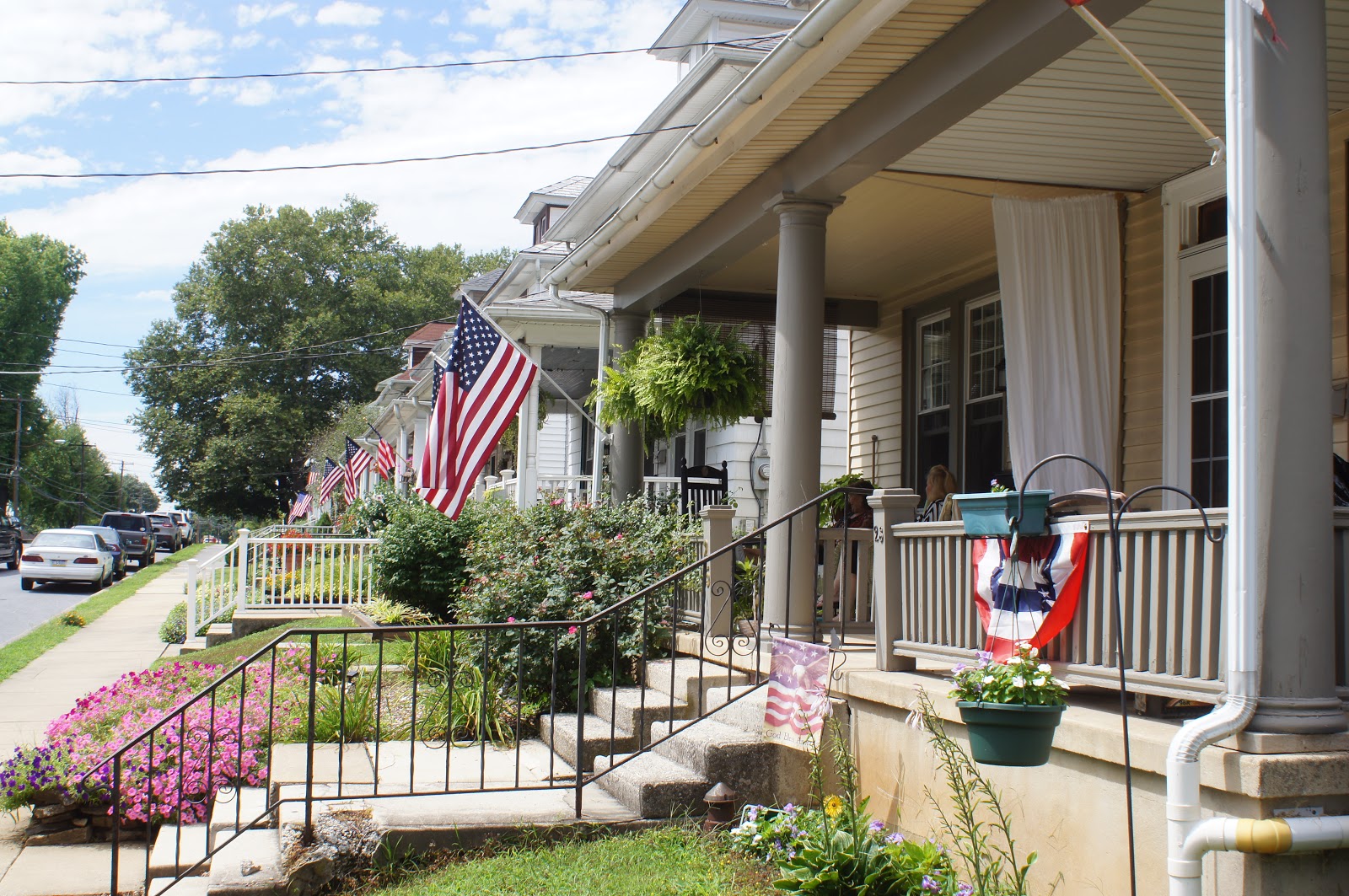
We have visited the town a few times on July 3rd for their annual parade and concert in the park and then the lighting of the candles in the park the following evening, July 4th, followed by fireworks.  Their celebrations are amazing, but one other thing I find amazing about the town of Lititz is their patriotism.  As I drove through the town on my way to the hardware store I noticed house after house as well as business after business displaying the stars and stripes as well as patriotic red, white and blue bunting hanging from porch rails and window sills.  On my way back through town I grabbed my new Nikon SLR and stopped to snap a few photos to share.  I took so many photographs that I had to pick and choose so I didn't bore you with too many photos.  Some photos have added comments while others don't need any comment.  Hope you enjoy one town's celebration of July 4th.  It was another extraordinary day in the life of an ordinary guy.  

  
One of the first homes I came upon as I entered the town on South Broad Street.  Please click on photographs to enlarge them.
The Spacht/Snyder Funeral Home on Broad St.

All light posts have double American Flags flying from them.
  
One side street off of Broad Street had flags on every home on the block.  Beautiful sight!


The Parkview Hotel on North Broad Street.

The Lititz Watch Technicum.
In the center of town is Lititz Springs Park.  Here you can see the flags that fly from each lightpost.
This poster and birthday cake in the background tell of the 201st Celebration of the 4th of July Celebration at the park.
The Lititz Mutual Insurance Company on the Square in Lititz. 

The Alden House Bed and Breakfast on Main Street.


Thursday, April 12, 2018

The "If Only Walls Could Talk: Part II" Story

The 1793 single-keyboard Tannenberg Organ.
It was an ordinary day.  Followed my guide Josh through the door into the west gallery of the Single Brothers' House in Lititz, Pennsylvaia.  My trip to the Lititz Moravian Church today was two-fold: to see where General George Washington had set up a Military Hospital during the Revolutionary War as well as learn about one of the 18th century's best  Master organ builders, David Tannenberg.  I recently saw a co-worker of mine when we both worked at Manheim Township High School.  I found she volunteers in the office at the Lititz Moravian Church and after a request to make a visit, I am being shown both of my requests by her nephew, both in the same location.  
Organ pipes are beautiful.
My story yesterday told of Washington's Military Hospital in the Brothers' House while today I will tell you about Mr. Tannenberg and give you a closeup view of a few of his famous organs while standing in the same Brothers' House.  The first of the two Tannenberg organs is in the west gallery of the Brother's House or what is also called the Brethren's House.  The second Tannenberg organ is in the first floor chapel and is a beautiful masterpiece of 18th century technology.  David Tannenberg, born on March 21, 1728 in Berthelsdorf, Upper Lusatia, was schooled in Moravain communities and traveled to the Moravian community in Zeist when he was 20 years old.  Shortly he made a decision to join a group of Moravians who were bound for the New World.  
This photograph shows black keyboard and four stops.
The group set out on February 20, 1749 and arrived in New York on May 12.  Wasn't long before he headed to Bethlehem, Pennsyl- vania and on July 15 of the same year was married to Anna Kern in what came to be called the "Great Wedding", 
since 27 other couples were married at the same time.  He became a joiner, which is an artisan who builds things by joining pieces of wood, and began to build homes in Bethlehem.  
This photo shows the foot pedal that can me manually
pumped to play the organ.
On August 8, 1752 he and his family moved to nearby Nazareth, PA, but returned to Bethlehem a few months later due to the possibility of attacks by the native American tribes that lived nearby.  In late 1757 David began to train with renouned organ builder Johann Gottlob Clemm who was from Germany, but moved to Pennsylvania in 1733.  In 1759 Clemm moved with the Tannenbergs back to Nazareth.  Mr. Clemm died on May 5th 1762 so Tannenberg was now on his own.  
The 1765 4 stop organ can be seen from floor level.  Part
of the second floor had to be lowered to make room for it.
He learned more about the trade from Georg Andreas Sorge who was using more modern organ building techniques and eventually David combined both the old and new techniques to make some of the best organs in the New World.  On August 16, 1765 Tannenberg moved with his family to Lititz, a Moravian Community, where he remained for the rest of his life.  
Some of the pipes can be seen from above the organ.
As Tannen- berg's fame as an organ builder spread, he needed an assistant and hired 30 year old Johann Philip Bachmann. With Bachmann's help, Tannenberg was able to build fourteen or fifteen organs in the last ten years of his life.  He died May 19th, 1804 two days after suffering a stroke while installing the organ he had built for Christ Lutheran Church in York, PA.  
A view from the second level.
His last organ was said to be his 42nd organ he had constructed.  He was buried in Lititz at the Moravian God's Acre Cemetery, but has since been moved to Prospect Hill Cemetery on North George Street in York, PA.  The organs I am photographing today are some of his earliest treasures.  My first subject is the smaller of the two organs and was originally made for the Moravian Church in Graceham, Maryland in 1793.  It was used continuously until 1957 when it was sold for $3,000 to the Lititz Moravian Church.  It is totally original, but was reconditioned in 1984 and again in 2011.  The keyboard is beautiful as is the entire pipe structure.  
The beautiful organ pipes.
The pitch of the organ is nearly one whole tone lower that modern pitch.  The organ can be manually pumped by the player using a metal foot pedal on the right side or by another person using a leather pull-strap located on the left side of the case.  I'm sorry to say I didn't have a chance to hear it.  The second Tannenberg, built in 1870, is located in the Chapel of the Brothers House.  It was moved to the Moravian Church in South Bethlehem, but returned once again to Lititz in 1910 where construction was needed to make it fit.  It stands about a half-level higher than the Chapel floor.  A majestic sight it is when entering the Chapel.  
Reverse keyboard with foot pedals and stops.
The keyboard is reversed color keys, as is the other organ.  Complete restoration took place on this organ in 1980-83.  The contrast between what appears to be mahogany and the white wood is beautiful.  It has 10 stops as well as a full foot keyboard.  I did not get to hear this organ either, but will make an effort to hear both being played in the near future.  My guide Josh gave me some of the basic facts about both which made it easier to understand the workings of both historic organs.  I left the Brother's House with the knowledge I had hoped to gain by my visit today.  It was another extraordinary day in the life of an ordinary guy.


A closer look at the keyboard.
Hand-carved finials on the top of the music rack add the extra touch to the organ.
Stops are hand-turned.
The brass tops of the organ pipes reach to the heavens.
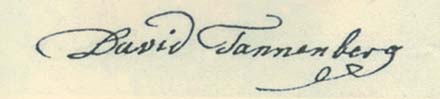
David Tannenberg's nameplate can be found on all his organs.
     PS - A side note to my story comes from a small pamphlet that Josh handed to me as I departed the church office after my tour.  In the pamphlet it tells that the landmark church spire was also designed by David Tannenberg.  A disastrous fire in 1957, which I have written about in an earlier story, destroyed the spire and belfry which had been used by the famous Lititz Trombone Choir to announce the deaths of church members, church festivals and significant days of the church year.