Extraordinary Stories

1944 (1) Act of kindness (12) Acting (2) Adoption (4) Adventure (766) Advertisement (6) Africa (1) Aging (14) Agriculture (47) Airplanes (9) Alphabet (5) American Red Cross (1) Americana (116) Amish (43) Ancestry (5) Ancesty (2) Animals (43) Anniversary (4) Antigua (10) Antiques (14) Apron (1) architcture (1) Architecture (36) Art (175) Art? (8) Arts and Crafts (69) Athletics (6) Automobiles (40) Awards (7) Banking (2) Barn raising (2) Baseball (103) Basketball (3) Batik (1) Beaches (89) Becoming A Citizen (1) Bed & Breakfast (2) Bee Keeping (6) Beer & Breweries (2) Bikes (3) Birds (9) Birthdays (34) Blindness (1) Blogging (5) Bookbinding (5) Books (12) Boxing (2) Brother Steve (12) Buisiness (3) Business (5) Canals (1) Cancer (14) Candy (30) Caribbean Islands (9) Caribbean Villas (15) Cats (5) Caves (1) Census (1) Chesapeake Bay (61) Children (28) Chocolate (4) Christmas (57) Church Adventures (122) Cigars (1) Circus (3) Civil Rights (8) Civil War (6) Classic Cars (7) Climate Change (5) Clubs (1) Coin club (2) Coins (1) Collections (73) Comedy (3) Comic Books (5) Commercials (1) Comnservation (2) Conservation (41) Covered Bridges (3) Craftsmanship (12) Creamsicle the Cat (11) Crime (16) Crisis (312) Cruise Travel (6) Crying (1) Culture (4) Dancing (1) Danger (16) Daughter Brynn (58) Daughter-In-Law Barb (7) Death (5) Death and Dying (65) Destruction (2) Donuts (1) Downsizing (2) Dunking (5) Easter (3) Eavesdropping (1) Education (48) Energy (15) Entertainment (165) Entrepreneurial (62) Ephrata (1) Etchings (1) Eternal Life (4) Facebook (5) Factories (4) Fads (6) Family (261) Farming (37) Father (42) Father Time (68) Favorites (88) Firefighting (1) Flora and Fauna (28) Fond Memories (490) Food and Cooking (171) Food and Drink (111) Football (16) Forgetfullness (3) Former Students (10) Framing (30) Friends (359) Fruits and Vegetables (3) Fun (4) Fundraiser (6) Furniture (1) Games (7) Generations (3) Gifts (1) Gingerbread houses (1) Giving (8) Globes (1) Golf (3) Good Luck (2) Graduation (1) Grandkids (136) Grandparents (3) Grandview Heights (29) Great service (3) Growing Old (8) Growing Up (187) Guns (2) Handwriting (3) Hat Making (2) Hawaii (49) Health and Well Being (61) Health Care (4) Health Hazards (110) Heartbreak (7) Heroes (26) High School (142) History (777) HO Railroading (4) Hockey (4) Holidays (134) Home construction (7) Horses (2) Housing (3) Humorous (71) Hurricanes (1) Ice and Preservation (2) Ice Cream (8) Inventions (34) Islands (4) Italy (12) Jewelry (3) Job Related (62) Just Bloggin' (56) Just Wondering (19) Juvenile Diabetes (5) Labor (3) Lancaster County (542) Law Breakers (8) LDubs In-Laws (3) Lefties (1) Libraries (1) Life's Lessons (175) Lightning (1) Lists (72) Lititz (18) Locomotives (1) Lodging (1) Love (4) Magazines (2) Magic (1) Maps (2) Marching (2) Market (5) Medical (161) Memories (28) Middle School (3) Milk (2) Minorities (1) Money (3) Mother (54) Movies (6) Mt. Gretna (1) Music (118) My Brother (19) My Wife (260) Neighbors (7) New Year's Day (5) Newspapers (4) Nicknames (2) Nuisance (3) Obsolescence (5) Occupations (2) Old Age (1) oldies (1) Pain and Suffering (12) Panama Canal Cruise (13) Parish Resource Center (14) Patriotism (3) Penmanship (1) Pets and Animals (99) Photography (220) Pizza (1) Plastic (2) Playing Trains (2) Poetry (2) Politics (27) Polution (3) Postal Service (2) Predators (2) Presidents (11) Pride (4) Printing (81) Protesting (3) Public Service (65) Questionnaire (1) Quilts (1) Race relations (6) Rain (1) Reading (4) Records (2) Religion (10) Retirement (4) Revolutionary War (3) Robotics (1) Rock & Roll (4) Rodents (2) Saints (4) Sand (1) Scouting (2) Sex (1) Shakespeare (1) Shelling (2) Shopping (24) Simple Pleasures (122) Slavery (6) Small Towns (4) Smoking (1) Snickedoodle (1) Snow (1) Son Derek (27) Son Tad (33) Son-In-Law Dave (27) Soup (1) Spices and Herbs (1) Sports (139) Sports and collectibles (1) Spring Break (1) St. James (2) St. Martin/Sint Maarten (306) Stained Glass (3) Stone Harbor (4) Story-Telling (26) Stragers (2) Strangers (4) Strasburg Railroad (1) Stress (3) Stuff (4) Suicide (2) Sun (1) Surfing (1) Tattoos (4) Teaching (49) Technology (90) Television (6) Thanksgiving (2) The Arts (6) The Beach House (62) The Flag (1) The Future (5) The Shore (78) This and That (23) Timekeeping (7) Tools and Machines (25) Tours (2) Toys and Games (31) Track & Field (1) Tragedy (8) Trains (19) Transportation (18) Travel (16) Trees (2) Trending (2) TV Favorites (23) Underground Railroad (10) Unit of Measurement (1) USA (2) Vacation and Travel (545) Vehicles (80) Vison and Eyesight (2) War (14) Watches and Watchmaking (5) Weather (48) Weddings (3) White House (1) Wisdom (3) Yearbooks (12) York County (3)
Showing posts with label Children. Show all posts

Thursday, September 10, 2020

The "Simply...The Yellow School Bus" Story

It was an ordinary day.  Looking out the window next to my lounge chair, watching the big yellow school bus make one of its runs since school ended this past March.  Bus looked to be only half full, since many parents have opted to have their children stay at home and accomplish their education online.  Needless to say, many are still frightened and worried that their children may be exposed to the COVID-19 virus.  
School bus from 1943.  Tough to tell the color in a black & white photo.
The bus seemed to be filled with happy young faces looking out the bus window, some looking my way as they passed.  Ever since I can remember, America's school buses have been yellow.  The color makes it recognizable to all and perhaps causes some to be more digilent as they pass the bus or approach it coming in the opposite direction.  
A 1955 Steelcraft school bus.
The man who put the idea in people's minds was Frank W. Cyr who was an educator and author from Nebraska.  He did research in ten states to help design a standardized bus and color for school transportation.    It was in 1939, during a meeting at Columbia University, that Cyr aimed to reinvent the fine art of getting to school.  Up until that time children got to school in a variety of ways.  
A 1957 Chevrolet School Bus.
Some traveled in wooden wheat wagons while others road in the back of pick-up trucks with floorboards covered with cow manure.  Mr. Cyr first received a degree in agriculture, then worked for years as a teacher and school superintendent.  During this time he finally decided to address the issue of getting to and going home from public schools.  He knew the economic benefits of public transportation to and from school was a no brainer.  He invited state educators from across the country, engineers from Chevrolet, International Harvester, Dodge and Ford as well as paint experts from DuPont and Pittsburgh Paint to a teachers college to set bus safety standards.  During one point in his meeting he hung up no less than fifty color strips.  After days of meetings and looking at these strips, they attendees were asked to suggest a color for the school bus.  One said red, white and blue to help instill national pride in students.  Eventually the iconic school bus shade of lead-chromate yellow was selected.  Today it is called National School Bus Glossy Yellow.  The color seems to have a psychological effect on those that see the buses.  
School buses as we visualize them today.
An Ophthal- mologist revealed that the color is "right smack in the middle" of the peak wave- lengths that stimulate the photoreceptor cells, known as cones, our eyes use to perceive red and green.  By stimulating two cones, the bus is easy to spot.  Today the colorful vehicle is involved in less that 1% of annual road casualties.  
Smaller sized buses fo transporting fewer children are easier to drive.
Seems that if there is fog or any kind of bad weather, drivers will still be able to see the yellow school buses.  And, if you take notice, large road-building and other outdoor machines are yellow to keep others from accidentally running into them.  Color has always been an important factor in our daily driving.  Traffic lights are red, yellow and green in all US states as well as every country and island my wife and I have visited during our lifetime.  To see a school bus in any other color would be tough to imagine, much the same as seeing a traffic light in any colors but red, yellow and green would be tough to imagine.  
The more modern flat-front school bus.  Easier for the driver
to see when all students are away from the front of the bus.
And, I did read that there is a national routine that school bus driver's are supposed to adhere to; after all kids have de-boarded, drivers must walk the length of the bus to ensure that no one has been left behind.  Hey, I find it easy to fall asleep when riding in a car, so why not tired students at the end of a day.  Once the bus is all clear, the driver is supposed to put a sign in the back window to indicate that the bus is empty.  Have you ever seen these signs?  Quite a bit of effort has gone into the design, color and size of school buses.  But, it is to protect the lives of our children as they head to and from school during the school year.  It was another extraordinary day in the life of an ordinary guy.

Saturday, May 18, 2019

The "Catholic Church On The Island Of Sint Maarten" Story

St. Martin of Tours Catholic Church on Front Street.
It was an ordinary day.  Walking along Front Street in Philipsburg, Sint Maarten when I pass the St. Martin of Tours Catholic Church.  The music emanating from the open windows draws me into the church to see what is the source of the music.  I find a group of about six parishioners, one with a banjo while the rest are vocalists, creating music that just makes you want to tap your foot to the rhythm.  
Front Street side of today's church.
A few years ago I wrote about this church that sits between the boardwalk and Front Street.  It was back in the 15th century that Christopher Columbus gave the name of St. Martin to the island when he set foot upon it on November 11, 1493.  That date happened to be the feast day of St. Martin of Tours, France.  When the church in Philipsburg was completed it took the name of St. Martin of Tours.  The Catholic Church is well founded on the island of St. Martin-Sint Maarten with a few Catholic parishes spread across the island that is part French and part Dutch.  My story today talks a bit more about the building that sits a few blocks east of the church on Front Street.  
The side entrance into the church.
In 1887 Father Nieuwenhuis died.  He left a sum of money, a house and a piece of property behind.  One of these houses was specially built for Catholic Sisters.  It was on April 15, 1890 that a group of Catholic Sisters left Holland and landed on the island of St. Kitts where they quickly chartered a schooner and on May 3 landed on St. Maarten.
St. Mary Boarding School on Front Street.  East of the church.
The house was so large that it became a convent for the Sisters as well as a school with classrooms.  It was known as the St. Joseph Convent and school.  The school opened on Monday June 3, 1890 with a Holy Mass.  All the students were in attendance and after mass went to their new classrooms.  The students were divided into two sections: Paying and non-paying.  
Sisters lead the children past the school.
The population of the school was: 62 children in kinder- garten, 14 children in the paying section and 56 in the non-paying section.  The main problem on day one was the language difference between Sisters and the children as well as students that lacked any discipline.  Eventually things got better and the school began to grow.  
Today's view of the building after it was repaired.
Then in 1923 a wooden building was constructed and named St. Mary's Boarding School.  Girls from neighboring islands lived there as they went to school.  In 1930 other islands began instruction of their own and the boarding school on Front Street closed it's doors.  
Final view of the building.
It continued as a primary school until 1990 when the building went over into private hands.  Hurricane Irma, a category 5 hurricane devastated St. Maarten on September 6, 2017 and destroyed the complete second floor of the old school.  A new cement roof has now replaced the old roof and the new owners have taken in consideration the history of the building and have keep the exterior looking the same.  As I stand in front of the repaired building today, I find it to be as beautiful as I'm sure the original one must have been.  It was another extraordinary day in the life of an ordinary guy.

Monday, March 11, 2019

The "You Have How Many Children?" Story

It was an ordinary day.  Carol and I were visiting long time friends and traveling companions Jere and Just Sue in State College, Pennsylvania.  Spent the weekend with them and had a good time walking through an extremely large antique store in Milroy, PA on Saturday afternoon.  The next morning I awoke and made my way to the living room where their Sunday Centre Daily Times greeted me.  Sat in the green chair by the light and began to peruse the front page of the newspaper.  A story about a struggling fire company caught my eye as did a story about the local school district having to add a week on to the school year due to missing too much school due to winter snow storms.  Then, in the bottom right of page was the story that really caught my attention.  In what appeared to be 48 point bold type was the headline: After donating sperm in State College, one man found his offspring decades later.  Unbelievable!  As I began to read the story I realized that the man in the story had originally written a similar story on September 28 of last year for the New York Times "Modern Love" column.  Googled the story and found it just as interesting as the story in the Centre Daily Times.  My story today is a condensed version of both his story and the article in the State College newspaper written by Lauren Muthler.  Back in 1984 Aaron Long graduated from State College Area High School.  The next ten years of his life remain a blur for readers, but in 1994 he returned to State College after teaching English abroad.  He left Europe, leaving his girlfriend in Germany, and moved in with his mom. Being in need of money, he began driving a taxi for Handy Delivery and also began "donating" sperm twice a week at the Fairfax Cryobank for $40 a pop, as he says.  The sperm donation was confidential, and at the time, DNA testing wasn't as available as it is today.  He was never asked to provide information except for college major, hobbies and family health history.  He had signed a nondisclosure waiver and assumed there would never be a way for him to find what might have happened to his sperm.  The next ten years saw him traveling between the West Coast and State College before making a home for himself in Seattle, Washington.  And then the Internet happened, as he says.  In the early 2000s he discovered the Donor Sibling Registry, but didn't see any of his offspring visiting the site.  He later found that his progeny (descendants) began to use the site in the 2010s as teenagers to try and find each other.  A few years ago he began to explore the site 23andMe, a service that analyzes your saliva and provided you with information about ancestry, health and DNA relatives.  He signed up for the service and nine months later got his results back and on the top of the list was the name Bryce Gallo, 22, son.  Aaron Googled him and after much consideration, wrote to him telling him he was his father.  Bryce replied almost instantly telling his dad that he wanted to meet him and that he was one of six children that he knew existed on the 23andMe.  Aaron was surprised at the results and even more surprised when Bryce had called him "Dad."  And, he had SIX children.  Bryce connected him with a daughter Madalyn, 19 years old.  Then a few months later another relative appeared on the website: Alice, age 11.  But, this time it was Alice's mother Jessica who wrote the note.  She and her female partner had each given birth to a daughter conceived with Aaron's sperm.  They broke up years ago, but have been raising both girls together until recently when the former partner and daughter moved away.  He and Jessica began to chat online and she told Aaron that she now had a boyfriend named Aaron.  Wasn't long before Jessica, Alice, Bryce, Madalyn and Aaron went on a vacation together to get to know each other better.  I should tell you that I have viewed the photo of the five of them which was in the State College newspaper, but which I don't have the right to publish, and...they really do look like their dad.  Jess and Aaron hit it off and Jess and Alice moved in with him in Seattle.  A year later Madi asked if she could move in with them.  Bryce is currently in the Air Force, but keeps in touch.  So far Aaron has met four of his biological children and knows of six more he hasn't met yet.  Jessica and Aaron are still a couple living in Seattle where Aaron works as a writer.  Now, how do you feel about the entire story you just read.  What do you think of sperm donation?  And, should Aaron be financially liable for the possible large quantity of children he might have produced?  I wish them well, but I personally am not sure how I would answer my own questions.  If you care to look at a photo of Aaron and his new family, Google the State College Centre Daily Times and look for the story from Sunday, February 24, 2019.  It was another extraordinary day in the life of an ordinary guy.

Friday, December 14, 2018

The "Bringing My Childhood Back To Life!" Story

It was an ordinary day.  Searching for the box of Lincoln Logs that Carol and I had bought for our oldest son in the late 1970s.  
A set of Lincoln Logs from the 1940s.
We spent many hours playing with the simple wooden pieces just as I had spent hours with my father doing the same with the box of Lincoln Logs he had bought for me in the 1940s.  Lincoln Logs were invented sometime around 1916 when John Lloyd Wright was working in Japan with his father.  
This is one of the drawings used to obtain the patent for Lincoln Logs.
The mold for the toy was based on the architecture of the Imperial Hotel in Toyko, which was designed by the inventor's father.  The toy logs weren't marketed until 1918 when John organized The Red Square Toy Company.  A patent was finally issued for the toy logs on August 31, 1920.  He later changed the name of his company to J.L. Wright Manufacturing.  The original set came with directions on how to build Uncle Tom's Cabin as well as Abraham Lincoln's cabin.  It followed other construction type toys such as Tinker Toys and the Erector Set.  
Playskool's 1978 package
of Lincoln Logs.
The current distributor of the toy claims it was named after Abraham Lincoln which is incorrect.  Others claim it was designed by Frank Lloyd Wright whose original name was Frank Lincoln Wright, but that too isn't correct.  John Lloyd Wright sold his company to Playskol in 1943 who in turn passed the copyright to Milton Bradley and Hasbro.  It was in 1999 that Lincoln Logs and John Lloyd Wright were entered in the National Toy Hall of Fame.  Today, Lincoln Logs are manufactured in the U.S.A. by K'NEX after having been manufactured for years in China.  Wasn't long after my grandson was born that I too had purchased a set of Lincoln Logs so he and I could play with them when he would visit.  Every time I dig out the round tube of logs and roofing material I reminisce about those days over 60 years ago when I would play with my neighborhood friends building small towns and using our metal cowboys and Indians who would inhabit the places we built.  And now, in 2018, this special toy to me as well as millions of others, has turned 100.  Happy Birthday!  It was another extraordinary day in the life of an ordinary guy.

This is the 2018 Anniversary Tube of Lincoln Logs.  Still the same as when I played with them.

Friday, November 2, 2018

The "A Hero Named Lale" Story

It was an ordinary day.  Reading online about a young man by he name of Lale Labuko.  I'm sure most of you have never heard the name before.  If I hadn't been searching for the term "mingi" I probably would have never come across the young man's name.  Mingi is the traditional belief among the Omotic-speaking Karo and Hamar tribes in southern Ethiopia that children with physical abnormalities, those born out of wedlock, those whose top teeth come in before their bottom teeth and those whose married parents have not received the necessary three blessings by elders are ritually impure and ancient traditions dictate that grievous harm will come to the village unless the mingi dies.  Thus, they are murdered by pushing them off high cliffs, thrown in the river to drown or eaten by crocodiles.  It is estimated that these tribes kill almost 300 children a year.  As for the young man with the interesting name of Lale Labuko.....he came from the Kara tribe and grew up in the village of Dus which is by the Omo River in Ethiopia, Africa.  At the age of nine his father sent him to a boarding school run by Swedish missionaries.  His father was highly criticized for doing so, but it changed his life.  When he was 15 he witnessed the practice of Mingi.  Back in his village he saw elders grab a baby from her mother and take her to the river to drown her.  From that point forward he began working to save the Mingi children.  He currently runs a shelter for the so-called cursed children.  Three years ago he was featured in the movie "Omo Child: The River and the Bush" which followed him as he tries to end the practice of Mingi.  Together with film maker John Rowe, he founded the Omo Child Shelter whose mission is to provide a safe, nurturing home and quality education for rescued Mingi children living in the remote Omo Valley.  The hope of the shelter is that these children will become future leaders in their tribes and communities as well as raise awareness about the practice of Mingi and see its elimination in the tribes of the Omo Valley by the year 2030.  
Lale Labuko with natives from the Omo Valley.
I don't recall what I was searching for at the time I came upon the name Lale Labuko, but I will never forget finding his name.  Lale is now 30 and the heart behind OMO Child.  One thing that influenced him was the fact that he had two older sisters, both deemed Mingi, who were killed before he ever knew them.  Outlawing and stopping Mingi has become his life's mission.  His main objective now is to create Southwest Ethiopia's future leaders and help to end the practice of Mingi.  To be 30 and leading the fight to save his tribe is remarkable.  A true patriot and hero in my eyes.  In a country where we seem to have a daily national crisis created by members of all parties, wouldn't it be nice to find someone like Lale Labuko to lead the way?  It was another extraordinary day in the life of an ordinary guy.

Monday, August 20, 2018

The "Down On The Farm With P. Diddy" Story

It was an ordinary day.  Early 1950s and I'm sitting on the front porch with my mom and brother watching all the people walk past our home on N. Queen Street, which was a block from the train station.  Family after family walked past the porch toward parking spaces to the south of our home.  Many families, almost all white, were ushering new family members, mostly black, toward their cars and trucks.  Happened every year as soon as school ended.  Lancaster, Pennsylvania was, and still is, a safe haven for children from New York City to visit for a few weeks to months each summer and escape the heat and crime of the inner city.  Most stayed on farms which in Lancaster County meant predominantly Amish and Old Order Mennonites.  They traditionally opened their large family farms to help host children as part of what was known as the Fresh Air Fund.  In 1877 the fund was established to allow children living in disadvantaged communities a chance to get away from hot, noisy city streets and enjoy free summer experiences in the country.  Each year thousands of children visit volunteer families in 13 states from Virginia to Maine and Canada.  As far back as I can remember, Lancaster County has been a host community for the children.  I can still remember reading stories in the local newspaper all summer-long about the experiences these children had on the host farms they called home for a few months every summer.  
Sean Combs
A week or so ago I was watching "Jimmy Kimmel Live" when Sean Combs, known to most as "P. Diddy" told his story about living on an Amish farm during the summer when he was a child.  Sean was telling Jimmy that his daughter had recently attended summer camp and didn't enjoy it since she didn't have her own bed.  He went on to say that he told her that when he went to camp in the summer he didn't even have lights, electricity or a car.  Seems his summers were spent in Lancaster County on an Amish farm where he spent time helping the Amish family with work on the farm from milking cows to picking berries.  He told his daughter that he had to ride in a horse and buggy and remembered partaking in lavish meals after church on Sunday.  As Sean talked to Jimmy you could tell he loved every minute of it.  He said he wonders if his host family knows what has happened to him over the years.  Well, our local newspaper found who his host family was and sent a reporter to talk with them.  Being the family was Amish, they didn't want to be photographed or identified, but did tell the reporter that Comb's sister, Keisha, who had also visited with them, had contacted them and made a visit. They told the reporter that if Sean wanted to visit, he could get information from his sister.  At the end of Comb's interview on the Kimmel show, he told Jimmy that one of the things that helped make him what he is today was his visits to Lancaster County.  And, the children still arrive by train and probably still walk past my old home on N. Queen Street.  Oh, the memories!  It was another extraordinary day in the life of an ordinary guy.

Wednesday, June 6, 2018

The "Cover Girl" Story

The cover of Pediatric Insights from the Spring of 2016.
It was an ordinary day.  The little sweetheart we know as KJ has made the cover once again.  It was back in the Spring of 2016 that she made the cover of Pediatric Insights.  The little girl with the neat red glasses was featured in the magazine telling about her liver transplant, donated by a high school classmate of her mother Donya.  This time around she is featured on the cover, as well as a four page interior spread, of the magazine IMPACT which is a publication of Children's Hospital of Pittsburgh.  The cover features a photograph of Dr. Mazariegas, lead Pediatric Transplantation specialist at Children's Hospital, giving Kennedy a big hug.  
Kennedy and her mother Donya.
It was a few years ago that Kennedy visited the Clinic for Special Children in nearby Strasburg, Pennsyvania and was diagnosed with an extremely rare genetic disorder.  They knew she needed the help of a specialist and they knew exactly who to call.  Dr. Kyle Soltys is a transplant surgeon at Children's Hospital who travels to Strasburg to check on a few of his patients.  
The latest cover for UPMC featuring KJ.
One day he was told about Kennedy and after talking with her other doctors, they all agreed that a liver transplant would help correct some of conditions contributing to KJ's rare disease known as AdoHcy deficiency.  Dr. Mazariegas led the team of surgeons who did the living liver transplant for KJ.  The article in the magazine featured the neatest page-and-a half photo of KJ in her jean's jacket with a headline that screamed - Living Hope: Changing the Face of Transplant Medicine.  KJ is the cover girl for some of these remarkable new surgeries.  A final 2/3 page photo features Dr. Mazariegas with KJ on a Big Wheel.  Donya asked if I would frame the article for her and the resulting frame and photos can be seen here.  It was another extraordinary day in the life of an ordinary guy.

The framed magazine article.  Click on the image to enlarge.

Thursday, May 31, 2018

The "Breaking News: There Really Is A Santa, Megan!" Story

Letter Santa and Elf Shimmer sent to Megan
telling her of the loss of her letter this past
Christmas.  Please click on images to enlarge.
It was an ordinary day.  Just received an email from Megan which included a letter she had recently received from Santa and his elf Shimmer.  Story started back in December of 2017 when Megan sent a letter to Santa telling him what she would like to have for Christmas.  Seems that the letter must have been at the bottom of his immense mail bag and he never had the chance to read it before Christmas.  I'm not sure if Megan ever received all the gifts she was wishing for, but if she did she was lucky since Santa never found her letter until a few weeks ago.  I should tell you that Megan is 11 years old and is the oldest daughter of my niece Kelly and her husband Shawn who live in nearby Ephrata, Pennsylvania.  
I'm sure that when Megan's mom and dad gave her the unopened letter recently sent to her, from Santa and his elf, she was amazed.  What are the chances that Santa would do that almost half a year after the letter was written to him.  Even I know that Santa must be something special to take time to send a letter to this young girl almost half a year after Christmas.  Megan shared the letter with her parents and siblings and decided to write her own letter telling of her experience of receiving the letter and her thoughts of Santa.  Trying to figure what a very sensitive and respectful young girl is thinking can be tough, but I have included the letter telling of Megan's impression of Santa after finding out he had misplaced her letter.  Please read it and see for yourself what this young girl's feelings are after receiving Santa's letter explaining why he didn't deliver to her what she had been wishing for this past Christmas.  Megan found and felt the goodness and love of Santa even after he had lost her letter.  What a wonderful story to share with children all over the world.  Christmas is more than half a year away, but for Megan, well she already has the Christmas spirit in her heart!  It was another extraordinary day in the life of an ordinary guy.
Megan's thoughts after receiving the letter from Santa.

Thursday, April 19, 2018

The "Hey, They Named A Camp After Him: Part I" Story

It was an ordinary day.  Looking at one of my favorite Facebook pages, "The Lancasterian".  As I scrolled down the page I found a photograph of the entrance to Camp Rodgers which at the time the photograph was taken was located on Camp Rodgers Road near the town of Ephrata in Lancaster County, Pennsylvania.  I made a comment on the "The Lancastrian" and received a few comments in return.  
Pamphlet showing the Church Camp
on Camp Rodgers Road in Schoeneck.
Wasn't long before I dug out my small pamphlet titled "A Day at Camp Rodgers" to see how much I remembered about the small church camp that I enjoyed so much when I was young.  It was back on December 8, 2009 that I first posted a story here telling about my experiences at the camp, but I never told much about how the camp began and the comments on "The Lancastrians" were leading in that direction.  So, I dug out my book titled St. James Church 1744-1944 by Klein and Diller and began my search.  St. James Episcopal Church began in 1744 and had a variety of organists and choirmasters during it's history, but one of the best was Mr. George B. Rodgers who was recommended by a small church committee who traveled to Princeton, New Jersey to hear him play and interview him.  Wasn't long before he was hired on February 8, 1910.  
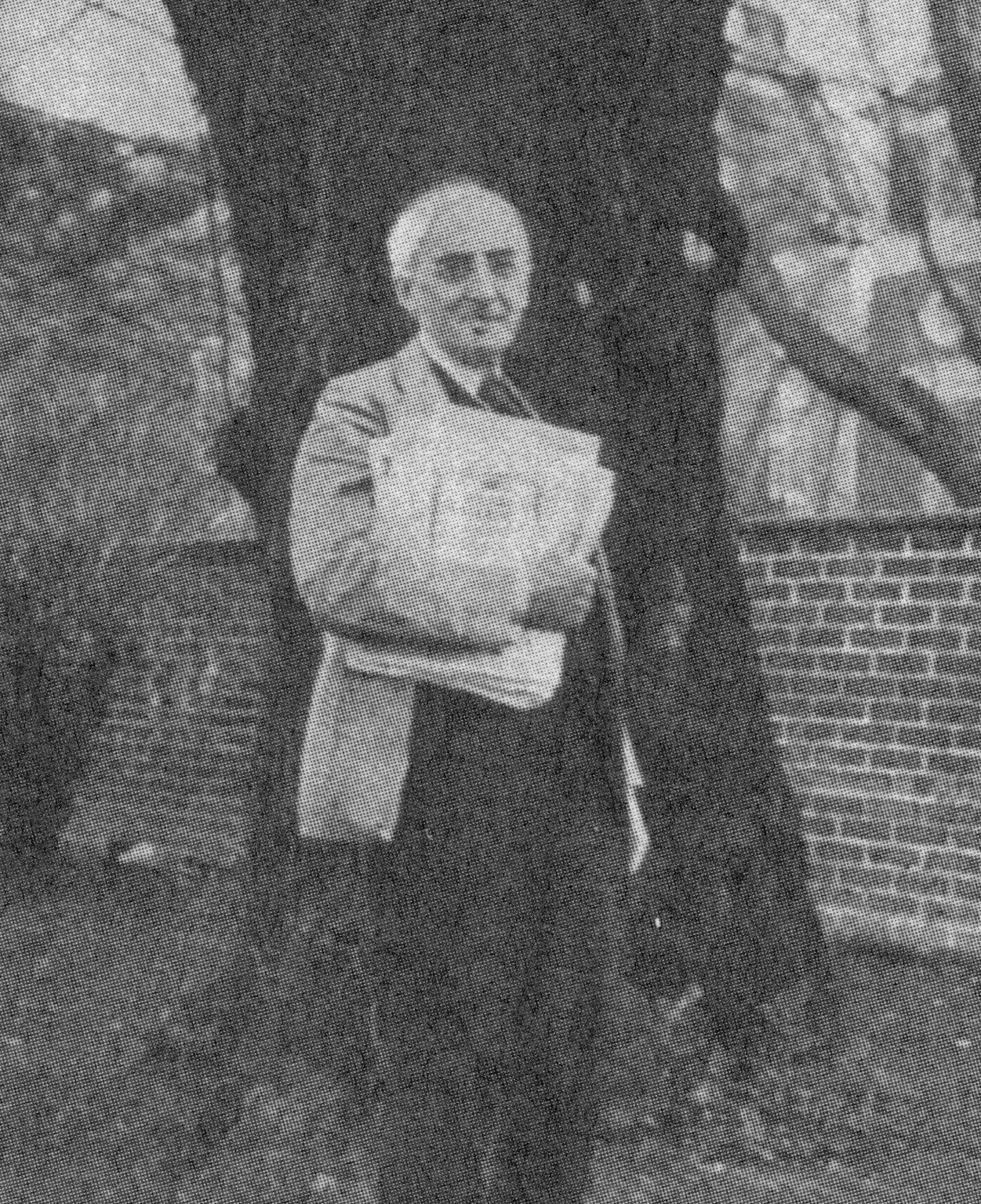
Mr. George B. Rodgers for whom the camp was named.
He spent 32 years at St. James and during that time began the boys choir at St. James as well as gaining recognition throughout the community for his musical library for the choir, his lenten organ recitals and his work with the youth of community.  He held his first church camp at nearby Pequea on the Susquehanna River in 1911.  A few years later he changed the location to the town of Goldsboro where he rented a cottage near the river.  
Fathers and sons in the choir.  My dad and I are in the
back row on the far right.  Dad and I both attended
summer church camp as children at Schelle Island
in the Susquehanna.
Wasn't long before the camp carried his name and was moved to a small farm house on Schelle Island near Goldsboro.  It was meant to be used by the youth in the community with those who were in his boy's choir allowed to go for free.  My father was one of those choirboys who had a chance to go to Mr. Rodgers' summer camp on Schelle Island.  Then in 1942 he retired as the organist and choirmaster, but was allowed to spend his summers at the church camp on Schelle Island.  Three years later he suffered a stroke at the camp and was brought back to Lancaster where he stayed in a Convalescent home until his death.  
Camp Rodgers on Schelle Island.  The building shown
here burned to the ground on May 4, 1956.
After Mr. Rodgers retirement, a few other organists filled the position until on Feburary 1, 1944 Mr. Frank McConnell became organist and choir- master.  Mr. McConnell continued the boys choir and the tradition of sending choir members to Camp Rodgers in the summer for a healthful summer vacation in a religious atmosphere.  I attended the camp for the first time in 1955 at the age of 11.  Memories I retain from my stay that year were jumping into the cold Susquehanna River at 7:00 AM every morning before breakfast, seeing one of the other campers shoot himself in the knee with an arrow from his own bow and seeing a large female snake run over by a lawn mower and watching as many baby snakes wandered under our sleeping quarters.  Then on Friday, May 4 of the following year the main camp building which was nearly 200 years old was destroyed by fire.  
Another photograph of Mr. George B. Rodgers.
It was impossible to fight the fire since no equipment could reach the island before the old farm house was destroyed.  The loss was great for the church camp since it was such a big part in the life of the parish since 1911.  Two days after the fire the church Vestry made a decision to erect a temporary building on the island for the coming camp season.  A pre-fab structure was taken by boat to the island and men of the church, including my dad, helped erect the building.  The new building held the dining room, kitchen and cook's quarters.  Then on December 21, 1956, the Vestry purchased  property consisting of 18 acres including 3 acres of woodland and a lake of considerable size.  A farm house and 6 small cottages were situated on the property.  The camp was moved from Schelle Island for $21,500.  The new Camp Rodgers near Schoeneck was ready for campers.  The road that leads to the camp was renamed Camp Rodgers Road and all was well once again.  Follow along tomorrow and I will show you some of the photos that were published in the pamphlet that I have saved all these years.  It was another extraordinary day in the life of an ordinary guy.


PS - The following is a two-page letter my dad sent to his mother when he was at Camp Rodgers on Schelle Island.  The second page was actually folded so it has to be read as the left side and then the right side.  Dad was 12 years old at the time he wrote the letter.  Click on photos to enlarge them.


Sunday, March 18, 2018

The "I Like You Just The Way You Are!" Story

I passed this sign on a sidewalk in Manheim, PA.
It was an ordinary day.  A beautiful day in the neighborhood as I walked pass a sign that wished Mr. Rogers a Happy Birthday.  Need I say anything more?  Well, just in case you didn't know, it was Mr. Rogers who always said, "Won't You Be My Neighbor?"  Mr. Rogers, for those who have never heard of him, was Fred McFeely Rogers who immediately after graduating from Rollins College in 1951 was hired by NBC television in New York as an assistant producer for The Voice of Firestone and later as floor director for The Lucky Strike Hit Parade, The Kate Smith Hour and the NBC Opera Theatre.  Mr. Rogers was born in Latrobe, Pennsylvania, so in 1953, after being asked to return to  nearby Pittsburgh station WQED, which was the nation's first community-sponsored educational television station, he moved back to his home state of Pennsylvania.  
Mr. Fred Rogers in the late 1960s.
Mr. Rogers was asked to develop the
first program schedule for the TV station.  Shortly after he produced "The Children's Corner" which was a daily, live, hour-long visit with music, puppets and host Josie Carey.  Rogers served as puppeteer, composer and organist.  Two years later his program won the Sylvania Award for the best locally produced children's program in the country.  It was on "The Children's Corner" that a few of Mr. Roger's Neighborhood regulars first made an appearance.  Anyone remember Daniel Striped Tiger, X the Owl, King Friday XIII, Henrietta Pussycat or Lady Elaine Fairchilde?  They would become regulars on his famous show, "Mr. Rogers Neighborhood."  
A shot from his TV set.  This was Mr. Rogers' Neighborhood.
During Mr. Rogers free time he attended Pittsburgh Theological Seminary and the University of Pittsburgh's Graduate School of Child Develop- ment.  In 1963 he became an ordained Presbyterian minister with a charge to continue his work with children and families through the mass media.  Later in 1963 he developed a children's program for CBC in Canada that was called MISTEROGERS.  He moved from behind the scenes to the show's on-camera host.  
Mr. Rogers Memorial Statue in Pittsburgh, PA.
He returned to Pittsburgh three years later with his wife and two sons to begin "Mister Rogers' Neighbor- hood" on National Educational Television and in 1968 on the Public Broad- casting Service (PBS).  A few years later my family discovered his show on PBS.  I actually enjoyed watching the show with all three of my children.  The show offered a safe haven for kids, not like many of the crazy cartoons and animated shows did.  His quiet demeanor presented him as an adult in a busy world with time for every child who viewed the show.  I can still remember my kids staring at the TV screen as he said, "I like you just the way you are!"  
Mr. Rogers' sweater now is in the Smithsonian Institution's
Musuem of American History in Washington, D.C.
The iconic sweater that he wore on just about every show is now on display in the Smithsonian Institution's Museum of American History.  He even has a memorial statue in Pittsburgh!  Mr. Fred McFeely Rogers died in 2003.  I also remember Jimmy Kimmel last year, after the mass shooting in Las Vegas, looking nervously at the TV camera and saying "look for the helpers."  Something that Mr. Rogers would say often.  

2018 is the celebration of the 50th anniversary of "Mister Rogers' Neighbor- hood."  A new Mr. Rogers documen- tary called "Won't You Be My Neighbor?" is scheduled to be released on June 8th.  I hope you will be able to watch it.  Also, this month the U.S. Postal Service is going to release a Mr. Rogers' Forever Stamp.  If only he could have lasted "Forever" to help influence generation after generation of children in this troubled world.  Maybe, just maybe, we really could have all been friends and neighbors.  It was another extraordinary day in the life of an ordinary guy.  

Saturday, February 17, 2018

The "The Story Of A Fine Young Man!" Story

It was an ordinary day.  Just pulled out my copy of the 2013 Manheim Township Middle School Yearbook to see if I could find the class photograph of a young man who was the center of a story in the morning newspaper (LNP).  Nicholas Vicidomini was a graduating 8th grader when I placed his class photo in the yearbook that year.  As I searched the rest of the book I found him in a photo of the 8th grade basketball team.  Nothing very special about the boy in the yearbook, but the LNP changed all that when they told the story about Nick and his travails through early life with lymphoblastic lymphoma, an aggressive form of cancer.  
Nick's photo from his 2013 yearbook.
When Nick was a 7 year-old he underwent three surgeries as well as eight months of chemotherapy.  It was back in 2007 that Nick and his family first went to THON.  For those not familiar with the Penn State IFC/Panhellenic Dance Marathon, commonly referred to as THON, it is a 46-hour dance marathon that takes place every February at the Pennsylvania State University in University Park, Pennsylvania with the purpose of raising money and providing emotional support to children and families in order to combat pediatric cancer.  It was started in 1973 by Penn State University's Interfraternity Council.  That year they raised more than $2,000 with 39 couples dancing for 30 straight hours.  Today it is the largest student-run philanthropy in the world with millions raised every year.
The official logo of THON.
 The money is donated to The Four Diamonds Fund which is a charity devoted to defeating pediatric cancer through research and caring for patients and their families at the Penn State Hershey Children's Hospital.  About three-quarters of the money raised is used by The Four Diamonds Experimental Therapeutics Endowment for research while much of the rest of the money is used for the young cancer patients family support.  
In 2005 Carol and I visited with our friends Jere and
Sue who live in State College.  We made a trip to Bryce
Jordan Center to see the dancers at THON.  An exciting
evening with dancing in our seats since the gym floor was
filled by thousands of students dancing the night away.
This year's event began yesterday with more than 16,000 people at the Bryce Jordan Center dancing their hearts away for the young children.  It was back in 2007 that Nick became involved in THON.  In the LNP story he is quoted as saying, "I like to think THON saved my life."  Nick has been cancer free since 2009.  But, he hasn't forgotten how he became that way.  This young man decided years ago that he wanted to continue with THON by entering Penn State University after graduating from Manheim Township HIgh School, which he did in 2017.  This guy was such a great basketball player that he was recruited by colleges who wanted his basketball services at their schools, but his loyalty to THON was so great that he turned them all down to enter Penn State so he could continue to be part of the school's THON program.  And, yesterday and today he will be one of the 16,000 people who will help raise money to continue  the program that at one time helped to save Nick's life.  I'm hoping that Nick's story might inspire you to give to The Four Diamonds Fund.  As I looked at his photo from the yearbook it never struck me that he would one day be one of the student's so inspired by what had happened in his life to feel compelled to lend his support for this worthy cause.  Our country is in good hands knowing that we have young men such as Nick Vicidomini leading the way.  It was another extraordinary day in the life of an ordinary guy. 

Tuesday, February 13, 2018

The "Books Lost...Books Found" Story

My old book press from my teaching years.
It was an ordinary day.  Helping my wife with the house cleaning.  Ran the vacuum on the first floor and grabbed a cloth to do some dusting.  For years I have been dusting the antique book press which sits next to an old desk we found at an antique dealer many years ago.  The book press was used for years in my classroom when we made hand-bound books, but when I retired and the new teacher didn't want it, the principal told me to take it with me.  I claimed the press plus the old floor model guillotine paper-cutter, wooden teacher's desk, a few dozen wooden California job cases and drawer after drawer of old wooden and metal type pieces plus metal engravings that were of no use to anyone.  As I dusted the book press I checked out the three books that have been a part of our home since we moved into our Beach House over 20 years ago.  As I looked at the small bound books I was stumped as to how we acquired them.  Carol and I found that one book came from the Martic Elementary School where she went to school as a child while the other two came from the Pequea Township School District.  All three have the little "Date Due" flyer in the back of them showing how many times the book had been read and in one case, what year it was placed in circulation in the library.  Somehow over the years we acquired the three children's books and placed them in our book press when we moved to our current location.  And, today for the first time in my life I opened them and examined them. The following information describes the really neat children's books what I re-discovered: 

  • Far from Marlborough Street by Elizabeth Philbrook.  

    This book was published in 1944 and is listed as a book for juvenile audiences.  The book tells the story of Nancy Wadsworth who could hardly believe her ears when her grandfather suggested she, ten year old girl that she was, go along on a stagecoach journey from Boston to Springfield.  It was in the year of 1793 and the roads were rutty.  But, who else could go?  Someone had to take the mysteriously valuable box to Uncle Jonathan to get him out of trouble.  The adventures she goes through from catching a horse thief to buying a moose are all explored in this book.  This book was actually one in Oprah's Bookclub.
  • The Lion, the Witch and the Wardrobe by C.S. Lewis.  
    This is book 1 on the Chronicles of Narnia and tells how Aslan, the noble lion, freed Narnia from the spell of the White Witch.  The novel is set in Narnia, a land of talking animals and mythical creatures that one White Witch has ruled for 100 years of deep winter.  Four English children are relocated to a large country house following a wartime evacuation.  They are sent to the countryside to live with professor Digory Kirke.  The youngest visits Narnia three times via the magic of a wardrobe found in a spare room.  All four children are together on her third visit, which proves that the youngest was telling the truth.  You must read the book to find what happens to the children.  The book all began with a picture in the author's mind of a faun carrying an umbrella and parcels in a snowy wood, but it wasn't until he was about 40 that he made a story about it.  After reading some online notes about the book, I fell compelled to read it myself, being a child at times in my mind.
  • A Horse Named Summer by Karen Bendick.  
    The book is based on a diary kept by the author when she was 14, therefore the style of the book is very simple.  The sentences are short and declarative and the illustrations, also by the author, are clear and unadorned line drawings.  The devotion the author had for her horse, which her family had rented for her over the summer, is quite evident.  Miss Bendick called her horse Sil Summer Salt and tells details about his care and comfort as well as the pleasure she took in riding him.  As the entries in the diary near the end of the summer, they indicate her transition to a more mature view of her relationship to the animal, which she began to liken to that of a parent and child.  Young girls will love the book it is said.  As I leafed through the book, reading passages, it reminded me of my wife as a young girl who too had a horse that she cared for during her high school years.  
All three books are now back in the book press, but can be removed if anyone would like to read them.  Just type me a comment and we may be able to arrange for you to borrow the books.  All three books have probably entertained quite a few children in the past half-century.  It was another extraordinary day in the life of an ordinary guy.

A popular book titled "A Horse Named Summer" which was borrowed close to 60 times.  On the back of it, but not pictured, was printed in all capital letters: I LOVE JOHN. 
Inside the book, "Far from Marlborough Street", can be seen dates as early as 1963.

Friday, December 15, 2017

The "The Case For Weighted Blankets" Story

It was an ordinary day.  The phone's ringing off the hook!  Now, for those of you who weren't alive when telephones had to be hung on a hook to disconnect the call, I guess I could say ... the phone won't stop dinging (or whatever tone you have selected for your iPhone).  The reason for the constant barrage of calls today is the article that appeared in the morning newspaper in the city of Lancaster, Pennsylvania.  
Cindy busy at work on her sewing machine.
Story titled "Blanket Benefit" which was written by Jenelle Janci and featured a story about weighted blankets that were made by Cindy Grebinger.  Cindy is the wife of Keith whom I had as a student in photography many years ago and for whom I now work at Grebinger's Gallery in Neffsville, PA.  About a year ago Cindy opened a sewing studio in one of the rooms of the gallery.  At first she did embroidery and children's clothing, but recently added weighted blankets to her list of offerings at the gallery.  
The weighted blanket can be seen here.  The side of it
has a zipper which allows you to place strips of beads
in the pouches that are sewn into the blanket.  You can
place as many of the strips of polypropylene beads as you
care to, depending upon the weight you want the blanket to be.
The weighted blankets are filled with polypro- pylene beads which are the type of beads found in Beanie Babies.  The blankets tend to add the feeling of calmness for those that use them.  The beads add weight to the blanket which makes it feel as if you are wearing a weighted vest.  The blankets are known to aide those with autism, anxiety and restless leg syndrome.  For the blanket to be effective it should conform to the person's size and body weight.  
Cindy also sells embroidered stockings.
It seems to be best if the blanket is about 10% of the person's weight.  Tests have shown that the blankets can increase serotonin which is a neurotransmitter that affects mood and social behavior.  Seems that just that little extra weight in a blanket can create a calming effect for those using them.  When used by children who have a hard time sitting or maintaining attention the blankets seem to cause relaxation and a calming effect for the user.  If a blanket is purchased for a child it is best to alter the weight as the child grows for maximum effect.  One of Cindy's customers told her about her grandson's struggles with night terrors and wondered if she had weighted blankets for sale.  Cindy made a few, but decided she could improve the design of the blankets.  
Cindy's baby clothes with customized
embroidery on them.
She talked with her son who is an engineer and she found that instead of adding weight by sewing it into the blanket, she could make zippered pouches in the blanket that could be used to change the weight as the child grows and needs more weight.  If the blanket needs to be washed, all you need to do is remove the weighted pouches of polypropylene beads and replace them when the blanket dries.  Cindy's blankets can be used from childhood to adulthood if needed.  With Cindy's unique design, a person with restless leg syndrome has the option of only weighting the lower half of the blanket with the weight of their choice.  If you use a weighted blanket, you should make sure it is weighted proportionally to the child's or adult's weight.  Never use them on infants.  If used for a child, the child should be strong enough to remove the blanket from themselve if needed.  If you are a parent and having trouble with your children sleeping, call Cindy and talk to her about what her blankets might do to help your child.  The comfort that is rendered the child, or even adult, may be all that is needed to help them lead a normal life.  You can find Cindy at: 717-569-9335.  Her mailing address is: 2618 Lititz Pike Rear, Lancaster, PA 17601, USA.  She would be more than willing to talk with you or email you about the items she has for sale.  It was another extraordinary day in the life of an ordinary guy.
Cindy also does custom embroidery that can be framed.
Cindy at work on her Brother sewing machine.