|
| Proposed as Oregon Village |
 |
| Plan for Oregon Village |
 |
| This is what will be lost |
|
| Proposed as Oregon Village |
|
| Plan for Oregon Village |
|
| This is what will be lost |
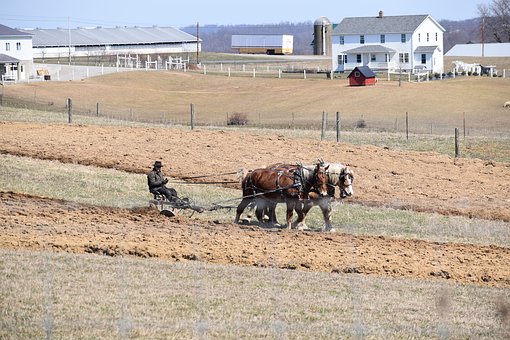 |
| Will scenes like this cease to be in Lancaster County? |
 |
| Will roads like these be filled with cars and trucks instead of Amish buggies? |
 |
| Scene's such as this will no longer be seen in Manheim Township if Oregon Village is approved. |
 |
| It will no longer be safe for The Amish to walk on the side of the road or drive their buggies on the roads. |
 |
| Let's keep the land looking like this! |
 |
| Mr. Lynn Smoker's collection of ice harvesting tools. |
 |
| The frozen Susquehanna River can be seen in the distance. |
 |
| These are tools used to check the depth of the ice. The ice needed to be between 6" and 9" thick so both men and horses would not be in danger of falling through. The hand drill on the right was used to bore a hole in the ice and the tool in the center was used to place in the hole. It had a lip on the bottom which would be hooked to the bottom of the ice. A mark was placed on the top of it for depth and the rule would be used for measuring the thickness of the ice. Click on photos to enlarge them. |
 |
| If there was heavy snow on the ice, it would be removed with an ice scraper to shave off the snow. |
 |
| These are saws from Mr. Smoker's collection. They would be used to saw through the ice along lines that were marked in a checkerboard style pattern. |
 |
| Eventually plows were used instead of the saws. This photo shows the plows cutting along the marked lines, through the ice. The horse drawn ice plow dates back to the 1890s. |
 |
| This shows a hand plow. |
 |
| This is known as breaking out and is done with hook chisels and breaking bars. The tools are used to break off large pre-cut ice pieces so they can be piked to the ice house. |
 |
| A selection of ice hooks from Mr. Smoker's collection. |
 |
| Another way to get the ice to the ice house is on wagons. |
 |
| The ramps were used to get the ice into the ice house. |
 |
| The lift was another way to get the ice into the ice house. |
 |
| Men would wear spikes on their boots while walking on the ice. |
 |
| The horses would wear horseshoes with spikes on them. |
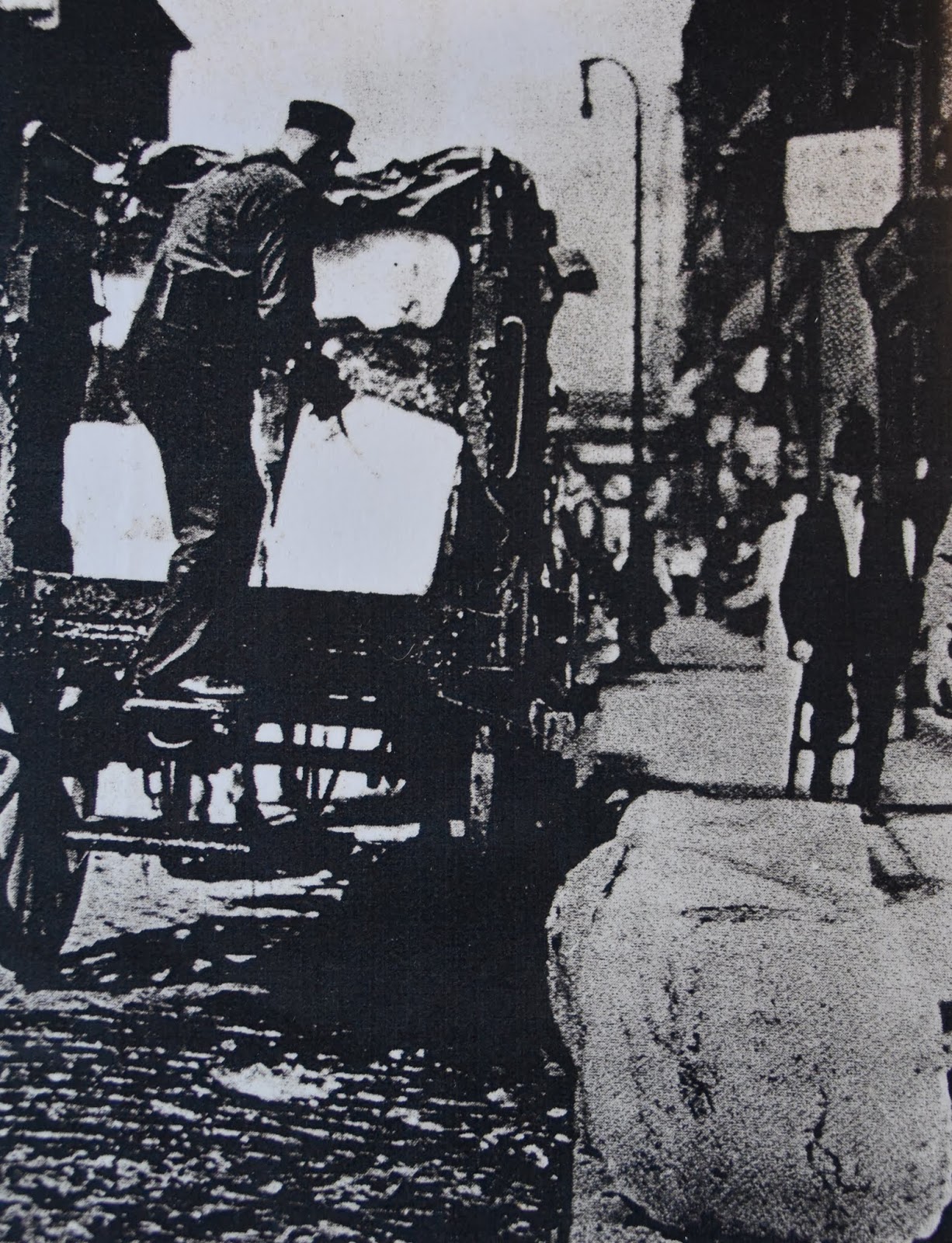 |
| The ice man making deliveries in neighborhoods. |
 |
| Another ice wagon making deliveries. |
 |
| Ice Axes and hatchets were used primarily in the ice houses as well as on the ice wagon to split blocks of ice before weighing them. |
 |
| This reminded me of an illustration from Saturday Evening Post. |
 |
| The tools of the ice man included a handheld saw, ax, and pick for breaking down ice for each household. Ice men also carried a scale to weigh the ice, but career ice men were skilled at estimating ice weight. |
 |
| Customers would display this in their window if they needed ice. It would tell the iceman what quantity of ice was needed. Ice was sold by the pound with the cost in Lancaster around 1900 being 35 cents per 100 pounds. |
 |
| The iceman or the customer could use tools to shave or chip the ice. |
 |
| Mr. Smoker's collection of ice shavers and chippers. |
 |
| Ads showing cold-storage cupboards and refrigerators. |
 |
| Another ad showing upscale ice boxes. Looks like you could even sit on them. |
 |
| This photo and the next are ice boxes that belong to Mr. Smoker. |
 |
| Ice boxes were manufactured for home use to be opened on the floor. Only a small block of ice and a few perishables could fit in such a box. The ice boxes here were only affordable to wealthy American households between the 1840s and 1870s. By the turn of the twentieth century almost every home had an icebox that could hold a substantial amount of food. |
 |
| Beautiful Lancaster County farmland |
 |
| Many Lancaster County farms are dairy farms |
 |
| Another beautiful Lancaster County farm |
 |
| The National Christmas Center along the Lincoln Highway in Lancaster County that closed last January. |
 |
| A display from the 1950s was a favorite of mine. |
 |
| The Belmont Barn on the Mayer-Hess property. Both barns were taken down piece by piece and will be reassembled in the future. The Belmont barn will be home to the National Christmas Center. |
 |
| The Mayer-Hess farmhouse with the Belmont barn in background. |
 |
| The historic Star Barn which was disassembled piece by piece and moved to the Stone Gable Estate about a half year ago. This photo is from a few years ago, before it was moved. |
 |
| The Wetlands Institute in Stone Harbor as shown on their Facebook page. Click on photographs to enlarge them. |
 |
| One of the many poster hanging in our Wings & Water bedroom. |
 |
| Panorama showing some of the Wetlands. |
 |
| A few of the waterfowl visiting the Wetlands. |
 |
| One of many metal enclosures placed over areas where Diamondback turtle eggs were located. This helps keep predators from eating the eggs. |
 |
| A small crab that our guide picked up to show us. |
 |
| The only Monarch butterfly I saw. Migration starts in a few weeks at the Wetlands. |
 |
| A small Diamondback turtle in their research center. |
 |
| An octopus in the research center. |
 |
| One final photo before I departed. |