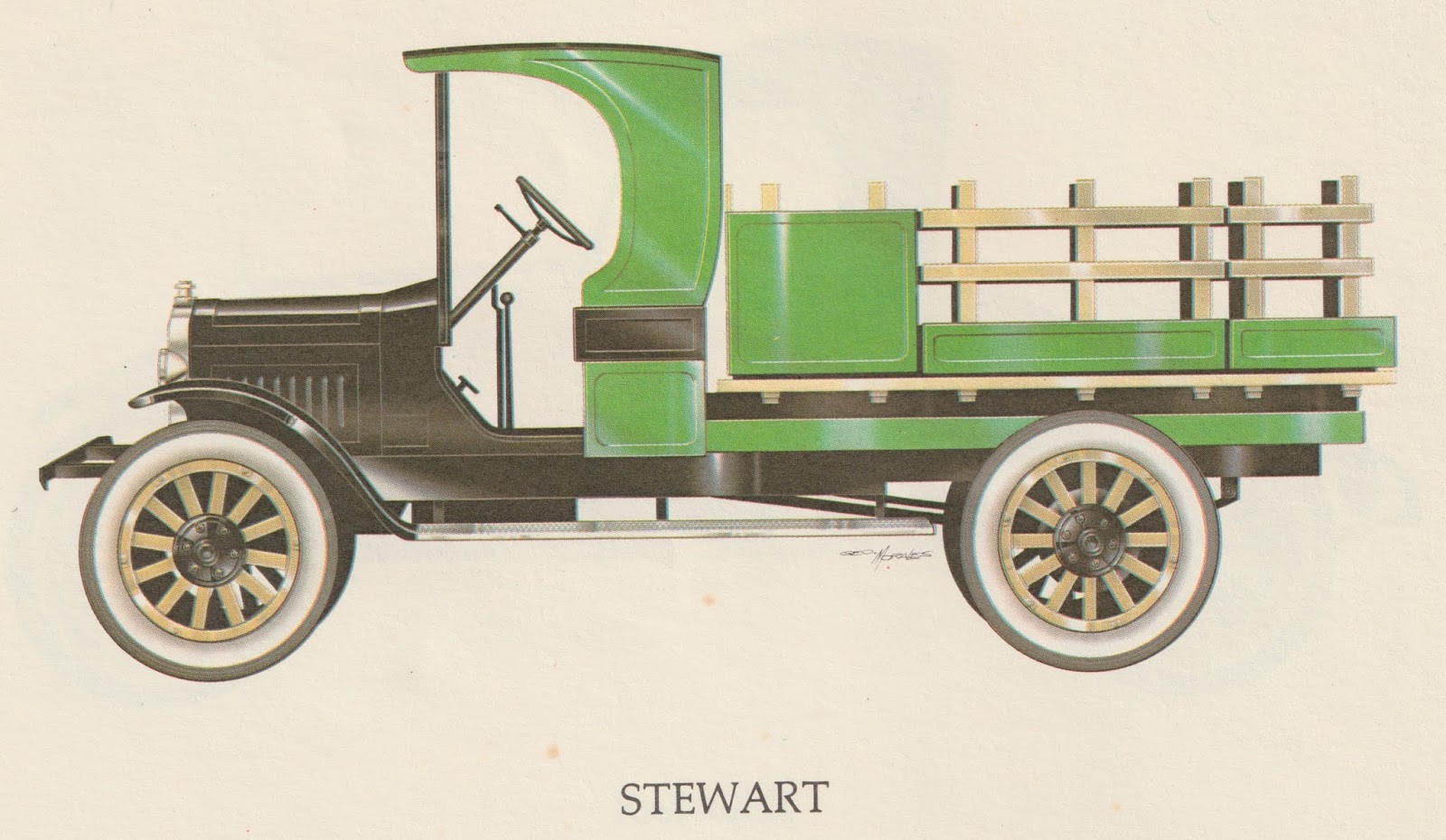
It was an ordinary day. Sometime in the early 2000's and I had just returned from a trip to a few of the antique stores near Adamstown, Pennsylvania known as Renninger's Antique and Collectors Market and Stoudt's Black Angus Antique Mall. This area of Pennsylvania is known for their high quality antiques and it is so interesting to see what others have decided to discard over the years. My "big" find today was a 1922 calendar that I gave to my mother since it was the year of her birth. Only problem was that it carried drawings of automobiles from that era. When she and my father died, I sort of inherited just about everything that my brother didn't have an interest in at the time. The calendar was special to me since I had bought it for her years before her death. As I leafed through the pages of cars it amazed me that there were several that I hadn't even heard of before. The first page from the calendar will show you the design of the calendar, but the photographs that follow will show you all the automobiles that were featured in the calendar. See how many you can remember that were in production in 1922. It was a another extraordinary day in the life of an ordinary guy. PS - Click on images to enlarge them.
Showing posts with label Collections. Show all posts
Friday, August 28, 2020
Thursday, August 27, 2020
The "My Favorite Collectibles: Part II - Metal Models Etc." Story
It was an ordinary day. Have reached the bottom of the final box I had found in the basement and what I discovered were more of my 1/18" scale metal cars as well as a few special items I had placed in the box years ago when we moved to the "Beach House" and had forgotten about until now. One special item was a metal box that was shaped like an automobile with the word "Speedster" on both sides. When I picked it out the box I had no idea what I had placed in the car years ago. As it was, I found four really neat pocket watches, each a different brand. Wound one of them and the movement began to operate. Placed them back in the can for safe keeping, as I did over 20 years ago. Another item I found was in a cardboard box that read: ELEGANT AND BEAUTIFUL DELUXE SEDAN...Heavy Gauge Sedan. Had a photo of what appeared to be a Corvette with the rather crude word Chevrolet on the side of the car. It, too, was made to 1/18" scale as were the Corvettes that I featured recently. Two other items were bright yellow Matchbox products that were made in China. One was a tractor-trailer with "Kodak Film Racing screen printed on the side and a small car, with the same Matchbox scale that had the number 4 and Kodak printed on it. For years I had collected Kodak items, and still have a few of them remaining, but the majority of that collection I had sold years ago, except for these few items. I also found two yellow H2 Hummers that were a perfect match except for the size of them. One was Matchbox size and the other 1/18" size. And the final item in the box of collectibles was a "Woodie" Ford Wagon with a surfboard on the top. It too was 1/18" scale. I had collected them years ago and put them away for safe keeping. At least that's what I tried to tell myself when I found them in the cardboard box. One final collection I had I recently asked my brother to try and sell online for me. My collection of license plates I had been collecting for over 20 years. Had plates from every one of the Caribbean islands we had visited as well as just about every state in the United States that we had visited. For years they were fastened to the base of our Tiki Bar on our back deck. Many were beginning to fall off and I thought it best to give someone else the chance to enjoy them. He recently gave me a check for the sale of them, minus those island plates that didn't have a sticker with the expired date on them. He said they had been removed from the site since they had no idea if they had been stolen or not. It was another extraordinary day in the life of an ordinary guy.
![]() |
| The metal "Speedster" |
![]() |
| Inside the "Speedster" were several pocket watches. |
![]() |
| The box and what was inside of it. |
![]() |
| This reads Chevrolet..I think! |
![]() |
| Two Kodak Matchbox products. |
![]() |
| A Matchbox Hummer and the 1/18 scale Hummer. |
![]() |
| The Ford "Woodie" with surfboard. |
Wednesday, June 5, 2019
The "Why Are Starfish Shaped Like Stars?" Story
It was an ordinary day. Cleaning the glass top of my coffee table in the living room of our beach house. Years ago I tried to explain that we don't live at the beach, but that our home looks very similar to houses found along a coastal area with a modern flair to it and a wooden walkway, much like a boardwalk, around the house. Anyway, the coffee table was smudged from our cats walking on it all the time so I thought I would clean it. I built the coffee table over 20 years ago when we moved into the house and made it so we could display the many sea shells and beach items we have collected over our lifetime during trips to the Jersey Shore and Caribbean islands. As I was wiping the glass on the coffee table, I looked at the large array of starfish that we have found and placed in our collection. All of them have five arms except for one that has 23 arms. Made me wonder why they are called a fish in the first place. So, I checked out one of my Smithsonian magazines and found a story titled "Why are starfish shaped like stars?" Seems that scientists can't pinpoint exactly why starfish evolved to have radial symmetry, with arms-usually five, but as many as 40 in some species-growing from a central axis. There are about 1,500 species of starfish that live in the seabeds around the world. They are found from the intertidal zone, where the ocean meets land, down to abyssal depths of 20,000 feet below the surface. Starfish are marine invertebrates which mean they do not possess nor develop a backbone or spine. And, since they don't possess a backbone, they are not technically fish. But, they certainly are pretty neat. At the tip of each arm is an eye that can detect changes in light intensity, and on the bottom are tube feet that enable it to move in any direction. Several species can regenerate an arm lost to a predator or an accident, and a few can even regenerate a new central disc from a severed arm, as long as a fragment of the disc remains with the arm.
During a vacation years ago to Sanibel, Florida, I purchased a booklet on collectible Florida shells and found starfish listed in it. It showed the varieties I should probably find around Sanibel as well as showing one named the Sunburst Starfish which is found in Mexico. It also points out a starfish that is called the Thin Starfish that is also known as a nine-arm starfish and is famous for its ability to drop and later regenerate an arm.
It grows to be between 3 to 12 inches. I did find several very unusual starfish with names such as the Royal Starfish that is purple and orange in color and is found on the east coast of North America, the Bat Sea Star that is found along the west coast of North America and is orange and red in color, the Crown-of-Thorns starfish that has venomous spines and is found in the Pacific Ocean as well as the Red Sea and Indian Ocean and the Necklace starfish that is jewel-like and found in the Indian Ocean. All these make my collection seem tame. Check out some of the starfish that I have been able to find over the years during our travels. It was another extraordinary day in the life of an ordinary guy.
![]() |
| The Royal Starfish |
![]() |
| The Necklace Starfish |
![]() |
| A variety of starfish my wife and I have collected from our travels. |
![]() |
| A few more starfish from our collection. |
![]() |
| The 23 arm starfish. |
Sunday, February 3, 2019
The "Working On The River! - The Ice Man: Part I" Story
Foreword: I'm standing in the Columbia Crossing River Trails Center in Columbia, Pennsylvania. As a student in high school I knew very little about the little town along the Susquehanna River known as Columbia, except for the fact that they traditionally had a top-notch basketball team. Always seemed to beat our high school team until five years after I graduated and my brother, Steve, became a senior and he and his teammates finally beat the team from along the river. Today, the quaint little river town is the perfect model of "Small Town America." The more I explore this town I feared as a teenager, the more I discover how much they influenced the building of our nation. The next three day's stories will deal with those that worked on what is known as the 16th largest river in the United states and played a major role in the start of our nation.
It was an ordinary day. Standing in the display area of the Columbia River Trails Center, with my camera in hand, taking photographs of history. The current exhibit at the center is called "Ice Harvesting On The Susquehanna River." Deals with the time in history when refrigeration was a big problem for the majority of the population. I can still remember going on vacation as a young boy to a small beach in Maryland known as Crystal Beach. My mom and dad, brother and myself, along with my Aunt Lillian and cousins Judy and George would spend two weeks every summer in a small cottage at Crystal Beach where we played in the sand, went swimming in the upper Chesapeake Bay and had some the most memorable times of our lives. And, I can still remember the ice man that made a few stops each summer so we could get a block of ice or two to put in the icebox that was on the rear porch. Only way we could keep our food and drinks cool in the hot summer weeks was by buying the blocks of ice. Well, today I am finally getting a chance to see how that ice was harvested for our use. The display in the Columbia Crossing River Trails Center comes from the vast collection of Mr. Lynn Smoker. a local historian. The display contains ice tools from small ice picks to large ice plows, to signs that home owners would put in their window.
And, not just one of each. This gentleman has a huge collection which he began in 2005. Most of the pieces in the collection are from the 19th century, since the 1880s were the peak of the ice industry. The harvest on the nearby Susquehanna River usually began in mid-January, provided the ice was at least 6 inches thick and safe to walk on without cracking it. To be able to have heavy equipment or horses on the ice, the ice needed to be at least 8 inches thick. A hole was needed to start the process. The hole was drilled in the ice and a tool was placed into the hole, The hook on the end of the tool would catch on the bottom of the hole and someone would mark the depth on the tool. After the tool was removed, a rule was used to check the thickness of the ice. If it was a suitable depth, the ice was cleared of debris and snow and a crisscrossed pattern was place on the ice.
Workable units of ice were usually 25 to 50 pounds blocks. Modern day clothing didn't exist so wool was the choice for winter weather. At times the weather was brutal so the job was not for the weak or faint of heart. The blocks were moved to the ice houses which lined the shore and packed in sawdust to keep it cold. When needed it was delivered to households and local businesses. Agricultural and meat-packing plants were other customers of the ice to keep their products fresh. Ice boxes were the fridges of today and they held the blocks of ice to help refrigerate the home owner's food. The harvested ice usually lasted until the end of the summer months, depending on the amount harvested and the thickness of the ice on the river.
Many of the people who worked to harvest the ice were the same people who farmed the land, since they didn't have as much to do in the winter months. The ice delivery man had to be strong since he was lifting up to 50 pound blocks of ice all day long. To keep your home in ice for that amount of time usually cost about 10% of your yearly income. Eventually ice farms were used to freeze water in a controlled environment. This ice was usually cleaner than river ice. For those that couldn't afford an ice box and the cost of ice drank warm drinks and shopped more often so their food wouldn't spoil. The display at the Center showed samples of everything from the saws used to cut the ice to the ice boxes used to keep it cold in your home much like the ice box I remembered from my summer vacations when I was a young boy. Eventually most all households had electricity installed and purchased refrigerated cooling units, thus eliminating the ice harvesting. Tomorrow I will take you on a visual tour of Mr. Smoker's vast display that I had the chance to view and photograph. It was another extraordinary day in the life of an ordinary guy.
And, not just one of each. This gentleman has a huge collection which he began in 2005. Most of the pieces in the collection are from the 19th century, since the 1880s were the peak of the ice industry. The harvest on the nearby Susquehanna River usually began in mid-January, provided the ice was at least 6 inches thick and safe to walk on without cracking it. To be able to have heavy equipment or horses on the ice, the ice needed to be at least 8 inches thick. A hole was needed to start the process. The hole was drilled in the ice and a tool was placed into the hole, The hook on the end of the tool would catch on the bottom of the hole and someone would mark the depth on the tool. After the tool was removed, a rule was used to check the thickness of the ice. If it was a suitable depth, the ice was cleared of debris and snow and a crisscrossed pattern was place on the ice.
![]() |
| A variety of ice harvesting tools. |
![]() |
| Ice chunks line the Susquehanna River last year. |
Tuesday, December 18, 2018
The "Exploring The Wild In Style" Story
It was an ordinary day. Heading north out of Lititz, Pennsylvania to make a visit to Cabela's, Inc. in Hamburg, Pennsylvania. The ride will take about an hour, since we are taking the back roads to take in the scenery. The store is about a quarter of a million square feet in size and extremely impressive if you are an outdoor's person. Our chauffeur today is Hal and I am sitting in the rear seat of his Ford Escape with Jeff while Barry plays shotgun for today's trip. The four of us have known each other for many years, since we taught school together in the Manheim Township School District in Lancaster County.
Hal had been to the store quite a few times while Jeff and Barry have visited a time or two. Today will be my first visit to the mammoth store that specializes in supplies for hunters and fishermen. The company, which was recently sold to Bass Pro Shops, does well over 1 billion in sales each year and attracts 60 million visitors a year.
The store has over 400 employees who are some of the most interesting and helpful you will ever meet. Hal told us the story of the place and how the entire area around the store was constructed after Cabela's was completed. The parking lot is as big as some residential neighborhoods. Anyone entering for the first time has to be impressed at the size of the place. Tough to see to the other end due to the immense size of the interior. If you aren't a fan of stuffed animals and taxidermy, this isn't the place for you. Has to be a couple of hundred preserved animals of all sizes in the myriad of displays around the store. The rest of my story will be a visual one to show you the immense size of the place and the quality of products they sell as well as the High Temple of Taxidermy. I naturally had my camera with me. I have only identified a few of the photos, since most are easily identifiable and the rest I have forgotten their names. Enjoy! It was another extraordinary day in the life of an ordinary guy. PS - Click on images to enlarge them.
| Main entrance of Cabela's in Hamburg, Pennsylvania |
| Stepping into the world of fishing and hunting |
![]() |
| Entering the fresh-water aquarium |
| Friends from left are Barry, Hal and Jeff |
| The second level has a lunch room |
![]() |
| John, one of many fabulous employees |
| The end of the journey. Took almost 2 hours to explore the place. |
Subscribe to:
Posts (Atom)