Extraordinary Stories

1944 (1) Act of kindness (12) Acting (2) Adoption (4) Adventure (766) Advertisement (6) Africa (1) Aging (14) Agriculture (47) Airplanes (9) Alphabet (5) American Red Cross (1) Americana (116) Amish (43) Ancestry (5) Ancesty (2) Animals (43) Anniversary (4) Antigua (10) Antiques (14) Apron (1) architcture (1) Architecture (36) Art (175) Art? (8) Arts and Crafts (69) Athletics (6) Automobiles (40) Awards (7) Banking (2) Barn raising (2) Baseball (103) Basketball (3) Batik (1) Beaches (89) Becoming A Citizen (1) Bed & Breakfast (2) Bee Keeping (6) Beer & Breweries (2) Bikes (3) Birds (9) Birthdays (34) Blindness (1) Blogging (5) Bookbinding (5) Books (12) Boxing (2) Brother Steve (12) Buisiness (3) Business (5) Canals (1) Cancer (14) Candy (30) Caribbean Islands (9) Caribbean Villas (15) Cats (5) Caves (1) Census (1) Chesapeake Bay (61) Children (28) Chocolate (4) Christmas (57) Church Adventures (122) Cigars (1) Circus (3) Civil Rights (8) Civil War (6) Classic Cars (7) Climate Change (5) Clubs (1) Coin club (2) Coins (1) Collections (73) Comedy (3) Comic Books (5) Commercials (1) Comnservation (2) Conservation (41) Covered Bridges (3) Craftsmanship (12) Creamsicle the Cat (11) Crime (16) Crisis (312) Cruise Travel (6) Crying (1) Culture (4) Dancing (1) Danger (16) Daughter Brynn (58) Daughter-In-Law Barb (7) Death (5) Death and Dying (65) Destruction (2) Donuts (1) Downsizing (2) Dunking (5) Easter (3) Eavesdropping (1) Education (48) Energy (15) Entertainment (165) Entrepreneurial (62) Ephrata (1) Etchings (1) Eternal Life (4) Facebook (5) Factories (4) Fads (6) Family (261) Farming (37) Father (42) Father Time (68) Favorites (88) Firefighting (1) Flora and Fauna (28) Fond Memories (490) Food and Cooking (171) Food and Drink (111) Football (16) Forgetfullness (3) Former Students (10) Framing (30) Friends (359) Fruits and Vegetables (3) Fun (4) Fundraiser (6) Furniture (1) Games (7) Generations (3) Gifts (1) Gingerbread houses (1) Giving (8) Globes (1) Golf (3) Good Luck (2) Graduation (1) Grandkids (136) Grandparents (3) Grandview Heights (29) Great service (3) Growing Old (8) Growing Up (187) Guns (2) Handwriting (3) Hat Making (2) Hawaii (49) Health and Well Being (61) Health Care (4) Health Hazards (110) Heartbreak (7) Heroes (26) High School (142) History (777) HO Railroading (4) Hockey (4) Holidays (134) Home construction (7) Horses (2) Housing (3) Humorous (71) Hurricanes (1) Ice and Preservation (2) Ice Cream (8) Inventions (34) Islands (4) Italy (12) Jewelry (3) Job Related (62) Just Bloggin' (56) Just Wondering (19) Juvenile Diabetes (5) Labor (3) Lancaster County (542) Law Breakers (8) LDubs In-Laws (3) Lefties (1) Libraries (1) Life's Lessons (175) Lightning (1) Lists (72) Lititz (18) Locomotives (1) Lodging (1) Love (4) Magazines (2) Magic (1) Maps (2) Marching (2) Market (5) Medical (161) Memories (28) Middle School (3) Milk (2) Minorities (1) Money (3) Mother (54) Movies (6) Mt. Gretna (1) Music (118) My Brother (19) My Wife (260) Neighbors (7) New Year's Day (5) Newspapers (4) Nicknames (2) Nuisance (3) Obsolescence (5) Occupations (2) Old Age (1) oldies (1) Pain and Suffering (12) Panama Canal Cruise (13) Parish Resource Center (14) Patriotism (3) Penmanship (1) Pets and Animals (99) Photography (220) Pizza (1) Plastic (2) Playing Trains (2) Poetry (2) Politics (27) Polution (3) Postal Service (2) Predators (2) Presidents (11) Pride (4) Printing (81) Protesting (3) Public Service (65) Questionnaire (1) Quilts (1) Race relations (6) Rain (1) Reading (4) Records (2) Religion (10) Retirement (4) Revolutionary War (3) Robotics (1) Rock & Roll (4) Rodents (2) Saints (4) Sand (1) Scouting (2) Sex (1) Shakespeare (1) Shelling (2) Shopping (24) Simple Pleasures (122) Slavery (6) Small Towns (4) Smoking (1) Snickedoodle (1) Snow (1) Son Derek (27) Son Tad (33) Son-In-Law Dave (27) Soup (1) Spices and Herbs (1) Sports (139) Sports and collectibles (1) Spring Break (1) St. James (2) St. Martin/Sint Maarten (306) Stained Glass (3) Stone Harbor (4) Story-Telling (26) Stragers (2) Strangers (4) Strasburg Railroad (1) Stress (3) Stuff (4) Suicide (2) Sun (1) Surfing (1) Tattoos (4) Teaching (49) Technology (90) Television (6) Thanksgiving (2) The Arts (6) The Beach House (62) The Flag (1) The Future (5) The Shore (78) This and That (23) Timekeeping (7) Tools and Machines (25) Tours (2) Toys and Games (31) Track & Field (1) Tragedy (8) Trains (19) Transportation (18) Travel (16) Trees (2) Trending (2) TV Favorites (23) Underground Railroad (10) Unit of Measurement (1) USA (2) Vacation and Travel (545) Vehicles (80) Vison and Eyesight (2) War (14) Watches and Watchmaking (5) Weather (48) Weddings (3) White House (1) Wisdom (3) Yearbooks (12) York County (3)

Friday, November 6, 2015

The "Museo de Las Americas: Part II" Story


Photograph of the Museo de Las Americas showing the
walled interior and the courtyard.

It was an ordinary day.  Traipsing through the many galleries that feature the work of Puerto Rican artist Antonio Martorell.  Mr. Martorell was born in Santurce and has been involved in the arts his entire life so as to justify his birth and postpone his death according to him.  He is the father of dancer Alejandra Martorell, stepfather of Giovanni Rodriguez who directed the cult film Red Canyon, and the grandfather of Gael Rodriguez.  He has exhibited and performed, created installations, engaged in workshops and lectured in Latin America, North America, the Caribbean and Europe, and participated in international collective exhibitions on all five continents.  He holds numerous awards both nationally and internationally.  
Wall of letters from artist Antonio Martorell.
The Museo de Las Americas is displaying objects from and of his work from September of 2015 until January of 2016.  One of Mr. Martorell's projects he has carried out in the past was to help in the designing of an alphabet in collaboration with the local Public School #48 students so that they will endear themselves to letters and words.  The concept is based on the tradition of medieval and baroque alphabets with human figures designed into the letters.  
Artist Antonio Martorell.
The project consisted of letters depicted in 26 colored woodcuts that were printed in a variety of textured and colored fabrics, framed and hung in the school auditorium alongside the wood cuts.  Along with the cuts hung a quote from Maria de Hostos who was an educator of Dominican and Puerto Rican lineage.  The quote read "Ignorance is the worst enemy of civilization."  My visit to the gallery today was immensely interesting, since I too have worked with students in the graphic arts and many of the works on display are from the same areas that I have taught for over 30 years.  The many wood cuts and screen prints brought back so many memories from my past and made me feel "at home" as I walked from one gallery to the next viewing Mr. Martorell's work.  Following are photographs of much of his work which I enjoyed tremendously.  It was another extraordinary day in the life of an ordinary guy.  PS - Please click on the photos to enlarge them.


We were greeted with this whimsical piece of art from Mr. Martorell as we walked from the 1st floor to the 2nd floor.
All these panels are prints from woodcuts.
A closeup of one of the actual woodcuts.  You can see the tool marks in the wood where the artist has cut the wood away.  The part that remains is the part that will print.  Known as relief printing.
Another woodcut print.
A display of prints place on sheer fabric that can be viewed from either side when lit.
This is another medium for the artist.  On the walls are pieces of mirror placed to form words that hold the word "Cover" in them while the floor is round ceramic tiles.
What you are viewing here are silk-screen frames that are rear-lit so you can view the actual screen with the design on it.


Carol and Just Sue are talking with the museum guide as they view this work by the artist.
A local library suffered a devastating fire which became the subject for a series of work by Mr. Martorell.
Another artwork depicting the remnants of the fire.
Bigger than life rocking chair with LDub relaxing under it.
Carol is admiring the work on the wall above the carpet designed by the artist.
Another photograph of the artist, Antonio Martorell


Thursday, November 5, 2015

The "Museo de Las Americas: Part I" Story

Courtyard in the Museo de Las Americas in Old San Juan, PR.
It was an ordinary day.  Walking around the upper level of the Museo de Las Americas in Old San Juan, Puerto Rico admiring the artwork of not only local artists, but artists from around the world who have their work in collections and on display at this fabulous building.  The museum is a short distance from El Morro, one of the two huge forts that stand on the corners of the walled town of Old San Juan, and is located in a former Spanish Army barracks that at one time housed over 1,000 soldiers and their families.  
A patron studies the guide book.
The original rooms served as bedrooms, warehouses, kitchens, jails, stables and dining rooms.  During WWII the building became a U.S. military hospital and eventually was given back to Puerto Rico where it finally became a museum.  The three levels of the square building have archways along each side that have railings to prevent visitors from falling to the lower level.  The walls seem to be between 18" to 24" thick that all face toward a central courtyard of squared patterned brick, stone and tile.  In one corner of the courtyard stand a few square umbrellas, the colors of the building, that have tables and chairs under them.  The museum was inaugurated in 1992 as a non-profit organization run and maintained through funds received from the local government as well as the Friends of the Museum.  The museum functions to provide a location for permanent as well as seasonal exhibitions whereby the public can gain an understanding of the history and culture of the Americas.  Artisans from Latin America, the United States and Puerto Rico are showcased in the museum.  
One of the many displays in the museum.
A local artist, Antonio Martorell, has his work exhibited in a few of the many galleries with work from many others displayed in the open walkways facing the courtyard as well a few other galleries.  There are two permanent exhibitions housed in galleries with one that features Indians in America that covers 22 ethnic groups that were able to survive conquest and colonization.  Tomorrow I will give you a glimpse into the work of the featured artist Martorell, while today I will give you a visual journey of some of the other artists.  After paying the $2.00 fee, Carol and I, along with friends Jerry and Just Sue, climbed the steps to the second level where the galleries begin.  The open walkways as well as the galleries feature historic artifacts which consist of folk art, tools, musical instruments, masks, wooden figures and just about anything that has become famous in popular culture in the Americas.  Follow along as I walk the balconies and look through the galleries.  It was another extraordinary day in the life of an ordinary guy. 


Oxcart from Puntarenas, Costa Rico.  A few years ago Carol and I had the chance to visit the factory where oxcarts are made in Puntarenas and watch the artisans at work.  The colors are vibrant and designs unique.  A true piece of Central American art.  This was along one of the balconies on the second floor of the museum.
Don Salvador Casellas constructed this dollhouse in the 1980s.  He was the first interior decorator in Puerto Rico when he started decorating houses in the 1940s.  He studied art at New York's Parsons Institute of Design.  This doll house was made by him as well as the furniture.  He and his sister Mercedes made the rugs and curtains.  Don Salvador was also a painter and decorated the Governor's Mansion, La Fortaleza, for Luis A. Ferre and Rafael Hernandez Colon.  His son donated this dollhouse in 2006 to the museum which is housed in one of the galleries.
This display shows the houses of the diverse regions of the Americas.  They reflect the climatological and environmental conditions of their location.  
The chapel is representative of those built up until a few years ago throughout Puerto Rico's rural areas.  They were made from tropical hardwoods, with palm leaves, grass and shrubs for thatching.  Members of neighboring rural communities held devotional ceremonies in the chapels.  This chapel and altar were built by Mr. Jose Lopez Diaz and Mr. Rodriguez who were both from Ciales, Puerto Rico. 
This Ceramic Chess Game was designed and made by Juego de Ajedrez from Peru.
This board game is called Wari or Mancala.  It is made of wood and seeds are used for playing pieces.  Built by Juego del Wari from Santa Lucia.  A few years ago my friends Jerry and Just Sue bought me one just like as a gift.

This outdoor display is titled the evolution of colonization and it shows several cannons.  I have included a closeup of one of the barrels of a cannon so you can view the delicate patterns made on the cannon.
This wall that I stand in front of is from the artist that I will feature in my story tomorrow.  His name is Antonio Martorell and he is a graphic artist from the island  of Puerto Rico.
Self-designed artwork from Antonio Martorell which is featured in his exhibit in the Museo de Las Americas.
 

Wednesday, November 4, 2015

The "Back To The Future" Story

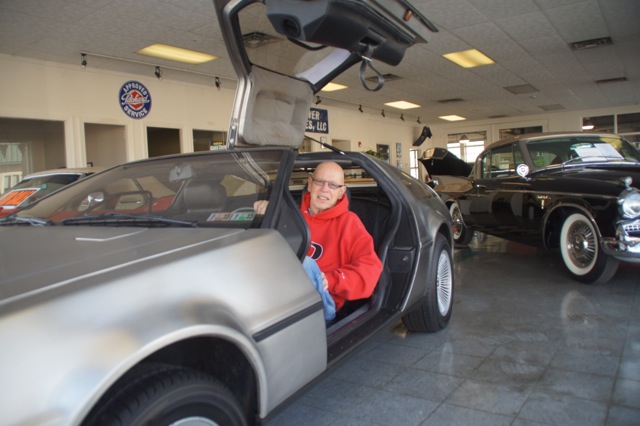
The gulled-wing DCM-12 DeLorean.
It was an ordinary day.  Sitting in a gulled-wing DCM-12, known to most of you as a DeLorean automobile, talking with Dave who works at Horsepower Enterprises LLC of Lancaster, PA.  I had Dave as a student in my Graphic Arts class in the late 1980’s and knew he worked at the business.  Had passed Horsepower Enterprises on North Prince Street many times in the past few months and saw the DeLorean in the window with the gull-wings raised and knew I just had to stop to sit in the stainless steel car. 
Movie poster for the movie
Back To The Future.
This was the same auto that a young man is accidentally sent 30 years into the past in the 1985 movie “Back to the Future” which was invented by his friend, Dr. Emmett Brown.  Stars of the movie were Michael J. Fox and Christopher Lloyd who predicted what the future would hold and actually some of those predictions came true 30 years later while others ..... well not so much.  So what predictions from the movie came true?  Here are a few you may recall:  (1) Video conferencing which Marty McFly does with one of his co-workers is much like our current day Skype and Facetime; (2) The Chicago Cubs were predicted to win the World Series in 2015 and they came very close this year to reaching that pinnacle; (3) McFly drank Pepsi Perfect in the movie which resulted in Pepsi releasing Pepsi Perfect for the “Back to the Future” fans; (4) The movie showed how fingerprints were use instead of keys and today our phones and various other tech devices use fingerprints to do just the same thing.  Some things in the film that didn’t come true .... yet, but may soon come true are: (1) A woman in the Oval Office which could happen if Clinton or Fiorina win the election; (2) Ejection seats that are now used in planes but could someday happen in automobiles; (3) A cure for cancer which McFly read in a newspaper which claimed that cholesterol was the cure; (4) And, flying cars which were said to eliminate roads and I predict will fill our skies and prevent our crops from growing from lack of sunlight. 
Driver's side of the gull-winged DeLorean.
Well, the DeLorean is a fantastic car even thought it was only made between 1981 and 1983 which was a few years before the movie was released.  A few facts about the car that are pretty neat are: (1) The car was created by John DeLorean who had worked for General Motors and was given credit for making the first muscle cars with high performance engines; (2) It was designed by Giorgetto Giugaro of Lotus fame; (3) The car was built in Northern Ireland in a factory that John DeLorean had built and stopped production after fewer than 10,000 cars were built; (4) It really wasn’t that fast for a car that looked like it could take you to the future; and (5) It was fun to drive and sit in as I can attest to the latter fact.  It was another extraordinary day in the life of an ordinary guy.

Tuesday, November 3, 2015

The "Forest of Clouds" Story


Sign for the El Portal Visitors Center.
It was an ordinary day.  Sitting a few rows behind Hymie, our driver and tour guide, in his small bus on our way to the El Yunque National Forest on the island of Puerto Rico.  What was once established as the Luquillo Reserve in 1903 was renamed Caribbean National Forest in 1935 and then El Yunque National Forest in 2007.  
The El Portal Visitors Center 
El Yunque is the only tropical rain forest in the United States National Forest System and its name may be attributed to either an aboriginal Taino (native Indian) word yu-ke, which means "white lands," or the word "anvil," which is yunque in Spanish.  El Yunque is located on the slopes of the Sierre de Luquillo mountains, encompassing 28,000 acres of land which make it the largest area of public land in Puerto Rico.  The park receives over 200 inches of rain a year, in some areas, which is created in some parts by the trade winds from the Atlantic assaulting the mountains.  We traveled about half an hour from our hotel in San Juan to El Yunque's El Portal Visitors Center where we exited the bus and watched a short film on the rain forest.  
Our tour guide, Hymie, showing a tree variety.
After a quick visit to the gift shop Hymie talked about some of the vegetation and flowers in the nearby area.  The trumpet tree, coffee tree, ginger tree, bread fruit tree, banana tree and tree fern were just a few of the surrounding items we saw.  Then on our way back to the bus Hymie pointed out an enormous termite nest in a tree.  
Termite nest in a tree with tubes leading from it to the ground.
Mud tubes led from the ground to the nest and when Hymie brushed a tube, termites exited.  Our tour today will take us to various locations throughout the forest, but there are other tours that take you along a multitude of trails with one trail that takes you to the peak of the rainforest.  Needless to say, people with any type of medical problems should be happy with a bus tour through the rain forest.  
The La Coca Falls with little water flow.
Back in the bus, we made our next stop at the La Coca Falls which were without the cascading fall of water due to less rain in the last day or two.  We then made our way to the Yokahu Observation Tower where you could see to the coast through the clouds.  It was at this point that the rains came .... and the borrowed umbrella from our resort which I so loyally brought with me, was in the bus.  Hymie assisted Carol back to the bus with his umbrella while I absorbed the rain.  During our time at Yokahu we had the chance to see some of the wildlife in the rainforest when we spotted a hummingbird and a few geckos of various colors.  Allegedly there are Puerto Rican Parrots, the Coqui tree frog and the non-venomous Puerto Rican Boas, but we didn't spot any of them.  Our final stop took us to the La Mina Trail which is a trail made in the 1930s by workers who earned 50 cents a day.  We wound endlessly through the forest which got its name from an Indian spirit, Yuquiye, which means "Forest of Clouds," then back to the bus.  A stop on the way back at an authentic Puerto Rican restaurant made the trip a unique and extremely interesting tour.  It was another extraordinary day in the life of an ordinary guy.  PS - click on photos to enlarge. Also, I'm sorry to say that many of my notes were made illegible by the rain so I have posted the following photos  without any ID.


A multitude of geckos of various colors.
The Yokahu Observatory
View from the top of the observatory.  A true "Forest of Clouds."
Rounded staircase.


One of a myriad of streams.
The La Mina Trail constructed in the 1930s.
Since much of the rainforest is on rock, the roots of the trees and plants grow above ground on the rocks. 
The names and initials of the workers who built the trail.
Hymie walking in front of us.
Bamboo as thick as your arm.


Monday, November 2, 2015

The "Clyde's Fabulous Cannon!" Story

Home-made cannon that my friend Clyde made.
It was an ordinary day.  Standing next to Clyde's cannon with my safety earmuffs in place getting ready to pull the cord to fire it.  Cannon has a barrel that is close to four feet long with a 4" diameter that holds a breech at the rear of it that can fire a 10 gauge Winchester shotgun shell that holds black powder.  On my third pull the cannon jumps off the ground with a puff of smoke coming from the end of the barrel and a percussion that can be felt throughout my body.  
The rear or firing end of the cannon.  The opening, also
known as the breech, is where you place the shotgun shell,
then close the back panel and lock it tightly in place for firing.
Wow!!  I had no idea of the noise or the explosive power that a black powder 10 gauge shotgun shell could provide, even in an open environ- ment.  Pretty impressive, to say the least.  I have known Clyde for over 30 years, having taught Industrial Arts at the high school level with him at Manheim Township High School in Lancaster, PA.  He taught primarily wood shop and his mechanical skills are twice what mine will ever be.  
The original breech had to be cut from the cannon since
the red shotgun shell had expanded from the blast and
couldn't be removed.  A longer breech was made to correct the problem.
Some time ago he was watching a show on the History Channel on his small color TV in his two-bay garage shop about the Spanish American War when he saw several cannons being fired.  Brought back memories of his time spent in the Coast Guard when he was responsible for firing the company's cannon during the daily colors ceremony.  Thought to himself that it was time for him to make a cannon, so that's exactly what he did.  
Shell is in position ready for firing.
Rounded up the materials and set out to build a cannon that would impress his friends and scare the neighbors.  Machined the barrel and fitted a 1/4" thick metal cap on one end where he drilled a hole and fitted the breech.  Found the original breech wasn't long enough, since when the first shell was fired it couldn't be removed from the cannon because the casing was enlarged on the end.  Redid the breech, making it slightly longer, and that corrected the problem.  The main body of the cannon is made with Douglas Fir while the wheels are made from hickory with metal rims around the edges.  These were purchased from an Amish shop in Stevens, PA at a cost of about $100 each.  I must admit I was impressed when I had the chance to fire the cannon and see the results of his mechanical achievements.  
This impressive photograph illustrates the power of Clyde's cannon.
I did miss the evening ceremony when friends gathered with him on the hill behind his house to fire the cannon.  I did get a chance to frame the resulting photo taken by a friend showing the smoke and flames emanating from the end of the cannon's barrel.  Can't imagine what might happen if he would actually fire an object from the cannon.  Well, I helped Clyde push the cannon back into his workshop and thanked him for the chance to see his latest mechanical experiment that he has completed.  Can hardly wait to see what is next!  It was another extraordinary day in the life of an ordinary guy.

Sunday, November 1, 2015

The "Baseball and Puerto Rico Part II: Roberto Clemente" Story

Foreword:  My story today is rather lengthy, but I decided I could not do Roberto Clemente justice had I shortened it just to help someone read it faster.  His life was one of athletic achievement, but more so, one of humanitarianism.  If you ever had the chance to see him play or meet him as he helped others, you will understand why his story cannot be shortened.


The Roberto Clemente Coliseum in San Juan, Puerto Rico.
This photo was taken as we were landing in San Juan.
It was an ordinary day.  Scouring through my photos from my recent trip to Puerto Rico when I came upon a photo of what looked to be a large stadium or coliseum that I had photographed from the air upon entry into the San Juan airport.  Did some research and found it to be the Roberto Clemente Coliseum in San Juan that was named for him in 1973, a year after his tragic death.  
The Roberto Clemente Stadium in San Juan, Puerto Rico.
I should go back a few years to the mid-late 1960's and early 70's when Roberto played for the Pittsburgh Pirates in the National League.  The Pirates were the cross-state rivals of my Philadelphia Phillies and I can remember visiting old Connie Mack Stadium in Philadelphia to see this young guy playing right field and making some of the most fantastic catches and throwing out some of the fastest Phillies base runners as well as hitting the ball into just about every gap in the stadium.  
#21 - Rightfielder Roberto Clemente.
He was one heck of a ball player and I hated it every time the Phils would play the Pirates, since I knew Clemente would find some way to help the Pirates beat my beloved Phillies.  Roberto Enrique Clemente was born in Barrio San Anton, Carolina, Puerto Rico on August 18, 1934.  He ended up playing 18 years for the Pirates before he was killed in a tragic plane crash.  He was inducted into the National Baseball Hall of Fame in 1973, becoming the first Latin American and Caribbean player to be so enshrined.  He was elected six months after his death rather than the stated five-year waiting period.  Roberto Clemente was an All-Star for twelve seasons and the Most Valuable Player in the National League in 1966.  

He led the National League in batting in 1961, 64, 65 and 67 and won a Gold Glove, awarded for the best at his fielding position, 12 consecutive seasons from 1961 to 1972.  He had a lifetime batting average of .317 and had his 3,000 Major League hit in 1972.  He also had the chance to play in two World Series and won the World Series Most Valuable Player Award in 1971 when the Pirates won the World Series.  Roberto was the youngest of seven children with four brothers and two sisters.  His father was a foreman in the sugar cane fields where Roberto worked alongside him.  
Roberto Clemente's photo from the U.S. Marine Corp.
Clemente joined Puerto Rico's amateur league when he was 16 and two years later was offered a contract with the Cangrejeros de Santurce team in the PR winter league.  In 1954 Clemente moved to Montreal to play for a Brooklyn Dodgers minor league team.  Clyde Sukeforth, a scout for the Pirates, noticed that Clemente was only a bench player and convinced Pittsburgh manager Branch Rickey to draft Clemente and the rest is history as they say.  His early Topps baseball cards referred to him as Bob Clemente which he did not like.  Clemente wore uniform #21 which was later retired by the Pirates.  During the winter season of 1958-59 he joined the U.S. Marine Corps Reserve and spent his six-month active duty at Parris Island, South Carolina and at Camp LeJeune, North Carolina.  
The Roberto Clemente Award
During this time he added ten pounds and considerable strength which helped in his athletic career.  Roberto Clemente was married in 1964 to Vera Zabala at San Fernando Church in Carolina, PR and they had three children, all boys.  During the off season he spent much of his time in charity work.  When Managua, Nicaragua was affected by a massive earthquake on Saturday, December 23, 1972, Roberto immediately set to work arranging emergency relief flights.  He learned that the first three flights had been diverted by corrupt officials of the Somoza government and decided to accompany the fourth relief flight to make sure it arrived.  The airplane that he chartered for a New year's Eve flight had a history of mechanical problems and was overloaded by 4,200 pounds.  It crashed into the Atlantic Ocean off the coast of Isla Verde, Puerto Rico immediately after takeoff.  An empty flight case belonging to Clemente was his only personal item recovered.  Roberto's body was never recovered.  Montreal Expos pitcher Tom Walker, a friend playing winter ball in Puerto Rico at the time, helped him load the plane, but was told my Roberto not to come along and have a good time on New Year's Eve.  Walker's son now plays second base for the Pirates.  Since 1971 the Roberto Clemente Award is presented to the player who performs well on the playing field and is personally involved in community work.  On May 14, 1973, President Richard Nixon presented posthumously the Presidential Citizens Medal to Roberto Clemente which says:


  "All who saw Roberto Clemente in action, whether on the diamond or on the front lines of charitable endeavor, are richer for the experience.  He stands with the handful of men whose brilliance has transformed the game of baseball into a showcase of skill and spirit, giving universal delight and inspiration.  More than that, his selfless dedication to helping those with two strikes against them in life has blessed thousands and set an example for millions.  As long as athletes and humanitarians are honored, Roberto Clemente's memory will live; as long as Citizens Medals are presented, each will mean a little more because the first one went to him." 

 
Click on this image to read it easier.
I sat on the beach along Isla Verde a few days during my vacation, looking out over the sea that was being calmed by a passing native man.  I only hope that I somehow might be blessed with the knowledge that I  have felt the spirit of Roberto Clemente as he died in that sea while helping humanity and fighting helplessness.  It was another extraordinary day in the life of an ordinary guy.