Extraordinary Stories

1944 (1) Act of kindness (12) Acting (2) Adoption (4) Adventure (766) Advertisement (6) Africa (1) Aging (14) Agriculture (47) Airplanes (9) Alphabet (5) American Red Cross (1) Americana (116) Amish (43) Ancestry (5) Ancesty (2) Animals (43) Anniversary (4) Antigua (10) Antiques (14) Apron (1) architcture (1) Architecture (36) Art (175) Art? (8) Arts and Crafts (69) Athletics (6) Automobiles (40) Awards (7) Banking (2) Barn raising (2) Baseball (103) Basketball (3) Batik (1) Beaches (89) Becoming A Citizen (1) Bed & Breakfast (2) Bee Keeping (6) Beer & Breweries (2) Bikes (3) Birds (9) Birthdays (34) Blindness (1) Blogging (5) Bookbinding (5) Books (12) Boxing (2) Brother Steve (12) Buisiness (3) Business (5) Canals (1) Cancer (14) Candy (30) Caribbean Islands (9) Caribbean Villas (15) Cats (5) Caves (1) Census (1) Chesapeake Bay (61) Children (28) Chocolate (4) Christmas (57) Church Adventures (122) Cigars (1) Circus (3) Civil Rights (8) Civil War (6) Classic Cars (7) Climate Change (5) Clubs (1) Coin club (2) Coins (1) Collections (73) Comedy (3) Comic Books (5) Commercials (1) Comnservation (2) Conservation (41) Covered Bridges (3) Craftsmanship (12) Creamsicle the Cat (11) Crime (16) Crisis (312) Cruise Travel (6) Crying (1) Culture (4) Dancing (1) Danger (16) Daughter Brynn (58) Daughter-In-Law Barb (7) Death (5) Death and Dying (65) Destruction (2) Donuts (1) Downsizing (2) Dunking (5) Easter (3) Eavesdropping (1) Education (48) Energy (15) Entertainment (165) Entrepreneurial (62) Ephrata (1) Etchings (1) Eternal Life (4) Facebook (5) Factories (4) Fads (6) Family (261) Farming (37) Father (42) Father Time (68) Favorites (88) Firefighting (1) Flora and Fauna (28) Fond Memories (490) Food and Cooking (171) Food and Drink (111) Football (16) Forgetfullness (3) Former Students (10) Framing (30) Friends (359) Fruits and Vegetables (3) Fun (4) Fundraiser (6) Furniture (1) Games (7) Generations (3) Gifts (1) Gingerbread houses (1) Giving (8) Globes (1) Golf (3) Good Luck (2) Graduation (1) Grandkids (136) Grandparents (3) Grandview Heights (29) Great service (3) Growing Old (8) Growing Up (187) Guns (2) Handwriting (3) Hat Making (2) Hawaii (49) Health and Well Being (61) Health Care (4) Health Hazards (110) Heartbreak (7) Heroes (26) High School (142) History (777) HO Railroading (4) Hockey (4) Holidays (134) Home construction (7) Horses (2) Housing (3) Humorous (71) Hurricanes (1) Ice and Preservation (2) Ice Cream (8) Inventions (34) Islands (4) Italy (12) Jewelry (3) Job Related (62) Just Bloggin' (56) Just Wondering (19) Juvenile Diabetes (5) Labor (3) Lancaster County (542) Law Breakers (8) LDubs In-Laws (3) Lefties (1) Libraries (1) Life's Lessons (175) Lightning (1) Lists (72) Lititz (18) Locomotives (1) Lodging (1) Love (4) Magazines (2) Magic (1) Maps (2) Marching (2) Market (5) Medical (161) Memories (28) Middle School (3) Milk (2) Minorities (1) Money (3) Mother (54) Movies (6) Mt. Gretna (1) Music (118) My Brother (19) My Wife (260) Neighbors (7) New Year's Day (5) Newspapers (4) Nicknames (2) Nuisance (3) Obsolescence (5) Occupations (2) Old Age (1) oldies (1) Pain and Suffering (12) Panama Canal Cruise (13) Parish Resource Center (14) Patriotism (3) Penmanship (1) Pets and Animals (99) Photography (220) Pizza (1) Plastic (2) Playing Trains (2) Poetry (2) Politics (27) Polution (3) Postal Service (2) Predators (2) Presidents (11) Pride (4) Printing (81) Protesting (3) Public Service (65) Questionnaire (1) Quilts (1) Race relations (6) Rain (1) Reading (4) Records (2) Religion (10) Retirement (4) Revolutionary War (3) Robotics (1) Rock & Roll (4) Rodents (2) Saints (4) Sand (1) Scouting (2) Sex (1) Shakespeare (1) Shelling (2) Shopping (24) Simple Pleasures (122) Slavery (6) Small Towns (4) Smoking (1) Snickedoodle (1) Snow (1) Son Derek (27) Son Tad (33) Son-In-Law Dave (27) Soup (1) Spices and Herbs (1) Sports (139) Sports and collectibles (1) Spring Break (1) St. James (2) St. Martin/Sint Maarten (306) Stained Glass (3) Stone Harbor (4) Story-Telling (26) Stragers (2) Strangers (4) Strasburg Railroad (1) Stress (3) Stuff (4) Suicide (2) Sun (1) Surfing (1) Tattoos (4) Teaching (49) Technology (90) Television (6) Thanksgiving (2) The Arts (6) The Beach House (62) The Flag (1) The Future (5) The Shore (78) This and That (23) Timekeeping (7) Tools and Machines (25) Tours (2) Toys and Games (31) Track & Field (1) Tragedy (8) Trains (19) Transportation (18) Travel (16) Trees (2) Trending (2) TV Favorites (23) Underground Railroad (10) Unit of Measurement (1) USA (2) Vacation and Travel (545) Vehicles (80) Vison and Eyesight (2) War (14) Watches and Watchmaking (5) Weather (48) Weddings (3) White House (1) Wisdom (3) Yearbooks (12) York County (3)

Sunday, December 11, 2016

The "'Foxduck' - Vespertine's Favorites" Story

The interior of the new Foxduck store in downtown Lancaster, PA.
It was an ordinary day.  Just exited our country's oldest farmer's market, Lancaster Central Market, with my grand- daughter, Camille.  We came downtown to take a photo for another story I wanted to write and decided to stop at market to buy some "Long Johns"; a real sugary treat that is about six inches long and shaped like a finger.  
One of many designs from Ryan.
The market stand that I visit, Shady Maple, sells them with vanilla, chocolate or peanut butter icing on them and either regular or filled with cream. We purchased half a dozen and headed out the door.  The alley we entered had about half a dozen small shops that feature a variety of items from clothing to artwork.  Years ago I had my altered Polaroid prints for sale in The Tag Shop which was owned and run by a childhood friend, Barry.  After Barry died I placed my photos in a neighboring store, Strawberry & Company.  
One of the display racks illustrating the shirts for sale.
The owner, Wayne, recently retired and closed his shop.  I told Camille I wanted to see what was in the Strawberry & Company building so we entered the store from the rear of the store from the alley right outside the market.  As we walked through the rear door of the store I saw a familiar sight in the front of the store.  A four-color, one station silkscreen t-shirt printing unit.  For years, while teaching graphic arts in high school, my classes would make silkscreened t-shirts.  At first we used frames hinged on a work table until we were finally given a unit much like the one I am looking at right now.  
Rebecca  demonstrates how the machine works.
Walked to the front of the shop and began telling Camille how the unit works.  The shop had a few customers and I talked briefly to the young woman helping customers and told her I would be back.  Well, I visited again a few days later and spent time with one of the owners, Rebecca who told me about the store and the shirts they have for sale.  The store had only been opened a few weeks ago and was owned by Rebecca and her husband Ryan as well as Rebecca's brother, Josh.  
The Foxduck business card that
features their logo near the bottom.
Ryan is an artist and does the designing of the t-shirts. Name of the store is Foxduck, a rather unique name, which came from Rebecca's young daughter Vespertine.  Two of her favorite animals are the fox and duck so the name was a natural.  The store at 11 West King Street in downtown Lancaster sells Lancaster themed t-shirts as well as speciality shirts dealing with different aspects of Lancaster.  One shirt tells of Lancaster and Capital Day, September 27, 1777 when the Continental Congress met in Lancaster for the day.  The shop also features shirts that bear the logos of some of Lancaster Businesses.  When those shirts are sold, some of the money from the sale of the shirt goes back to that business.  I told Rebecca that I taught silkscreening and asked her if she would pose by her printing unit for a photo for my story.  She was glad to oblige.  
The t-shirt my daughter requested.
They silkscreen most of their own shirts at their home shop, but are checking about using a digital method in the future.  I told her my daughter saw the shirts she sells on her website and wanted the one that reminded her of the shirt that Joanna wears on the TV show "Fixer Upper."  The shirt must have been popular since it was out of stock, but Rebecca promised me I could have one by the end of the week.  The shop and it's owners are fantastic.  Here's hoping they make a big splash as a local business in downtown Lancaster.  They certainly offer a great product that is very well made. You can access their website from the business card I have posted here.  It was another extraordinary day in the life of an ordinary guy.

Saturday, December 10, 2016

The "Time And Time Again: Part III - Roman Numeral Debacle" Story

The new clock in downtown Lancaster, PA.
It was an ordinary day.  Standing at Penn Square in downtown Lancaster, PA with my granddaughter Camille taking a photograph of the new clock that stands there.  Clock was donated by the Charles F. Snyder Funeral Home and recently erected in the square to ... (1) help people see the time or (2) create a controversy as to the Roman Numerals on the face of the large clock.  Well, it definitely gives you the time of day and yes ... it really makes you wonder why the Roman numerals are they way they are on the face of the clock.  If you are familiar with Roman Numerals, you know that: 1=I, 2=II, 3=III, 4=IV, 5=V, 6=VI, 7=VII, 8=VIII, etc.  Seems the clock downtown has IIII for the number 4 instead of IV.  Many people were wondering if it was a mistake.  
Part of an entire wall of clocks
at the National Watch and Clock
Museum.  Not a single clock had
IV for the Roman Number 4.
Lancaster's newspaper ran a short story on the reason for the alleged gaffe while on my recent visit to the National Watch and Clock Museum in nearby Columbia I had the chance to ask my guide about the reason for changing the number for IV to IIII.   He came up with a variety of answers which all seemed to make sense to me.  Seems clock makers and watchmakers have been using the IIII instead of the IV for several hundred years.  It really is a matter of aesthetics and visual symmetrical balance.  By using IIII it makes the dial look visually better and more legible, since it is balanced with the VIII on the opposite side of the dial where the number 8 would be.  It is called a "watchmaker's four".  And he continued with ... It's also the way its always been done as far back as 1550 and probably earlier.  Originally it was common to use IIII to represent four because IV represented the Roman god Jupiter whose Latin name, IVPPITER, begins with IV.  Romans were hesitant to put part of their god's name on a sundial, so IIII became the preferred way to write a #4.  But then he also pointed out that IV wasn't used until after the fall of the Western Roman Empire since they didn't use the subtractive method in Roman Numerals when writing numbers.  Way back then the number 9 was even written VIIII.  Lost yet?  
I'm holding my grandfather's pocketwatch that has
the Roman Numeral IIII in place for the #4.
Then he said King Louis XIV of France preferred IIII instead of IV for probably the same reason as Jupiter wouldn't have wanted two letters from his name on a sundial.  Do all these explanations make sense?  Maybe the IIII is used for the same reason that all clocks and watches run clockwise!  Or do they?  Does it really matter?  As I walked though the museum I had a hard time finding a clock or watch that didn't have Roman Numerals let alone used IV for the number 4.  Very interesting!!  So, as far as trying to explain why the clock in Lancaster's square had IIII, there is no good, or at least reasonable, explanation.  At least Camille didn't care how it was written.  Made sense to her that it was IIII.  "Looks better that way," she said.  Ditto!  It was another extraordinary day in the life of an ordinary guy.  PS - click on photos to enlarge them.


This is one of the few clocks or watches in the entire museum that used numbers that are in use today.  I didn't look at every single watch and clock in the museum, but didn't see many that didn't use Roman Numerals.

Friday, December 9, 2016

The "Time And Time Again: Part II - The Monumental Clock" Story


Entrance to the National Clock and Watch Museum in Columbia, PA
It was an ordinary day.  Looking at the display of pocket watches that were made for railroad transporta- tion in the early 1900s when someone tapped me on the shoulder and told me that he was beginning a talk on the Engle clock in a few minutes. If I cared to join him and the other two museum guests, I should be at the Monument Clock display around the next corner of the museum.   Today I am in the National Clock and Watch Museum in nearby Columbia, Pennsylvania.  
Mr. Stephen Decatur Engle
The museum is an unbelievable collection of time pieces in history and is recognized as the largest and most comprehensive horological collection in North America.  And, all this in the tiny Susquehanna River borough, or town, of Wright's Ferry, now known as Columbia, which was founded in 1726 by Colonial English Quakers and sits between the cities of Lancaster and York.  Well, I headed to the Monumental Clock display and met the other two museum visitors, a husband and wife, and the museum guide began his talk about the Engle clock.  During the last quarter of the 19th century a novel and short lived style of clock grew in favor with the American public.
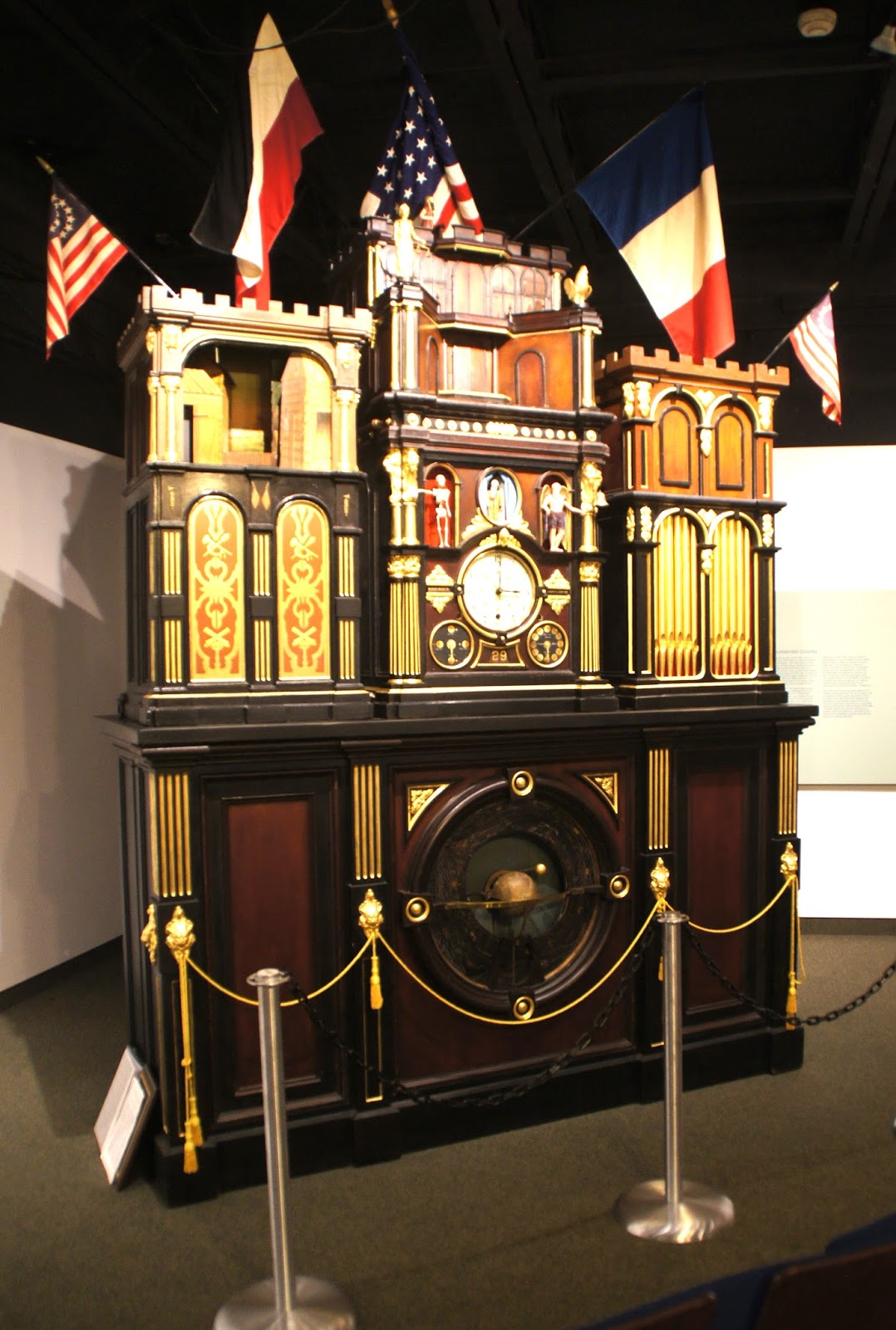
Stephen Engle's Monumental Clock
 The monumental clock was meant to do more than tell time, it was meant to entertain.  During 1875 and 1900 about two dozen clocks toured the United States and Europe and amazed and entertained the public.  The first known American-made clock was built by Stephen Decatur Engle in Hazleton, Pennsylvania.  It was completed around 1878 after twenty years of off-and-on construction.  Mr. Engle, more an inventor than showman, turned over the clock to Philadelphia entrepreneurs Captain and Mrs. Jacob Reid for exhibiting it.  The pair billed the clock as "The Eighth Wonder of the World."  The clock was exhibited throughout the eastern United States, charging anywhere from 15 to 25 cents to view it.  
The clock as it appears in the museum.
It toured for the next 70 years and then disappeared from public view after being shown at the 1951 Ohio State Fair.  Eventually it was found in 1988 and was transferred to Columbia for restoration.  As the three of us sat in front of it, we were amazed with the size of the clock.  Stands 11 feet high, is 8 feet wide and 3 feet deep.  I contains three towers with the side towers holding organ movements.  There are 48 moving figures, a tellurian that illustrates the positions of the moon, constellations and zodiac relative to the rotating earth.  The clock also displays the day of the week, month of the year, phase of the moon and current tides.  Some of the moving figures include Jesus Christ, the twelve Apostles, the three Marys, Satan, Father Time, the three Ages of Man, Death, Justice Orpheus and Linus.  On the hour, a skeleton representing Death strikes a bone against a skull attached to the column of the clock.  
This is an advertisement for the clock.
It is a colored lithograph on paper.
Every fifteen minutes, Father Time strikes a bell with a scythe and turns his sandglass while the central figures of Youth, Middle Age, and Old Age revolve in the arch above the clock dial.  Oh yeah, Mr Engle made an image of himself as the figure that represents Middle Age.  At 40 minutes past the hour, a group of revolutionary soldiers and Molly Pitcher appear on the top left tower while a barrel organ plays "patriotic tunes."  At five minutes before the hour, the three Marys come out of the central tower as a procession of the Apostles takes place accompanied by hymns.  When Judas Iscariot finally appears and revolves past Jesus, a devil figure appears from another door.  On the very top of the entire clock is a sentry soldier marching back and forth at all times.  The three of us watched and watched as our guide made one thing after another move.  
Our tour guide preparing to turn the clock's hands to
show us that will happen at 2:40.
Hard to see everything in one go-around, so he did it again.  Then we were asked to follow him behind the clock as he opened the rear doors and showed us the movements from the rear.  Unbelievable!!  The clock's main movement was not working, but he was still able to show us just about everything by manually moving the hands on the clock.  The clock was recently restored by a professional who had to rebuild many of the parts as well as refurbish the characters and just about everything that moved.  The "Eighth Wonder of the World" is worth the price of admission to the museum.  Well, back to the rest of my tour.  It was another extraordinary day in the life of an ordinary guy.  PS - Click on photos to enlarge them.  

This is Jesus who appeared and his first Disciple preparing to walk in front of him.


This photograph shows Judas Iscariot as he passes Jesus and the Devil has appeared in the upper right-hand window.
This shows the clock's face with Father Time above the 12 as well as the skeleton striking the skull with a bone to signify death.
Looking at some of the mechanism that runs the clock and it's many pieces.
One of the barrel organs is pointed out.  Looks much like a cylinder on a player piano.
A view of Molly Pitcher and the soldiers from inside the clock as they prepare to exit onto the front of the clock. 
This photo shows the skeleton, representing death, strikes a bone in hand against a skull.

Thursday, December 8, 2016

The "Time And Time Again: Part I - The Museum" Story

Upon entering the town of Columbia, I was greeted with
this mural. Click on images to enlarge them.
It was an ordinary day.  Sitting in the National Watch and Clock Museum Theater watching an interesting ten minute video about "Time".  Happen to be the only one in the theater on this overcast and rainy day.  The museum is located in Columbia, Pennsylvania, about twenty minutes from my home in Lancaster.  Have been meaning to visit the museum for years, but never found the time (pun intended).  The beautiful majestic stone pillars in the front of the building are an omen as to what one will find inside the doors of the museum.  This museum is dedicated solely to horology or the science and art of timekeeping and timekeepers.  The National Watch and Clock Museum was founded in 1977 by the National Association of Watch and Clock Collectors and featured less than 1,000 items.  
The National Watch and Clock Museum in Columbia, PA
Today the museum is consider- ably larger and has at least 12,000 items which show and tell the complete history of time- keepers from non-mechanical devices such as sun-dials and hour-glasses to the atomic clock.  Some of the displays are interactive and some are immense such as the Monument Clocks.  My friend Jerry is a miniature railroad fan so I enjoyed the Railroad watches collection.  There are timepieces from nations all over the world.  Asian timepieces from Japan and China, European clocks from Germany, France and the Netherlands and technological items from Russia all line the shelves and display cases in this museum.  Pocket watches, Regulators, Novelty clocks, car clocks, Military clocks, alarm clocks, and even James Bond's wristwatches hold prominent places in this museum.  
The gift shop at the museum
The place is huge!  I arrived at approxi- mately 1:30 pm and I was worried I wouldn't be able to see everything in the museum by closing at 4:00 pm.  As it was, I tired before closing time and will make an effort to return and finish those parts of the museum that I missed.  It was truly an impressive display of everything horological and not to be missed.  You are allowed to take non-flash photographs of everything except one special display that I assume changes from time to time (another intended pun).  I will share with you today and over the next two days a few photographs of the many areas of the museum, but by no means will I touch upon the immense quantity and astounding quality of clocks and watches that can be seen at the museum.  It is truly a museum that displays the entire history of timekeeping.  It was another extraordinary day in the life of an ordinary guy.


This large upright sundial is made of stone and has a brass gnomon.  There is a face carved at the top of the dial and the date "1639" is carved along the front of the base.  One of the earliest methods of timekeeping.
Sandglasses were occasionally constructed of a frame with multiple glasses, each measuring a different amount of time.  In this example, the four glasses measure fifteen, thirty, forty-five and sixty minutes, respectively. The size of the opening in the center allows for different amounts of sand to escape.
In 300 AD astronomers were using a compact, hand-held instrument called an astrolabe to observe the altitudes and positions of celestial bodies.  This instrument became popular among the astronomers of medieval and Renaissance Europe.
Scholars theorize that the primary purpose of the Antikythera mechanism was to use gears and dials to exhibit the position of sun and moon in accordance with the phases of the moon.
This is an Egyptian Clepsydra reproduction from 1400 B.C.  The sides of the vase are adorned with hieroglyphics around three bands.  When in use the clepsydra would be filled with water and as the water flowed out thorugh a small hole near the bottom of the device, the interior dotted lines provided a means of determining how much time had passed by observing the diminishing water level.
This table clock is from around 1660.  It has a brass fusee, spring-driven movement and crown verge escapement.  The iron case is extensively inlaid with silver and depicts allegorical and mythological themes.  The three dials indicate time, day of month and day of the lunar moon.  
This is a Renaissance Clock.  It is a small, highly ornamental clock.  The small size and delicacy of Renaissance clocks necessitated smaller clock movements and the spring-drive mechanism was invented.
This is a tall-case or longcase clock.  Also known as a floor clock or grandfather clock which is a tall, freestanding, weight-driven pendulum clock with the pendulum held inside the tower of the clock.  The case often featured elaborately carved ornamentation with a decorated clock face.   The clock in the center was made by John Eberman, Jr. who worked on North Queen Street in Lancaster, PA from 1772 to 1807.  It has a 30-hour movement.  I must have examined over 50 of these beautiful clocks from all over the world.
A shelf clock from around 1830 made by Henry Ober of nearby Elizabethtown, PA.  These clocks are weight-driven and has an eight-day clock movement.  The case is cherry wood with mahogany veneer on the door.
A pocket watch from 1896.  This Swiss watch was donated to the museum by Ambassador Donald C. Johnson.
This 1890 Cuckoo Clock is from Germany.  The hunting motif was a common one on German Cuckoo clocks.  This clock has a carved walnut case with a thirty-hour brass movement which strikes the hour on a gong as well as the famiiar cuckoo birdcall. When every 15 minutes passes in the museum, the place comes alive with sounds from around the world.
An 1880 Picture Clock from Munich, Germany.  Reverse painting on the glass was used to create the beautiful dial on the clock.  It has a thirty-hour movement with steel pivots and brass gears.
This is a shelf clock from Plymouth, Connecticut, c. 1822. Clocks such as this were known as Salem Bridge clocks.   
This pocket watch was made in Lancaster, PA at Hamilton Watch Company in 1935.
This is an advertisement from the 1830s.  The first railroads had a need for controlling train movements and used systems based upon time.  Each railroad defined their own "Standard Time."  Train crews used imported watches until American-made 11 or 15 jewel watches became available in the 1850s and 1860s.  The watches were improved to 17 or more jewels in the 1890s.  Railroad time systems disappeared after radio-controlled timekeeping took over in the 1990s.
An advertising board from 1900 which is advertising for pocket watches used by train personnel.  The ad is for the Rockford Watch Co. in Illinois.
This is the working mechcanism of the E. Howard Tower Clock produced in Boston, MA.  The company manufactured their No. 2 Tower Clock in two models.  One was called the Striker and featured a seven-foot dial with bells weighing 2,500 pounds.  The other was the Special and had an eight-foot dial and 3,500 pound bells.  The one shown is for the Striker.  The list price for this particular clock was $775.
This clock tower was made by Lancaster clockmaker John Eberman Jr.  He had a shop in Lancaster from 1772 to 1807 where he made tallcase movements as well as the one on the top of the Lancaster County Courthouse shown here.  Only three of his tower clock movements still exist; The movement in this courthouse, which is in the Museum's permanent collection, the movement in the Moravian Church in Nazareth, PA, and the partial movement in the Moravian Church in Lititz, PA which was destroyed by fire with a few of the pieces of the clock still remaining.
I enjoyed this display of James Bond quartz watches from movies during the years 1973 to 1995.

Wednesday, December 7, 2016

The "Worst President Ever? I Don't Think So!!" Story

President James Buchanan
It was an ordinary day.  Just finished watching CBS Sunday Morning's feature story on James Buchanan, considered by many to be the worst President ever.  It was a little over two years ago that I wrote a story myself about "Ten Cent Jimmy" which I titled "Finally Hit The Bottom Of The Barrel."  In my eyes there have been worst, but I never lived in the Civil Rights and the Civil War eras.  Perhaps if I had, I would have also considered Buchanan the worst ever.  The host of the CBS show, Mo Rocca, said that out of all the possibilities, James Buchanan stands out as the worst.  James was in Lancaster, Pennsylvania at his home on President Ave. when he found out he'd been elected to the highest office of our country.  
Wheatland, James' home in Lancaster, Pennsylvania.
Seems that Mr. Rocca made a visit to Wheatland, Buchanan's home, in order to find out more about him.  Got to see his five person outhouse with two adult seats, one in-between size and two for children.  Seems many historians rank Buchanan right in that outhouse.  Hey, he couldn't have been too bad.  He was elected President of the United States!  Also elected and served in both houses of the Pennsylvania Legislature, elected and served in both houses of the U.S. Congress, was ambassador to Russia, ambassador to Great Britan and was Secretary of State.
Anne Coleman, girlfriend of James Buchanan.
 How could anyone with those credentials be picked as the worst President?  Heavens, there weren't even cell phones and emails at that time in history.  Perhaps it was because it was rumored that James was gay and heaven forbid you could be gay and also be the President.  I did write a story about James and his girlfriend Anne Coleman.  Ann thought that James wasn't loyal to her and committed suicide and is buried in the graveyard of my church, St. James Episcopal, in downtown Lancaster.  He vowed he would never marry after losing Anne so James has the distinction of being the only bachelor President.  He did know how to throw a good party though.  He threw the best party of the middle part of the nineteenth century, the Inaugural Ball.  Six thousand people showed up for that party.  
Anne Coleman was buried in St. James Churchyard.
Maybe someone who didn't get invited held a grudge and voted him the worst!  He was done in two days after his inaugu- ration when the Supreme Court handed down the Dred Scott decision which allowed escaped slaves to be forcibly returned to their owners.  Seems Buchanan backed this decision and slavery forever was his undoing.  He viewed the decision as he did, fearing it would be the end of the union if he hadn't.  When the south began to secede, his friends abandoned him, since many were from the south.  The Civil War was then known as Buchanan's war.  My guess is that whomever was in office at the time probably would have been picked as the worst.  After leaving office Buchanan told incoming President Lincoln, "Sir, if you are as happy in entering the White House as I shall feel on returning to Wheatland, you are a happy man indeed."  At the time he told his friends and family that he more than likely would be the last ever president of these United States, fearing the Union was about to be history.  Well, Mo Rocca at least got a chance to see where one of my favorite Presidents lived.  I realize I might be slightly prejudiced, but then again, who wouldn't be to have had a President of the United States who lived slightly over a mile from their house.  It was another extraordinary day in the life of an ordinary guy.

Tuesday, December 6, 2016

The "Bay Street Memories" Story

It was an ordinary day.  Talking with Joyce about the table full of family heirlooms sitting in front of us in her family home on Bay Street in Lancaster, Pennsylvania.  
One of the three sheets with coins that Joyce
posted on Remember When In Lancaster Facebook
page.   Another Facebook reader replied that the
1840 campaign tokens in the bottom left were
probably the most valuable of her collection.
I learned of Joyce and her amazing collection of family historical memorabilia from the Facebook website Remember When In Lancaster when I opened the site and found a series of very interesting coins and tokens that she had posted in a link on the website.  I became interested in some of the coins and gave Joyce a call and was asked to come and visit and take a look at the coins.  When I arrived this morning I was treated to an entire table of historical memorabilia that was fascinating. Joyce and I talked about two large stacks to textbooks that were from the Lemon Street Elementary School where her relatives had gone to school.  
Just a few of the many small textbooks that Joyce showed me.
The school was more recently known as The Haupt Elementary School which eventually became known as the Lancaster General Hospital School of Nursing.  Neat books that gave one an idea as to what was taught in elementary schools in Lancaster City in the early 1900s.  
Fulton playbills from the past.
She then shared with me some personal items such as a beautiful drinking glass from the 1911 Lancaster Fair, a few play bills from the Fulton Theatre, later known as the Fulton Opera House, a photo of her parents taken in the backyard of the house I am now visiting, a page from our local newspaper, the Lancaster New Era, which featured articles written for the paper by Clarence Chamberlin, Colonel A. Lindbergh and Commander Richard E. Byrd, all American pioneers of aviation.  
Small display of antique Christmas items featuring a lighted church.
One corner of her dining room table featured a small display of antique Christmas items which featured a lighted church that played music.  Her home features an assortment of family photos, cupboards of beautiful antique dishes and a lifetime of wonderful tales she loved to share with me.  Joyce has been a Lancaster resident all her life and lives with her husband in the house in which she was raised.  
An early photo of Joyce standing by her home
on Bay Street.  To the right is Pensupreme Dairy.
The house is directly across the street from the original Lancaster Pensupreme Dairy which is no longer in business.  She told me that she would visit the dairy before school each day and they would give her a bottle of milk before she headed to school.  My visit to Bay Street was most enjoyable and the lessons and stories I learned were priceless.  Lancaster is truly a city of wonderful and sharing individuals and I just met one more of them today.  It was another extraordinary day in the life of an ordinary guy.


Monday, December 5, 2016

The "Stop The World ... I Want To Get Off!" Story

It was an ordinary day. 1999 and I had just retired from teaching Industrial Arts at Manheim Township High School.  I was elated, joyous, but yet sorrowful for I would never have the chance again to teach some of my favorite subjects in a high school setting: graphic arts and photography.  I had taught film photography when that was all there was.  Well, I guess I should tell you that the digital camera was invented in 1975 with the first cameras having 10,000 pixels.  As for me, the day after I retired I retired my film camera also and have only taken digital photos from that day forward.  Poor Kodak Company had 170,000 employees a year before I retired and sold 85% of all photo paper worldwide and within a few years had declared bankruptcy.  At first it was a big disappointment to me, since film photography was all I had known and taught for over 33 years, and now it was obsolete.  It succumbed to the Exponential Age which refers to a dynamic Internet, knowledge and information technology coupled with massive and quick developments rendering current technologies obsolete.  It was like living in a totally new Industrial Revolution.  I often think the older I get I will be lost in all the new technologies, and it may be, but so far I feel I haven't been too overwhelmed.  Within the next decade new software will be developed that will change our lives forever.  Uber is not really a taxi company.  They are a software tool without any cars just as Airbng is the biggest hotel company but doesn't own a single building.  Wasn't too long ago that "Watson" beat both Manheim Township grad Brad Rutter as well as Ken Jennings.  Today, through the use of computers, you can get legal advice within seconds with 90% accuracy compared to advice from humans which is perhaps 70% accurate.  "Watson" already is helping diagnose cancer more accurately than humans.  Facebook has software that can recognize faces better than humans. It has been said that by 2030 computers will become more intelligent than humans. Now that's really scary!  I have read that self-driving cars will appear in another year and by 2020 you won't even need to own a car.  Pick up the phone, a car will arrive and take you to your destination.  Call for the car on you phone and pay for the ride by using Bitcoin which is a form of computer money.  There will no longer be a need for parking lots so more green space will be available to the public.  Car companies owned by Tesla, Apple and Google will put the others out of business.  Car insurance companies will more than likely go out of business.  Solar power will outpace any other type of energy and fresh drinking water will be available to everyone.  Remember the "Tricorder" that was on Star Trek.  Everyone will have access to one that will scan your retina, take a blood sample and breath sample and then analyze it to see what disease you may have.  World class medical analysis will be available to everyone.  Two years ago I wrote a story about visiting Manheim Township High School to watch their technology department operate their new 3-D printer.  They now have several of the printers which will be able to print body parts in the future.  Shoe companies already use 3D printers to make shoes.  Soon you will be able to control your own 3-D printer with you smartphone.  Actually, you will be able to operate and access EVERYTHING with your smartphone.  In a few years there will be an app that will be able to tell when you are lying just by your facial expressions.  And, through your smartphone, you will be able to access education anywhere in the world.  Scary?  I'm petrified!!  I call my granddaughter to help me when I have a problem with my computer.  And, I don't want to give up driving.  Now, I wouldn't mind making my own shoes with my own 3-D printer, or even making a new body part for those that are quickly wearing out.  But, I wouldn't mind heading back into the darkroom from time to time to make my own black and white prints in a developing tray.  You know how much fun that is to see the image appear magically in front of your  eyes.  Guess that will never happen again.  So sad!!  Technology isn't always the best answer to everything!!  It was another extraordinary day in the life of an ordinary guy.