Extraordinary Stories

1944 (1) Act of kindness (12) Acting (2) Adoption (4) Adventure (766) Advertisement (6) Africa (1) Aging (14) Agriculture (47) Airplanes (9) Alphabet (5) American Red Cross (1) Americana (116) Amish (43) Ancestry (5) Ancesty (2) Animals (43) Anniversary (4) Antigua (10) Antiques (14) Apron (1) architcture (1) Architecture (36) Art (175) Art? (8) Arts and Crafts (69) Athletics (6) Automobiles (40) Awards (7) Banking (2) Barn raising (2) Baseball (103) Basketball (3) Batik (1) Beaches (89) Becoming A Citizen (1) Bed & Breakfast (2) Bee Keeping (6) Beer & Breweries (2) Bikes (3) Birds (9) Birthdays (34) Blindness (1) Blogging (5) Bookbinding (5) Books (12) Boxing (2) Brother Steve (12) Buisiness (3) Business (5) Canals (1) Cancer (14) Candy (30) Caribbean Islands (9) Caribbean Villas (15) Cats (5) Caves (1) Census (1) Chesapeake Bay (61) Children (28) Chocolate (4) Christmas (57) Church Adventures (122) Cigars (1) Circus (3) Civil Rights (8) Civil War (6) Classic Cars (7) Climate Change (5) Clubs (1) Coin club (2) Coins (1) Collections (73) Comedy (3) Comic Books (5) Commercials (1) Comnservation (2) Conservation (41) Covered Bridges (3) Craftsmanship (12) Creamsicle the Cat (11) Crime (16) Crisis (312) Cruise Travel (6) Crying (1) Culture (4) Dancing (1) Danger (16) Daughter Brynn (58) Daughter-In-Law Barb (7) Death (5) Death and Dying (65) Destruction (2) Donuts (1) Downsizing (2) Dunking (5) Easter (3) Eavesdropping (1) Education (48) Energy (15) Entertainment (165) Entrepreneurial (62) Ephrata (1) Etchings (1) Eternal Life (4) Facebook (5) Factories (4) Fads (6) Family (261) Farming (37) Father (42) Father Time (68) Favorites (88) Firefighting (1) Flora and Fauna (28) Fond Memories (490) Food and Cooking (171) Food and Drink (111) Football (16) Forgetfullness (3) Former Students (10) Framing (30) Friends (359) Fruits and Vegetables (3) Fun (4) Fundraiser (6) Furniture (1) Games (7) Generations (3) Gifts (1) Gingerbread houses (1) Giving (8) Globes (1) Golf (3) Good Luck (2) Graduation (1) Grandkids (136) Grandparents (3) Grandview Heights (29) Great service (3) Growing Old (8) Growing Up (187) Guns (2) Handwriting (3) Hat Making (2) Hawaii (49) Health and Well Being (61) Health Care (4) Health Hazards (110) Heartbreak (7) Heroes (26) High School (142) History (777) HO Railroading (4) Hockey (4) Holidays (134) Home construction (7) Horses (2) Housing (3) Humorous (71) Hurricanes (1) Ice and Preservation (2) Ice Cream (8) Inventions (34) Islands (4) Italy (12) Jewelry (3) Job Related (62) Just Bloggin' (56) Just Wondering (19) Juvenile Diabetes (5) Labor (3) Lancaster County (542) Law Breakers (8) LDubs In-Laws (3) Lefties (1) Libraries (1) Life's Lessons (175) Lightning (1) Lists (72) Lititz (18) Locomotives (1) Lodging (1) Love (4) Magazines (2) Magic (1) Maps (2) Marching (2) Market (5) Medical (161) Memories (28) Middle School (3) Milk (2) Minorities (1) Money (3) Mother (54) Movies (6) Mt. Gretna (1) Music (118) My Brother (19) My Wife (260) Neighbors (7) New Year's Day (5) Newspapers (4) Nicknames (2) Nuisance (3) Obsolescence (5) Occupations (2) Old Age (1) oldies (1) Pain and Suffering (12) Panama Canal Cruise (13) Parish Resource Center (14) Patriotism (3) Penmanship (1) Pets and Animals (99) Photography (220) Pizza (1) Plastic (2) Playing Trains (2) Poetry (2) Politics (27) Polution (3) Postal Service (2) Predators (2) Presidents (11) Pride (4) Printing (81) Protesting (3) Public Service (65) Questionnaire (1) Quilts (1) Race relations (6) Rain (1) Reading (4) Records (2) Religion (10) Retirement (4) Revolutionary War (3) Robotics (1) Rock & Roll (4) Rodents (2) Saints (4) Sand (1) Scouting (2) Sex (1) Shakespeare (1) Shelling (2) Shopping (24) Simple Pleasures (122) Slavery (6) Small Towns (4) Smoking (1) Snickedoodle (1) Snow (1) Son Derek (27) Son Tad (33) Son-In-Law Dave (27) Soup (1) Spices and Herbs (1) Sports (139) Sports and collectibles (1) Spring Break (1) St. James (2) St. Martin/Sint Maarten (306) Stained Glass (3) Stone Harbor (4) Story-Telling (26) Stragers (2) Strangers (4) Strasburg Railroad (1) Stress (3) Stuff (4) Suicide (2) Sun (1) Surfing (1) Tattoos (4) Teaching (49) Technology (90) Television (6) Thanksgiving (2) The Arts (6) The Beach House (62) The Flag (1) The Future (5) The Shore (78) This and That (23) Timekeeping (7) Tools and Machines (25) Tours (2) Toys and Games (31) Track & Field (1) Tragedy (8) Trains (19) Transportation (18) Travel (16) Trees (2) Trending (2) TV Favorites (23) Underground Railroad (10) Unit of Measurement (1) USA (2) Vacation and Travel (545) Vehicles (80) Vison and Eyesight (2) War (14) Watches and Watchmaking (5) Weather (48) Weddings (3) White House (1) Wisdom (3) Yearbooks (12) York County (3)

Wednesday, March 14, 2018

The "A Pi Is A π Is A JJ's Pie" Story

It was an ordinary day.  March 14th or 3.14 written as a decimal.  And, I remembered that today is Pi day, as in Ï€ day, while watching Jeopardy on television last evening and hearing one of the contestants say that he and his wife were married on Pi day.  They were both mathematicians and therefore planned their marriage for 3.14.  If you are not aware, Ï€ day is observed today, since 3, 1, 4, or to most of you March (third month) 14 are the first three significant digits of Ï€.  After doing some Googling last evening I discovered that there is actually a yearly celebration of Pi Day in San Francisco Exploratorium.  It was organized in 1988 by Larry Shaw who happened to work at the Exploratorium as a physicist and who had staff from the place, as well as the public, walk around one of the Exploratorium's circular spaces, consuming fruit pies.  Hey, count me in on that idea.  Then in 2009 the U.S. House of Representatives passed a non-binding resolution recognizing March 14, 2009 as National Pi Day.  The following year Google Doodle celebrated the holiday by having the word Google laid over images of circles and Ï€ symbols.  
My favorite JJ's Pies
For me, I will celebrate the day by eating what my family calls a "Larry Pie".  I found the pies while on vacation in the Turks and Caicos Islands many years ago.  They were individually wrapped pies that we found at a grocery store and were marketed as JJ Pies.  Checked the info on the wrapper and found they were made in Erie, Pennsylvania!  I loved the things and after eating over a dozen of them during vacation, they became known as "Larry Pies".  I have found a location in my home town of Lancaster, PA that sells them, so I can now consume one whenever I care to have one.   Pi Day is observed in many ways, including  MIT, or Massachusetts Institute of Technology, mailing its application decision letters to prospective students on that day and Princeton, New Jersey hosting events relating to Albert Einstein's birthday that happens to be today as well as Albert having lived in Princeton for more than 20 years.  When I was in high school I had a math teacher who inspired me so much that I wanted to be a math teacher.  Ended up being a teacher, but Pi for me has since been just a dessert.  For the mathematicians, Pi, or Ï€, is the ratio of a circle's circumference to its diameter and happens to be an infinitely long, non-repeating number.  I guess all mathematicians already knew that!   In 1981 an Indian man named Rajan Mahadevan accurately recited 31,811 digits of it from memory, but eight years later a fellow from Japan, Hideaki Tomoyori, recited 40,000 digits of it.  The Guinness World Record holder is Lu Chao of China who in 2005 recited 67,890 digits of Ï€.  I'm going to start to practice and give it a try next 3.14.  My problem right now is that I don't know if I could actually count that high.  Gonna need to devour a whole bunch of "Larry Pies" before I start practicing.  It was another extraordinary day in the life of an ordinary guy.  PS - ready to give it a try....

    etc. etc. etc.

Tuesday, March 13, 2018

The "Baron Henrich Wilhelm Stiegel: His Stories - Part III" Story

It was an ordinary day.  Writing the story telling of the demise of Baron Henry William Stiegel is a tough assignment.  Mr. Stiegel came to the New World in 1750 from a small town near Cologne, Germany.  Within a few years he had built an alleged fortune as an iron master and glassmaker.  He bought enough land to form and build the industrial town of Manheim, Pennsylvania.  He treated his employees well and lived in great luxury with his family.  And, he just might have survived had it not been for his extravagance in a time when all seemed to go bad.  His future looked bright at one time, but his fortune soon turned for the worse.  Money in the Colonies became increasingly tight and taxes from England became more oppressive.  He hired some of the best artisans who came from Europe to help run his businesses and paid them well, as he should have.  The profits that he did gain from his glassworks weren't high enough to pay off his debts so he had to mortgage his two ironworks and glassworks as well as give up thoughts of a second glassworks.  But, he did not give up his extravagant lifestyle.  He still had sole ownership of his town of Manheim, but that wealth was mostly on paper.  Eventually his debts caught up with him and he lost property after property and finally was placed in debtor's prison.  While in prison he wrote pitiful letters to those he thought could and would help him, but to no avail.  He comprised spiritually moving prayers, which didn't help either.  Finally enough of his friends in the legislature passed an act for his release and he left Lancaster County Jail.  
Sketch of the school where he went back to teach.
He tried to return to his old home at the Elizabeth Furnace, but the owners, whom were allegedly his friends, didn't like it and he had to leave.  He tried teaching school in one of the schools he had established years before which didn't work out.  He went back to Elizabeth Furnace and became a foreman for a short time, but that also didn't work out.  He had become a shell of his former self and at forty-eight years of age was a thin, bent, nearly bald man with poor eyesight who had become a dejected and beaten man.  He had to rely on relatives for his existence.  During this time of helplessness he did get to witness the rise to power of his beloved nation whose industry and art he had greatly stimulated.  On January 10, 1785 he died, penniless and in poverty and buried in an unmarked pauper's grave.  A main thoroughfare in his beloved Manheim still bears his name taking workers, school children, tourists and even myself past the lot where his glassworks once stood until 1812.  Even though I can't photograph his tombstone for this story, his name I will never forget for all the good that he did in his life.  It was another extraordinary day in the life of an ordinary guy.  

Monday, March 12, 2018

The "Baron Henrich Wilhelm Stiegel: His Stories - Part II" Story

It was an ordinary day.  Sitting in the Lititz Family Cupboard Restaurant having breakfast with a couple dozen former teachers from Manheim Township High School where I taught for over 30 years.  Across the table from me is Ed who taught Physical Education at the high school.  He asked if I ever went to see the third floor of the Brother's House in the Moravian Circle in Lititz.  
The Stiegel glass that my friend Ed owns.
He had made arrangements for me to do so, but his contact had never called me.  He was upset that no one called, but the topic changed quickly when I told him I was trying to find a piece of Steigel glassware that was made in Manheim, Pennsylvania.  "What are you doing after breakfast?" Ed asked.  "Not much today," I responded.  "Follow me home and I'll show you a Stiegel glass that I just bought at auction." he said.  Wasn't long before we were sitting on his rear porch looking at a rather unusual, but beautiful piece of glass.  The sticker on the bottom said it was a piece of Stiegel Flip Glass with a 6" bell.  
Bottom of glass showing info about it.  Click on
image to enlarge.  Notice the clear spot on the
bottom where it had been released from the mold.
It originally was marked $140.00 but the seller had paid $110.00 for it at the 1971 York Antique Show.  It looked as if a Mr. Williams was the buyer, and now the seller of this remarkable piece of glass made in nearby Manheim, PA.  At first I thought it was plastic due to its lightness in weight, but after striking it gently with my fingernail and hearing the "ting" of it, I knew it was glass.  Tough to tell how it had been made.  Was it formed in a mold or perhaps some other way to give it the shape.  On the bottom I could see where it looked as if it had been broken away from another piece of glass and then ground smooth.   It had the true unevenness of texture with wavy lines through it.  
Drawing of the glassworks in Manheim.
The decorative patterns around the top were evidently etched into the glass after it had been formed or cast.  A remarkable piece of glassware from the glassworks of a master.  It was in 1763 that Baron Stiegel began his new adventure of glassmaking.  His Elizabeth Furnace to the northeast of Manheim, PA could be used for fusing the glass.  He began his glassworks with ten craftsmen who made bottles and window glass.  Not long after he began production he decided to build a new town on his Rapho Township tract of land he had acquired.  
This is the location where the original glassworks stood.
He named his new town Manheim after nearby Manheim Township, but most already settled in the area referred to the new town as Stiegel Stadtel.  He first built a mansion for his family and then built his glassworks factory in 1765.  He was the first glassworks in the New World and began to fill orders throughout the colonies.  His glass had all the qualities of skilled craftsmen from Germany, Ireland, England and Venice.  He began to make decanters, bottles, cruets, vials, toys, mugs as well as his glasses of different sizes and shapes.  Wasn't long before he introduced pastel colors such as green, amethyst, amber and "Stiegel" blue.  The future looked bright for Baron Henry William Stiegel.  But then it took a turn for the worse.  Follow along tomorrow to see what happened to the Baron who was responsible for the town of Manheim.  It was another extraordinary day in the life of an ordinary guy.

Pennsylvania historical marker showing the location where the Baron Stiegel had his glassworks.  

Sunday, March 11, 2018

The "Baron Henrich Wilhelm Stiegel: His Stories - Part I" Story

It was an ordinary day.  Traveling north along Main Street, known to many as SR72, in the town of Manheim.  My first knowledge of this street was when my best friend Bill moved to Manheim after second grade.  Boy did I miss him!  But, that is not the gist of my story today; the town of Manheim is the real story.  The town got its name from a guy by the name of Baron Henrich Wilheim Stiegel, known to those who live in Lancaster County, Pennsylvania as Baron Henry William Stiegel.  Actually the title of Baron is disputed by many, since he never signed his name that way.  On August 31, 1750 Stiegel, his widowed mother and brother Anthony arrived from Cologne, Germany on the ship "Nancy" in Philadelphia.  Henry found his first job working for the Stedman brothers who were successful merchants in Philadelphia.  Two years later he became associated with Jacob Huber, an ironmaster in a Northern Lancaster County furnace, as a clerk.  Mr. Huber's furnace was built in 1750 in Brickerville, PA where he made cast iron from ore that came from the nearby Cornwall mines.   While working with Huber, he became acquainted with Mr. Huber's daughter Elizabeth and shortly after married her.  Steigel's wife had two daughters, Elizabeth and Barbara.  In 1757 Steigel purchased Huber's furnace property which at the time was one of the largest and oldest furnaces in the New World.  He tore the old furnace down and built a new one which he named after his wife Elizabeth.  Elizabeth Township, where the furnace was located, was named after the furnace.  He eventually moved his family from Philadelphia, where they had been living, to a large house that was near Elizabeth Furnace.  The following year his wife died leaving him with two small children, but the following year he married Elizabeth Holtz from Philadelphia and she bore him a son in 1760.  Steigel began to make stoves at Elizabeth Furnace and by 1760 the furnace was hugely successful with 75 men employed and 25 tenant houses nearby for some of them to live.  The furnace lands covered 900 acres, much of it wooded.  Then in 1762, his old friends, the Stedmans, and he bought 729 acres on the north bank of the Chickies Creek.  By the end of the year he has surveyed his tract and divided it into lots with streets and alleys.  The town of Manheim was born.  
Drawing of Stiegel's house at Market Square and East High St.
Stiegel and his wife were the first to build  a house on the northeast corner of Market Square and East High Street.  He realized that his town would not grow unless it had some industries, so in 1765 he began to build a glass factory on the northwest corner of Stiegel and Charlotte Streets.  The factory took three years to build and it was so large that a four-horse team could turn around in it and come out the same entrance.  
Latest image of Elizabeth Furnace.
At the time it was the only glass factory in the country and he brought skilled glass blowers from Europe to work in the factory.  They made vases, sugar and finger bowls, salts, flasks, pitchers, tumblers, wine glasses, toys and various other products in a variety of colors.  In 1769 the Stedmans sold their shares in Manheim to Isaac Cox who in turn sold them to Baron Stiegel.  By 1770 he was the sole owner of the town of Manheim.  Soon after he moved his family from the Elizabeth Furnace site to his new mansion in the center of Manheim.  Follow along tomorrow while I tell you the tale of his demise.  It was another extraordinary day in the life of an ordinary guy.

Saturday, March 10, 2018

The "The Whistle Blows Once Again" Story

Lancaster, Pennsylvania's Amtrak Station
It was an ordinary day.  Heading into the Lancaster Amtrak Station to check on train tickets for a trip to visit our friends Pat and Dale who live in Bluffton, South Carolina.  I never tire of heading up the marble steps that lead to the beautiful main level of the station.  The brass railing in the center of the steps brings back memories from my youth when my friends and I would spend hours sliding down the railing.  As I reached the top of he steps I noticed quite a few people in the distance looking at a long glass exhibit case that seemed to me to be a new addition.  As I entered the seating area I saw the display was placed there for Black History Month which was in February.  Since 1976, every American President has designated February as Black History Month and endorsed a specific theme.  
Upper level of the station.  Through the doors is the
display titled "African Americans in Times of War."
This year the theme was "African Americans in Times of War," since 2018 marks the 100th anniversary of the end of WWI and honors the roles that black Americans have played in warfare from the American Revolution to the present day.  Lancaster's train station was showcasing the African-American experience in Lancaster from the Colonial days to WWII with  a special emphasis on the abolitionist movement and the Underground Railroad that helped slaves escape to freedom in the North.  
The center section of seating is filled with display cases.
Case after case was filled with written information as well as photos and mementos.  Highlighted were a number of locations and people which are as follows:  (1) Lancaster's greatest track and field star, Barney Ewell who won three medals at the 1948 Summer Olympics at the age of 30.  
The start and finish of the 100-meter race in the
1948 Olympics held in London. In the top photo
Barney is the 2nd from the right and in the second
photo he is the 2nd from the top.
He also set a world record of 5 seconds in the 50-yard dash held in Philadelphia's Convention Hall in 1940.  (2)  The Shreiner-Concord Cemetery at Mulberry and Chestnut Streets in center city was established in 1836 and was the only public cemetery at the time.  Lancaster's Republican congressman and abolitionist Thaddeus Stevens wanted to be buried there along with other Civil War Veterans and U.S. Colored Troops.  (3) Frederick Douglass, famous orator and abolitionist, visited Lancaster by train in July of 1863 to speak to a gathering of African-Americans from the Union Army.  As he was talking, he was told a white lynch mob was heading to the train station so he departed to prevent a riot.  
A painting of St. James Church by Margaret Dana Lestz showing the
church on the right and the Cloister, Chapel and parsonage to it's left.
(4) Another gentleman featured was Samuel Evans who was a Civil War Veteran and journalist whose essays in May of 1870 told of anti-slavery action by means of the Under- ground Railroad.  His work was used by other writers as a model for their work.  (5) St. James Episcopal Church at the corner of Duke and Orange Streets in downtown Lancaster was known to minister to free blacks as well as slave owners.  
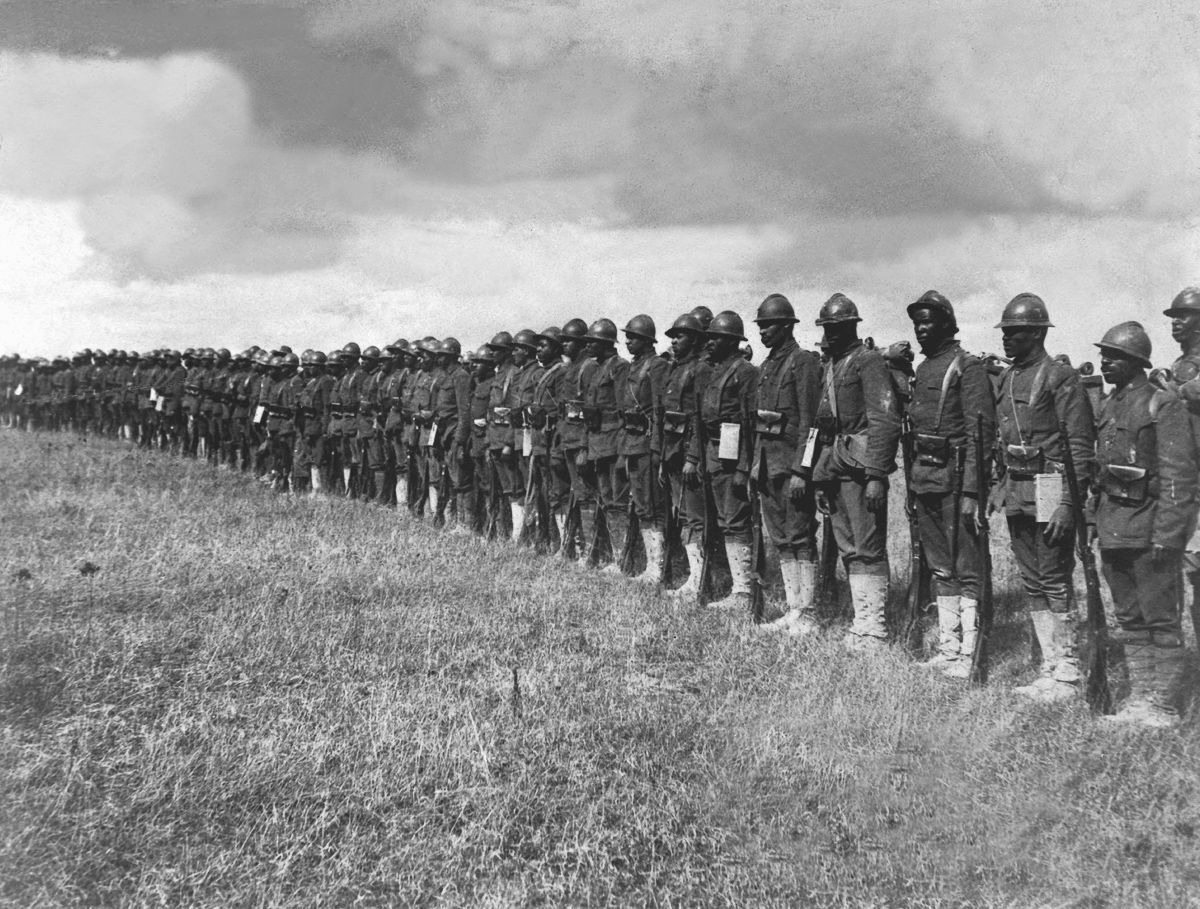
The all-black WWI regiment renowned for courage.
As a member for almost 70 years now, I often sit in church and wonder what it might have been like to be a member during the Civil War era.  Many of the African member of the parish eventually established the Bethel African Methodist Episcopal Church on nearby Strawberry Street a few blocks to the south of St. James.  (6) And finally, a display which featured local African-American men who were part of the "100 Colored Troops Enlisted Men of the U.S. Army" who served during WWI.  I recently visited the Bethel AME Church and saw grave sites of a few of these men.  The display at the train station is very moving and I should note that anyone who can add to the display with photographs, diaries, old letters or any other items should contact the Bethel Museum at 512 E. Strawberry Street in Lancaster, Pennsylvania.  It was another extraordinary day in the life of an ordinary guy.


The Shreiner-Concord Cemetery 
The south-east side of St. James Churchyard
Frederick Douglass who was an American social reformer, orator, abolitionist, writer and statesman
The tombstone of Thaddeus Stevens in the Shreiner-Concord Cemetery 
Information on the Underground Railroad in one of the showcases 
  

Friday, March 9, 2018

The "Medical Marijuana May Help Decrease PA's Opioid Epidemic!"

It was an ordinary day.  Standing in front of the new Medical Marijuana (MedMar) dispensary which is about a city block from my home in Manheim Township, Lancaster, PA.  The place is a very small, non-descript corner store in a strip mall that is anchored by Dunkin' Donuts on one end and a home-goods store called At Home on the other end.  Neighbors in my neighborhood aren't quite sure what to expect as far as traffic, noise and any other problems that may occur from the store opening.  My guess is we won't notice any difference from what was in the place in the past.  I'm rather interested in what they will dispense and how it may at one time help me with my medical problems.  The store is called Cure Dispensary and is one of the stores approved in 2017 by the State of Pennsylvania after our Governor Tom Wolf and state legislators enacted one of the most comprehensive MedMar programs in the nation.  Pennsylvania has been experiencing an opioid epidemic and perhaps with the beginning of the legalization of MedMar that may begin to decline.  Medical cannabis has been approved to treat 17 medical conditions in patients of all ages.  MedMar has been a proven treatment for patients with debilitating pain with minimal risk, especially when using strains low in THC which is the main mind-altering chemical found in marijuana.  THC content of marijuana is 10,000 times stronger that alcohol in its ability to produce intoxication.  A low THC content is very effective in treating depression, arthritis, anxiety, lupus and multiple sclerosis as well as preventing epileptic seizures.  Another active chemical in marijuana is cannabidiol (CBD) which is non-psychoactive and seems to have many health benefits.  CBD provides relief from pain, anxiety, paranoia and seizures as well as having potential as a cancer treatment.  
It is primarily the CBD oil which states have deemed a legal, safe product due to its harmless medicinal effects and overall separation from THC-based marijuana.  For the people who are fortunate to live in a state that has legalized MedMar, those with medical problems that have suffered for years will be able to find relief.  MedMar is certainly not the same as what many think of as marijuana which people smoke.  Marijuana smoke contains over 400 chemicals with many of those chemicals toxic.  Removing the THC from the plant creates MedMar which is what has been made legal in Pennsylvaia.  There are states that have legalized recreational marijuana, but that is totally different than what we will have in Pennsylvania.  Perhaps someday that too will happen in my state, but I'm hoping that isn't in my lifetime.  What a relief it must be for those who will benefit from, or whose children will benefit from, Governor Wolf's decision to sign the MedMar bill into law and allow relief for so many medical problems.  And, I'm hoping that the new dispensary in my neighborhood will be a godsend for those in need.  It was another extraordinary day in the life of an ordinary guy.

Thursday, March 8, 2018

The "Strawberry Street Forever" Story

It was an ordinary day.  Parked my car on East Strawberry Street in the southeast section of the city of Lancaster and crossed the street for my photo shoot.  In this section of the city, with rows and rows of primarily two-story row homes,
The graveyard of the Bethel AME church.
it is rare to find any large grassy areas, but that isn't the case today as I wandered through the beautiful crocus-covered, grassy graveyard of the Bethel African Methodist Episcopal Church.  This small church was at one time a stop on the underground railroad that ran through the city of Lancaster, Pennsylvania to points to the north and east.  It was on June 10, 1817 that about fifty free people of color gathered at the home of James and Elizabeth Clendenin to map out plans for a separate house of worship for African-Americans in Lancaster.  Two distinct committees were created; (1) one comprised of three men-of-color who would speak on the behalf of the free people and (2) another committee of six white men from nearby Episcopal and Lutheran churches whom the first group would approach for advice.  Wasn't long before the two committees met and adopted resolutions of support for the fledgling church.  It is said, but not totally documented, that the African church first gathered for services in a tavern on East King Street.  One of the three men-of-color from the committee worked at the tavern and so it was assumed that was the site for the first home of the African church.  The church grew and eventually in 1821 they had saved enough money to buy land to build a proper church for worship.  The land they purchased was in the neighborhood once known as Adamstown and Mussertown; now known as Churchtowne.  On February 11, 1821 the Reverend Christian Endress from Trinity Lutheran Church preached the dedicatory sermon.  
Early photo of the AME Church in Churchtowne.
During most of the first fifty years of existence, the people of Bethel risked their own lives to help Southern slaves escape on the Under- ground Railroad.  There was even a group of women who were known as the Tent Sisters who made clothing to help the slaves change their appearance.  Two lumber merchants in the area, Stephen Smith and William Whipper, who had close ties to the church, were what was called conductors on the Underground Railroad.  They helped build secret compartments in railroad cars to conceal those escaping to the east by train.  It was thought that the Bethel Church was originally called St. James African Methodist Church, since it was believed that they were affiliated with St. James Episcopal Church on nearby Duke Street, my home church, since the city directory of 1843 refers to the new church as St. James African Church.  
Front of today's Bethel AME Church.
Then on March 27, 1848 the trustees of the Bethel Church incorpo- rated the church as "The African Methodist Episcopal Church of the City of Lancaster."  A year later the city contributed $150 to help build a Sunday school house.  The school was also used as a school for African Americans during the week.  On April 26, 1870 the Bethel congregation celebrated the ratification of the 15th amendment to the Constitution which gave African Americans the right to vote.  
Tombstones of Veterans line the graveyard.
Nine years later though two young men were seen running from a burning Bethel Church.  Arson was suspected, but the building was still structurally sound.  A few months later the building had a new brick facade.  Today, the church has an overlay of formstone and behind it on Strawberry St. stands the Bethel African Methodist Episcopal Church Cultural Center.  The church is a vibrant part of the community and I enjoyed walking through the cemetery, viewing the tombstones of African Civil War veterans who forever will rest in Bethel's cemetery.   As I stood in front of the church with my camera, I pictured in my mind a rousing Sunday service full of excitement, music, prayer and the love that made this church so special.  It was another extraordinary day in the life of an ordinary guy.  


Gravesite of an African Civil War Veteran.
The majestic front door of the church.  Hard to imagine how many historical and special people have walked through these doors since the church was first built in 1821.
Message board telling of the services held at the church.

Wednesday, March 7, 2018

The "My Take On School Violence" Story

It was an ordinary day.  Reading page after page of comments in our local newspaper that were written by local high school and middle school students; the future voters in the United States.  I'm sure you can imagine what they are telling the adults about the violence in their schools.  My background in this entire issue goes something like this:  I taught high school for almost 35 years and for five years of that time I coached the rifle team.  It was much different than the rifle teams of today where they use air rifles for competition.  My teams used .22 long rifles with live ammunition.  No one thought any different in using live ammo and all I did after a match or practice was lock the door to the range which was under the high school stage.  I was also a hunter for a few years as a youth as well as during college.  I stopped that practice when I was narrowly hit by a bullet from another hunter who mistakenly thought I was a deer.  Scared the crap out of me so I gave up hunting.  And, for many years and years I was a member of the National Rifle Association.  Even had a bumper sticker as well as a window sticker on my car.  But, all what I just shared with you was back in the late 1960s till the late 1970s when I gave up coaching due to a hearing loss contributed to being on the rifle range most every day of the school year.  I still own a rifle, but not a handgun.  I do not object to persons owning hand guns or rifles, as long as those weapons are not military style weapons which were developed for warfare.  Now a bit more background for you to peruse: The Revolutionary War was fought from April 19, 1775 to September 3, 1783.  During the Revolutionary War the weapons that were used were muskets, shotguns, single shot pistols and even hand-to-hand combat with swords and knives.  And, if you haven't heard yet, the United States won the war!  Then on December 15, 1791 the Second Amendment to the United States Constitution, relating to the right of people to bear arms, was enacted as part of the Bill of Rights.  I just can't believe that anyone who signed that piece of legislation realized that one day people would be able to fire a rifle that can spew out bullets faster than you can talk.  In 2013 it was reported that over 4,000,000 United States citizens owned the AR-15 automatic weapon.  Do you really believe that our founding fathers knew that in the future there would be weapons made and owned that could kill as quickly as that when they constructed the 2nd Amendment.  I DON'T THINK SO!!  And, my guess is that just about everyone reading this story today doesn't think so either.  I guess you can see where this is going, right?  I still am involved in the public schools today, since I do both the Manheim Township Middle School and Intermediate School yearbooks as well as visit the High School throughout all seasons to run the printing press and do the in-house printing needs for the school district.  On almost all my visits to the schools there are children roaming the halls or are in classes.  I often think what might happen if one of those students pulled out a gun and opened fire.  This week there were threats found in bath rooms of a few Lancaster, PA schools telling of violence that was going to happen, perhaps with assault-style weapons.  Police were called in and at least one school called off classes.  This NEVER happened when I was a student in school, since weapons such as that weren't for sale.  In my opinion, military assault-style weapons where never thought about when the 2nd Amendment was written, so should be banned for use by everyone except the military.  And, you'll never change my mind.  If these weapons of mass destruction had never been offered to the general public, our schools, as well as the general public, wouldn't be faced with the horrendous problem we now have.  And, the majority of today's elected officials will not change the laws since they would lose their big contributions that the NRA offers to them to be able to continue to sell those killing machines.  I fear for all youth of today and can hardly wait until they are of voting age and put an end to the sale of automatic weapons by voting in to office like-minded people.  It will happen, but I'm afraid not soon enough.  It was another extraordinary day in the life of an ordinary guy.

Tuesday, March 6, 2018

The "One Of The Coolest Cities In The U.S." Story

It was an ordinary day.  Searching the shelves at Barnes & Noble Booksellers for a travel magazine as well as another sports magazine that may have stories on the Philadelphia Eagles as well as the Phillies.  Happened to pick up the latest Forbes Magazine and while leafing through it found something rather interesting.  One of the articles in the magazine talked about "The 10 Coolest U.S. Cities to Visit in 2018."  What caught my eye was the fact that Savannah, Georgia was on the list and Carol and I had just made arrangements to visit our longtime friends who had moved a few years ago to Bluffton, South Carolina which is about a half-hour drive from Savannah.  We were hoping to get a chance to visit Savannah during our visit and I naturally had to read about the town in the magazine.  Then I started to check out some of the other cities.  Louisville, Detroit, Portland and even Philadelphia were on the list with small stories about each city.  Then I read about Richmond, Columbus, and nearby Baltimore.  But what really caught my eye was when I turned the page and saw that Lancaster, Pennsylvania was listed as one of the top 10 Coolest U.S. cities.  
Cobblestone walks next to Lancaster's Central Market
can be seen in one of my altered Polaroid prints.  Cool!
My hometown is one of the Coolest Towns in the country!  Wow!  Guess that makes me cool to be living in a cool town.  Nah, but I can only hope.  Small story tells about our Victorian city, just three hours from New York, and still is one of our country's best kept secrets.  And, that's just the way many in our town like it.  Naturally, the Amish are always a big draw and at times I think they like the attention.  Seems that another reason our town is becoming so hip is the town's architecture as well as the food scene.  Walk the cobblestone Market Alley to visit the oldest continuously operating market house in the nation.
Street art such as this can be found throughout the city.  Cool!
 Indulge in the cultural food choices and drinks that are found around the city in places with names like "The Fridge", "Thistle Finch Distillery" and "Luca" which is one of Chef's Alton Brown's favorites.  Seems he is a constant visitor to Lancaster, since in 2006 he named another of our downtown restaurants, Ma(i)son, as one of his top two restaurants.  
The Fulton Opera House designed by C. Emlen Urban.  Cool!
But, what caught my eye in the article was the fact that they noticed the architecture that makes our city so special to those who live here.  There are many stores and homes around the city that were designed by renowned architect C. Emlen Urban during the late 1800s into the early 1900s.  The first department store in the United States, Hager's, in the city was designed by Urban as well as Watt & Shand Department Store.  Both still stand in the city.  
Gallery Row features many art galleries to explore.  Cool!
One of my favorites, The Fulton Opera House, was another of his master- pieces.  And, the final reason that the magazine thought our town was cool is the art scene that is Lancaster.  Everything from painted pianos, which stand at a variety of places in the city for all to play, to street art which covers many walls throughout the city to Lancaster's famous Gallery Row where there are galleries galore.  All lend to the coolness that is Lancaster.  So, if you want to see a cool place, head to Lancaster, Pennsylvania.  It's been my home for close to three-quarters of a century now, and I still enjoy making visits to town to walk the streets, eat a long john or two and take a few photos of some of the neatest architecture you'll ever see.  It was another extraordinary day in the life of an ordinary guy.

Sunday, March 4, 2018

The "What Do You Call A Sandwich That Looks Like A Navy Ship?" Story

It was an ordinary day.  Carol and I were talking about the great sandwiches we used to get when we lived at Manor House Apartments when we were first married and when we lived in Grandview Heights where we raised our family.  While living on the west side of Lancaster we would head to Zangari's on Lemon Street for our subs and steak sandwiches and when we moved to Manheim Township, we would head to G&G Grocery store for our subs.  
Gene was the "Sub King".  Even had a sign that he wore that
said so.  Gene and I worked together at the Acme Supermarket
and he eventually quit to open his G&G Grocery story with his
wife Gwen.  Always bought my subs from them.
You know...the submarine sandwich!  What else would you call it.  Well, I found out that not everyone calls it by its correct name.  Some actually call it a hoagie while others call it a hero or maybe a grinder or even a wedge, filled roll or a spukie.  Come on, now!  They didn't name the sandwich after a battleship or a destroyer, they named it after a submarine.  They even named an entire chain of sandwich shops after the submarine.  You know...Subway!  I'm hoping no one will leave me a comment telling me they call it a bomber, torpedo, zeppelin, blimp or heaven forbid a Dagwood. I know!  Depends where you live, right!  Well the sandwiches Carol and I bought at G&G were called subs and were served on a long Italian roll.  
When Gene died, his son Derek took over
as the Sub King.  Here he is making my
turkey sub with extra mayonnaise.
We loved the turkey sub the best.  Gene would cut the roll, coat it with mayonnaise (extra for me), place piece after piece of turkey roll along the mayonnaise, layer after layer of the cheese of our choice, then came the onions on my half, tomatoes on the whole sandwich, pickles from time to time if we felt like it and lettuce which I would describe as stringie.  Salt, pepper and oil finished the sandwich.  The rolls made the sandwich and Gene got them delivered every day from an Italian bakery.  Now, that was a sub!  Then someone told me that people in Philadelphia and South Jersey called their subs "Hoagies".  Said it was due to the Italian-American culture.  Reason was that the Italian immigrants that worked at the Philadelphia Navy Yard called the place Hog Island, thus "Hoggies".  But, how could you call it a Hero?  That was said to come from New York City and was based on the fact that the name implies the heroic effort needed to actually eat a sub. 
Now, that's a great SUB.
Then you have the New Englanders who called it a Grinder and say it could be filled with meatballs or sliced chicken breast which would require so much grinding or chewing.  As far as calling a sub sandwich a Wedge, that comes from the counties north of New York.  They base the name on the diagonal cut in the middle of the sandwich which creates two wedges of bread.  You gotta be kidding me!!  And then there is the Spukie which is unique to the city of Boston and comes from the Italian word spucadella which means "long roll."  That's not even a Italian word.  Doesn't matter what you call it, it still is a sub and one of the best sandwiches you can buy.  It was another extraordinary day in the life of an ordinary guy.

Saturday, March 3, 2018

The "Were We Duped? Story

It was an ordinary day.  There on the front page of Lancaster's LNP Always Lancaster morning newspaper was the headline: "ORIGIN STORY - Feds: Bollman Hat marketing tack was misleading."  It was back on November 27, 2016 that I wrote a story about my brother Steve and I making a visit to the Bollman Hat Company which is located in Adamstown, Pennsylvania.  
The Bollman Hat Company in Adamstown, Pennsylvania.
We had a great visit.  Had a chance to meet Don Rongione, president and CEO of Bollman Hat Co. who talked to us and told us that every piece of clothing, from his underwear to his Bollman hat had been made in America.  Now I'm finding out that he may have been fibbing.  Story in he newspaper tells of Bollman Hat Co. settling a federal complaint alleging it falsely and deceptively implied that all of it products are made in America when in reality, they aren't.  Naturally Bollman denies the allegations by the Federal Trade Commission.  
Logo in question.
At issue was Bollman's use of their marketing phrases, "American Made Matters," "Choose American," and "Made in USA since 1868."  The FTC said that consumers such as Steve and I could have concluded that all Bollman products are made in the United States.  That's exactly what we concluded, since that's what he told us.  Just happens not to be true.  As for me..."Say it ain't so Don!"  The FTC was able to prove that in many instances Bollman's products are totally imported while in others there are significant inputs to their products from overseas.  Therefore the representation that they are American Made is false or misleading.  And...I agree!  
Mr. Don Rongione, company President and CEO.
Mr. Rongione said the issue seems to come from the "American Made Matters" logo on their website.  Duh!  Seems that "American Made Matters" is a campaign that he started in 2009 and other companies could join the campaign if they met certain standards and claim the same thing...for a price.  Evidently Mr. Rongione shouldn't have been using his own logo.  He said that he never suggested that every branded and private label product that Bollman Hat Co. produced was made in their factory.  Now, he is right when he says this.  He never said that all the products they sell were made in Adamstown, but I'm sure that most everyone on the tour that Steve and I were on assumed they were made there.  I think we might have been duped.  
One of the product lines at the factory.
But, to be fair, what we did see being made were top notch quality.  And, the workers were fantastic artisans.  The newspaper story did say that the CEO pointed out the company imports their straw hat bodies, known as blanks, then shapes, stiffens and dyes the hats at Adamstown.  Those hats are labeled "made in the USA of globally sourced materials."  70% of their hats styles are imported or finished products.  Since the complaint, their website took down the "American Made Matters" logo.  That was the logo or seal that the FTC was critical of in the past.  Mr. Rongione countered that his logo never said all hats were totally made in the USA.  I can see both sides of the story and hope there can be a satisfactory outcome for both sides.  The Bollman Hat Company is the USA's oldest hat manufacturer, having been founded 150 years ago and owned by the employees, and I hate to see it struggle due to logo wording.  It was another extraordinary day in the life of an ordinary guy.   

Friday, March 2, 2018

The "Reasons To Love Lancaster County" Story

Magazine section of our local newspaper.
It was an ordinary day.  Carol had just said to me, "Marg loved your story that was in the newspaper about the train station."  I looked at her puzzled and said, "What story might that be?"  She talked a few more seconds to Marg on the phone and said, "The story you wrote about the train station."  "Where did she see that?" I asked her.  More time on the phone and then, "They get part of their Sunday News on Saturday evening and they just finished looked at the magazine section of the paper."  Ah, now I know what she's talking about.  A few weeks ago the readers of the LNP Sunday News were asked to submit stories telling "The Reasons to Love Lancaster County Right Now."  A few years ago I wrote a story for this blog about my childhood visits with my friend Jere to the Lancaster Train Station which was a couple hundred yards from my house on North Queen Street in Lancaster, Pennsylvania.  
Lancaster's first train station in downtown Lancaster.
It was Lancaster's second train station, the first having been located in downtown Lancaster which eventually was demolished and moved about a mile to the north of the city.  Throughout my childhood the train station was part of my life.  Daily visits during the summer months and trips to the next door Railway Express, where my friend Jere's dad worked, were part of my life.  
1929 train station a half-block from my house.
Brings back happy memories every time I think about my childhood.  Naturally had to be a reason to love Lancaster.  So, I wrote a story detailing our trips to slide down the brass railing multiple times during the day, trips along the couple of platforms they had at the time, rides on the elevators with workers at the station, daily stops at the soda fountain to read comic books and have a cherry coke or a visit to see Jere's dad and pop open a bottle of Cole in the refrigerated unit with a can opener and drink the Coke with a straw.  Neighborhood games of  baseball were a regular routine during hot summer months on the lawn outside the station while games of football on the same lawn filled the cooler fall months.  
My story titled "Lancaster Amtrak Station."
These were all part of my story I typed on my trusty MacBook Air and emailed to the magazine section editor of the newspaper.  I also wrote a few Haiku poems and attached them to the email, hoping if they didn't publish my story they would at least publish one of my poems.  Well, when I retrieved the Sunday Newspaper from my driveway, I hustled in the house to open the paper and find the magazine section.  Their it was in the center of the section, titled Lancaster Amtrak Station.  
Jere's HO recreation of Lancaster's Train Station.
I began to read what I had written and when I finished I thought, I didn't write this...did I?  When my wife read it she said she liked it, but why didn't I write about this and that.  "But, I did,"  I told her.  "They just didn't include it.  It's like they rewrote my story." Carol replied, "Didn't you see the statement that said they would condense and alter stories if needed for space and content?"  Geeze, I must have missed that.  I guess that's why they call some people editors.  Oh well, the story was OK, but what I wrote was great...and considerably longer!  At least to me it was.  Wonder what they might do to my poems I wrote.  Can hardly wait to see.  It was another extraordinary day in the life of an ordinary guy.  PS - click on images to enlarge and you may be able to read my story

Thursday, March 1, 2018

The "Did We Really Like That Stuff?" Story

It was an ordinary day.  Checking out a few photos I found of our first house that Carol and I purchased in 1968.  House was located in the neighborhood of Grandview Heights in Manheim Township, Lancaster County, Pennsylvania.  It was an English Tudor semi-detached home with a detached garage.  
Our first home at 925 Janet Ave.
The home was built in 1929 and many parts of the house reflected the architecture that was used in that era.  The kitchen was one of our top priorities when we moved to the house.  The kitchen had woodgrain contact paper on the walls and bright yellow paint on the door, window and kitchen cabinets.  The kitchen cabinets were mostly metal which was very common in the 1950s since World War II had ended about 10 years before and the factories that produced weapons for the war were put to work making metal kitchen cabinets.  
The kitchen as it looked when we moved into the house.
White enameled cast-iron sink and metal cabinets.
One of the factories was the General Electric factory who not only made cabinets, but also appliances.  The white ceramic sink was hung on the wall with no cabinets under it therefore there was some wasted space and there was no trace of a dishwasher, except for the person standing in the kitchen, which usually was me.  The stove and refrigerator were white and in need of replacement.  
Same view but with a double stainless sink and dark
wooden cabinets above and below.  Our harvest yellow
electric stove stands to the left.
In the 1960s dark wood began to replace the metal cabinets and colored appliances became quite prevalent with pastel colors like avocado green and harvest yellow being the most popular.  Well, we decided our new house was in need of a new kitchen.  Since I taught high school wood shop at the time, it was an easy decision that I make all the cabinets.  Pine framing and plywood doors with a v-groove in them and metal drawer pulls added to the design.  We built in the sink and added a stainless double sink.  Our kitchen was taking on the look of a modern kitchen for the early 1970s.  
Here you can see the fridge to the left and the basement
door with the flowered contact paper on it. Just awful!
We replaced the stove and oven with a new harvest yellow combo and added a harvest yellow fridge.  Added formica pre-formed kitchen counters and placed ceramic tiles on the walls.  We had a door in the kitchen that opened to the basement stairway.  That, along with any other woodwork was painted yellow to match the appliances.  On the inset of the doorway we added some psychedelic contact paper.  We cut a small pet door in the bottom of the basement door and added the same contact paper to the movable panel in the pet opening.  We were way too cool for the old neighborhood we were living in at the time.  As we looked at the old photos we wondered how we could ever have liked something as hideous as that kitchen.  Hey, times and tastes change and we were part of the era when that type of stuff was in style.  Our current kitchen will probably look awful to the people that will eventually buy our house.  But, that's going to be their problem to solve. 
It was another extraordinary day in the life of an ordinary guy.