Extraordinary Stories

1944 (1) Act of kindness (12) Acting (2) Adoption (4) Adventure (766) Advertisement (6) Africa (1) Aging (14) Agriculture (47) Airplanes (9) Alphabet (5) American Red Cross (1) Americana (116) Amish (43) Ancestry (5) Ancesty (2) Animals (43) Anniversary (4) Antigua (10) Antiques (14) Apron (1) architcture (1) Architecture (36) Art (175) Art? (8) Arts and Crafts (69) Athletics (6) Automobiles (40) Awards (7) Banking (2) Barn raising (2) Baseball (103) Basketball (3) Batik (1) Beaches (89) Becoming A Citizen (1) Bed & Breakfast (2) Bee Keeping (6) Beer & Breweries (2) Bikes (3) Birds (9) Birthdays (34) Blindness (1) Blogging (5) Bookbinding (5) Books (12) Boxing (2) Brother Steve (12) Buisiness (3) Business (5) Canals (1) Cancer (14) Candy (30) Caribbean Islands (9) Caribbean Villas (15) Cats (5) Caves (1) Census (1) Chesapeake Bay (61) Children (28) Chocolate (4) Christmas (57) Church Adventures (122) Cigars (1) Circus (3) Civil Rights (8) Civil War (6) Classic Cars (7) Climate Change (5) Clubs (1) Coin club (2) Coins (1) Collections (73) Comedy (3) Comic Books (5) Commercials (1) Comnservation (2) Conservation (41) Covered Bridges (3) Craftsmanship (12) Creamsicle the Cat (11) Crime (16) Crisis (312) Cruise Travel (6) Crying (1) Culture (4) Dancing (1) Danger (16) Daughter Brynn (58) Daughter-In-Law Barb (7) Death (5) Death and Dying (65) Destruction (2) Donuts (1) Downsizing (2) Dunking (5) Easter (3) Eavesdropping (1) Education (48) Energy (15) Entertainment (165) Entrepreneurial (62) Ephrata (1) Etchings (1) Eternal Life (4) Facebook (5) Factories (4) Fads (6) Family (261) Farming (37) Father (42) Father Time (68) Favorites (88) Firefighting (1) Flora and Fauna (28) Fond Memories (490) Food and Cooking (171) Food and Drink (111) Football (16) Forgetfullness (3) Former Students (10) Framing (30) Friends (359) Fruits and Vegetables (3) Fun (4) Fundraiser (6) Furniture (1) Games (7) Generations (3) Gifts (1) Gingerbread houses (1) Giving (8) Globes (1) Golf (3) Good Luck (2) Graduation (1) Grandkids (136) Grandparents (3) Grandview Heights (29) Great service (3) Growing Old (8) Growing Up (187) Guns (2) Handwriting (3) Hat Making (2) Hawaii (49) Health and Well Being (61) Health Care (4) Health Hazards (110) Heartbreak (7) Heroes (26) High School (142) History (777) HO Railroading (4) Hockey (4) Holidays (134) Home construction (7) Horses (2) Housing (3) Humorous (71) Hurricanes (1) Ice and Preservation (2) Ice Cream (8) Inventions (34) Islands (4) Italy (12) Jewelry (3) Job Related (62) Just Bloggin' (56) Just Wondering (19) Juvenile Diabetes (5) Labor (3) Lancaster County (542) Law Breakers (8) LDubs In-Laws (3) Lefties (1) Libraries (1) Life's Lessons (175) Lightning (1) Lists (72) Lititz (18) Locomotives (1) Lodging (1) Love (4) Magazines (2) Magic (1) Maps (2) Marching (2) Market (5) Medical (161) Memories (28) Middle School (3) Milk (2) Minorities (1) Money (3) Mother (54) Movies (6) Mt. Gretna (1) Music (118) My Brother (19) My Wife (260) Neighbors (7) New Year's Day (5) Newspapers (4) Nicknames (2) Nuisance (3) Obsolescence (5) Occupations (2) Old Age (1) oldies (1) Pain and Suffering (12) Panama Canal Cruise (13) Parish Resource Center (14) Patriotism (3) Penmanship (1) Pets and Animals (99) Photography (220) Pizza (1) Plastic (2) Playing Trains (2) Poetry (2) Politics (27) Polution (3) Postal Service (2) Predators (2) Presidents (11) Pride (4) Printing (81) Protesting (3) Public Service (65) Questionnaire (1) Quilts (1) Race relations (6) Rain (1) Reading (4) Records (2) Religion (10) Retirement (4) Revolutionary War (3) Robotics (1) Rock & Roll (4) Rodents (2) Saints (4) Sand (1) Scouting (2) Sex (1) Shakespeare (1) Shelling (2) Shopping (24) Simple Pleasures (122) Slavery (6) Small Towns (4) Smoking (1) Snickedoodle (1) Snow (1) Son Derek (27) Son Tad (33) Son-In-Law Dave (27) Soup (1) Spices and Herbs (1) Sports (139) Sports and collectibles (1) Spring Break (1) St. James (2) St. Martin/Sint Maarten (306) Stained Glass (3) Stone Harbor (4) Story-Telling (26) Stragers (2) Strangers (4) Strasburg Railroad (1) Stress (3) Stuff (4) Suicide (2) Sun (1) Surfing (1) Tattoos (4) Teaching (49) Technology (90) Television (6) Thanksgiving (2) The Arts (6) The Beach House (62) The Flag (1) The Future (5) The Shore (78) This and That (23) Timekeeping (7) Tools and Machines (25) Tours (2) Toys and Games (31) Track & Field (1) Tragedy (8) Trains (19) Transportation (18) Travel (16) Trees (2) Trending (2) TV Favorites (23) Underground Railroad (10) Unit of Measurement (1) USA (2) Vacation and Travel (545) Vehicles (80) Vison and Eyesight (2) War (14) Watches and Watchmaking (5) Weather (48) Weddings (3) White House (1) Wisdom (3) Yearbooks (12) York County (3)

Monday, March 26, 2018

The "Havin' A Good Time In Lancaster: Part II" Story

Witmer's Tavern on Old Philadelphia Pike.
It was an ordinary day.  Standing in front of Witmer's Tavern wondering what ever happened to it!  I can remember taking a Polaroid photo of it years ago to add to my altered Polaroid collection, but back then there were rocking chairs on the front porch with the smell of fresh baked bread coming from the open front door.  
Photo of the Witmer's Tavern as it appears now.
It really looked like a tavern and inn, not as it looks today.  The building is on the list of National Historic Landmarks & National Register of Historic Places in Pennsylvania, which means it must stand for eternity...if possible.  The roof is in need of repair, a side building is ready to fall down, the driveway around the building is filled with debris and the blue tarp covering the building tells visitors that it is in dire need of repair.  
Click to enlarge photograph.
Standing in front of the building is the Pennsylvania Historical and Museum Commission sign telling the story of the building: built about 1725 by Benjamin Witmer, passed on to his son John, enlarged by Henry Witmer in 1773, prominent in the construction of the Philadelphia-Lancaster Turnpike in 1792.  This place drips in history, but sadly it drips in desperation and sorrow.  I walked around it and headed back to my car where my wife waited for me.  "That's so sad," she said when I was back in the car.  What more can anyone say!   The tavern sits on an acre of land and is also known as the Conestoga Inn Tavern.  It most recently was renovated in 1978 and was at that time operated as a bed and breakfast.  There were two barns on the property at the time, but a prop plane crashed into one of the barns and did quite a bit of damage to the roof and rafters of that barn.  Both barns were eventually torn down.  Luckily both the pilot and passenger of the plane survived.  

I hope that repairs will be made soon to the remaining tavern.  
Witmer's stone bridge over the Conestoga River.
Shortly I headed west toward Witmer's Bridge which stands on the bottom of what we in Lancaster call East King Street.  It too bears the Witmer name which was so prominent in Lancaster County.  Immediately after the Revolutionary War there was no bridge.  
The 1932 bridge built over the Conestoga River.
In 1753 Lancaster Commis- sioners met and talked about the need for a bridge over the Conestoga River to replace the busy ferry that was in place.  The following year they asked the the General Assembly of the Province for help with the cost.   On the west side of the bridge stands what at one time was known as the Witmer Restaurant, but today is called the Conestoga Restaurant and Bar.  
An early photo of the Conestoga Inn and Restaurant.
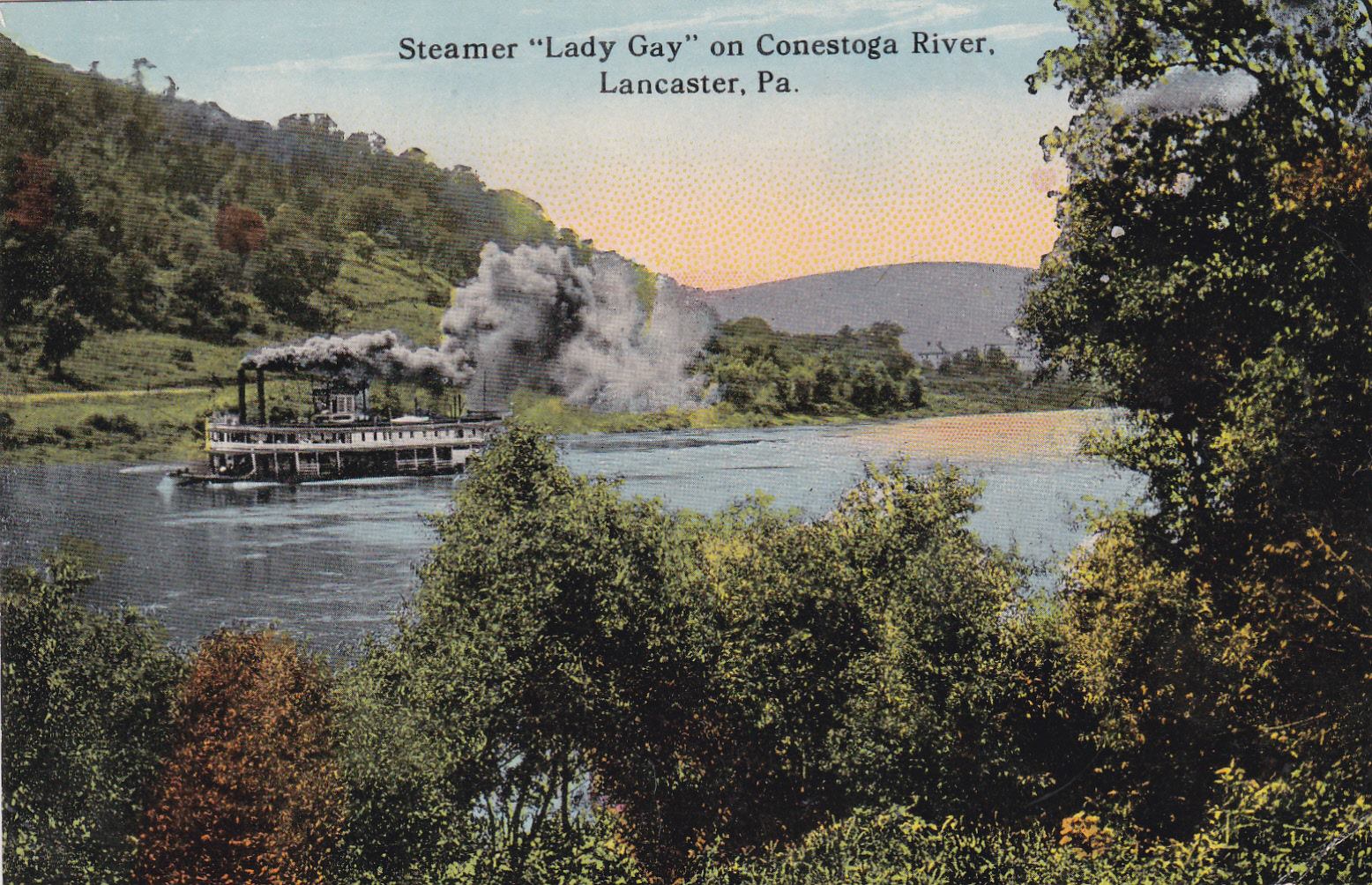
The original building was constructed in 1742 with the present building being built by Abraham Witmer about 1789, shortly after the American Revolu- tionary War ended.  The name and its owners have changed many times since then, but the name Conestoga was used most often.  To the east of the restaurant is the Conestoga River with a grassy area that at one time was more than likely the landing where patrons would board the "Lady Gay" riverboat to travel to Rocky Springs Amusement Park.  
The east entrance into the Conestoga Restaurant.
At first they thought they could hold a lottery to pay for the bridge, but that fell through.  Then the owner of the land on the west side of the river, Abraham Witmer, decided to help pay for the bridge, assuming it would be a toll bridge so he could get his money back.  It was said that the toll for every coach, chariot, wagon or other four-wheeled carriage would be 1 shilling and 6 pence, for every chaise, riding chair, cart or two-wheeled carriage would be 9 pence, every sled would be 1 shilling, every single horse and rider would be 4 pence and every foot passenger 2 pence with every head of horned cattle or swine 1 pence.  It was also decided that all poor persons could pass for free.  The bridge would be built across the river where the current road stood.  The bridge built by Abraham Witmer under the act of 1787 was not the current bridge, since it was built of wood.  
Another view of the Conestoga Restaurant.  One of the
owners was a student of mine in high school.
So another act was passed saying Mr. Witmer should built a more permanent bridge and remove the old one.  On November 12, 1800 Abraham Witmer informed the public that his new bridge will be completed by  tomorrow.  The stone bridge was 540 feet and the width was 19 feet with a tablet in the middle of it on the north wall telling of the history of the bridge.   Evidently Mr. Witmer was paid for the bridge by the county, and the toll was removed on September 5, 1918.  In 1932 a new concrete bridge over the Conestoga River replaced Witmer's stone bridge.  I have traveled across that bridge many times in my lifetime.  My Aunt and Uncle lived about 300 yards from the bridge on the east side of it and there were many times that I went fishing in the shadow of the bridge.  I must admit that once I found out that it wasn't the original Witmer bridge, the excitement of crossing it and following in the same tracks of many famous people seemed to evaporate.  The photograph I took today is still special, since I perhaps was standing on the exact spot that Mr. Abraham Witmer may have stood years and years ago.  It was another extraordinary day in the life of an ordinary guy.
The Conestoga Restaurant as seen from Lincoln Highway.
Witmer's Bridge looking west toward the city of Lancaster.
One more view of Mr. Witmer's second bridge of stone.  This was replaced in 1932 with the bridge that now crosses the Conestoga.

Sunday, March 25, 2018

The "MARCH FOR OUR LIVES DAY" Story

It was an ordinary day.  A "MARCH FOR OUR LIVES DAY".  Kids a quarter of my age organized the march, and boy did they do a fantastic job!  I listened to what they had to say in Lancaster, Pennsylvania, Washington D.C. and all over the world.  Kids who are tired of being scared to go to school. Carol and I recently visited with out daughter and her family in Urbana, Maryland, a small bedroom community outside Washington D.C.  Our oldest granddaughter, Courtney, told us how scared she is to go to school.  And, I believed her since I could see it in her eyes and hear it in her voice!!  She said kids talk about guns all the time.  A student in nearby Solanco High School, to the south of Lancaster, told the Lancaster Newspaper that they have "active shooter drills" as part of their school day.  Unbelievable!!  I can remember when I was a high school student and we had "active atomic bomb" drills, but with a much different meaning.  I grew up during the cold war era and we were always afraid that Russia was going to bomb us.  Our new high school which opened in 1958 had a section of the building that was totally underground with extremely thick walls to keep us away from the radioactivity that would be created from the bombs.  We practiced marching silently single file from our classrooms to the area near the locker rooms and sat on the floor with our heads between our knees until we got the all-clear signal.  We were never told if it was real or not, but I can remember being scared and wondered why my fellow classmates took so long to walk down the stairs to the bomb shelter.  My aunt and uncle built a bomb shelter in their basement and kept it filled with non-perishable food and bottles of drinking water.  They too were afraid of what might happen if we were bombed by Russia.  Time passed and nothing ever came from it, but that's not the case for our younger generation.  Seems like almost every week someone starts to shoot up a school somewhere killing people.  The common denominator today seems to be a deranged young man with an automatic weapon.  What's an easy way to calm the younger generation?  Take away the murder weapon and treat the mentally ill young man.  Not easy to do since there are so many automatic weapons in existence today which seem to find their way into the hands of those who have a grudge against society.  But, this younger generation is sick of it and are willing to do something about it.  Many students from various school districts in the Lancaster area boarded buses yesterday to participate in "MARCH FOR OR LIVES DAY" yesterday in Washington D.C.  I watched it on TV and found the most stirring speaker was a young woman from Marjory Stoneman Douglass High School in Parkland, Florida where the most recent mass murder had occurred.  Young lady by the name of Emma Gonzalez, a senior at the Florida high school, who made a call to action by the youth of today.  She said, "We call BS! to leaders who thing kids don't know anything and new laws won't work."  As she stood on stage she became silent, with tears flowing down her face.  The crowd also became silent, with most people crying.  I must tell you that Carol and I also had tears flowing at the same time.  She stood at the podium, silent for 4 minutes and 25 seconds then told the crowd to "Fight for your lives before it's someone else's job."  I found out later she timed her speech to last 6 minutes and 20 seconds, the exact time the gunman spent shooting up her classmates.  The Lancaster Newspaper reported that a young girl from Lancaster shouted to her, "We love you!" while waving a sign which read, "They tried to bury us.  They didn't know we were seeds."  I'm convinced that these young people who formed this march today, who will be national leaders in our government in the near future, will get their gun reform they deserve sooner than later.  Just a simple ban on automatic weapons and mental health reform is all they want.  If it helps eliminate the death count, how can anyone disagree?  It has nothing to do with our Second Amendment and everything to do with the wealth of the NRA and those who take their donations!  You'll never convince me that isn't the case!  I'm hoping the youth who formed the rally will see their hard fought battle come to fruition in a timely manner. It was another extraordinary day in the life of an ordinary guy.

Saturday, March 24, 2018

The "Havin' A Good Time In Lancaster: Part I" Story

A view of Witmer Bridge along the Lincoln Highway.
This was one of the locations that the Lady Gay
would pick up passengers.
It was an ordinary day.  Standing next to the Witmer Bridge on Lincoln Highway East trying to imagine what it must have been like to ride the "Lady Gay" down river on a Saturday afternoon, heading to Demuth's Park to swim and have a nice picnic lunch.  Sound like something you might want to do on a piping hot summer day?  
This would have been the view years ago.  The bridge seen
here had been replaced in later years.
Well, that's what Lancasterians did for years and years during the late-1800s to the mid-to-late 1900s.  The "Lady Gay" was called "a grubby little
steamboat" which was owned by John B. Peoples.  It ferried passengers on the Conestoga River between Conestoga Park and Rocky Springs Park beginning at the turn of the century.  
A post card showing the Lady Gay traveling on the Conestoga.
I knew Rocky Springs as an amusement park, roller rink and swimming pool for most of my life, but at one time it was just a place for a nice picnic.  Any swimming done there was in the Conestoga River.  In 1855 a Lancaster butcher, Michael Trissler, purchased the property and built an inn and picnic grounds for picnicking.  27 years later he sold it to Samuel J. Demuth who operated a confectionery and ice cream garden in nearby downtown Lancaster, Pennsylvania.
The Lady Gay dropping patrons off at Rocky Springs Park.
Click on images to enlarge.
 Mr. Demuth erected a few buildings and planted a few bushes and named it Demuth's Park.  It was a fabulous place and used by many for parties.  A few years later he bought an additional 14 acres to enlarge his park.  Demuth died in 1888 and the park fell into the hands of his heirs as well as the Anderson family who happened to have a small side-wheeled steamboat called "Lady Gay" which was used to take passengers to the park.  In 1890 Demuth's estate leased the park to John B. Peoples for five years.  
The swimming pool at Rocky Springs Park.  I swam in
this pool on numerous occasions.  
John added picnic tables and about 100 benches around the park to go with a big fountain filled with goldfish that stood at the entrance to the park.  There were amusements, one such being the shooting gallery, tennis courts, children's swings, a cane game and a game where you threw baseballs.  
The Merry-Go-Round at Rocky Sprigs Park.
A refreshment stand and photo- grapher's booth where you could have a tintype taken were all part of the park.  And, it was free to enter the park.  By 1894 the local newspaper reported that hundreds of people visited the park.  John eventually added bathing houses and made a sand beach along the Conestoga.  Then in 1896 the park was leased to Herman B. Griffiths and Emma J. Wiener of Philadelphia.  Mr. Peoples opened and operated another amusement park across the Conestoga River from Demuth's Park as well as operating his boat, the second "Lady Gay", which took 16 minutes to get from the wharf at Witmer's Bridge to the park.  Well, Emma Wiener got upset with Peoples, accusing him of charging only a nickel to get people from Witmer to his park while charging ten cents to her Demuth's Park.  
The "Wild Cat" at Rocky Springs.
The case was dismissed!  Then in 1899 the park's name was changed back to Rocky Springs Park and the Demuth heirs sold a third of the property to Thomas Rees, a fellow from Pittsburgh, who saw it as an investment.  Griffiths was still leasing the park and decided to add more steamboats to carry people to the park.  He named them Emma Belle and Evelyn B.  It was at this time that the merry-go-round, dance pavilion, show pavilion and boat-passenger pavilion were added.  Shortly the coal oil torches and lamps, used to illuminate the park after dark, were changed to electric lights.  In 1907 a roller-skating rink with white maple floor was placed at Rocky Springs park.  As to who owned the park by now...the 1910 Lancaster census listed Mr. Griffiths as the proprietor of the park and Emma Wiener as a boarder at the Rocky Springs Mansion.  
The Lancaster Coin Club added this coin to their
collection in 1971.  It features the "Lady Gay Steamer."
I began to head to the park as a child in the early 1950s.  I never knew it as anything other than an amusement park and never rode the "Lady Gay" to the park.  My grandpap Bill would always load us in his car and drive us the 15 minutes to the park.  Wonderful memories never to be forgotten.  Well, I snapped my photo of the Witmer Bridge and hopped back in the car to tell my wife my tale which you have just read.  After a few minutes she said, "You've told me the same tale hundreds of time!  Anything else new you can share?"  I relied, "Nah, you got it all!"  It was another extraordinary day in the life of an ordinary guy.  


PS - In 1963 a man by the name of Earl Clark, a Lancaster County potato farmer who sold potatoes to area potato chip factories, opened what is today known as Dutch Wonderland in Lancaster, PA and what is so neat is that he used the "Lady Gay" riverboat in his amusement park.  More tales of Rocky Springs Park can be found if you type Rocky Springs Park in the white box at the top left of this story.


Black and white photo of the Lady Gay Steam boat.

Friday, March 23, 2018

The "We Really Didn't Need This, You Know!" Story

The morning newspaper's headline.
It was an ordinary day.  Ordinary perhaps if it were the middle of winter, but this for heaven's sakes is the first full day of Spring.  You know...spring flowers, getting the lawn mover ready, getting the outdoor furniture in position, etc., but not an all-time record for most snow!!  This goes back before I was born...back when they first started keeping weather records.  The headline on the LNP newspaper this morning read, "RECORD BREAKER".  For some parts of the world having close to two feet of snow in the beginning of Spring is ordinary, but for those of us who live in the "Garden Spot of America"...well, that's just not right!  
Beautiful Winter scene in my back deck.  Only problem...
it was Springtime!
Heavens, I had just put the snowblower away a few days ago when the tempera- ture in Lancaster, Pennsyl- vania hit 80 degrees.  And over the past weekend I took my new electric hedge trimmer my son Tad had gotten me for Christmas and spent a few hours trimming are beach grasses that had grown close to five feet tall this past summer.  And now we have a record snowfall!  It just can't be.  I had to use the snowblower twice yesterday, since the snow had accumulated at one point close to the maximum the blower could handle, and the TV was calling for at least six to eight inches more.  
After a few more hours of snow.
The morning paper declared a record, but couldn't give an exact amount because it was still snowing at press time and the snow total, which now stood at 16 inches, would grow.  I can still remember the spring of 1989 when my son was a member of the Manheim Township High School baseball team and we had close to a foot of snow in early Spring.  All team members and their families were asked to report to the field a day or two later with shovels to remove the snow from the entire field so the team could practice since the first game was only a week away.  Well, the official record total ended up being 17.5 inches according to Eric Horst, head meteorologist at nearby Millersville University. Eric was once a student in my photography class I taught at Manheim Township and if I had known he would do this to me, well who knows what grade I would have given him.  
My total after the snow had stopped: 12.5".
This official total came from following National Weather Service protocol of using a snowboard to take hourly measurements.  Snow depth, or a measurement of snow on the ground, came in about 14 inches at Millersville University, but since the snow was so heavy, it compacted  over the hours it fell.  By taking hourly readings it ended 3.5 inches more than the total on the ground at the storm's end.  And, it seems the snowfall didn't break the record, since Millerville University recorded 18 inches on March 13, 1993.  Now I just have to hope that the weekend will bring temperatures close to the 80 degree mark so I can back to my Spring chores.  It was another extraordinary day in the life of an ordinary guy.


A few brave birds arrive at the bird feeder. 


Thursday, March 22, 2018

The "It Ain't Worth A Wooden Nickle" Story

It was an ordinary day.  Standing in Hot Z Pizza paying for my medium size pizza I ordered about 15 minutes ago.  Had a couple of extras on it so the total price was $9.05.  Pulled out my wallet and gave the lady a $10.  Then I reached in my pocket and pulled out the nickel I had just found in the parking lot in front of the store.  Handed it to her and she jokingly said, "This isn't a wooden nickel, is it?" I then jokingly asked, "Do you get a lot of them here?"  
Wooden nickel produced for fairs and festivals.
She smiled and told me she never saw one in her life.  As far as me, I have seen wooden nickels, but at the time didn't realize what they were.  I can remember when I was a young child going to festivals and fairs at neighbor- hood towns around Lancaster, PA and receiving wooden coins as tokens from different stands set up to advertise their wares.  Wooden nickels, as they were called, aren't worth... well, a wooden nickel.  They were novelty coins made to advertise or commemorate organizations.  Some say you could redeem them for a drink at the festival or fair.  But, during the Great Depression they became legal tender due to coin shortages in some parts of the country.  Banks actually issued wooden nickels with expiration dates to help merchants make change for sales.  
A Round Tuit!
And, there was also a special kind of wooden nickel called "A Round Tuit".  The Round Tuit was a type of wooden nickel that has been popular for decades.  They too were distributed at fairs and festivals.  Once you had one you could no longer tell your parents that you would do your chores when got around to it!.  You can still buy wooden nickels from the Old Time Wooden Nickel Company in San Antonio, Texas.  
The Shield nickel.
Now, the first legal currency five-cent piece was the Shield nickel designed by James B. Longacre which was in use from 1866 to 1883.  Mr. Longacre made his nickle from the same alloy of which American nickels are struck today.  In 1883 the Liberty Head or "V" nickel came into use.  The nickel featured the head of Liberty, the Roman goddess and was made until 1913.  The demand for coins began due to the invention of coin-operated machines.  


The Liberty nickel.
Then in 1913 new molds were made and several 1913-dated Liberty Head nickels were produced to test the mold before they were changed to the Buffalo or Indian Head nickel.  Those few Liberty Head nickels are now collector coins with one being sold in 2010 for almost $4 million at auction.  
The Buffalo nickel.  The "tails" side really was a Bison.
The designer of the Buffalo nickel was James Earl Fraser and was issued from 1913 to 1938.  From 1938 until 2004 the copper-nickel coin featured a profile depiction of founding father and third U.S. President Thomas Jefferson.  The likeness came from a Rembrandt Peale portraiture from 1800.  
The Jefferson nickel with Monticello.
On the "heads" side of the coin are the words "IN GOD WE TRUST" with the word Liberty and the year of issue.  On the flip side is a classic rendition of Monticello.  This nickel is a copper-nickel coin and was designed by artist Felix Schlag.  During WWII the alloy was changed to 56% copper, 35% silver and 9% manganese rather than the 25% nickel and 75% copper.  
Monticello got a facelift.
When the war ended it returned to the silver and copper that it was before the war.  In 2006 the coin changed slightly with Monticello getting more detail and a cursive Liberty on the "heads" side with an updated portraiture of Jefferson.  The coin is smooth around the edges and close to a billion and a half nickels are made every year.  For many, coins aren't as important as they used to be.  If you found a penny in the street you always picked it up, unless you were superstitious and then you only picked it up if it was "heads".  
The new "Head" side of the Jefferson nickel.
Now, many people don't feel it is worth bending over to pick up a coin, no matter what denomination it many be.  For me, well that nickel I picked up as I walked in the pizza store saved me a pocket full of coins.  It was another extraordinary day in the life of an ordinary guy.   

Wednesday, March 21, 2018

The "The Future Of Medicine" Story

It was an ordinary day.  Just grabbed the mail from my mailbox and distributed it between my wife and myself.  One of my pieces of mail today was The AARP Magazine.   For those who are youngsters or perhaps from a country other the the USA, AARP stands for American Association of Retired Persons and by joining you get a variety of services at reduced rates as well as a monthly newspaper and magazine.  
Latest AARP Magazine
As I leafed through the magazine I came upon an article titled "Is This the Future of Medicine?"  Pictured on the double-page layout was a doctor sitting in front of a series of TV screens, Facetiming with a patient.  Showed it to Carol and said, "This is exactly what we did a few weeks ago when I took you to the hospital and you were diagnosed with Transient Global Amnesia."  Needless to say, she had no idea what we did because that Tuesday, a few weeks ago, has been forever wiped from her memory by the medical condition that affects the mind.  I explained that while in the Emergency Room in nearby Lititz, Pennsylvania, we were able to talk with a medical specialist over 25 miles away who was sitting in a room at Hershey Medical Center which is part of Penn State Medicine.  We did this through a computer Application that allows us to see as well as talk with someone in another location through a television, computer or smart phone.  The young woman doctor, who was a specialist in neurology, told us what Carol had experienced and what to expect as a result of that experience.  As I stared at the TV screen it was as if she were in the next room rather than miles away from the ER we were in at the time.  As the title of the article that I was reading stated...is this the future of medicine?  The hospital did not have a neurologist on staff at the time of our arrival so after doing extensive testing on Carol, it was determined to call Hershey Medical Center, one of the best medical institutions in the USA, and ask for their help.  The young doctor told us that the mind is one part of the body that they still know very little about, but assured us that what she experienced will go away in 12 to 24 hours.  Knowing that we had one of the best physicians talk to us through Facetime helped relieve the anxiety that both of us had.  And now, as I read the article in the magazine, I can see the huge advantage that virtual care can give to both patient and family or friends.  

A small story within the magazine article was titled "The Patient's Perspective."  It listed five benefits of virtual care for those who have had a lifetime of in-office visits and might feel intimidated by modern technology.  The benefits include: (1) Convenience so you don't waste your time, (2) Managing chronic conditions such as diabetes, high blood pressure and COPD can be monitored more easily, (3)  Treating urgent symptoms without having to sit in a waiting room filled with other sick people, (4) More efficient health care so your family doctor can have access to specialists and (5) First-class care anywhere which Carol and I really appreciated.  You may have read my story of having shingles while on vacation in St. Martin and going to a doctor who had no idea what it was until my wife suggested shingles and he looked it up on his computer to tell me I had shingles as well as my story telling about Carol being stricken with appendicitis while in Providenciales on the Turks & Caicos Islands.  She did receive good care, but perhaps being able to Facetime with a specialist in the USA may have changed how he performed his surgery.  I look forward to the future of medicine and how technology will help virtual care be a reality for us.  It was another extraordinary day in the life of an ordinary guy.

Tuesday, March 20, 2018

The "Birth Of The Almanac" Story

It was an ordinary day.  Tuesday, March 6 and the day is slowing drawing to a close.  Big news of the day is the approaching storm that is expected to bring up to 10 inches of snow to the area.  Allegedly!  So, just where do they get their information from to determine how much snow we will get?  We in Lancaster County, Pennsylvania have had one of the lowest snow totals in recent history this winter that I can remember.  I haven't had a need to use my snowblower at all this winter and hope to put it to bed for the year without any use at all.  Will that happen?  By the time you read this you may know the answer.  For me, one of the tools that I use to determine my need for my snowblower is the Old Farmer's Almanac.  It is one of many almanacs that is printed every year, but the Farmer's Almanac is the grand-daddy of all almanacs, since it is the oldest continuously published periodical.  
Cover of Old Farmer's Almanac.
It's first editor was Robert B. Thomas who printed his first edition of the Farmer's Almanac in 1792 during George Washington's 1st term as president.  His almanac became an instant success, since his predictions were actually very accurate.  His first year of publication he sold approximately 3,000 copies while the second year his production was tripled.  Cost for the almanac was six pence ($.09).  Almanacs that were printed both then and now supposedly records and predicts astronomical events, tides, weather and other phenomena with respect to time.  Seems Mr Thomas used a complex series of natural cycles to devise his own secret weather forecasting formula.  His results were amazing accurate.  80% accurate to be exact.  How many weathermen can make that claim today?  Seems not only was his weather forecasting more accurate, but his advice and feature stories more entertaining.  Mr. Thomas produced his last edition of the Farmer's Almanac in 1846 and his predictions were much the same as they were 50 years before.  During those years he established his publication as one of America's leading periodicals.  It outsold and outlasted most other periodicals during his reign as top dog in predicting.  His publication was terminated due to his death in 1846 as he was proofreading his 1947 edition of The Farmer's Almanac.  Actually, Robert B. Thomas' almanac wasn't the first in North America, that record going to William Pierce who published his almanac in 1639 in Cambridge, Massachusetts.  There have been almanacs published since that time with most of them including the word "Farmer's" in the title.  One early almanac that didn't stick to that format was Poor Robin's Almanack which was published by Poor Richard, Knight of the Burnt Island.  It was declared a comic almanac.  In 1664 a note in his almanac said: This month we may expect to hear of the Death of some Man, Woman, or Child either in Kent or Christendom.  Wow, I could predict that well.  In 1728 a fellow by the name of James Franklin began to publish the Rhode-Island Almanack.  
1942 photo of FBI agents capturing the German spy.
Five years later his brother began to publish Poor Richard's Almanack.  Have you guessed by now that James' brother was Benjamin Franklin.  Mr. Thomas' Farmer's Almanac changed names in 1836 and is now known as The Old Farmer's Almanac.  This years' edition of the Old Farmer's Almanac features astronomical events; trends, gardening, anniversaries, recipes, home remedies, pets husbandry, folklore, amusement, contests, fishing and more.  And, as you might have guessed, you can go online and get access to their online weather.  One final note to my story today is: In 1942, a German spy was apprehended by the FBI after landing on Long Island by U-boat.  In his coat pocket was a copy of The Old Farmer's Almanac.  The U.S. Government speculated that the Germans were using the Almanac for weather forecasts, which meant that the book was indirectly supplying information to the enemy.  Compare that to today's news stories!  It was another extraordinary day in the life of an ordinary guy. 

Monday, March 19, 2018

The "The Government Folly Known As The 'Goat Path'" Story

It was an ordinary day.  Traveling through the city of Lancaster, Pennsylvania heading east on Route 23.  Route 23 was one of the very first pioneer paths in the early 1800s that connected the eastern states heading west, passing through what eventually would become the city of Lancaster.  As I exited the city limits I drove past the city waterworks where I used to fish and swim under the railroad bridge that crosses Rt. 23.  
After leaving Lancaster on Rt. 23E I came to this barricade
past the Lancaster Water Works.  You need to turn left and
exit onto Route 30E and then back onto Rt.23 once again.
Straight ahead of the barricade is the "Goat Path".
About  a quarter-mile past the bridge I came to the end of the road and had to exit left to continue on Rt. 23.  It was at the end of that four-lane road that back in 1963 was supposed to be a new Rt. 23 that would be a new highway from Lancaster to New Holland, PA.  In '63 the Pennsylvania Dept. of Transportation began work on perhaps the most controversial project ever in Lancaster County history.  The first feasibility study of $50,000 started at that time.  Three years later it was announced that a two-lane, 21.8 mile highway with five interchanges on a four-lane right-of-way would cost $15.4 million.  It was to run parallel to the current Rt. 23, but about a mile south of the current Rt. 23.  It would be built in three parts with a section from Lancaster to Route 30, another section from Route 30 to the town of Leola and a third section from Leola to New Holland.  Work would begin in 1968.  Carol and I lived near what would be the Lancaster end and were hoping to be able to travel the distance to New Holland in considerably less time that it did in 1968.  But, two years later the state ran out of money and the project never really got started.  Three years later Democratic Governor Milton Shapp budgeted $26.46 million to begin the first two parts of the project and in 1974 work began on the new Rt. 23.  The road near the waterworks was to be the starting point and construction finally began.  I remember the road being very controversial since it required county farms in the Garden Spot of America, many of them Amish and Plain Sect farms, to be divided in half.  Well, by 1977 the funds had been exhausted after only 4.9 miles of construction.  So what to do with a 4.9 mile long roadbed and interchange bridges through some of the best farmland in the country.  
This photograph which I took yesterday shows the 4-lane
wide "Goat Path" that goes on for almost 5 miles.  Many
places along the path you will see cows and goats grazing.
How about covering it with eight inches of dirt and throwing grass seed on the dirt.  Yep, that's what they did.  Told the farmers whose property it divided that they could allow their cows, sheep and goats to graze on it until further notice.  Not long before it was known as the "Goat Path".  That was almost 50 years ago.  Yes, you read that right...50 YEARS AGO!  That was my money they used to build a "Goat path".  Another recent study found it could cost in excess of $100 million to begin the project once again so it has been decided that the "Goat Path" will now become a part of the Greater Lancaster Heritage Pathway from the west side of Lancaster to Rt. 722 on the east side of Lancaster County near the town of Leola where the "Goat Path" ended.  The proposed 11-mile pathway will be a non motorized trail.  But, the pathway will have to go through five municipalities and who will maintain it?  It does sound rather interesting since it will create many bike and walking trails, but I'm almost positive it will never happen in my lifetime.  Maybe they'll prove my wrong, but this is government run.  Nah, it'll never happen, since I'm running out of time!  It was another extraordinary day in the life of an ordinary guy.

Sunday, March 18, 2018

The "I Like You Just The Way You Are!" Story

I passed this sign on a sidewalk in Manheim, PA.
It was an ordinary day.  A beautiful day in the neighborhood as I walked pass a sign that wished Mr. Rogers a Happy Birthday.  Need I say anything more?  Well, just in case you didn't know, it was Mr. Rogers who always said, "Won't You Be My Neighbor?"  Mr. Rogers, for those who have never heard of him, was Fred McFeely Rogers who immediately after graduating from Rollins College in 1951 was hired by NBC television in New York as an assistant producer for The Voice of Firestone and later as floor director for The Lucky Strike Hit Parade, The Kate Smith Hour and the NBC Opera Theatre.  Mr. Rogers was born in Latrobe, Pennsylvania, so in 1953, after being asked to return to  nearby Pittsburgh station WQED, which was the nation's first community-sponsored educational television station, he moved back to his home state of Pennsylvania.  
Mr. Fred Rogers in the late 1960s.
Mr. Rogers was asked to develop the
first program schedule for the TV station.  Shortly after he produced "The Children's Corner" which was a daily, live, hour-long visit with music, puppets and host Josie Carey.  Rogers served as puppeteer, composer and organist.  Two years later his program won the Sylvania Award for the best locally produced children's program in the country.  It was on "The Children's Corner" that a few of Mr. Roger's Neighborhood regulars first made an appearance.  Anyone remember Daniel Striped Tiger, X the Owl, King Friday XIII, Henrietta Pussycat or Lady Elaine Fairchilde?  They would become regulars on his famous show, "Mr. Rogers Neighborhood."  
A shot from his TV set.  This was Mr. Rogers' Neighborhood.
During Mr. Rogers free time he attended Pittsburgh Theological Seminary and the University of Pittsburgh's Graduate School of Child Develop- ment.  In 1963 he became an ordained Presbyterian minister with a charge to continue his work with children and families through the mass media.  Later in 1963 he developed a children's program for CBC in Canada that was called MISTEROGERS.  He moved from behind the scenes to the show's on-camera host.  
Mr. Rogers Memorial Statue in Pittsburgh, PA.
He returned to Pittsburgh three years later with his wife and two sons to begin "Mister Rogers' Neighbor- hood" on National Educational Television and in 1968 on the Public Broad- casting Service (PBS).  A few years later my family discovered his show on PBS.  I actually enjoyed watching the show with all three of my children.  The show offered a safe haven for kids, not like many of the crazy cartoons and animated shows did.  His quiet demeanor presented him as an adult in a busy world with time for every child who viewed the show.  I can still remember my kids staring at the TV screen as he said, "I like you just the way you are!"  
Mr. Rogers' sweater now is in the Smithsonian Institution's
Musuem of American History in Washington, D.C.
The iconic sweater that he wore on just about every show is now on display in the Smithsonian Institution's Museum of American History.  He even has a memorial statue in Pittsburgh!  Mr. Fred McFeely Rogers died in 2003.  I also remember Jimmy Kimmel last year, after the mass shooting in Las Vegas, looking nervously at the TV camera and saying "look for the helpers."  Something that Mr. Rogers would say often.  

2018 is the celebration of the 50th anniversary of "Mister Rogers' Neighbor- hood."  A new Mr. Rogers documen- tary called "Won't You Be My Neighbor?" is scheduled to be released on June 8th.  I hope you will be able to watch it.  Also, this month the U.S. Postal Service is going to release a Mr. Rogers' Forever Stamp.  If only he could have lasted "Forever" to help influence generation after generation of children in this troubled world.  Maybe, just maybe, we really could have all been friends and neighbors.  It was another extraordinary day in the life of an ordinary guy.  

Saturday, March 17, 2018

The "So How Do You Feel About Sports And Religion?" Story

It was an ordinary day.  Reading another story about athletes and their religion.  I have found quite a few stories in the past couple of weeks that tell of professional athletes and their willingness to tell the story of their faith and how it has influenced their life and the choices they now make.  
Nick Foles and Carson Wentz, Eagles quarterbacks.
As you have probably read if you are a reader of my blog, I am a fan of the Philadelphia Eagles.  Not the boisterous and obnoxious fan as many are, but just a plain down-to-earth fan of a great football team.   I loved the way the team fought their way to the Super Bowl through the many injuries and setbacks they endured.  But what impressed me the most were the leaders on the team who quietly talked of not only their football journey, but their spiritual journey.  We all know the story of Nick Foles and the fact that he wants to become a pastor sometime in the near future, but there are many more athletes on the team that also worship the same God that Nick Foles does.  The guy who Nick replaced in the lineup when he went down, Carson Wentz, said that "Faith, to me, is the No. 1 thing in my life.  If Jesus isn't in it, I don't want to be a part of it."  It was reported that the Eagles' Christian faith became "the locker room's binding force" as the team played through injury after injury.  Some of the leaders on the field weren't afraid or embarrassed to talk about their faith and this had to be an influence on others in the locker room.  Sure, some just didn't feel comfortable talking about Jesus, and there may have been a few who didn't care about religion, but for those who did, they felt it was that force that brought the players closer together as a team and as individuals.  They had as much belief in Jesus as they did in their coach, Doug Pederson.  Many teams have Bible study groups, but the Eagles' group seemed to grow throughout the season.  
The baptism of Marcus Johnson before a game.
On October 12th, before the Eagles would take the field against the Carolina Panthers later that evening, Eagle wide receiver Marcus Johnson gathered with a bunch of teammates and friends at the hotel pool to be baptized.  It was so important to him that he posted a photo of his baptism on his Twitter account.  I've played sports most of my life, but have never been exposed to teammates such as were on the Eagles this year.  I have always believed in the Holy Trinity, but what might I have become if I had been a member of the Eagles this year?  
An advertisement for the movie "42"
I also recently read a story about the 2013 movie about Jackie Robinson, the baseball player that broke the color barrier in major league baseball.  The story said that Robinson's faith was integral to his success, but you didn't see any of that if you went  to see the movie.  The filmmakers of the movie "42" were evidently uncomfortable with all this religious stuff and avoided it in the movie.  And, many believe that omitting the role of faith in this story does a serious disservice to history.  Seems that Dodgers General Manager Branch Rickey made it clear to Robinson that he wanted someone to be the first African American in the majors "with guts enough not to fight back."  He needed someone who would resist the temptation to retaliate.  If not, they would not succeed in baseball.  Robinson was chosen by the deeply religious Rickey because of his faith and moral character.  He knew Robinson was more than a great athlete.  He could turn the other cheek.  
First African American to play in the Major Leagues. Jackie
Robinson, the Hall Of Fame player, broke the color barrier
in 1947.  His faith was a major reason for his success.
It was said that there were many nights during his first couple of years that he got down on his knees asking for strength from God.  Seems that the filmmakers of "42" were uncomfor- table with all this so they just avoided putting it in the film.  Faith had always played a big part in Jackie Robinson's life.  Couldn't they see how much more powerful the movie could have been had they included this in the film?  I'm sorry to say that much of the abuse Jackie Robinson had to endure was at the hands of my favorite Philadelphia baseball club, the Phillies.  The name calling and taunting he had to endure were tremendous.  Only after realizing this do you truly understand how special Jackie Robinson really was.  Religion will always be a part of sports.  Some wish it weren't true, but it's bound to be part of sports as much as religion is part of life.  So, should we embrace it or not.  I guess it is up to each and every one of us to decide for ourselves.  I believe you know how I feel, but do you know how you feel?  It was another extraordinary day in the life of an ordinary guy.

Friday, March 16, 2018

The "My Hero 'Rocky' Riedel Has Died" Story

It was an ordinary day.  Sitting in my favorite lounge chair, reading the morning newspaper.  Read all the local, national and international news and then turned to the obituary page to see whom I might know who has had their photo in the paper for the last time.  One name, with photo above it, struck a note with me, but I couldn't place his face or name.  As I began to read his obituary I finally figured out how I knew him.  He was my favorite Saturday Morning  sidekick as I watched my mom and dad's small black and white Philco TV with an antennae that had pieces of aluminum foil on it to help with the TV signal.  
Daily Test Pattern on WGAL-TV.
Lancaster, Pennsyl- vania's WGAL-TV had just began broad- casting in the early 1950s and all the kids in my neighbor- hood would tune in Saturday morning about 7:15 a.m and view the Test Pattern that was on probably all night.  At about 7:30 a.m. the National Anthem would be played followed by perhaps ten minutes of local news and then......"Rocky" Riedel, dressed in full cowboy gear, would introduce the "Covered Wagon Theatre".  
LDub dressed in full cowboy gear.
Every Saturday the feature presentation was an hour-long Western movie with "Rocky" Riedel talking to his TV audience during intermission.  I was always dressed in my blue jeans, cowboy shirt, chaps, neckerchief, holster and cowboy hat, just like my hero "Rocky."  The same "Rocky" Riedel who died Friday, March 9th at his Pequea Twp. home, close to where my wife grew up.  As I read his obituary I was amazed at his lifetime story.  Graduated from high school in 1945, but his parents had to accept his diploma, since he had already joined the Navy to serve as a hospital corpsman in WWII.  After returning home he worked for WGAL Channel 8 doing the evening "Pioneer Playhouse" as well as "Covered Wagon Theater."  
My hero "Rocky" Riedel.  I actually thought
he was a real cowboy.  Imagine that!
He also worked for RCA, General Cigar, drove a bakery truck and was a Fuller Brush salesman.  His music career included his band, "Rocky Riedel and his Raiders", as well as "101 Ranch Boys."  Then I read something really cool telling that he was a stunt rider for the "Cisco Kid" TV show.  Wow, no wonder he was my hero.  But what followed reminded me of another great TV legend, Mr. Rogers.  "Rocky" was called to the ministry where he graduated from Franklin & Marshall College in 1959, completed his masters degree at Lancaster Theological Seminary in 1963 and took night classes at Eastern Baptist Theological Seminary.  
Reverend "Rocky" Riedel.  RIP
My hero "Rocky" Riedel was now Reverend "Rocky" Riedel who served churches until 1992 when he became a substitute for other pastors.  Rev. "Rocky" enjoyed traveling as well as reading about history, planting flowers, painting, and watching TV shows.  How much do you want to bet he loved Westerns.  He is survived by his wife, son and family, daughter and family, 3 grandkids, 6 great-grandkids, his dog Princess and thousands of admiring kids who woke up every Saturday morning, dressed in full cowboy or cowgirl gear, to hear what words of Western knowledge "Rocky" Riedel had to tell us.  His obituary ended telling, instead of sending flowers, to donate to the Salvation Army in Lancaster.  A true Hero!  It was another extraordinary day in the life of an ordinary guy.

Thursday, March 15, 2018

The "Baron Henrich Wilhelm Stiegel: His Stories - Part IV" Story

It was an ordinary day.  A day in which I hope to tell the good side of Mr. Henry William Stiegel.  Although he was a lavish spender and considered one of the wealthiest and most influential men in Pennsylvania, he had a very humane and caring side to him.  He was a man that saw a need for education and as his fortune grew had schools built and hired schoolmasters to educate the children of his workers and town.  He also was an accomplished musician and supported a band in his town of Manheim as well directing the choir of Trinity Lutheran Church in nearby Lancaster.  His love and appreciation of music led him to purchase musical instruments for those he employed that couldn't afford the instruments.  His wealth allowed him to build a chapel on the second floor of his mansion in the center of Manheim and he held Lutheran services on Sunday in the chapel.  
Zion Lutheran Church in Manheim which
was built on land granted to the churuch
by Henry William Stiegel in 1772. It is
known as the Red Rose Church, since one
red rose is still given yearly for rent on the property.
The church is located at the corner of Hazel
and High Streets, directly behind where Steigel
lived in his Mansion located on Main street.
He was not only an important community leader, but a lay delegate to the Lutheran Ministerium of Pennsylvania.  Deeply concerned about the affairs of the church, in 1772 he gave his fellow Lutherans in his town of Manheim a plot of ground on which to build a church.  Henry was at the top of his career so he and his wife decided to donate the lot where the church would be built.  The only stipulation to the donation was that the church pay five shillings to make the deed lawful, and the annual rental fee of "one red rose" which would be due in the month of June, yearly and forever.  It is said that the payment of the red rose was all but forgotten for over 100 years, but in 1892 a local physician thought it would be great to have an all-day festival and pay the red rose to a descendent of Henry Stiegel.  So in 1892 John C. Stiegel of Harrisonburg, VA came to Manheim to receive one red rose from the Zion Lutheran Church.  This past year, on Sunday, June 11, Ms. Teresa Trible from Waukee, Iowa, a ninth-generation descendent of Mr. Stiegel and his second wife, Elizabeth Holtz Stiegel, came to Manheim to receive her payment of a red rose.  
The churchyard of Zion Lutheran with tombstones dating back
to the late 1700s.  A memorial plaque for Steigel is also there.  
How excited she must have been.  And, to top that off, an ice cream social was held after the service.  Don't know why I didn't see that in the newspaper, since I would have loved to have photographed the event for this story and had a bowl of vanilla ice cream with nuts, chocolate syrup and whipped cream on top for dessert.  So, as you can see, Baron Henrich Wilhelm Stiegel was not only the founder of the town of Manheim where he helped employ many of its residents, but was a wonderful person as well.  It was another extraordinary day in the life of an ordinary guy.


A rather unique tombstone which appears to be in German is in the graveyard next to the church.
This is the plaque which reads:  
Memorial to Henry William Stiegel
Glassmaker and ironmaster who was born at Cologne in 1709 and died at Charming Forge in 1785.  Picturesque figure of Colonial America, his memory is perpetuated by his artistic glassware, by traditions of the Baronial pomp of his career and by this churchyard which he gave to the Manheim Lutherans in 1770 for one red rose  His glassworks were at the northwest corner of Charlotte & Stiegel Streets.  Erected by the Lancaster County Historical Society-1934
The corner of Main and High Streets.  Click to read the historical marker.