Extraordinary Stories

1944 (1) Act of kindness (12) Acting (2) Adoption (4) Adventure (766) Advertisement (6) Africa (1) Aging (14) Agriculture (47) Airplanes (9) Alphabet (5) American Red Cross (1) Americana (116) Amish (43) Ancestry (5) Ancesty (2) Animals (43) Anniversary (4) Antigua (10) Antiques (14) Apron (1) architcture (1) Architecture (36) Art (175) Art? (8) Arts and Crafts (69) Athletics (6) Automobiles (40) Awards (7) Banking (2) Barn raising (2) Baseball (103) Basketball (3) Batik (1) Beaches (89) Becoming A Citizen (1) Bed & Breakfast (2) Bee Keeping (6) Beer & Breweries (2) Bikes (3) Birds (9) Birthdays (34) Blindness (1) Blogging (5) Bookbinding (5) Books (12) Boxing (2) Brother Steve (12) Buisiness (3) Business (5) Canals (1) Cancer (14) Candy (30) Caribbean Islands (9) Caribbean Villas (15) Cats (5) Caves (1) Census (1) Chesapeake Bay (61) Children (28) Chocolate (4) Christmas (57) Church Adventures (122) Cigars (1) Circus (3) Civil Rights (8) Civil War (6) Classic Cars (7) Climate Change (5) Clubs (1) Coin club (2) Coins (1) Collections (73) Comedy (3) Comic Books (5) Commercials (1) Comnservation (2) Conservation (41) Covered Bridges (3) Craftsmanship (12) Creamsicle the Cat (11) Crime (16) Crisis (312) Cruise Travel (6) Crying (1) Culture (4) Dancing (1) Danger (16) Daughter Brynn (58) Daughter-In-Law Barb (7) Death (5) Death and Dying (65) Destruction (2) Donuts (1) Downsizing (2) Dunking (5) Easter (3) Eavesdropping (1) Education (48) Energy (15) Entertainment (165) Entrepreneurial (62) Ephrata (1) Etchings (1) Eternal Life (4) Facebook (5) Factories (4) Fads (6) Family (261) Farming (37) Father (42) Father Time (68) Favorites (88) Firefighting (1) Flora and Fauna (28) Fond Memories (490) Food and Cooking (171) Food and Drink (111) Football (16) Forgetfullness (3) Former Students (10) Framing (30) Friends (359) Fruits and Vegetables (3) Fun (4) Fundraiser (6) Furniture (1) Games (7) Generations (3) Gifts (1) Gingerbread houses (1) Giving (8) Globes (1) Golf (3) Good Luck (2) Graduation (1) Grandkids (136) Grandparents (3) Grandview Heights (29) Great service (3) Growing Old (8) Growing Up (187) Guns (2) Handwriting (3) Hat Making (2) Hawaii (49) Health and Well Being (61) Health Care (4) Health Hazards (110) Heartbreak (7) Heroes (26) High School (142) History (777) HO Railroading (4) Hockey (4) Holidays (134) Home construction (7) Horses (2) Housing (3) Humorous (71) Hurricanes (1) Ice and Preservation (2) Ice Cream (8) Inventions (34) Islands (4) Italy (12) Jewelry (3) Job Related (62) Just Bloggin' (56) Just Wondering (19) Juvenile Diabetes (5) Labor (3) Lancaster County (542) Law Breakers (8) LDubs In-Laws (3) Lefties (1) Libraries (1) Life's Lessons (175) Lightning (1) Lists (72) Lititz (18) Locomotives (1) Lodging (1) Love (4) Magazines (2) Magic (1) Maps (2) Marching (2) Market (5) Medical (161) Memories (28) Middle School (3) Milk (2) Minorities (1) Money (3) Mother (54) Movies (6) Mt. Gretna (1) Music (118) My Brother (19) My Wife (260) Neighbors (7) New Year's Day (5) Newspapers (4) Nicknames (2) Nuisance (3) Obsolescence (5) Occupations (2) Old Age (1) oldies (1) Pain and Suffering (12) Panama Canal Cruise (13) Parish Resource Center (14) Patriotism (3) Penmanship (1) Pets and Animals (99) Photography (220) Pizza (1) Plastic (2) Playing Trains (2) Poetry (2) Politics (27) Polution (3) Postal Service (2) Predators (2) Presidents (11) Pride (4) Printing (81) Protesting (3) Public Service (65) Questionnaire (1) Quilts (1) Race relations (6) Rain (1) Reading (4) Records (2) Religion (10) Retirement (4) Revolutionary War (3) Robotics (1) Rock & Roll (4) Rodents (2) Saints (4) Sand (1) Scouting (2) Sex (1) Shakespeare (1) Shelling (2) Shopping (24) Simple Pleasures (122) Slavery (6) Small Towns (4) Smoking (1) Snickedoodle (1) Snow (1) Son Derek (27) Son Tad (33) Son-In-Law Dave (27) Soup (1) Spices and Herbs (1) Sports (139) Sports and collectibles (1) Spring Break (1) St. James (2) St. Martin/Sint Maarten (306) Stained Glass (3) Stone Harbor (4) Story-Telling (26) Stragers (2) Strangers (4) Strasburg Railroad (1) Stress (3) Stuff (4) Suicide (2) Sun (1) Surfing (1) Tattoos (4) Teaching (49) Technology (90) Television (6) Thanksgiving (2) The Arts (6) The Beach House (62) The Flag (1) The Future (5) The Shore (78) This and That (23) Timekeeping (7) Tools and Machines (25) Tours (2) Toys and Games (31) Track & Field (1) Tragedy (8) Trains (19) Transportation (18) Travel (16) Trees (2) Trending (2) TV Favorites (23) Underground Railroad (10) Unit of Measurement (1) USA (2) Vacation and Travel (545) Vehicles (80) Vison and Eyesight (2) War (14) Watches and Watchmaking (5) Weather (48) Weddings (3) White House (1) Wisdom (3) Yearbooks (12) York County (3)

Thursday, June 21, 2018

The "May The Lord Be With You!" Story

It was an ordinary day.  Had just finished a few framing jobs and took them upstairs to the gallery to be placed in a safe area until the customers come for them.  Amy, the young girl who was working today in the gallery told me she had something to show me that had just come in for matting and framing.  
Drawing of Charles Haddon Spurgeon.
She pulled out a tinted etching of an older man and a piece of paper that had been hand-written with lines through much of the copy and notes placed over and under much of the copy.  Amy was extremely excited while showing me the corrected piece of paper.  Her eyes lit up when she told me she had taken a class at Lebanon Valley College that dealt with the English Baptist preacher Charles Haddon Spurgeon.  Her excitement was due to the fact that the hand written paper she was holding belonged to Spurgeon and was a hand corrected sermon that he had preached at one time.  
The certificate telling of the hand-corrected sermon notes.
She showed me the layout and and the mats and frame that the customer wanted to use and told me she had to place the paper it in a safe place until Keith, the owner of the gallery, returned from vacation in another day.  That evening I "Googled" Charles Haddon Spurgeon and never realized that he was the quintessential Victorian Englishman, yet his masterful preaching astonished his era, and lives long beyond it.  
The hand-corrected sermon notes.
Click to enlarge which may help you see it.
Page after page of stories told of Spurgeon's many sermons that he preached during his ministry.  Actually his sermons were collected in The New Park Street Pulpit and The Metropolitan Tabernacle Pulpit and filled 63 volumes in these two collections.  The sermons' 20-25 million words are equivalent to the 27 volumes of the ninth edition of the Encyclopedia Britannica.  The series of sermons stands as the largest set of books by a single author in the history of Christianity.  Charles Spurgeon was born in 1834, one of 17 children born to his mother, nine of whom died in infancy.  When Charles was only 10 years old, a visiting missionary, Richard Knill, said that the younger Spurgeon would one day preach the gospel to thousands and would preach in Rowland Hill's chapel, the largest Dissenting church in London, England.  
This is the certificate of validation and
authenticity from Spurgeon's College.
His words were fulfilled!  Spurgeon missed going to college due to being shown into the wrong interview room.  He later claimed that was because God spoke to him, "Seekest thou great things for thyself?  Seek them not!"  Before he was 20 he had preached over 600 times.  The more I read the more I realized that the items the customer had brought to the gallery were something very special.  Perhaps you may have heard of Charles Haddon Spurgeon, but if you haven't, you will be amazed as to how he spread the word of God during his lifetime.  His contributions were larger than his preaching, since he established alms houses and an orphanage as well as his Pastor's College which still is in operation today.  He preached his last sermon in June of 1891 and died six months later.  
The final work.  Very plain and unassuming, but when
you realize what it is, it is unbelievable!
While I worked on the collection of pieces today I was extremely careful of what I was handling.  The hand written manuscript, in cursive, is rather hard to read and understand and being that much has been crossed out with Charles' own handwriting above the crossed out wording makes for some confusion.  The customer who owns the manuscript wanted a very simple single brown mat with a plain frame.  They did request Conservation glass to help preserve the piece of history they had.  I took photographs with my iPhone throughout my work so I could share the work with everyone.  Just to touch the manuscript was special to me.  I learned so much by matting and framing this special piece, even though the final result wasn't as  impressive as many other pieces I have done in the last 19 years while working at Grebinger Gallery in Neffsville, PA.  It was another extraordinary day in the life of an ordinary guy.

Wednesday, June 20, 2018

The "It's Strawberry Season!" Story

It was an ordinary day.  And, it's the most wonderful time of the year, for you see it's strawberry season in the northeastern part of the United States.  Strawberries and peaches are my favorite fruits and they happen to come in back to back seasons during the spring and summer.  
Sign in front of Kreider's Strawberries.
I have already made five shortcakes to go with the couple that my wife has made for me.  My favorite location to buy my fresh strawberries is Kreider's farm in Manheim Township, Lancaster County, Pennsylvania.  I wrote a story about the place a few years ago and ever since then they have treated me extremely well.  
The strawberry fields are being picked by workers who
place the results in this antique truck.
I ordered two quarts of "seconds" yesterday and when I went to pick them up they saw who the two boxes were meant for and the owner grabbed a few more of berries and added them to the order.  After picking them up I had to head home and make another shortcake to go with the two quarts of berries.  Most of today's shortcakes are usually either of the biscuit or sponge-cake variety, but earlier American recipes called for pie crust in rounds of broken-up pieces, which was a variety still enjoyed in the 21st century, particularly in the South.  The very first strawberry shortcake appeared in an English cookbook as early as 1588.  
My strawberries await my arrival.
By 1850, strawberry shortcake was a well-known biscuit and fruit dessert served hot with butter and sweetened cream.  In the USA strawberry shortcake parties were held as celebrations of the summer fruit harvest.  This tradition is upheld in some parts of the country on June 14, which is the day designated as Strawberry Shortcake Day.  Japanese-style strawberry shortcakes use a sponge base, and are a popular Christmas treat.  For me, I love making what is known as a Dinette Cake and can be found in the 1961 Betty Crocker's Cookbook.  On Saturday, April 9, 2011 I posted a story about the Dinette Cake and added the recipe from the cookbook on my post.  Check it out if you care to try what I make.  
The Strawberry Shortcake cartoon character.
A couple of other facts about strawberry shortcake are: the average strawberry has 200 seeds, there is a museum in Belgium dedicated solely to the Strawberry, the largest strawberry shortcake ever made was in the town of La Trinidad, Benguet in the Philippines on March 20, 2004 which weighed 21,340 lbs., and if you were a parent of a child in the early 1980s you would know that "Strawberry Shortcake" was a cartoon character originally used in greeting cards and later expanded to include dolls, posters and other products.  Well, I must be going since the buzzer has sounded indicating my shortcake (Dinette cake) is ready to be taken out of the oven.  Another hour and I'll be ready for a big piece of the cake with a couple of spoonfuls of strawberries on it.  It was another extraordinary day in the life of an ordinary guy.

Tuesday, June 19, 2018

The "Too Many Events To Celebrate!" Story

Dining at the John Wrightsville Restaurant in Wrightsville, PA.
It was an ordinary day.  June 16th and Carol and I are sitting on the outdoor deck at the John Wright Restaurant in Wrights- ville, Pennsyl- vania having dinner to celebrate our 51st wedding anniversary.  We had a grand celebration last year for our 50th, but this year isn't as exciting so we decided to have lunch along the Susquehanna River.  The weather was near perfect with temperatures in the mid-80s with a slight breeze.  
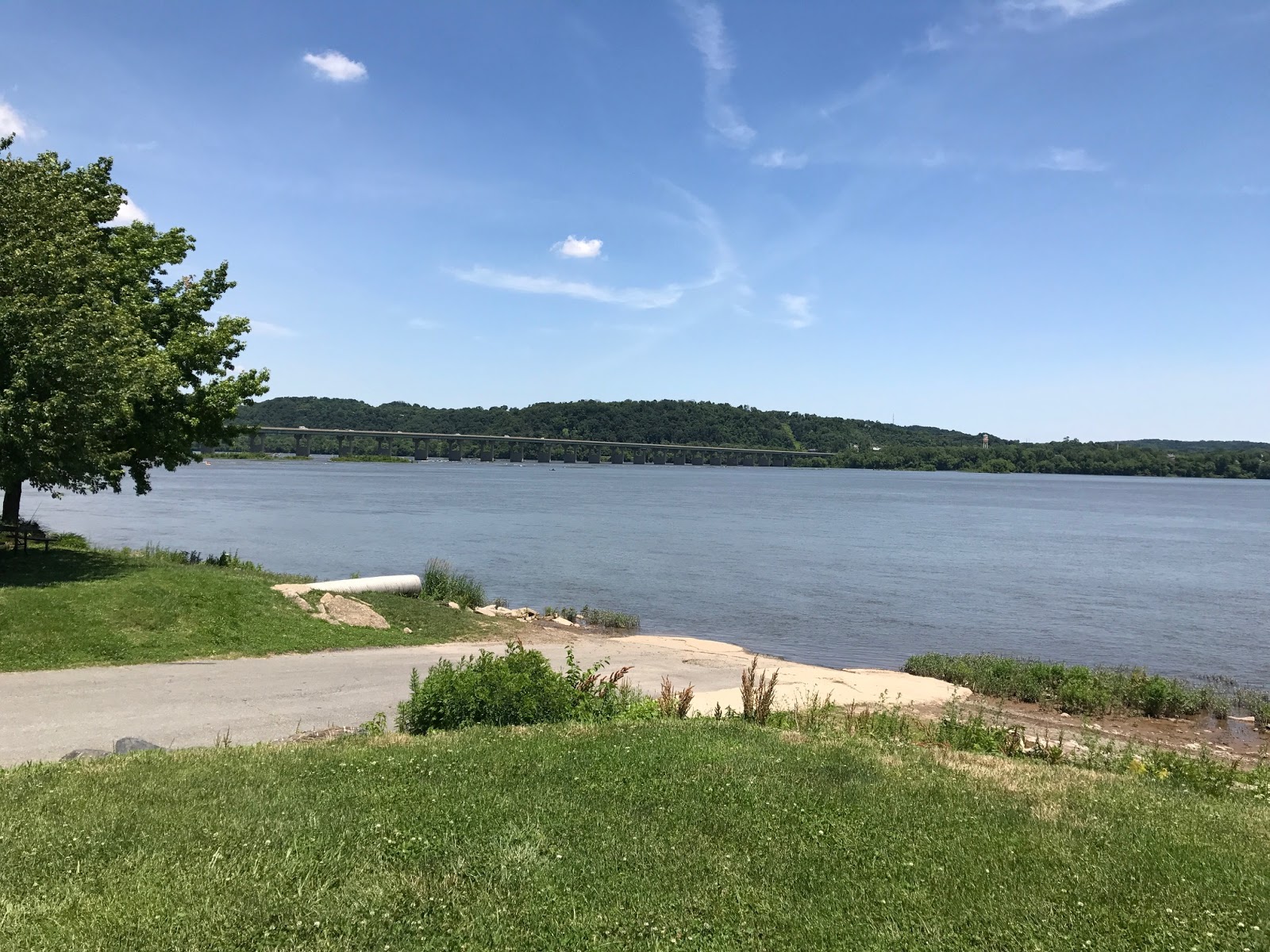
The view from the restaurant looking toward the Veteran's
Memorial Bridge.  In the background, to the left, is Columbia, PA.
The day was beautiful and the scenery was fantastic.  We have eaten at this spot before and always enjoy watching the activity on the river as we dine.  Plenty of boating and fishing taking place today.  We reserved a table closest to the water and weren't disappointed.  Carol had a salmon burger with slaw and a drink and I had a BLT with Cream of Crab/asparagus soup and a drink.  Shared a dessert which for the life of me I can't remember what it was.  Wasn't any good or I would have remembered.  Our wedding anniversary is actually on the 17th, but it happens to fall on Father's Day, so we opted to celebrate our anniversary a day early.  
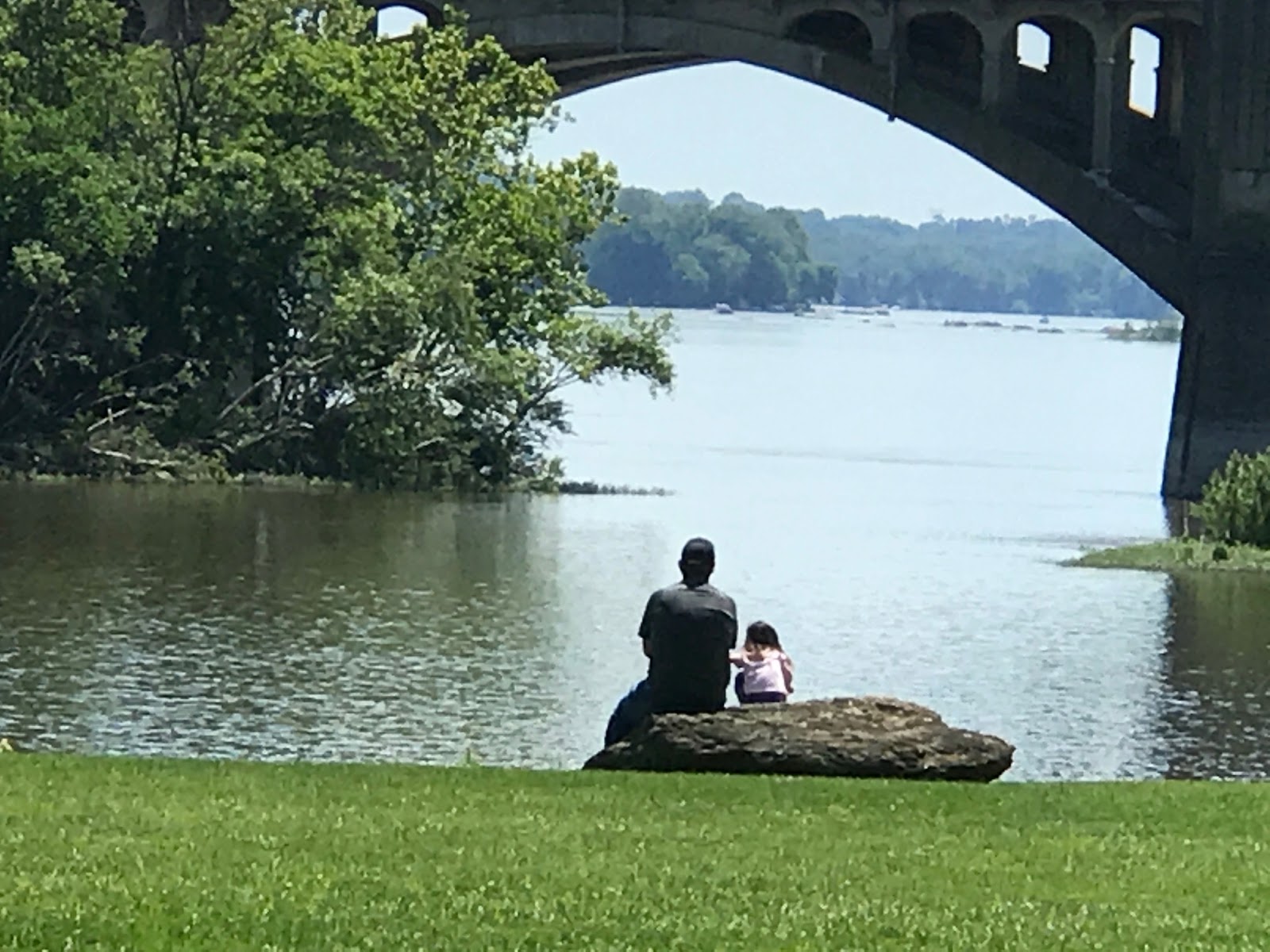
A young father and his daughter watch the water activity.
The older you get, the more "special days" don't seem to be as special and when a few fall on the same day, you learn to make adjust- ments.  The view from our table is amazing with the bridge to our right being the 1930 Columbia-Wrightsville Bridge, also known as the Veterans Memorial Bridge.  The American Society of Civil Engineers named the bridge an engineering landmark and said it is "a splendid example of the graceful multi-span, reinforced-concrete, arched form popular in the early 29th Century highway bridges in the United States."  Sitting south of the bridge are concrete abutments that at one time held a railroad bridge.  
Off to our left is the Wright's Ferry Bridge or US Rt. 30.
Click to enlarge photographs.
The Veterans Memorial Bridge is the 5th bridge to span the Susque- hanna at this location with the 6th and latest bridge, The Wright's Ferry Bridge, or current Rt. 30, to the left of us.  An earlier bridge where the Veterans Bridge now stands was intentionally burned during the Civil War to stop the South from crossing and heading to Philadelphia.  Instead they retreated to Gettysburg and were defeated there.  The very first bridge was built of wood in 1814.  After our meal we found a place to sit along the water and enjoyed the day while watching the fishermen and boaters as well as the traffic on the bridges on either side of us.  Although our day wasn't as spectacular as last year's anniversary, we still had a chance to share a special moment together.  Anyway, tomorrow being Father's day is another day for celebrating!  It was another extraordinary day in the life of an ordinary guy.

Monday, June 18, 2018

The "Free Samples For Everyone" Story

It was an ordinary day.  Looking over the USA Today's 10 Best Food Factory Tours.  Tours of some of the neatest factories in the United States from Kealakekua, Hawaii to …..  Nottingham, Pennsylvania.  Many of the factories are well-known names such as Jelly Belly in Fairfield, California to the Pez Company in Orange, Connecticut to the Tabasco Pepper Sauce factory in Avery Island, Louisiana.  In case you haven't read the article, here is a brief description of the factories with a photo of a few of them.

  • #10 - Boudin Bakery in San Francisco, CA.  During this tour visitors can watch the famous Boudin bread being made right before their eyes.  A glass catwalk gives you a birdseye view of the 12,000 loaves of bread that are made every day.  They also offer bread sampling in a tasting room.
  • #9 - Jelly Belly Visitor Center in Fairfield, CA.  Wear pants with deep pockets, since this tour is said to leave your pockets full of free jelly beans.  You can watch the bean-making behind the scenes during a forty minute walking tour, but you need to do it during the week since the factory shuts down on weekends and holidays.  
  • #8 - Greenwell Kona Coffee Farms in Kealakekua, HI.  I'm not sure I could stand to take this tour since I am not a coffee drinker or don't even enjoy the smell of coffee.  But, if you do enjoy the smell and taste, you are in for a great time since you get a cup of free coffee at the end of the tour as well as free samples of their products.  During the tour you get to see how the coffee beans are harvested on a working Hawaii farm in your 30-minute guided tour.
  • #7 - Cabot Visitor Center, Cabot, VT.  When you visit Vermont's Cabot Creamery you can learn about the history of the creamery which dates back to 1919.  During the tour you will have a chance to see how they make their cheese and then have a chance to sample the different cheeses.  Naturally, you can purchase their products in the company's Visitor Center.
  • #6 - PEZ Visitor Center in Orange, CT.  Would love to take a tour of this place.  I used to have quite a few PEZ dispensers and still buy them for my grandkids at Christmas time.  The 4,000-square-foot visitors center includes the production room and factory store.  The self-guided factory tour lets you see how the candy, as well as the collectible dispensers, is made while looking through windows.  While visiting you get a chance to sign up to win a free PEZ dispenser which I assume is loaded with their sugary treat.
  • #5 - Celestial Seasonings factory tour in Boulder, CO.  You can see tea being made during the 45-minute factory tour which takes you through the tour to see the ingredients blended, packaged and then put on the line for shipping.  Free samples of the tea are given as well as being able to visit their Tea Shop to purchase the variety of teas they make.
  • #4 - Hershey's Chocolate World in Hershey, PA.  OK, now you've come to one of the factory tours that I have taken.  
    Photograph of the Hershey Chocolate Factory in 1905.
    The free tour starts when you step into a tram-style car that takes you on a 30-minute tour where you learn how cocoa beans are transformed into the chocolate bars that you will get to taste at the end of the tour.  A "Premium" tour takes you on a trolley that goes through a make-believe, old-fashioned chocolate city where you learn about the life of Milton Hershey.  
    Factory as it appears today.
    Years ago, when I was a child, I was able to tour the actual Hershey's plant where they made the Hershey Bars that were wrapped and then shipped.  Sanitary and safety problems caused Hershey to build their Chocolate World which is how you now get to see the simulated chocolate procedure.
      
  • #3 - Hammond's Candies Factory in Denver, CO.  This free tour starts with a video, a tour of the candy shop and a tour of the real-world Willy Wonka factory where you can watch workers making candy in massive kettles, coloring it, cutting it and packaging it.  There is no mention of getting any free candy during this tour, but I can't help but believe you can't find a piece or two somewhere on the floor of the factory.
  • #2 - Tabasco Pepper Sauce Factory in Avery Island, LA.  This tour is said to be a tour like no other.  During the tour you get to see the spicy sauce aged in white oak barrels as well as being bottled and shipped.  But, since the factory is located on a salt dome island, the tour includes a 170-acre jungle garden, marshes that are home to alligators and wildlife and a country store where you can pick up goodies to take home.
  • #1 - DRUM ROLL PLEASE!  This is also a tour that I took a few years ago and even have posted a story about taking the tour.  The factory is the Herr's Snack Factory in Nottingham, PA.  
    Front of the Herr's Snack Factory.
    The factory is about a forty-minute drive from my home and by the end of the tour I had eaten way more than my share of potato chips. The tour takes one-hour and you need to register online since the tour is so popular it is heavily attended.  On the day of the tour that Carol and I took, we left home in plenty of time …. so we thought.  Traffic and road construction saw us arrive about two minutes before the start of our tour time.  
    Photo of the packaging line.
    We ran from our car to the tour entrance and were the last two people on the tour.  Proved to be a great place in line since we got to eat the warm samples that were left over at each one of the stops along the tour. And to top that off, we each got a free bag of chips before we went home.  I can see why this was voted the #1 factory tour in the United States.
So there you have the list of favorite factory tours.  I'm sure you have probably been on some memorable tours during your life, but if you ever happen upon one of these locations described above, stop and enjoy the tour and a few free snacks.  It was another extraordinary day in the life of an ordinary guy.

Sunday, June 17, 2018

The "Photographs And Photographers Throughout Lancaster's History" Story

A wedding photograph taken of my wife in 1967 by
John Gates.  It's been 51 years ago today that it was taken.
It was an ordinary day.  Just pulled out the wedding photos that Carol and I had taken when we were married on June 17, 1967.  Album had 26 8"X10" photo- graphs; 4 of them were color prints while the rest were black and white.  We chose John Gates Studio in Lancaster, Pennsylvania after seeing some of his work as well as being able to afford his prices.  If I remember correctly, there were about two dozen professional photographers in Lancaster when we got married.  If you Google "Wedding Photographers in Lancaster, PA" today you will find reviews for 340+ photographers.  Wow, either Lancaster has grown tremendously since we were married over 50 years ago or people are getting married more frequently.  Got me thinking about how many photographers there might have been in Lancaster when having wedding photographs taken first became popular.  I had a hard time finding information so I took my search online to the Facebook page titled "The Lancastrian".  
Back and front of a Carte de Visite from
Frank Saylor Studio at 45 West King Street.
Wasn't long before I had answers, though they weren't necessarily about wedding photo- graphers.  Seems that photo- graphic studios began to open in Lancaster in the late 1800s.  The first permanent images came about in the late 1830s in France when Joseph Niepce used a portable camera obscura to expose a pewter plate coated with bitumen to light.  Daguerreotypes, emulsion plates and wet plates followed in the mid to late 1800s.  Then in the 1880s George Eastman started a company called Kodak and the flexible roll of film that fit in a self-contained box camera gave the public a chance to take images of just about everything including weddings.  You would take photos with your box camera then take your camera back to the store to have the camera sent to Kodak so the film could be developed and prints made.  When you went back to the store for your photographs you would also pick up your camera loaded with more film.  Then in the 1930s the use of 35mm cameras began.  
Another Carte de Visite from Otto Weber Studio in Lancaster.
In 1948 Polaroid introduced a film that would allow you to take a photograph and watch it develop after it came out of the camera.   It was in 1991 that Kodak produced the first digital camera that was used successfully by professionals.  Those people who answered my request for photographers in Lancaster gave me a wealth of information.  Some people showed me samples of carte de visite which began in the mid-1800s and were slightly over 2 inches by 3.5 inches.  Studio photos were placed on lightweight board and used to trade with friends and relatives.  
The larger Cabinet Card from Ernst
Studio at 28 East King Street in Lancaster.
Local studios that produced these cards that I know about were Saylor at 45 West King Street, J. Stehman at 10 West King Street, Otto Weber at 108 North Queen St., J.S. Saurman at 43 1/2 N. Queen Street and Cummings at 6 North Queen Street.  Next came the larger Cabinet Cards.  A Facebook responder, Sharon, told me that her husband collected Cabinet Cards from the turn of the last century and has photos from the following galleries: Ernst at 28 East King Street; Wm. T. Gill at 19 E. King St.; The Fowler Gallery at 12 W King Street; Rote at 106 N Queen Street; A.M. Lease at 22 N. Queen Street; Black's Gallery at 24 W. King Street; Otto W. Weber at 106 N. Queen Street; Aller's Gallery at 12 W. King Street; and Dengler's Studio at 14 S. Queen Street.  Another poster, Brenda, told me of a studio that was in business in 1923 called Killian.  
Cabinet card from Killian Studio.
I also had quite a few people tell me of places they knew in Lancaster from the mid-1900s such as Darmstaetters at 37 N. Queen Street, Russo's and Peel's in downtown Lancaster, Jaffe's Camera Shop in center city, and Gates Studio to the west of the city.  In 1944 George Coe opened his camera shop in Lancaster along North Queen Street.  His store was a photography store which sold cameras and film rather than operate as a studio.  In 1965 his store was part of a redevelopment project and was demolished so he moved a block to the west and opened at 220 N. Prince Street.  I got to know Mr. Coe as well as those that worked in his store and those who took over the store after Mr. Coe retired.  I would purchase my supplies, equipment and materials for my high school photography class I taught beginning in the early 1970s.  
George Coe opened his photo store in 1944 on North
Queen Street.  You can see it in the second block on
the right of this photograph.  Click to enlarge.
Another long time photo- grapher in Lancaster was Jack Long Photo- graphy which was located at 642 Fountain Ave.  Jack and his son Ken took the senior portraitures for Manheim Township High School's yearbook for years.  Since I was the yearbook advisor I got to know both of them quite well.  
George Coe inside his photo store.
Ken would often talk to my photography classes.  Another friend and photographer, Andy Kelly, operated a store in the Lancaster Shopping Center for many years.  Andy still supplies me with photos of sports teams for the Manheim Township yearbooks.  Photographs and photographers are a part of every community and city throughout the world.  Their services may have changed somewhat from what they did years ago, but the fact that they helped document the history of the communities and cities in which they are located will never change.  And, I suspect that many years from now it will still be that way.  It was another extraordinary day in the life of an ordinary guy.


Downtown Lancaster Photographic Store Darmstaetter's would produce these Album Prints booklets from a roll of film.
The back of the albumn tells the Subject, Place and Date the photos were taken.
Ben inside Coe Camera Store on North Prince Street.
  

Saturday, June 16, 2018

The "Jimmy Buffett Owned One Of These" Story

It was an ordinary day.  Carol and I were driving back from one of my grandson's baseball games at nearby New Holland when out of the corner of my eye I saw it.  Turned my head slightly and saw the name on the building as Steffy's Garage.  In a few seconds I had lost the neat little car that was in the building's front window.  I knew at that moment I would return to see it as soon as I could.  
1954 Nash Metropolitan
A few days later I retraced my route and pulled into the front parking lot of the car repair shop.  I walked through the door and asked the man at the counter if I could take a few photos of the 1954 Nash Metropolitan that was next to me.  "Help yourself," he responded.  "Is it for sale?" I asked.  He replied, "Anything is for sale...if the offer is right!"  
My first car...a 1953 Henry J.  It was very close to this color,
 but that may have been due to it being covered in rust.
Took a few steps to the front of the car and marveled at the condition the car was in after all these years.  It looked as if it had been repainted, but the interior was in near-perfect condition.  Brought back memories of my first car, a 1953 "Henry J" which had a coat of rust on the exterior when it was delivered to my house in the north end of the city of Lancaster, PA.  
A better look at the rear of the Metro with tire on rear.
The four-cylinder "Henry J" was the idea of Henry J. Kaiser who was one half of the Kaiser-Fraiser car company.  Eventually painted it and refurbished the interior before it was demolished by a drunk driver one evening while sitting in front of my home.  As for this gorgeous '54 Metropolitan, I'm not sure if I ever saw a care quite as small.  It was smaller than the VW Bug in 1954.  It was known as both an economy car and subcompact car.  The four-cylinder car was actually sold as a Hudson when Nash and Hudson merged in 1954 to form American Motors Corporation.  
Closer look at the front of the car.
The car was in production from 1953 to 1962.  It was sold as either a 2-door convertible or a 2-door hardtop which is what I was standing in front of right now.  The engine was either a 1,200 cc or a 1,500 cc model.  All Metros came with a 3-speed manual transmission.  It was 149.5 inches in length, 61.5 inches wide and 54.5 inches high with a curb weight of 1,785 pounds.  
The car had the original 1954 Pennsylvania inspection sticker.
Not sure if it had been saved and taped back in place or if
the car had only been on the road for a year.
It was built to resemble the bigger Nash automobile, but much smaller.  The car was first named NKI (for Nash-Kelvinator Inter- national) and built entirely in Europe, but the name was changed to Metro- politan just two months before its public release.  Nash dealers had to take off the custom chrome nameplates and replace them before the cars were shown for the first time.  
This photo show the front seat area.  Carpet, upholstery,
floor mats and headliner all look to be new or restored.
The car featured a map light, electric windshield wipers, cigar lighter and "conti- nental- type" rear-mounted spare tire and cover.  To make it more luxurious they added Bedford-cord upholstery trimmed in leather, an AM radio, "Weather eye" heater and whitewall tires.  It at first was marketed specifically for women.  The first spokesperson for the car was Miss America 1954, Evelyn Ay Sempier, who just happened to be a resident of Lancaster County, Pennsylvania.  
You can see the cramped space in the rear.
It was featured in Woman's Wear Daily.  As I stood in front of the car I wondered if I would fit in it.  Wasn't long before I was sitting in the driver's seat!  Would be tough to sit in the rear seat if you were an adult, but it was comfortable in the front seat.  Checked out the interior and escaped from the seat to take a few photos of the car to share with you.  The car was only in production for 10 years, probably due to the fact that Americans loved big, bulky cars at the time.  A few of the paint colors for the car carried names such as Canyon Red, Caribbean Blue, Sunburst Yellow and Mardi Gras Red.  If this car had been made today it may have been more successful due to its size.  And, to think Jimmy Buffett owned one of these!  Now that's cool!  It was another extraordinary day in the life of an ordinary guy.

Friday, June 15, 2018

The "Lancastrians Who Fought For The USA In WWI: Part III" Story

It was an ordinary day.  Reading a story, or perhaps I should say a first-hand account via a diary, written by Dr. Charles P. Stahr who was a Captain in the United States Army during WWI.  I was able to access files which contained personal diaries of several Lancastrians who fought in several wars for the United States.  
This is Lancaster's Armory which eventually became known as
Stahr Armory on North Queen Street in the city of Lancaster, PA
These files are part of transcriptions made by Franklin & Marshall College students in Lancaster, Pennsylvania that can be found in the F&M archives and website.  Charles P. Stahr's diary begins on April 17, 1917 and tells of the brutal war that affected the entire globe.  It also affected alumni, students, professors and staff of F&M who all wanted to do their part during WWI by enlisting in the military.  One of those students was Pvt. J. Reah Hollinger who I wrote about yesterday and who was part of the 111th Ambulance Company.  The 111th Ambulance Company was captained by Charles P. Stahr, a Lancaster educator as well as a medical doctor.  Dr. Charles P. Stahr's father, The Rev. Dr. John Summers Stahr, served as President of Franklin & Marshall College where he had taught since his graduation from the college.  After college Dr. John Stahr became a professor of history and German and after receiving his Master's Degree studied theology and became pastor of St. Paul's Reformed Church in Lancaster.  
This monument can be found in Lancaster's
Buchanan Park.  It honors Lancastrians who
served in the 111th Ambulance Company.
Charles P. Stahr was the oldest son in the family who chose to attend F&M and then Medical School at the University of Pennsylvania.  He returned to Lancaster to install and run the first diagnostic laboratory at Lancaster General Hospital.  He opened his own practice on Walnut Street in downtown Lancaster and when the war broke out in Europe in 1914 and then in 1916 along the US border with Mexico, he decided to use his medical skills to help his country.  He enlisted in the army in 1916 and achieved the rank of 1st Lt. of the 4th Pennsylvania Infantry.  He was soon assigned to the Mexican border campaign against Francisco (Pancho) Villa.  After returning to Lancaster he served with the 3rd Ambulance Co. of the National Guard.  He then was asked to begin an ambulance company which he did at the Lancaster Armory by recruiting 90 men from F&M, Millersville State Normal School and Lancaster city.  He readied them for combat and by August 5th of 1917 they traveled to Georgia for deployment to England and then on to France where his ambulance company was one of four belonging to the 103rd Sanitary Train which served in conjunction with a field hospital unit of the same number.  His group was stationed as close to the trenches as possible serving as the first stop in the process of treatment.  
On the plaque you can see the wording used to honor the
111th Co.  Directly under it is listed Charles P. Stahr's
name.  Click on photo to enlarge it.
Troops would arrive, receive immediate care and be quickly moved to the ambulances for transport to the field hospital which was a few miles behind the battlefront.  But, at times battlefield conditions didn't allow the ambulances to depart and the members of the company had to treat everything from broken hands to chest and head wounds, way beyond the scope of their training.  All relied on Stahr's ability as a captain and a doctor.  During his service, Stahr's company only suffered one casualty.  When the war ended, Captain Charles Stahr received an honorable discharge, only to resume his military service in Europe during WWII as a surgeon in the Army's Infantry Unit.  He remained in service to his country for 26 years and earned the rank of Brigadier General in the Medical Corp of the Pennsylvania National Guard.  If you are old enough to remember the TV series "Mash", you can probably relate to what Stahr and his group must have gone through.  Upon his retirement in 1956, a bronze plaque was dedicated in his honor on behalf of the remaining members of the 111th at the Lancaster Armory.  He also received the General's three stars he had earned.  He died at the age of 85 of a cerebral hemorrhage.  He is remembered in Lancaster as being deputy coroner for Lancaster County, the framing of Lancaster's first pure milk ordinance as well as beginning the first immunization program for the city's public schools.  A true Lancaster hero!  It was another extraordinary day in the life of an ordinary guy.

Thursday, June 14, 2018

The "Lancastrians Who Fought For The USA In WWI: Part II" Story

It was an ordinary day.  May 30, 1918, Liverpool, England and Pvt. J. Reah Hollinger of Lancaster, Pennsylvania had just arrived on his way to serve with the 111th Ambulance Company, 103rd Medical Battalion of the 28th Div. U.S. Army.  
Pvt. J. Reah Hollinger (left) next to his ambulance.  This
photograph is from the F&M diaries collection.
Pvt. Hollinger was a 1913 graduate of Franklin & Marshall Academy as well as a graduate of F&M College in Lancaster.  His 1919 diary, housed in the Martin Library of Sciences at F&M College, tells of his exploits during WWI.  Men from F&M and the Lancaster area felt a need and duty to enlist in their nation's military to serve their country as WWI flared in Europe.  But, as these same men were removed from Lancaster to fight, they often suffered from homesickness and therefore felt the need to document their wartime travels and experiences for their families.  
A monument honoring members of the 111th Ambulance
Company can be found at the Buchanan Park in Lancaster, PA.
These diaries can be found at F&M.  I was able to read parts of Pvt. Hollinger's story as he served under another Lancastrian, Captain Charles P. Stahr, a key figure in the Lancaster educational and medical community who eventually became a Brigadier General in the Army and who was honored in Lancaster when the local armory was named after him.  Hollinger's diaries cover the period from January 1, 1918 to June 20, 1919 and give insight into the experiences of an ordinary soldier in WWI as well as WWI medical care.  Dr. Stahr (Captain Stahr) enlisted in 1916 and served along the Mexican border in the campaign against Francisco (Pancho) Villa, a Mexican general and revolutionary.  After service there he returned to Lancaster and served with the 3rd Ambulance Co. of the National Guard.  When the war in Europe began he recruited 90 men from F&M College and Millersville State Normal School as well as the surrounding Lancaster area and began to train them as an Ambulance Company.  Although they never expected to fight in battle, the medical work they would do on the front lines required training and practice.  They practiced at the Lancaster Armory.  
Pvt. J. Reah Hollinger's name can be seen on the monument
as a bugler for the 111th Ambulance Company.
When war was declared, Pvt. Hollinger and 155 other men, traveled by railroad to Camp Hancock in Georgia where they started to train with the ambulances that would follow the unit across the Atlantic.  When they landed in England their company was split into smaller units with Capt. Stahr, now called "Skipper" by his troops, in command.   Pvt. J. Reah Hollinger was part of Capt. Stahr's 111th Ambulance which was one of four ambulance companies that were part of the 103rd Sanitary Train.  He was the bugler as well an an orderly in the company.  In France they oversaw a mobile First Aid Dressing Station as well as working the front lines, treating wounds and helping transfer wounded to field hospitals.  Reading the accounts of the 111th was compelling.  Pvt. Hollinger's account of the events told of the dangers they constantly faced, even though they weren't on the front lines of the war.  At one point he wrote that at the time there were no planes with "iron pills."  That was what German bombs were called.  Both Stahr and Hollinger made it home after the war.  There is a monument in nearby Buchanan Park to memorialize the 111th.  Hollinger died in Lancaster in 1996 at the age of 101 and was the last survivor of the 111th Ambulance Company.  I couldn't find the date that Brigadier General Charles P. Stahr died.  If you live within diving distance of Buchanan Park, stop sometime and view the memorial.  It was another extraordinary day in the life of an ordinary guy.   

Wednesday, June 13, 2018

The "Lancastrians Who Fought For The USA In WWI: Part I" Story

It was an ordinary day.  Its been a little over 100 years ago that close to 500 Lancastrians marched through Penn Square following a flag bearer.  They followed as he took them through the streets of downtown Lancaster singing patriotic songs as they vowed to win the war with Germany.  The day before, April 2, 1917, the President of the United States, Woodrow Wilson had asked all Americans to join the fight in Europe.  Soon after, Congress supported the declaration of war and a patriotic spirit filled the streets of the Red Rose city as it had during the Spanish-American War and the Great Rebellion.  The mayor of Lancaster, Mr. H.L. Trout, told the citizens of Lancaster that between 800 and 1,000 men were needed to respond to the call to bear arms and join the Army and Navy.  More than 5,000 volunteered or were drafted.  Thousands participated in a preparedness parade.  But, the march was silent since everyone knew how costly it would be to wage war.  Thousands marched away to help defeat Germany, but the cost was tremendous with 250 Lancasterians killed and 9 million soldiers and 10 million civilians dying during the war.  Many from Lancaster fought in the Army's 28th Division under a young Lieutenant by the name of Daniel Strickler.  That young man eventually was gassed and wounded, but would survive to become a General in WWII as well as the Korean War and also became Pennsylvania's Lieutenant Governor.  Another young man by the name of Charles P. Stahr, a Lancaster physician, commanded the 28th Division, 111th Ambulance  Company of the 103rd Medical Battalion.  
War Memorial in Buchanan Park dedicated
to those who fought in WWI.
Today, in Buchanan Park in the city of Lancaster stands a memorial to the 111th.  In 1996 the final survivor of that company, Reah Hollinger, died at the age of 101.  Another Lancastrain, Boone Bowman was said to be the first American to plant our nation's Stars and Stripes in a German-occupied territory when he placed a flag behind enemy lines while on an early mission to rig a telephone line.  On the home front National Guardsmen guarded the bridges along the Susquehanna River as well as the Pennsylvania Railroad tracks.  The Red Cross "Gray Ladies" sold Liberty Bonds from a miniature Courthouse in the center of Lancaster and all Lancastrians observed gasless Sundays, meatless Mondays and heatless Tuesdays to help conserve supplies for our troops.  
The miniature Court House where the Red Cross "Gray
Ladies" sold War Bonds.  It now stands in Buchanan Park.
And, German prejudice increased in Lancaster with German Street being renamed Farnum Street and Freiburg Street becoming Pershing Ave.  An F&M professor and a Lutheran minister were forced to resign were forced to resign after being viewed as not patriotic.  People of German heritage were mistreated.  Then on November 11, 1918 at 11:00 am the celebration began when church bells rang out and factory whistles sounded as the fighting ended and surviving soldiers came home.  Rallying around the flag of the United States had worked as it has many times since then.  My stories the next two days will tell of a few Lancastrians who went beyond the call to duty to help our nation.  Follow tomorrow as I tell of those from Lancaster who fought for the USA in WWI.  It was another extraordinary day in the life of an ordinary guy.  

Tuesday, June 12, 2018

The "Lancaster County: History and Fun All Tied Into One!" Story

It was an ordinary day.  Pulled up an old story from a few years ago that listed the names of towns in Lancaster County that had rather unusual or perhaps repugnant names given to them years ago.  Towns with names such as Bareville, Blue Ball, Bird-In-Hand and even Intercourse have been part of Lancaster's heritage for hundreds of years and aren't going to change any time soon.  It's what draws attention to some of Lancaster's cities as well as draws tourists to the towns.  But, there are also quite a few names of towns or locations in Lancaster County that possess Native American names and carry Native American backgrounds to them. All the major streams in Lancaster County have Native American names.  It isn't quite clear whether the Susquehanna River has a Native American name since the origin of Susquehanna varies according to different sources.  In one case Susquehanna comes from the Lenapi (or Delaware Indian) term Sisa'we'hak'hanna, which means "Oyster River."  The Lenapi tribe were known for farming oysters from the river.  They also were known to have lived in Washington Boro, also called Ka'ot;sch'ie'ra.  
Map of Lancaster County, Pennsylvania showing the
NativeAmerican names associated with towns
and rivers.  Click on the image to enlarge.
The entire area of Southern Lancaster County was called Sisa'we'- hak'
hanna'- unk by the Lenape tribe.  Yet again, in another case, the origin of Susque- hanna, from earlier Sasquesa- hanough, was the name of an Iroquoian people in an unidentified Eastern Algonquian language.  The entire area of southern Lancaster's Conestoga river is derived from Kanastoge which means "place of the immersed pole."  The Conestogians were Iroquoian-speaking Native Americans who lived in the area adjacent to the Susquehanna river and its tributaries.  Running through the center of Lancaster County is the Pequea Creek which was named for the Piqua tribe of the Shawnees.  In the town of Columbia there was a Shawnee Run and to the north of Lancaster County is the Cocalico Creek which means "place where the snakes gather in dens to pass the winter."   The Conewago Creek divides Lancaster from Dauphin County and gains its name from the Ganowungo tribe, meaning "at the rapids."   To the northeast of the county runs the Conoy Creek which is the name for the Conoy tribe which was permitted to settle in Western Lancaster County.  The Chikiswalungo Creek eventually became known by the Native Americans as "the place of the crawfish."  In 1817 a war with the Seminoles in the southeastern United States led to the name of a small village in the north-center of Lancaster County called the Village of Seminole even though there was never a single Seminole Indian in the place.   So, as you can see, Lancaster County is rich in Native American history, but still draws many visitors and tourists due to the rather unusual names given to the small towns spread throughout its 984 square miles.  Change the names and they may not take the time to visit.  It was another extraordinary day in the life of an ordinary guy.

Monday, June 11, 2018

The "An Historic Susquehanna Beach Town: Part II" Story

It was an ordinary day.  Talking with a woman who is taking her young child for a walk on the sidewalks of Marietta, Pennsylvania.  She and her older daughter, who is walking their pet dog, stopped to talk with me about the building I am standing in front of taking photographs.  
The Meeting House with graveyard around it.
Click on photographs to enlarge them.
Very interesting place that is solid brick and resembles a church.  A cemetery surrounds the building and new walkways are being placed around the building.  A cupola with metal weather vane sit atop the structure.  I asked the woman if she knew what purpose the building served in the community.  
A few of the tombstones that date to the early 1800s.
She said she grew up in Marietta and lived her entire life there.  Her son and older daughter were both married in the building.  She knew it as the  Meeting House.  I thanked her for her information as she continued on her way.  The building is on an unusual angle in the middle of what looked to be two streets that didn't meet where they were supposed to meet.  
The Old Town Hall Museum dated 1847.
Close by was another building called the "Old Town Hall Museum."  As I stood in front of that building I read a plaque that gave me part of my answer to the two buildings.  Seems that in 1812, two towns, New Haven and Waterford, were incorporated to form Marietta Borough.  New Haven and Waterford were developed by James Anderson and David Cook on a bend in the Susquehanna.  
An old black and white photo of the Old Town Hall.
The towns were located at a scenic 90 degree bend in the Susque- hanna River that was formerly known as Anderson's Ferry after the ferry boat that traversed people from one side to the other on the river.  The town got it's name due to the fact that the wives of both men where named Marietta.  The town was formed by joining the main streets of the two towns which resulted in the S-bend where I was standing.  
First bank built in Marietta.  Photo from Steve Bailey
On the small church-like building is a cornerstone with a date of 1818.  I found that the Union Meeting House was built and completed in 1818 and had space for a public burying ground.  The nearby Town Hall has a marble date block that carries the date of 1847.  Both buildings are in excellent condition and both beautiful.  
Current building as it appears today.
I found another remarkable building along Market Street that had a stone by the entrance- way that read Duffy- Rottmund House with a date of 1863.  Mr. James Duffy and two others purchased 161 acres of land and laid out 62 building lots and necessary streets.  One of the mansions along the street was the home to Mr. Duffy.  
The Duffy-Rottmund House built 1863.
Presidents Grant and Cleveland along with Supreme Court justices and railroad presidents made frequent visits to Mr. Duffy's house.  Not quite sure why, but didn't stop to ask.  Another building along Market Street is the First National Bank of Marietta.  It was built in 1863.  Check out some of the photographs I took during my recent visit to Marietta.  
View of the Susquehanna River from the
Northwest Lancaster River Trail.
Before I left the town I decided to make one last visit.  I followed the signs to the Northwest Lancaster River Trail.  Finally parked my car and began my trek along the river.  Didn't take long before I made a quick turn and return to my car.  As I walked through the vegetation along the trail to try to get to the water, I was accosted by a multitude of mosquito's.  Quickly found my way back to the car and headed out of of Marietta knowing I would return again to visit the musuems that happened to be closed the day I made my visit.  My trip to the town was interesting, but as my title says, I never found the beach as was suggested in Google's listing online.  Maybe my next trip.  It was another extraordinary day in the life of an ordinary guy.


Sign next to the door of the Music Box Museum.
The Music Box Museum on Market Street in Marietta, PA
I entered this town government building to ask for any brochures they might have on the history of the town.  Sadly they had none.  I did get one brochure on the Northwest Lancaster River Trail which I used to locate it.