Extraordinary Stories

1944 (1) Act of kindness (12) Acting (2) Adoption (4) Adventure (766) Advertisement (6) Africa (1) Aging (14) Agriculture (47) Airplanes (9) Alphabet (5) American Red Cross (1) Americana (116) Amish (43) Ancestry (5) Ancesty (2) Animals (43) Anniversary (4) Antigua (10) Antiques (14) Apron (1) architcture (1) Architecture (36) Art (175) Art? (8) Arts and Crafts (69) Athletics (6) Automobiles (40) Awards (7) Banking (2) Barn raising (2) Baseball (103) Basketball (3) Batik (1) Beaches (89) Becoming A Citizen (1) Bed & Breakfast (2) Bee Keeping (6) Beer & Breweries (2) Bikes (3) Birds (9) Birthdays (34) Blindness (1) Blogging (5) Bookbinding (5) Books (12) Boxing (2) Brother Steve (12) Buisiness (3) Business (5) Canals (1) Cancer (14) Candy (30) Caribbean Islands (9) Caribbean Villas (15) Cats (5) Caves (1) Census (1) Chesapeake Bay (61) Children (28) Chocolate (4) Christmas (57) Church Adventures (122) Cigars (1) Circus (3) Civil Rights (8) Civil War (6) Classic Cars (7) Climate Change (5) Clubs (1) Coin club (2) Coins (1) Collections (73) Comedy (3) Comic Books (5) Commercials (1) Comnservation (2) Conservation (41) Covered Bridges (3) Craftsmanship (12) Creamsicle the Cat (11) Crime (16) Crisis (312) Cruise Travel (6) Crying (1) Culture (4) Dancing (1) Danger (16) Daughter Brynn (58) Daughter-In-Law Barb (7) Death (5) Death and Dying (65) Destruction (2) Donuts (1) Downsizing (2) Dunking (5) Easter (3) Eavesdropping (1) Education (48) Energy (15) Entertainment (165) Entrepreneurial (62) Ephrata (1) Etchings (1) Eternal Life (4) Facebook (5) Factories (4) Fads (6) Family (261) Farming (37) Father (42) Father Time (68) Favorites (88) Firefighting (1) Flora and Fauna (28) Fond Memories (490) Food and Cooking (171) Food and Drink (111) Football (16) Forgetfullness (3) Former Students (10) Framing (30) Friends (359) Fruits and Vegetables (3) Fun (4) Fundraiser (6) Furniture (1) Games (7) Generations (3) Gifts (1) Gingerbread houses (1) Giving (8) Globes (1) Golf (3) Good Luck (2) Graduation (1) Grandkids (136) Grandparents (3) Grandview Heights (29) Great service (3) Growing Old (8) Growing Up (187) Guns (2) Handwriting (3) Hat Making (2) Hawaii (49) Health and Well Being (61) Health Care (4) Health Hazards (110) Heartbreak (7) Heroes (26) High School (142) History (777) HO Railroading (4) Hockey (4) Holidays (134) Home construction (7) Horses (2) Housing (3) Humorous (71) Hurricanes (1) Ice and Preservation (2) Ice Cream (8) Inventions (34) Islands (4) Italy (12) Jewelry (3) Job Related (62) Just Bloggin' (56) Just Wondering (19) Juvenile Diabetes (5) Labor (3) Lancaster County (542) Law Breakers (8) LDubs In-Laws (3) Lefties (1) Libraries (1) Life's Lessons (175) Lightning (1) Lists (72) Lititz (18) Locomotives (1) Lodging (1) Love (4) Magazines (2) Magic (1) Maps (2) Marching (2) Market (5) Medical (161) Memories (28) Middle School (3) Milk (2) Minorities (1) Money (3) Mother (54) Movies (6) Mt. Gretna (1) Music (118) My Brother (19) My Wife (260) Neighbors (7) New Year's Day (5) Newspapers (4) Nicknames (2) Nuisance (3) Obsolescence (5) Occupations (2) Old Age (1) oldies (1) Pain and Suffering (12) Panama Canal Cruise (13) Parish Resource Center (14) Patriotism (3) Penmanship (1) Pets and Animals (99) Photography (220) Pizza (1) Plastic (2) Playing Trains (2) Poetry (2) Politics (27) Polution (3) Postal Service (2) Predators (2) Presidents (11) Pride (4) Printing (81) Protesting (3) Public Service (65) Questionnaire (1) Quilts (1) Race relations (6) Rain (1) Reading (4) Records (2) Religion (10) Retirement (4) Revolutionary War (3) Robotics (1) Rock & Roll (4) Rodents (2) Saints (4) Sand (1) Scouting (2) Sex (1) Shakespeare (1) Shelling (2) Shopping (24) Simple Pleasures (122) Slavery (6) Small Towns (4) Smoking (1) Snickedoodle (1) Snow (1) Son Derek (27) Son Tad (33) Son-In-Law Dave (27) Soup (1) Spices and Herbs (1) Sports (139) Sports and collectibles (1) Spring Break (1) St. James (2) St. Martin/Sint Maarten (306) Stained Glass (3) Stone Harbor (4) Story-Telling (26) Stragers (2) Strangers (4) Strasburg Railroad (1) Stress (3) Stuff (4) Suicide (2) Sun (1) Surfing (1) Tattoos (4) Teaching (49) Technology (90) Television (6) Thanksgiving (2) The Arts (6) The Beach House (62) The Flag (1) The Future (5) The Shore (78) This and That (23) Timekeeping (7) Tools and Machines (25) Tours (2) Toys and Games (31) Track & Field (1) Tragedy (8) Trains (19) Transportation (18) Travel (16) Trees (2) Trending (2) TV Favorites (23) Underground Railroad (10) Unit of Measurement (1) USA (2) Vacation and Travel (545) Vehicles (80) Vison and Eyesight (2) War (14) Watches and Watchmaking (5) Weather (48) Weddings (3) White House (1) Wisdom (3) Yearbooks (12) York County (3)

Thursday, September 20, 2018

The "Life In The Sand Dunes" Story

It was an ordinary day.  The second day of vacation at Stone Harbor, New Jersey.  Carol and I arrived yesterday after driving through a blowing rain for a bit over three hours.  After we arrived we headed to our destination along Second Street near the south end of what is known as the Seven Mile Island which is comprised of both Avalon and Stone Harbor.  We are guests for a week with my brother Steve and sister-in-law Kathy as well as nephew Matt and his wife Katie and their one-year-old son John.  
Access to the beach has been restricted.
As we pulled into the driveway, which is about 100 yards from the beach, we could see that the beach had been barricaded and the sand dunes had been drastically changed due to a week of bad weather and the prospect of another bad week and possibly the arrival of a hurricane by the end of our stay.  We unpacked, ate lunch and tried to plan the rest of the day.  
When we were able to use the pathways you had to
walk through waist deep sand dunes.
Some decided to try and reach the beach to see what damage might have been done while I decided against it since I am still recovering from back surgery and am wearing a supporting harness.  From the second floor balcony I could see the sand dunes and the fact that they are doing exactly what they were meant to do...that being a narrow ribbon of sand that is nestled between the high-tide line of the beach and the landscaping of the beachfront homes that butt up against it.  
Here you can see the height of the dunes in the background.
The sand in the foreground was deposited there by the waves.
Here you can see the sea grasses that helped stop the sand and ocean.
The dunes of the Seven Mile Beach rise close to 14 feet with a few higher areas and in most places they form a single ridge.  Beaches automa- tically know the level of the sea and at times tend to move either landward or seaward.  In Avalon and Stone Harbor the Army Corp of Engineers, the New Jersey Department of Environmental Management and both boroughs spend millions of dollars annually to try and keep the beach to hold its same position.  The success of holding its position is dependent on the whims of Mother nature.  Having a healthy dune line and wide beach can change dependent on the time between storms.  
Another view showing the sand that was
washed into the dunes from the ocean.
The dunes are the first line of defense in a storm.  They have to sacrifice themselves to absorb the incoming wave attacks.  Following a storm the dune is cut back, leaving a steep cliff face to a beach that tends to be eroded.  Dunes are very fragile, yet resilient.  The plants are an important part of the dune.  American beach grass is the native grass and is adapted to life in harsh conditions.  The grass thrives in conditions of shifting sand, sand burial and high winds.  Their strong root system is the key to their survival.  The plants actually need the over wash of the ocean to deposit seaweed which supplies nutrients to feed the grass.  One of the few things that negatively affects dune grass is people walking on it.  That will kill the dune grass and harm the structure of the dunes.  Its imperative to use walkways designed to allow passage to the beach.  
Other plants bloom amongst the sea grasses.
There are also other plant species that live in the dunes.  One, known as Seaside goldenrod, shows its late summer and fall yellow flowers that draw monarch butterflies to them as they head to wintering grounds in Mexico.  Other birds and small mammals use the dunes for food, shelter and nesting.  On the beach-face dunes, Ghost crab burrows are always abundant.  When fall arrives mass groupings of tree swallows feed in the coastal dunes.  
The bulldozer cleared the pathways for beach traffic.
These birds consume close to 2,000 insects each day.  During migration they also feed on berries that grow in the dunes.  In the winter the snowy owl can be seen in the dunes as they move south from their northern homes.  The dunes that we witnessed during our week stay were dunes that definitely had protected the homes along the west side of the dunes.  Large piles of sand covered the dune fences which told us that the wind and waves had forced the sand from the ocean floor onto the dunes.  The plant life also helped save the homes from destruction as they helped stop the water from advancing.  
Here a Ghost crab is clearing his home of sand.
On our fourth day of vacation we were able to access the beach and bulldozers arrived to push the sand that had covered the pathways with close to five feet deep sand mounds.  The sea is a beautiful creature, but can be destructive.  The destruction can be halted if towns can prepare by planning their sand dunes accordingly.  We certainly witnessed that feat during our vacation.  The planning saved the homes along the shoreline and the beach plantings were a big part of that planning.  Congratulations to all involved in the constant restoration of the sand dunes along beaches all over the World.  It was another extraordinary day in the life of an ordinary guy.
Every day of vacation was as this one.  The sea mist kept you from seeing more than perhaps 100 yards and the sun was absent from our vacation this year.  Very few people frequented the beach.

Wednesday, September 19, 2018

The "Faces of Strangers: #51" Story

Front of Clarke's Sunset Market in Stone Harbor, New Jersey.
It was an ordinary day.  Stopped in Clarke's Sunset Market on Third Street in Stone Harbor, New Jersey with my brother Steve to buy some groceries for the evening meal.  As we walked around the small grocery store I found a few items near the deli counter that interested me.  There on a shelf to the rear of the deli counter was a deep-sea diving helmet.  Wow, what a great piece of diving history.  I asked the clerk about it and she told me she would get the owner to help me.  
Charlie, store owner and metal shop teacher standing
in front of the diving helmet he has on display in his store.
Before long I was introduced to Charlie who owned and managed the store as well as loved anything nautical.  He told me all about the diving helmet and where he bought it and then directed me to a few other pieces of nautical equipment that were close by.  Sitting on the end of the deli counter was a light that looked as if it might have been on a ship or even a lighthouse.  
On the end of the deli counter sits this
great beacon light.  The base was made
by Charlie for display.
I examined it and said to Charlie, "Was this base that it sits on part of the original lamp?"  He replied, "No I made it myself to display the light.  I used to be a metal shop teacher."  Wow!  "The weld job you did around the base of the light is perfect," I said in return as he got a smile on his face.  Then I said, "I used to teach high school wood and metal shop myself before I ended up teaching graphics and photography."  Well, we spent the next fifteen minutes talking about where he taught and how he came to be the owner of the grocery store.  He had to pull up a few photos on his computer to show me of a shop built by a friend who now teaches woodworking to adults.  We could have spent another hour talking about teaching and his nautical collection, but I noticed my brother was in the checkout line.  Asked if I could take a few photos and after shaking his hand, headed out the door.  The older I get the more I realize how small a world we really really do live in.  Seems there is always someone around the next corner that I share a story or interest with and enjoy talking to.  Most times they are complete strangers!  It was another extraordinary day in the life of an ordinary guy.


The label on the diving helmet says it was made by Schrader's in Brooklyn, NY in December of 1943.  Made primarily from copper and brass.  Inside was a speaker that was used for communication with the vessel above.
Another neat beacon light standing in the store.

Tuesday, September 18, 2018

The "Stone Harbor's Wetlands Institute" Story

The Wetlands Institute in Stone Harbor as shown on their
Facebook page.  Click on photographs to enlarge them.
It was an ordinary day.  Visiting the Wetlands Institute in Stone Harbor, New Jersey.  It was back in 1992 that my wife Carol and myself, along with my parents, made our first visit to the Institute.  Enjoyed our visit so much that we bought one the the prints offered for sale that year for their Wings and Water Festival.  
One of the many poster hanging in our Wings & Water bedroom. 
Over the years since then we have purchased about a dozen other prints to help their Institute as well as to decorate one of the bedrooms in our house which we now call our Wings & Water Room.  My trip today is to see once again the wonderful job that this non-profit organization, which was started in 1969, does to help protect the wetlands and its wildlife in Stone Harbor.  
Panorama showing some of the Wetlands.
The Wetlands Institute sits on 6,000 acres of protected wetlands which you must drive through as you cross from the mainland to the Seven Mile Island which is shared by the towns of Avalon and Stone Harbor.  The staff at the Institute is amazing!  
A few of the waterfowl visiting the Wetlands.
When I arrived I paid for my ticket and sat in on a short film telling of the Institute and the wetlands before our guide took the dozen or so guests on a walking tour of the wetlands.  We got to examine many of the plants and foliage and learn how each affects the environment of the wetlands.  
One of many metal enclosures placed over areas
where Diamondback turtle eggs were located.
This helps keep predators from eating the eggs.
As we walked we saw small bright blue metal labels at various locations along the trail.  We were told they were locations where female Diamondback turtles had laid eggs.  They were marked so when they begin to hatch the staff can gather them before they are eaten by other rodents or birds.  They are kept at the Institute until they are large enough to be released into the wetlands.  We walked the metal walkways that cover the wetlands as our guide talked about the birds we could see and the other wildlife that might me in the wetlands under and around us. A few of the birds that call the wetlands home are mute swans, American black ducks, snowy egrets, Canadian geese, red-wing blackbirds and swamp sparrows.  
A small crab that our guide picked up to show us.
We stopped at one point and our guide picked up a crab to show the size of the one claw it had.  The claw was half the weight of the crab.  As we looked out over the expansive wetlands we were told that the majority of all the wildlife, from fish to crustaceans, in this area will begin its life in these wetlands.  Interesting trip and well worth the time for anyone wanting to experience the wetlands.  It was another extraordinary day in the life of an ordinary guy.


The only Monarch butterfly I saw.  Migration starts in a few weeks at the Wetlands.
A small Diamondback turtle in their research center.   
An octopus in the research center.
One final photo before I departed.
   

Monday, September 17, 2018

The "Historic Life Saving Station" Story

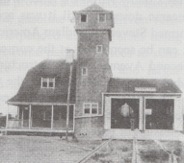
Tatham's Life Saving Station
It was an ordinary day.  Standing with my camera at the corner of 117th Street and Second Avenue in Stone Harbor, New Jersey taking a photo of the oldest building in Stone Harbor.  The building was at one time the Tatham's Life Saving Station that dates back to the late 1800's.  
The square tower and double-bay
garage of the life-saving station.
It was in 1789 that the U.S. Lighthouse Service was established to maintain America's lighthouses and sea markers, warning ships of nearby dangers.  By 1831, the Lighthouse Service began to provide rescue craft where some of the most hazardous conditions prevailed.  In 1848 a new lifesaving organization was started and taken over in 1871 by Sumner Kimball.  Three years later members were held to Mr. Kimball's strict rules and regulations.  A network of coastal stations were organized along the eastern coast of the United States.  Each station had a six-man crew.  It was in 1871 that the Tatham Lifesaving Station was begun in a small building in Stone Harbor.  Then in 1895 architect George R. Tolman designed and built the Duluth style station along what at the time was the waterfront in Stone Harbor.  The building was fitted with a square tower and added to the National Register of Historic Places on October 8, 2008.  
Old photo showing the metal tracks from the garage
leading into the sand in front of it.  
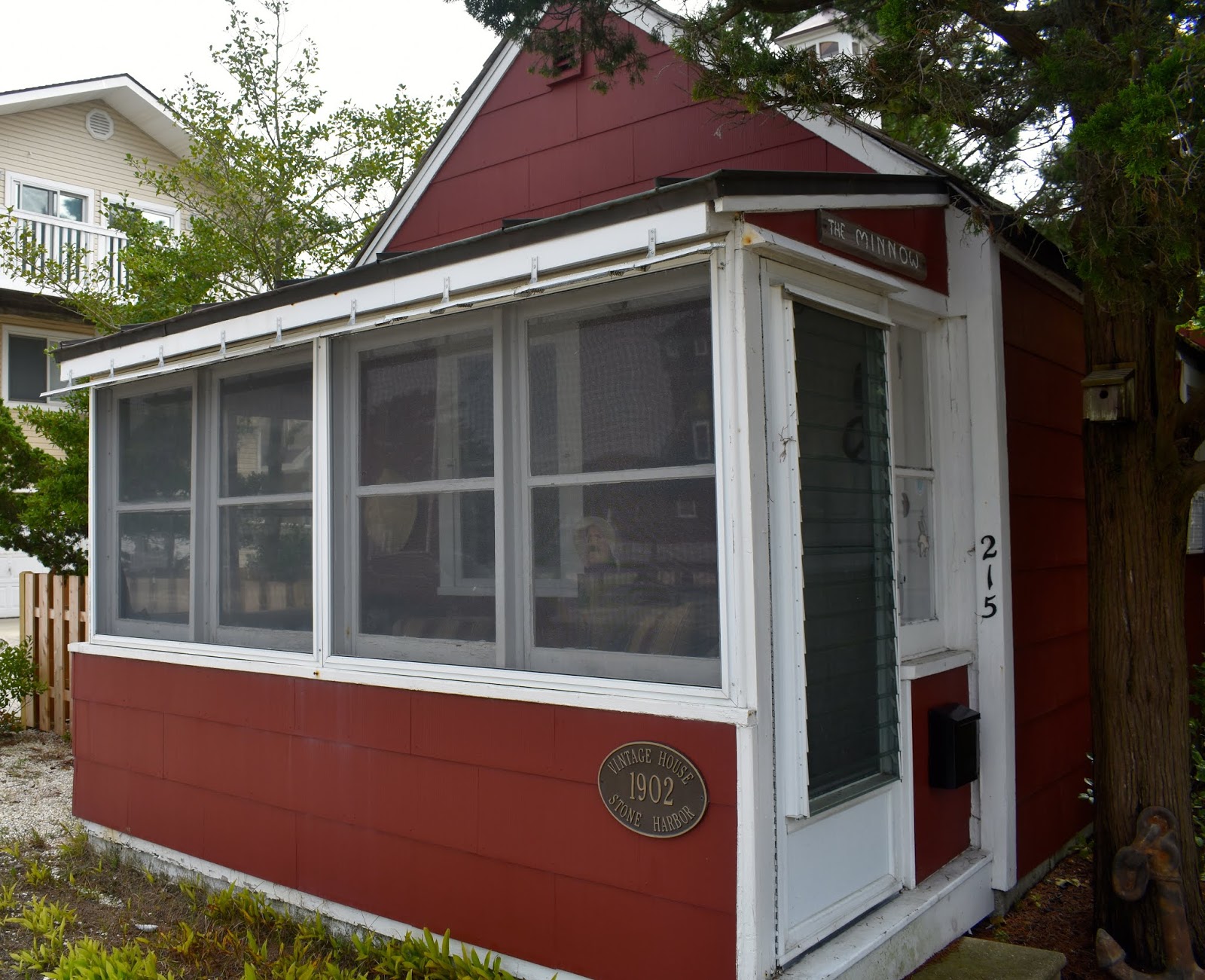
It is the oldest building in Stone Harbor and was known as Life Saving Station #36.  Later it was known as Coast Guard Station #132 and now serves as American Legion Post 331 as well as a museum honoring the history of the Life Saving Service, the Coast Guard and our military.  Closeby to it, at 215 117th Street and built in 1902, stands what is known as "The Minnow" which served as the Life Saving Station keeper's home.  
The nearby "keeper's house" known as "The Minnow".
Both the Life Saving Station and keeper's house carry plaques listing them as Vintage Houses in Stone Harbor.  It was back in the mid to late 1800s that fishing and whaling vessels made their home in and near Stone Harbor.  Actually, the first life saving station was on 80th Street around 1849, but was eventually re-located to the 117th Street location because of its proximity to the Hereford Inlet.  
One of the early  boats from the Life Saving Station.
During WWII Tatham's Life Saving Station was used by Coast Guardsmen who patrolled what is known as the 7-Mile Beach to help prevent enemy attacks.  After WWII ended, the station became deserted until it was acquired by the American Legion Post and turned into a meeting location and museum.  I found one photograph of the place when it was the Life Saving Station and had metal rails leading to the water in front of it which were used to pull the life-saving boats from the garage into the water.  I assume that most cities and towns in the United States have tales to be told about how they began and my story today gives you a glimpse as to how Stone Harbor began years ago.  It was another extraordinary day in the life of an ordinary guy.
The metal plaques telling of the history of the building.

Sunday, September 16, 2018

The "Lives Like Quilts: Bits & Pieces, Joy & Sorrow, Stitched With Love" Story

Barn quilt on barn along Strasburg Pike in Lancaster County, PA.
It was an ordinay day.  Driving along Strasburg Pike in Lancaster County searching for one of the four barn quilts that grace the landscape in the county.  For those who may not know what a barn quilt may be, it is quilt that is meant to decorate a barn instead of a bed, sofa or chair.  
Barn near Eliazbethtown, PA.
It gives the owner of the barn a chance to share the beauty of quilting with a larger audience.  I turned onto the Strasburg Pike from the old Route 30 and before long found my target.  Had to make a U-turn, but had a photo of the red, blue and yellow 8-foot square quilt a short time later.  
A barn in Lancaster County displaying hex signs.
The quilts are made of aluminum to make them last longer as well as easier to raise and attach to the barn.  Barns in Lancaster County have been decorated for centuries with stars and hex signs as well as advertisements for a variety of products.  Then in 2001 a woman in Ohio decided to honor her mother by painting a quilt on their tobacco barn.  Barn quilts began to pop up on barns in other states, with Lancaster County now having four such quilts.  
Lancaster's latest barn quilt at Willow Valley Communities.
The latest quilt in Lancaster County is at the Willow Valley Retirement Community in Willow Street, having been designed by the Willow Valley Quilt Guild who used the pattern known as the pathways block design.  They used Willow Valley colors of green and orange and placed the quilt on a barn near the cultural center.  A nearby sign company made the barn quilt from aluminum and hung it on the barn.  The Willow Valley group that made the quilt now would like to create a group that would travel on a quilt trail.  The other two quilts in Lancaster County are in Elizabethtown at the Masonic Retirement Home as well as a barn on Landisville Road in Lancaster.  Interesting idea and a great way to spread the hobby of quilting throughout the United States.  It was another extraordinary day.  

Saturday, September 15, 2018

The "Raise The Roof" Story

Before Central Market was built, vendors sold produce along the street.
It was an ordinary day.  Reading about Lancaster's Central Market House beginning to put a new roof on the market house.  It was back in 2005 that the Central Market Trust was formed and recently they have become the motivating force in raising money for a new roof for the market house.  The 127-year-old Central Market has had a few facelifts over its lifetime, but this time a new roof is in order.  
City Hall is pictured on the left with open air market stands
behind it.  This became the location of Central Market House.
The current asphalt roof was installed 30 years ago and it has begun to leak.  The original roof had been made of slate.  A new asphalt roof would cost $500,000.  If $1.5 million can be raised, a slate roof, which would last much longer, could be installed.  
Lancaster County and Lancaster City officials have both been asked to donate for the roof, but the rest must come from public donations.  Well, the money is in and $1.6 million was raised from more than 700 donors.  
A 1940 shot of Central Market House behind City Hall on left.
A neat feature of the fund raising was the fact that if you gave $100 or more you were given the opportunity to sign one of the actually slates that will be used in the new roof.  Over 600 of these slates have been signed to date.  This past Christmas I sang in a Flashmob that sang the Hallelujah Chorus at several locations in the city of Lancaster.  
Central Market House as seen today.
During one of our practices we were given the chance to donate toward one of the slates and then sign our name on that slate.  Just about everyone donated and signed the slate and will now be part of the renovation of the slate roof on the market house  A week ago scaffolding was erected around Central Market in anticipation of replacing the roof.  
The slate signed by members of the Hallelujah Flash Mob.
Construc- tion will take place four days a week with hopes of finishing the roof in about three months.  The interior of the market house has plastic tarps in place to prevent any damage to the market stands under them.  The "Raise The Roof" project has been a complete success thus far and I'm glad I have become a part of it with my donation and signature on one of the slates.  It was another extraordinary day in the life of an ordinary guy.


Friday, September 14, 2018

The "So Who Are These People That Ride In Buggies? - Part V" Story

Professor Donald Kraybill, Amish expert.
It was an ordinary day.  Reading one of many articles written by Donald Kraybill, an expert on Lancaster County Amish and their traditions and lifestyles.  Mr. Kraybill is a distinguished college professor and Senior fellow at the Young Center for Anabaptist and Pietist Studies at Elizabethtown College in nearby Eliabethtown, Pennsylvania.  Before that he was Provost of Messiah College in Mechanicsburg, Pennsylvania.  Mr. Kraybill is the author or editor of more than 18 books and dozens of professional articles, one of which I am reading right now. 
Bucolic scene from Lancaster's Amish farmland.
I have lived my entire life living amongst the Old Order Amish and Mennonites, but find I still learn daily about them and their practices.  Mr. Kraybill's books and articles have been a tremendous help in writing the stories I just shared with you.  Today will end my series which I hope you read and had a chance to see what I get to see on a daily basis.  
Amish man filing up a gas can at a local convenience store.
The Amish in Lancaster County are actually a progressive community being that most have indoor plumbing and bathrooms.  Local Amish dairy farms use automatic milking machines that are powered by generators run by gasoline or deisel fuel.  A recent story in our local paper told of the use of solar panels on the roofs of Amish farms to supply power to needed farming equipment.  
Local shopping areas have spaces for Amish buggies.
The Lancaster Amish do not drive cars, but do hire drivers to transport them unlike other Amish commun- ities that totally shun cars.  My wife's cousin has a large van and spends quite a few days a week transporting Amish to medical appointments as well as shopping.  Mr. Kraybill says the Amish in Lancaster County are changing all the time.  They are more willing to use cellphones, but still have many rules about their use.  
Wash day shows the colors of Amish clothes.
When I visited an Amish buggy maker a few years ago they were amazed when I pulled out paper and pen to take notes instead of typing on my phone as they do.  If you were a fan of the TV show "Amish Mafia", you didn't see the same Lancaster that we see on a daily basis.  Retaliation and revenge are not part of Amish life as depicted in the show.  A few other things the Lancaster Amish community do is celebrate two Christmases and two Easters.  
This young Amish woman gets in
line in traffic for a left-hand turn.
The first day of each holiday is only a religious observance while the second day is for social interaction with friends and neighbors.  The original Amish community that arrived from Europe in the 18th Century no longer exists.  The last families from that community dissolved in 1936.  According to Kraybill there are 40 Amish tribes in 31 states with the Lancaster delegation the largest in the country.  The first Pennsylvania Amish settlements were to the north of Lancaster in Berks County with a settlement of Amish in Manheim Township where I live, which was eventually forced out by surburban expansion.  I personally know very few Amish, but those I do know are very caring, helpful and loving people.  The type of person you'd want to be your neighbor.  It was another extraordinary day in the life of an ordinary guy.

Thursday, September 13, 2018

The "So Who Are These People That Ride In Buggies? - Part IV" Story

It was an ordinary day.  A weekday in November and Carol and I are heading to Chesapeake City for lunch along the C&D Canal.  The day is beautiful with just a touch of chill in the air.  After reaching Quarryville we continue south towards the Lancaster County border when we see an Amish farm off to the left that has close to fifty buggies lined along the lane to the farm.  In a nearby field are about the same amount of horses enjoying what grass remains from the summer harvest.  
Buggies line the lane into the farm for a wedding.
Carol looks at me and says, "Someone is getting hitched today."  Happens often this time of year after harvest season.  In the Old Order Amish there are no arranged marriages and marriage is for life.  Pairings begin to happen in the fall at church community events as well as Sunday evening singings.  A young Amish boy makes his choice and takes her to his farm to meet his parents before taking back to her home.  He will more than likely make arrangements to visit her again in the next week or two.  Their relationship is secretive until they announce in a few days to a few weeks before their marriage is "published".  In Lancaster County the '"publishing" is done by a church deacon while in other Amish communities a bishop may do that.  Now, I have noticed for years that during the spring and early summer, when my grandson's baseball team plays at locations which may be near heavily populated Amish areas, that large groups of young Amish men gather to play baseball  on fields near where my grandson plays.  Naturally there are large groups of young Amish girls who show up to watch the baseball game.  The Amish boys will sit on one side of the field while the girls sit on the opposite side.  A few times I have walked closeby to watch the games and notice both boys and girls pointing and smiling at the opposite sideline.  My guess is they are beginning to make their selection.  I don't believe that young men and women marry outside their Amish heritage.  The wedding takes place at the bride's home with hundreds of guests in attendance.  The wedding naturally includes a feast for the guests.  Old Order Mennonite weddings are usually held in homes while other Mennonite groups will get married in a church.  Weddings are traditionally held on Tuesday or Thursday when field work is not as demanding.  The service may take more than four hours and usually begins early in the morning.  The wedding includes hymns, a long sermon on marriage illustrated from the Bible, simple vows, testimonies from church leaders and extended prayer.  There are no photographs allowed, no rings, no kissing, no flowers, no fancy dresses or suits or expensive caterers.  After the service, lunch is served  consisting of chicken, filling, mashed potatoes and gravy, ham, relishes, canned fruit, cakes, pies and cookies.  The bride and groom eat first while sitting in the Eck (corner) of the living room.  After the first group eats, the next group enters the living room and eats.  This is continued until all are fed.  Singing takes place most of the day and when dinner is served, the same routine takes place once again.  In the Amish community, marriage signals the beginning of responsibilities for the new family.  Both husband and wife work on the farm.  Children are taught to be disciplined, respectful and obedient.  Chores are assigned to everyone in the family.  Menus for the family follow the seasonal harvests.  As far as using a doctor if your children become ill, Amish and Mennonites do not oppose modern medicine.  Medical fields are one that may be entered by the Amish that do not farm the fields.  Faith healing and home remedies are usually not the norm for the Amish.  When a person dies in an Amish community, that death is felt by all.  The church family provides monetary support for the burial, wood coffin and funeral service.  
Amish graveyard along a road in Lancaster County.
Local funeral directors usually do only the embalming, but may supply the coffin.  The body is dressed in white and a viewing is in the home.  The service has no eulogies or music.  Hymns are spoken.  The gravesite is hand-dug and no flowers are used.  A simple headstone  may mark the spot.  Following the funeral, everyone gathers to eat together.  Most Amish and Mennonite communities are growing.  I have noticed that many farms in Lancaster County have changed hands in the past generation and are being purchased by Old
Order Amish and Mennonites.  As I said before, if you can see electrical lines heading down a farm lane, it is not Amish.  But, I at times notice small sheds along the road in front of Amish farms.  They hold telephones which are used in case of emergencies.  The Amish may not look kindly on worldly things, but they aren't stupid and know they may at time need help.  Self-preservation is a way of life for all.  Tomorrow's final tale will tell you a bit more about the Lancaster County Amish according to an expert on the sect.  It was another extraordinary day in the life of an ordinary guy.     

Wednesday, September 12, 2018

The "So Who Are These People That Ride In Buggies? - Part III" Story

It was an ordinary day.  A few more bits of history of the Old Order Amish begins with the fact that the Amish are against extended education.  They feel it isn't necessary beyond reading, writing and arithmetic.  Back in the early 1950s local school districts were consolidated and minimum age requirements were increased and "worldly" subjects such as physical education were included in the curriculum.  That did it for the Amish community.  
A Lancaster County one-room Amish school.  Swing set can be
seen in the school yard with water pump outside of school.
School bell is on top of the building. Click on photos to enlarge.
They didn't want their children taught in schools where they would be exposed to values such as individual- ism, evolution, material- ism, secularism and competitiveness, since this would undermine the Amish lifestyle.  So, they decided to build their own one-room schools and start their own parochial system of education.  They believe that work is just as important as school and therefore only require their children to go as far as 8th grade.  
Another one-room Amish school.
Both the Old Order Mennonites and Old Order Amish do pay public school taxes.  The Amish school teachers are primarily female Amish school graduates who return to teach the subjects they had just finished learning.  Now, the Mennonites are quite different.  They have dozens of elementary schools, more than 20 high schools, 11 colleges and three seminaries sponsored by North American Mennonite groups.  They believe that education is a wholesome preparation for life.  As more and more Mennonites began to leave farm work, it became necessary for more schooling, thus the large network of private and use of public schools.  
Beautiful Lancaster County Amish farm.
Both the Amish and Mennonites are known as some of the world's best farmers.  I certainly can attest to that.  In Lancaster's Central Market there are many Amish and Mennonite stands that provide some of the best produce, fruit and meat in Lancaster County.  Travel throughout Lancaster County and you will find many farms with small stands along the road where you can buy the products they raise.  Most Amish farms are about 40 acres in size since they have to farm the land with only mule and horse drawn equipment.  
Corn can be seen on the left with tobacco on the right.
Crops usually include corn, alfalfa, wheat, barley, rye and tobacco.  Lancaster County is known as the Garden Spot of America due to the soil that is found in this area.  That means the the Amish farm yield is almost always excellent and usually greater than their "English" neighbors.  If you drive the back roads of Lancaster County you can usually tell which farms are Amish and which are "English".  The farms that have no electric lines running from the main road to the farm are Amish, since they don't believe in being connected to the outside world.  
Amish barn filled with tobacco which is curing.
Besides farming there are other occupations that are performed by the Amish such as cabinet making, buggy making and general construction.  The majority of Amish though are farmers.  That is totally different with the Mennonites who can be found in just about any occupation including politics.  I taught school with a Mennonite who I happened to have as a student when he was in high school.  He taught metal shop in the room next to me.  
This is the Amish buggy shop I visited.
After several years his father, who was a farmer, retired and he took over the farm from his father.  He met a young woman who taught with us, married her and she too left teaching to work on the farm.  I still stop often at their stand to buy vegetables and fruit.  Old Order Amish are not part of the United States Social Security System.  
Canned fruit and vegetables for sale at an Amish farm.
They gained an exemption years ago and now have their own system where they look after each other.  They also do not have health insurance and help their Brethren who may be in need as they age and may be in poor health.  They all participate in the cradle-to-grave system.   Many Mennonites sponsor their own retirement homes, Lancaster County having one such home.  They do allow those who are not Mennonite to become part of the community, but you must pay as you would if you wanted to enter any other retirement home.  Tomorrow I will take you along as I tell of weddings to funerals.  It was another extraordinary day in the life of an ordinary guy.