Extraordinary Stories

1944 (1) Act of kindness (12) Acting (2) Adoption (4) Adventure (766) Advertisement (6) Africa (1) Aging (14) Agriculture (47) Airplanes (9) Alphabet (5) American Red Cross (1) Americana (116) Amish (43) Ancestry (5) Ancesty (2) Animals (43) Anniversary (4) Antigua (10) Antiques (14) Apron (1) architcture (1) Architecture (36) Art (175) Art? (8) Arts and Crafts (69) Athletics (6) Automobiles (40) Awards (7) Banking (2) Barn raising (2) Baseball (103) Basketball (3) Batik (1) Beaches (89) Becoming A Citizen (1) Bed & Breakfast (2) Bee Keeping (6) Beer & Breweries (2) Bikes (3) Birds (9) Birthdays (34) Blindness (1) Blogging (5) Bookbinding (5) Books (12) Boxing (2) Brother Steve (12) Buisiness (3) Business (5) Canals (1) Cancer (14) Candy (30) Caribbean Islands (9) Caribbean Villas (15) Cats (5) Caves (1) Census (1) Chesapeake Bay (61) Children (28) Chocolate (4) Christmas (57) Church Adventures (122) Cigars (1) Circus (3) Civil Rights (8) Civil War (6) Classic Cars (7) Climate Change (5) Clubs (1) Coin club (2) Coins (1) Collections (73) Comedy (3) Comic Books (5) Commercials (1) Comnservation (2) Conservation (41) Covered Bridges (3) Craftsmanship (12) Creamsicle the Cat (11) Crime (16) Crisis (312) Cruise Travel (6) Crying (1) Culture (4) Dancing (1) Danger (16) Daughter Brynn (58) Daughter-In-Law Barb (7) Death (5) Death and Dying (65) Destruction (2) Donuts (1) Downsizing (2) Dunking (5) Easter (3) Eavesdropping (1) Education (48) Energy (15) Entertainment (165) Entrepreneurial (62) Ephrata (1) Etchings (1) Eternal Life (4) Facebook (5) Factories (4) Fads (6) Family (261) Farming (37) Father (42) Father Time (68) Favorites (88) Firefighting (1) Flora and Fauna (28) Fond Memories (490) Food and Cooking (171) Food and Drink (111) Football (16) Forgetfullness (3) Former Students (10) Framing (30) Friends (359) Fruits and Vegetables (3) Fun (4) Fundraiser (6) Furniture (1) Games (7) Generations (3) Gifts (1) Gingerbread houses (1) Giving (8) Globes (1) Golf (3) Good Luck (2) Graduation (1) Grandkids (136) Grandparents (3) Grandview Heights (29) Great service (3) Growing Old (8) Growing Up (187) Guns (2) Handwriting (3) Hat Making (2) Hawaii (49) Health and Well Being (61) Health Care (4) Health Hazards (110) Heartbreak (7) Heroes (26) High School (142) History (777) HO Railroading (4) Hockey (4) Holidays (134) Home construction (7) Horses (2) Housing (3) Humorous (71) Hurricanes (1) Ice and Preservation (2) Ice Cream (8) Inventions (34) Islands (4) Italy (12) Jewelry (3) Job Related (62) Just Bloggin' (56) Just Wondering (19) Juvenile Diabetes (5) Labor (3) Lancaster County (542) Law Breakers (8) LDubs In-Laws (3) Lefties (1) Libraries (1) Life's Lessons (175) Lightning (1) Lists (72) Lititz (18) Locomotives (1) Lodging (1) Love (4) Magazines (2) Magic (1) Maps (2) Marching (2) Market (5) Medical (161) Memories (28) Middle School (3) Milk (2) Minorities (1) Money (3) Mother (54) Movies (6) Mt. Gretna (1) Music (118) My Brother (19) My Wife (260) Neighbors (7) New Year's Day (5) Newspapers (4) Nicknames (2) Nuisance (3) Obsolescence (5) Occupations (2) Old Age (1) oldies (1) Pain and Suffering (12) Panama Canal Cruise (13) Parish Resource Center (14) Patriotism (3) Penmanship (1) Pets and Animals (99) Photography (220) Pizza (1) Plastic (2) Playing Trains (2) Poetry (2) Politics (27) Polution (3) Postal Service (2) Predators (2) Presidents (11) Pride (4) Printing (81) Protesting (3) Public Service (65) Questionnaire (1) Quilts (1) Race relations (6) Rain (1) Reading (4) Records (2) Religion (10) Retirement (4) Revolutionary War (3) Robotics (1) Rock & Roll (4) Rodents (2) Saints (4) Sand (1) Scouting (2) Sex (1) Shakespeare (1) Shelling (2) Shopping (24) Simple Pleasures (122) Slavery (6) Small Towns (4) Smoking (1) Snickedoodle (1) Snow (1) Son Derek (27) Son Tad (33) Son-In-Law Dave (27) Soup (1) Spices and Herbs (1) Sports (139) Sports and collectibles (1) Spring Break (1) St. James (2) St. Martin/Sint Maarten (306) Stained Glass (3) Stone Harbor (4) Story-Telling (26) Stragers (2) Strangers (4) Strasburg Railroad (1) Stress (3) Stuff (4) Suicide (2) Sun (1) Surfing (1) Tattoos (4) Teaching (49) Technology (90) Television (6) Thanksgiving (2) The Arts (6) The Beach House (62) The Flag (1) The Future (5) The Shore (78) This and That (23) Timekeeping (7) Tools and Machines (25) Tours (2) Toys and Games (31) Track & Field (1) Tragedy (8) Trains (19) Transportation (18) Travel (16) Trees (2) Trending (2) TV Favorites (23) Underground Railroad (10) Unit of Measurement (1) USA (2) Vacation and Travel (545) Vehicles (80) Vison and Eyesight (2) War (14) Watches and Watchmaking (5) Weather (48) Weddings (3) White House (1) Wisdom (3) Yearbooks (12) York County (3)

Thursday, September 19, 2019

The "The Lancaster-York Heritage Region: The Corridor Of Culture & Commerce " Story

Our tour boat for the River Discovery Tour on the Susquehanna River.
It was an ordinary day.  Carol had just asked our tour guide if we will see big piles of dead Bald Eagles under the wind turbines when they come into view?  As we meander down the Susquehanna River on our River Discovery Tour the huge wind turbines on the property of Turkey Hill Dairy loom high above us to our left.
The wind turbines from Turkey Hill Dairy.
 Carol's friend Marg had told her that the wind mills have killed many birds, since they were erected in 2011.  The turbines have reduced the dairy's greenhouse gas emissions by roughly 5,900 tons annually which is the equivalent of removing 1,000 cars from the road.  The wind turbines stand 262 feet in the air, thus the reason why some fear they are killing birds.  
Our tour guide for our trip, Kevin.
Our young and handsome tour guide, Kevin, looked at her and said, "You're the second person to ask me that today!  And, no, I don't think they have ever killed any Bald Eagles let alone any other birds.  But they do supply all the needed energy for Turkey Hill as well as places around them."  The day is cool for a day in early September with the temperature in the mid-60s as we begin our tour of the mighty Susquehanna River after leaving from the dock at the Zimmerman Center for Heritage.  
Safe Harbor Dam.
The tour is a new event this year and is a free activity due to a grant from the National Park Service and Pennsyl- vania Depart- ment of Conser- vation and Natural Resources.  It was a year ago that I wrote a story telling about this area along the Susquehanna River being named the 50th National Heritage Center.  I assume the funds for the water excursion came from the U. S. Park Service.  
The Pennsylvania Railroad tracks run under this water trough.
Three hour and a half long tours leave the dock below the Zimmerman Center daily.  They were supposed to stop at the end of August, but I recently received an email telling that the tours would run a few more weeks.  Asked for tickets and Carol and I are sitting in the small watercraft with about a dozen other people enjoying the history lesson our guide is giving to us.  We headed south, or downriver, until we reached the Safe Harbor Dam which is a hydroelectric gravity dam that was built between April of 1930 and December of 1931.  During the 60 minute ride our guide pointed out various species of birds as well as a Bald Eagle nest high in the trees along the shore.  
One of a few Bald Eagles we saw.
He also pointed out where the Susquehanna and Tidewater Canal was located.  At one time it ran between Wrightsvile, PA and Havre de Grace, MD, at the head of the Chesapeake Bay.  As we headed north he told us about the start of the Pennsylvania Railroad system along the eastern shore of the Susquehanna which was primarily very high rock formations for quite a distance.  The railbed was constructed along the rock with several aquafer troughs running over the rail line.  The troughs were necessary due to the amount of water running through the rocks along the shore.  We also learned of the very large shad population and how the fish were gathered from the river years ago.  Stories of the Native Americans and early settlers to the area gave us a look at what life was like along the river years ago.  
Stick sculptures can be seen along the shoreline.
We headed upriver toward the Veterans Memorial Bridge which opened in mid-1929.  It used to be called the Columbia-Wrightsvile Bridge and was the longest multi-arch concrete bridge in the world.  Twenty-eight three-ribbed open-spandrel reinforced concrete arches, each spanning 185 feet carry the bridge across the Susquehanna between Lancaster and York Counties.  
It is on the National List of Historic Places and is still the longest such bridge in the world.  We didn't reach the bridge due to the shallow water, but turned once again and headed back to the Zimmerman Center.  The weather was chilly and the water sprayed on us a few times, but we enjoyed our trip learning about the history of the river.  Our thanks to Kevin, our guide as well as the River Discovery Tours for the free history lesson.  It was another extraordinary day in the life of an ordinary guy.

Another water trough over the railroad tracks.
A cormorant sits on a rock in the river.
The Veterans Memorial Bridge which connects Wrightsville and Columbia.

Wednesday, September 18, 2019

The "The Lancaster-York Heritage Region: The Dritt Mansion" Story

The Dritt Mansion as seen from the Susquehanna River.
It was an ordinary day.  Parked the car in the small parking lot of the Zimmerman Center of Susque- hanna Heritage and walked the path to the front door of the beautiful home known as the Dritt Mansion which faced the Susquehanna River in Wrightsville, Pennsylvania.  The building is just remarkable with it's bluestone exterior and majestic view of the river about 100 yards from the front door.  
The rear of the mansion.
If you are not familiar with bluestone, it is a fine-grained sandstone that appears blue when wet.  The original property where the house stands was known as Pleasant Garden and was owned by Thomas Cressap in 1729.  Mr. Cressap obtained the land by a Maryland land grant from the fifth Lord Baltimore.  He was responsible for naming the 150 acre property Pleasant Garden.  
Near the side of the mansion is a stone
with a plaque telling about Thomas Cressap.
He built a "fort" on the property and was owner of the Blue Rock Ferry that he established in 1730.  He also collected taxes for Maryland as well as being loyal to Lord Baltimore.  He was hated by Pennsylvanians and became known as the "Maryland Monster" for his aggressive actions towards settlers.  He was arrested in 1736 after bloody skirmishes with Pennsylvania neighbors known as "Cresap's War."  Eventually in 1784 Charles Mason and Jeremiah Dixon surveyed the land and marked the Maryland boundary 15 miles south of Thomas Cressap's property.  So, he became a Pennsylvanian!  Over time the property had eleven different owners including at one time Mr. Jacob Dritt (aka Tritt) whose name is still carried by the mansion.  I found that Jacob Dritt was a Captain in the Revolutionary War, but also was said to have been a Colonel.  
1831 sketch of Jacob Dritt. 
He later attained Major General status around 1800 for his Pennsylvania Militia duties.  At the time that Dritt owned the property he also owned thousands of acres including the river islands near the eastern bank of the river.  He operated a river ferry between the west and east banks of the Susquehanna River, ran a saw mill as well as mills that processed grain and flax.  He was said to have dealt in wine and spirits as well as serving as Justice of the Peace.  In early March of 1818 he was crossing the icy waters of the Susquehanna when his boat capsized near Turkey Hill and he drowned.  Shortly after, his daughter Margaret was declared owner of the property where she and her husband, Judge Samuel Bonham, resided.   Today's mansion was not the original building from when Mr. Cressap got the property.  Today's house is dated circa 1738.  Writings in the attic have helped date the mansion.  The property remained a farm into the 1930s with a barn, pastures and fields along the river and hillsides.  
Interior 1st floor fireplace of Dritt Mansion.
In the late 1990s John and Kathryn Zimmerman purchased the property, which was beginning to waste away from lack of care, and totally restored the home as an historic jewel on the Susquehanna River.  Then in 2007 they donated the property to Susquehanna Heritage as a place for storytelling, inspiration and outdoor adventure.  In 2014 Susquehanna Heritage used private and public money to add a nearby dock, boardwalk and waterfront pavilion.  
Stairway leading to second floor.
Two years later the National Park Service designated the Zimmerman Center for Heritage as the first-ever Visitor Contact & Passport Station for the Captain John Smith Chesapeake National Historic Trail which brought with it well deserved national recognition to the Zimmermans' legacy.  Carol and I enjoyed our visit and tour of the Dritt Mansion and its surrounding area.  The grounds are immaculate and the view of the river is remarkable.  We eventually headed down the path to the nearby dock to take a trip on the Susquehanna River.  Follow along tomorrow as I take you with us on our journey.  It was another extraordinary day in the life of an ordinary guy.


Doorway with double door.  All hand-made hardware.
This is a lock or clasp on the top of another door.  Handmade also.
View towards the Susquehanna from one of the many windows.
This is the plaque telling the tale of Thomas Cresap.  Very hard
to read.  Click on image to enlarge it.  May make it easier to read.

Tuesday, September 17, 2019

The "Postlethwaite's Tavern In Conestoga Gains Notoriety" Story

Postlethwaite's Tavern in Conestoga
It was an ordinary day.  Carol and I traveled once again to the south of Lancaster County for a photograph that I could use for my story today.  The corn is still high along the sides of the road, but the view from the areas where there is no corn is amazing.  At times I forget just how lucky I am to be able to drive along deserted country roads and see the beautiful farms and farmland that makes Lancaster County the Garden Spot of America.  
Holding Court at Postlethwaite's Tavern.
We turned right off SR72 onto Long Lane which had us heading west in the township known as Conestoga.  In a few minutes we crossed over Slackwater Road and in another minute or two we found the house I was looking to photograph.  The house was constructed along Long Lane in 1725.  The land on which the home was built is said to have belonged to John Postlethwaite at one time, but was later acquired by George Fehl.  
Postlethwaite's Tavern as it appears today.  The porch
seems to have been added later to the original tavern.  
Back in the 1720s there was little established government in rural Pennsyl- vania.  The British held court infre- quently, though on several occasions they held court at Mr. Postlethwaite's house which was known as Postlethwaite's Tavern.  At the time Lancaster was transitioning from an area where Conestoga Indians prospered to one where nearly 100 Swiss German families were settling.  These families had been expelled from Switzerland for their beliefs and had lived and worked on land for generations in an area called the "Pfalz" along the Rhine River.  It was the same area where William Penn had worked hard to recruit potential settlers to his new territories.  The area known as Conestoga aspired to become the center of the emerging town known as Lancaster, but others had picked a location to the north-east of Conestoga.  
The front door tells the tale of Colonial
America and all those who walked through
that door hundreds of years ago.  Benches
on either side were probably filled with those
who would be called into the Court in due time.
The road that passed in front of John Postlethwaite's Tavern was at the time a passageway toward the west and the mighty Susquehanna River.  The new provincial government thought it best to hold court at the Tavern.  Provincial Prothonotary, or chief clerk of the court, Andrew Hamilton was charged with the duty of finding a suitable location for court to be held.  He selected the Tavern along Long Lane near Rock Hill.  It was Lancaster County's first "courthouse" in 1729.  That first courthouse was what I was now standing in front of taking a photograph.  As I stood in front of the property to take my photograph, I half expected someone to open the door and ask what I was doing.  The house is in beautiful condition with black shutters and benches that run the length of the front of the home.  I can just imagine what it must have looked like almost 300 years ago.   Probably had a rail to tie your horse and cover for the buggy in the barn.  
The plaque that stands in front of
the home tells the story of years ago.
Click on image to enlarge.
To the left of the tavern was a large rock that carried a metal plaque placed there by the Lancaster County Historical Society on October 8, 1815.  It told the story of the Justice's of His Majesty, King George II who met for the first time in Lancaster County.  Magistrates present were John Wright, Tobias Hendricks, Andrew Cornish, Thomas Read and Samuel Jones.  John Wright presided over the meeting.  The Courts were held at Postlethwaite's that August and November terms as well as the 1730 terms in February, May and August.  Not quite sure where the Court met after the last term, but I'm sure Mr. Postlethwaite was proud to have had the Court meet in his tavern during 1729 and 1730. The Postlethwaite Tavern was the home of the first Court held in Lancaster County.  A part of history that will always be remembered in the area known as Conestoga.  It was another extraordinary day in the life of an ordinary guy.

Monday, September 16, 2019

The "Memories To Share Forever!" Story

It was an ordinary day.  Just finished framing a rather unique project brought to Grebinger Gallery in Neffsville, Pennsylvania.   The gallery is located a few miles north of Lancaster on Route 501N.  The customer was a young woman who brought her wedding corsage of dried flowers, her head piece, earrings, wedding announcement and lapel corsage that her husband wore at their wedding a few years ago.  She also brought a wooden, unassembled 3/4" thick, oak shadow box she had purchased previously.  It was our job to put the shadow box together, add a frame to the front which she has chosen at the gallery and finish her shadow box with the treasured wedding items she had brought to the gallery.  The photographs that follow will give you an idea how we handled the project and show the results that she received.  It was another extraordinary day in the life of an ordinary guy.


The square oak shadow box had to be glued together. 
This is the frame sample that was used and the actual frame that I cut for the job.
To fasten the shadow box I used cardboard guides to make sure it was equal on all four sides.
A special drill bit was used to put the screws into the front frame.  The screws
had to be inside the edge of the box so the inside panels fit tight to the shadow box.
Next I cut a piece of Museum glass to fit the opening in the shadowbox/frame.
Museum glass is both reflection free and conservation approved.
I placed the glass in place in the box. It sat on the lip you can see at the bottom of the shadow box.
Next I placed a layer of 1/4" acid free foam board around the sides of the shadow box.
I did not come the entire way to the bottom of the wooden shadow box so that
I could set the panel holding the momentos brought in by the customer in place. 
This shows the shadowbox with frame in front and glass inside, panels along the sides,
and the two pieces, one a piece of foam board and another the mat she chose, that will be taped and glued together that will hold the mementos 
After joining the front mat board and rear foam board with tape and glue,
I attached the corsage with fishing line.  I chose fishing line so it will be
invisible when viewed.  It is also stronger than thread.  I sewed it top and bottom
under the wrap that holds the bouquet together.  I made two holes at the top
and bottom of the wrap and used the needle and line from the back to go
around the corsage.  Tied it tightly in the rear of the job.
Next came the head piece with ribbon, both held in place with fishing line.  I did
make only one hole in the board for the ribbon and had to run the fishing line through from
the rear, around the ribbon and back through the same hole.  Then had to use a
button with two holes in it to secure it on the rear of the board.
The announcement was placed on a few layers of foam using glue and put in place.
The groom's corsage is prepared for sewing in place on the bottom right of the board.
This is the rear of the foam board showing the plastic threads in place.  Three locations
I had to use buttons to hold the fishing line in place; two on the head piece and one on the corsage.
All the pieces are in place and ready to be put together.
Flower petals are used on the bottom, since the weeding corsage was so brittle that when put
together dropped pieces to the bottom.  By using other petals on the bottom it will look better
if and when the corsage drops more pieces in the future.
Since I have loose petals in the bottom, I can not lay the shadow box on the front.
I must place the kraft paper on the rear while it sits upright.  This cover is placed
on the job to make the rear look good and to keep any critters out of the job.
Metal hangers called wall buddies are attached to the rear on the corners.  This will hold the job
on the wall without the top hanging away from the wall as it would with wire on the back.
Last part of the job is putting the Gallery label and instruction on how to clean the Museum glass.

Sunday, September 15, 2019

The "When You Care Enough To Write The Very Best!" Story

It was an ordinary day.  Reading a story written by a retired magazine editor telling that it's becoming a fad again to write letters and drop them into a physical mailbox.  It was back on December 12, 2011 that I wrote a story about the lost art of handwritten letters.  Well, it seems that the trend is beginning to be reversed and the fact that someone actually takes the time to handwrite a letter makes it more special.  For those receiving a hand-written letter, the fact that someone took the time to actually sit down and write you a message makes it even more special.  The hand-written letter is definitely better than an email or even a text, but then again it does take longer to compose and longer to reach the receiver, but that perhaps is what makes it so special.  If you take the time to hold a pen or pencil in your hand, you will more than likely express yourself with greater honesty.  Does writing a letter by hand make you old-fashioned?  Could it mean you are a forward thinker?  And, what should you use to write with?  Seems logical you should use a pen, but if you make a mistake you may have to start over again where if you used a pencil you could erase a mistake if you made one.  Then again, the receiver of your letter might notice you had erased something and wondered why you did that.  I also read that the writer should select the pen or pencil and the paper that fit your personality.  Colored paper is more personal, but maybe too frilly for a male to use.  Do you use blue ink or black ink?  Is this more involved than you first thought it might be?  Of course it is.
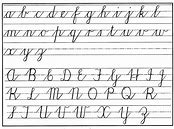
Practice sheets such as this can help with your cursive.
 Hey, you are expressing yourself in your own handwriting so you should take the time to choose the correct paper, writing utensil and color of ink.  But the big question is...can you actually write?  Were you ever taught how to write cursive in school or do you always print what you write?  Some hand-written letters may be so hard to decipher if your cursive is a mishmash of crazy strokes.  But with practice you may become an accomplished cursive writer.  
My wife's friend, Marg, always makes
hand drawn cards with cursive lettering.
Click on image to enlarge to see it better.
When I taught graphic arts in school, I had my classes spend a week of so of the year long course doing calligraphy.  I had then practice all the letters of the alphabet between rows of lines on the practice sheets.  I had them practice both cursive and printed letters.  It was one of the student's most favorite parts of my course.  After a week or two of practice each student would choose a quote or brief sentence and use their newly gained skills to write or print it.  Many chose cursive, since it was all new to them.  Many were displayed on the hallway bulletin board for all to see.  Writing a letter in cursive or even  printing it can be so powerful that it evokes true-life heartache or emotion that it captures the reader's attention more than any text or email ever could.  Try it sometime and see if your letter doesn't add that extra touch that makes the note so much more important than you might have imagined.  It was another extraordinary day in the life of an ordinary guy.


A hand-written letter from my father to his mother when he was a child.
You can see how much he improved years later.

Saturday, September 14, 2019

The "Seven Historic Watering Holes In Lancaster County" Story

The Stockyard Inn
It was an ordinary day.  Talking with my son, Tad, about his favorite place to visit for a great meal.  Took him all but a few seconds to come up with his favorite; The Stockyard Inn at the corner of Keller Ave. and the Lititz Pike (State Rt. 501) in Manheim Township.  The building was the original farmhouse that was built on the corner in 1750.  It stood on the northeast border of colonial Lancaster and had a lookout tower that was used to scout for hostile Native Americans.  It has seen a few owners in its lifetime, but perhaps the most famous was James Buchanan who purchased the property in 1856, the year before he became the President of the United States.   The Lancaster Stockyards was the largest stockyard east of Chicago and the cattlemen who arrived at the stockyards found the Stockyard Inn to be a great place to find food and shelter.  In 1952 James Fournaris purchased the Stockyard Inn and reinvented the venue into the upscale steakhouse it is today.  
The Black Knight Tavern & Grill
It is one of the oldest and most historic taverns and watering holes in Lancaster.  Another famous watering hole is The Black Knight Tavern & Grill which is located at 335 Main Street in Landisville, Pennsylvania.  It was built in 1875 and was originally a hotel that was located along the then-busy Old Harrisburg Turnpike.  At one time it was known as Gatsby's on Main before changing names in 2005.  If you visit at night you may be able to see one of the two ghosts that are said to have been spotted from time to time at the Tavern.  
The Catacombs at Bube's Brewery.
This is one of my favorite watering holes.  Another rather unusual watering hole has a rather unusual name; Bube's Brewery.  A few years ago Carol and I had a great meal in the catacombs which are beneath the brewery.  The building was built in 1860 and didn't gain the name of Bube's until about 1876.  Brewing was not done at the catacombs from 1917 until 2001.  The original oak bar can be found in the ornate Victorian room.  Part of the complex was an adjoining hotel that was said to have had the first flush toilet in nearby Mount Joy, Pennsylvainia.  
The Conestoga Inn
A former student of mine is one of the owners of another watering hole on the east side of Lancaster at 1501 E. King Street.  The Conestoga Inn was built in 1741, but is now known as the Conestoga Restaurant, since the Inn part of the property has not been opened after the nearby Conestoga River flooded the inn.  A good watering hole on the east end of town along what at one time was the main road between Philadelphia and the Susquehanna River to the west.  
The Bulls Head Public House at the General Sutter.
In 1764 the Zum Anker was erected in the small town known as Lititz which is to the north of the city of Lancaster.  It is located at the intersection of Main and Broad, which is one of the main routes leading north from Lancaster.  The Zum Anker is an Inn with a watering hole known The Bulls Head Public House as part of the building.  The Zum Anchor eventually became the Lititz Springs Hotel and then changed names once again in 1930 when it was known as The General Sutter Inn named after John Augustus Sutter who was a California gold rush pioneer.  I should mention that the watering hole, The Bulls Head Pub, has been named the best bar in America.  
The Revere Tavern House
Quite impressive!  In nearby Paradise, located to the east of Lancaster, is the watering hole known as the Revere Tavern.  It was built in 1740 and was known as a "Stage Tavern" which catered to those travelers that were following the Lancaster Turnpike from Philadelphia to points west.  It too was at one time owned by President James Buchanan.  Starting to get the idea that President Buchanan enjoyed watering holes.  The building at one time was the parsonage for President Buchanan's brother, The Rev. Edward Buchanan and his wife Eliza Foster Buchanan.  Mrs. Buchanan was the sister of musician Stephen Foster who wrote the song "Oh Susannah!" while visiting his sister along the Pequea Creek.  
Shank's Tavern in Marietta, Pennsylvania.
The final historical watering Hoel in Lancaster and surrounding area I have never had the chance to visit.  It is known as Shank's Tavern and is in nearby Marietta, Pennsylvania.  It was built in 1814 and was originally known as The Square and Compass Tavern.  It is the oldest continuously operating tavern in Lancaster County.  Even operated during Prohibition as a speakeasy.  The original tile floor and fireplace are all original. One of the biggest differences was removing the wall that separated the "ladies area" from the main bar. in 1954.  The tavern is well known as having the first Taco Night and sushi in Lancaster County.  If you ever get the chance to visit Lancaster or happen to live in Lancaster County, make a visit to one of these historical watering holes.  I'm sure the stories will fly as the drinks go down.  it was another extraordinary day in the life of an ordinary guy.  

Friday, September 13, 2019

The "Faces Of Strangers: #54" Story

Preface:  I composed this story over a year ago, but never posted it to my blog.  Story about a young man whom I happened upon while taking a photograph in the city of Lancaster.  I give you this information since the "Keys for the City" program was discontinued last summer due to the COVID virus.  I found the story while doing some clean-up on my blog and thought you may enjoy reading it even though it is over a year old. 

It was an ordinary day.  Just finished taking a photo of the Pennsylvania Historical Museum Commision's street sign featuring Peter Simon for a story I plan to write on Mr. Simon.  I was returning to my car parked on nearby Water Street in downtown Lancaster, PA when I heard piano music.  Classical music!  
Musician in Lancaster who is part of the "Keys for the City" program.
Wow, just had to find our where it was coming from.  Reached the intersection of North Prince and West Orange and found the music was coming from a piano under the Prince Street parking garage.  Rounded the corner and there sat this young man playing his heart out on a bright yellow piano.  The city of Lancaster is known as the "Street Piano Capital of the World" because of all the pianos that line the streets of the city of Lancaster.  This year is the tenth year that Lancastrians have embraced and cared for these pianos in a way that has been inspiring to all residents of the county.  
Isaac plays on the "Music For Everyone" piano.
The program is known as "Keys for the City" and gives anyone a chance to sit in front of a piano and try to play it.  Needless to say this fellow in front of me today has much more talent than most.  I watched him for a short time and walked toward the piano as I listened to another choice from his repertoire.  I snapped a few photographs and stopped to talk.  Isaac is a student at the Lancaster Center for Classical Studies on Marietta Ave. in Lancaster.  He graduated from high school in nearby Harrisburg, PA and entered the school in Lancaster after high school.  Every Monday since school started he has been at the keyboard entertaining the population of Lancaster city.  His favorite musician is Jackson Brown, but he does love to play music of all genres.  
Isaac on the keyboard.
The sheet music he is using today is titled "Song of the Violet Flame which when I Googled it says it is contemplation music.  He asked if I like Bach and began a piece from Bach.  This talented young man makes you realize that his generation is more than just rap and hip hop.  He, to me, is a classical musician.  I could have stood and listened more, but I was late for my next appointment, so I thanked Issac for his music and departed.  The "Keys for the City" program was begun years ago just for people such as Issac and myself.  One to play and the other to enjoy.  We both were part of the program today.  Music is alive in the city of Lancaster.  It was another extraordinary day in the life of an ordinary guy.


Thursday, September 12, 2019

The "My Favorite Column" Story

It was an ordinary day.  Fed the cats and headed out the driveway for the morning paper.  Sunday, so the paper is immense as compared to other days of the week.  One of the sections of the paper is titled LIVING and deals with routine life in the city of Lancaster, Pennsylvania.  One story told of the many problems that are happening due to vaping which is beginning to claim the lives of some of those who chose to do it.  One of my favorite parts of the section though is titled "The Lancaster That Was".  It goes back in newspaper files to dig out stories that might interest newspaper readership and tells what happened 100 years ago, 75 years ago, 50 years ago and 25 years ago.  I checked out the 100 years ago story which reported on a "hearty" welcome for returning soldiers in the eastern end of the county.  Soldiers returning home to Lancaster County areas known as Paradise, Leaman Place, Kinzers, Gordonville and Intercourse were treated to a "jubilee" at Beiler's Meadow.  The newspaper edition also told of a big Labor Day Picnic at Rocky Springs given by The Central Labor Union.  It drew 12,000 people to the park where they had a baby show, sporting events and guessing contests.  Prizes were wristwatches, newspaper subscriptions, cigarettes and packs of tobacco.  75 years ago the stories in the newspaper dealt with reopening of county schools.  The reopening was in question due to a polio outbreak.  21 people had cases of infantile paralysis which was below the state's threshold, so schools would open on time.  In the same edition of the newspaper was a story about building a new police station in the city.  Several sites were being considered.  On a lighter note, Dorothea E. Woods gave birth eight days later to Larry W. Woods, renowned author of this blog.  50 years ago a seaplane crashed in the nearby Susquehanna River.  Luckily the three passengers survived the crash.  The crash was caused by the plane hitting the water wrong and slamming down into the river.  The plane was an old Navy seaplane built in 1943.  It was reported that if they had been in any other plane they probably would have died.  The same edition told of the State Police launching their "Bring 'Em Back Alive" campaign to ask returning vacationers to drive carefully.  
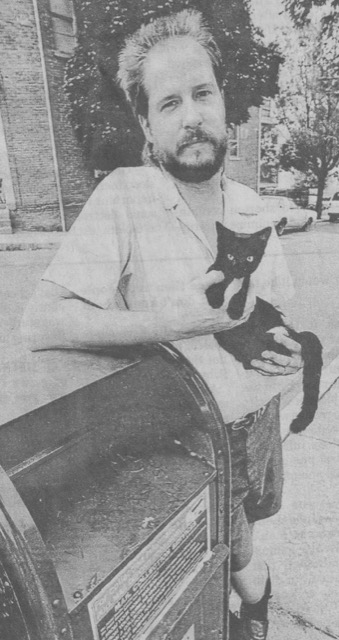
Mailman saves dog.
Lancaster Newspapers
Finally, 25 years ago a national leader in preservation visited the county to help residents deal with all the new "big box" stores.  But, the final story showed a Lancaster mail carrier holding a cute little black kitten.  Seems he opened one of the big blue mailboxes on the corner of North Pine and West King Streets and found the little kitten inside.  He promptly took the kitten to the Organization for the Responsible Care of Animals.  ORCA discovered the female kitten had a dislocated hip, probably from being tossed in the mailbox.  The mail carrier named his new friend Maily.  All these stories were part of the "The Lancaster That Was" section of the September 1 editions on their respective years.  The Sunday article is always one first that I turn to when I grab the morning paper.   It was another extraordinary day in the life of an ordinary guy.