Extraordinary Stories

1944 (1) Act of kindness (12) Acting (2) Adoption (4) Adventure (766) Advertisement (6) Africa (1) Aging (14) Agriculture (47) Airplanes (9) Alphabet (5) American Red Cross (1) Americana (116) Amish (43) Ancestry (5) Ancesty (2) Animals (43) Anniversary (4) Antigua (10) Antiques (14) Apron (1) architcture (1) Architecture (36) Art (175) Art? (8) Arts and Crafts (69) Athletics (6) Automobiles (40) Awards (7) Banking (2) Barn raising (2) Baseball (103) Basketball (3) Batik (1) Beaches (89) Becoming A Citizen (1) Bed & Breakfast (2) Bee Keeping (6) Beer & Breweries (2) Bikes (3) Birds (9) Birthdays (34) Blindness (1) Blogging (5) Bookbinding (5) Books (12) Boxing (2) Brother Steve (12) Buisiness (3) Business (5) Canals (1) Cancer (14) Candy (30) Caribbean Islands (9) Caribbean Villas (15) Cats (5) Caves (1) Census (1) Chesapeake Bay (61) Children (28) Chocolate (4) Christmas (57) Church Adventures (122) Cigars (1) Circus (3) Civil Rights (8) Civil War (6) Classic Cars (7) Climate Change (5) Clubs (1) Coin club (2) Coins (1) Collections (73) Comedy (3) Comic Books (5) Commercials (1) Comnservation (2) Conservation (41) Covered Bridges (3) Craftsmanship (12) Creamsicle the Cat (11) Crime (16) Crisis (312) Cruise Travel (6) Crying (1) Culture (4) Dancing (1) Danger (16) Daughter Brynn (58) Daughter-In-Law Barb (7) Death (5) Death and Dying (65) Destruction (2) Donuts (1) Downsizing (2) Dunking (5) Easter (3) Eavesdropping (1) Education (48) Energy (15) Entertainment (165) Entrepreneurial (62) Ephrata (1) Etchings (1) Eternal Life (4) Facebook (5) Factories (4) Fads (6) Family (261) Farming (37) Father (42) Father Time (68) Favorites (88) Firefighting (1) Flora and Fauna (28) Fond Memories (490) Food and Cooking (171) Food and Drink (111) Football (16) Forgetfullness (3) Former Students (10) Framing (30) Friends (359) Fruits and Vegetables (3) Fun (4) Fundraiser (6) Furniture (1) Games (7) Generations (3) Gifts (1) Gingerbread houses (1) Giving (8) Globes (1) Golf (3) Good Luck (2) Graduation (1) Grandkids (136) Grandparents (3) Grandview Heights (29) Great service (3) Growing Old (8) Growing Up (187) Guns (2) Handwriting (3) Hat Making (2) Hawaii (49) Health and Well Being (61) Health Care (4) Health Hazards (110) Heartbreak (7) Heroes (26) High School (142) History (777) HO Railroading (4) Hockey (4) Holidays (134) Home construction (7) Horses (2) Housing (3) Humorous (71) Hurricanes (1) Ice and Preservation (2) Ice Cream (8) Inventions (34) Islands (4) Italy (12) Jewelry (3) Job Related (62) Just Bloggin' (56) Just Wondering (19) Juvenile Diabetes (5) Labor (3) Lancaster County (542) Law Breakers (8) LDubs In-Laws (3) Lefties (1) Libraries (1) Life's Lessons (175) Lightning (1) Lists (72) Lititz (18) Locomotives (1) Lodging (1) Love (4) Magazines (2) Magic (1) Maps (2) Marching (2) Market (5) Medical (161) Memories (28) Middle School (3) Milk (2) Minorities (1) Money (3) Mother (54) Movies (6) Mt. Gretna (1) Music (118) My Brother (19) My Wife (260) Neighbors (7) New Year's Day (5) Newspapers (4) Nicknames (2) Nuisance (3) Obsolescence (5) Occupations (2) Old Age (1) oldies (1) Pain and Suffering (12) Panama Canal Cruise (13) Parish Resource Center (14) Patriotism (3) Penmanship (1) Pets and Animals (99) Photography (220) Pizza (1) Plastic (2) Playing Trains (2) Poetry (2) Politics (27) Polution (3) Postal Service (2) Predators (2) Presidents (11) Pride (4) Printing (81) Protesting (3) Public Service (65) Questionnaire (1) Quilts (1) Race relations (6) Rain (1) Reading (4) Records (2) Religion (10) Retirement (4) Revolutionary War (3) Robotics (1) Rock & Roll (4) Rodents (2) Saints (4) Sand (1) Scouting (2) Sex (1) Shakespeare (1) Shelling (2) Shopping (24) Simple Pleasures (122) Slavery (6) Small Towns (4) Smoking (1) Snickedoodle (1) Snow (1) Son Derek (27) Son Tad (33) Son-In-Law Dave (27) Soup (1) Spices and Herbs (1) Sports (139) Sports and collectibles (1) Spring Break (1) St. James (2) St. Martin/Sint Maarten (306) Stained Glass (3) Stone Harbor (4) Story-Telling (26) Stragers (2) Strangers (4) Strasburg Railroad (1) Stress (3) Stuff (4) Suicide (2) Sun (1) Surfing (1) Tattoos (4) Teaching (49) Technology (90) Television (6) Thanksgiving (2) The Arts (6) The Beach House (62) The Flag (1) The Future (5) The Shore (78) This and That (23) Timekeeping (7) Tools and Machines (25) Tours (2) Toys and Games (31) Track & Field (1) Tragedy (8) Trains (19) Transportation (18) Travel (16) Trees (2) Trending (2) TV Favorites (23) Underground Railroad (10) Unit of Measurement (1) USA (2) Vacation and Travel (545) Vehicles (80) Vison and Eyesight (2) War (14) Watches and Watchmaking (5) Weather (48) Weddings (3) White House (1) Wisdom (3) Yearbooks (12) York County (3)

Monday, August 10, 2020

The "The Edison Of Lancaster" Story

It was and ordinary day.  Reading an article that had been recently posted to the "SoWe Lancaster" website by Jim Gerhart who has written several very interesting and informative stories that deal with the South Western area of the city of Lancaster, Pennsylvania known as Cabbage Hill.  The post I was visiting was titled "Lancaster's Edison: Anthony Iske of Cabbage Hill."  He begins with asking his readers "What do an extension table, a dumping coal wagon, a hospital bed, a meat slicer, a reclining chair, a burglar alarm, and a fire ladder have in common?  They are all patented right here in Lancaster, on Cabbage Hill."  I knew right away I was going to enjoy Jim's story since I have enjoyed just about every other story he has written about Cabbage Hill.  
Mr. Anthony Iske
Seems that Mr. Anthony Iske invented each of the items I just listed.  Mr. Iske held close to 200 patents for a wide variety of devices beginning in 1860 and for the next 50 years.  His contributions to the Cabbage Hill community as well as the city of Lancaster are immense for an industrious immigrant who was born in Alsace, France in 1831.  At the age of 14 he became an apprentice at his grandfather's cabinetmaking business.  Four years later he was in charge of the shop.  In 1853 he had an invitation to build an altar for a new church in Lancaster, New York.  When he arrived in New York City he hopped on the wrong train and landed in Lancaster, Pennsylvania instead.  Just so happened that St. Joseph Catholic Church was building a new church and needed to build a main altar, two side altars and a pulpit.  A year later he completed the task as well as marrying one Felicite Ruhlman who had also immigrated to the United States from Alsace, France on the same ship.  Wasn't long before they had a child who died four days later.  But, over the next 10 years they had five more children, but only three survived to adulthood.  The family lived in the middle of the 400 block of High Street and Anthony had set up a furniture business there.  When the Civil War broke out he added coffins and an undertaking business to his workload.  With all that going on, he still was sought after to build church furnishings.  
Hospital Bed Mr. Iske invented. (Click on images to enlarge them.
At this time in his life he began to invent a variety of wood and metal devices such as an extension table, a dumping coal wagon, a fire escape and a hospital bed.  By 1860 he had moved into a home he built at 452 High Street.  Six years later he moved to 412 High Street where his family lived for the next 15 years.  In his backyard he built a workshop for making furniture and working on his inventions.  That house still stands today.  Patents followed for several dozen items such as a cigar press, a meat slicer and a reclining chair.  His son Albert joined him in the shop and gaining patents of his own.  In 1879 Anthony was forced to sell his house and property as well as his workshop to pay off lawsuits that occurred due to his patent and payment disputes.  He lost his workshop at 412 High,  
A Cork Driver invented by Anthony
and his son Albert.
but his resilience came through and two years later he had purchased a property in the first block of West Strawberry Street.  His new house was across from the Plow Tavern.  Within a year Anthony and his son Albert had built two additional buildings on the new lot.  Albert and his new family moved into one of the houses while Anthony and his wife moved into the house on the other end of the lot.  The building in the middle was their workshop.  They worked together on a fire ladder, a hay rake and various other items.  Then in 1889 they sold the property where Albert's family was living to the Christ Lutheran Church for its new building.  Albert and his family moved to the upper floors of the workshop at 12 West Strawberry Street.  
An invention for a door bell.
Not only did the inventions continue with an elevator, doorbell and trolley repair wagon, but Albert's family continued to grow.  So much so that they had to enlarge the upper floors of the workshop.  But, all wasn't good at the time.  They ran into financial problems and had to sell part of their property.  Luckily the new buyer rented the property back to them.  Anthony's wife, Felicite, died in 1898 and his daughter Emma married George Heim in 1900.  
Anthony Iske invention of a vegetable slicer.
The newly married couple purchased back the former Iske house on West Strawberry and Anthony was able to stay with them.  Even in his 70s and 80s he continued to tinker with perpetual-motion machines.  In early January of 1920 Anthony fell down the basement stairs at 20 West Strawberry and died from internal injuries 10 days later.  Anthony's life was a treasure chest of church, family and community.  After arriving in Lancaster by mistake, he sure made a remarkable life for himself.  Although he never became rich money wise, he became rich in many other ways and was an important part of the SoWe community.  It was another extraordinary day in the life of an ordinary guy.

Sunday, August 9, 2020

The "Musings From A Lonely Man: Part II" Story

It was an ordinary day.  Reading about the annual Anguilla Salt Festival.   Anguilla is a small island off the coast of the island of St. Martin/Sint Maarten (SXM) in the Caribbean.  Carol and I have visited the island several times on day trips when we were on vacation in SXM.  Made a visit with musician Bankie Banks on one visit, had a tour of a hydroponic farm with its developer Dr. Resh on another visit and visited the restaurant of Robert and Melinda Blanchard who were authors of "A Trip To The Beach and visited world-renown Shoal Bay East beach a few times.  But Anguilla is also known for it's annual salt festivals.  This years festival kicked off on Thursday, July 23 with an art, photo and product exhibit at the St. Gerald's Catholic Conference Centre in Wallblake, in the Valley.  Anguilla's salt ponds were once a major producer of salt and played a significant role in the island's livelihood.  Salt was harvested and exported throughout the Caribbean region with close to 90,000 barrels of salt exported from Anguilla in the 1700s and 1800s.  The Road Bay salt pond was the predominant source.  
Heading to the salt pond to harvest the salt.
Today it still produces salt though it is no longer harvested for expor- tation.  On July 25, beginning at 6:00 am, participants accom- panied a guide and they gathered their own salt.  The two-hour expedition was a valuable cultural experience and persons who participated left with not only a bucket of local salt, but an improved knowledge of Anguilla's first natural industry.  
Two of the participants display their salt.
It was much the same on the island of SXM.  The Arawaks named the island "Souliga" meaning Land of Salt.  In 1624 the Dutch moored on Sint Maarten for ship repairs discovered the Great Salt Pond.  It was an important discovery since now they had access to a supply of valuable goods.  In dry weather the salt yields were substantial.  The salt would be stored in locations in Philipsburg to protect it from the elements.  
Map shows the location of he salt pond on the right.
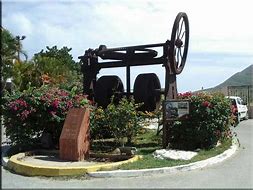
Another salt pond on the French side of the island in Grand Case was the largest producer on the French side.  The salt press, which was used to crush the salt, still stands along the street near the salt pond.  The pond would fill with salt water and when the sun would evaporate the water, salt crystals remained.  
The salt press sits along the road today.
Ships would pick up slaves in Africa, make passage to islands in the Caribbean and trade slaves for salt and sugar.  They would then head for the United States with their loads.  The production of salt on the Dutch side of the island stopped in 1949 with it being stopped on the French side in 1967.  The salt industry on both sides of the island preceded and outlived indigo, tobacco, sugar, cotton and every other effort undertaken on Sint Maarten/St. Martin.  The salt quantity and quality brought trade to the island and exchange with the outside world.  
The Great Bay salt pond can be seen on the right of this
photograph.  Part of the salt pond was turned into a dump.
In 1839 a report was written which tells of the original harvest of salt in 1789 in Great Bay, Philipsburg.  That date happened to be the same date that St. Martin's Fort Louis was completed which was constructed to help in the defense of the island.  The report was commissioned by the Commander of the Netherlands side of the island, Abraham Cannegieter as well as Richard Richardson.  The report told of the opening of the salt pond with close to six or seven thousand islanders, many who were laborers, standing along the banks of the salt pond with flags and colored handkerciefs fixed to small poles waving in the air.  The national flag was heisted at the fort in honor of the occasion.  At a specific time a gun was fired from the fort announcing that the pond might be entered for the collection of the salt.  By the end of the salt collection, it was said that over three million barrels were reaped with a value of thirty thousand guilders.  St. Martin's salt was awarded the Diploma de Grand Prix as the Best Product in the Brusel's Universal Exposition of 1910.  Today the salt ponds of St. Martin are just pools of water reflecting the sun and moon.  They now provide an ecosystem for wildlife.  Today, what is now known as the Sanitary Landfill on Pond Island in the Dutch city of Philipsburg has become known as "The Dump".  It exceeded it's limitations years ago and burns on a daily basis.  What can be done to stop the practice of toxic smoke being emanated from the dump.  Some time ago I wrote a story about my friend Barbara Cannegieter who led the charge to stop the pollution.  At first it seemed to be promising, but as of today I'm not sure just how much has been done to stop the air pollution.  Oh, for the days of the old salt ponds in Sint Maarten/St. Martin  and the ships lined up in the harbor to collect the salt for transport to other countries of the World.  It was another extraordinary day in the life of an ordinary guy.

Saturday, August 8, 2020

The "Musings From A Lonely Man: Part I" Story

It was an ordinary day.  The first week of August and I haven't had my vacation!  And, boy do I need it!  I missed my long awaited visit to the island of Sint Maarten after they closed the island to those of us who live in the United States.  Seems we couldn't control the spread of COVID-19, so they didn't want us to contaminate their island.  Really don't blame them, but I need a long swim in the crystal blue waters of Orient Beach and some time in the sun so I don't appear as a ghost.  My wife Carol and I have called Sint Maarten our second homeland for close to 20 years now.  We enjoy the lifestyle and the many friends we have met on what is known as the "Friendly Island." My wife has her own personal jeweler on Front Street in the Dutch capital city known as Philipsburg.  The town was named after Commander John Philips who had done a great job in advancing the economy of Sint Maarten in the mid-1700s.  He was responsible for removing the island from the administration of St. Eustatius and become self-governing.  He revitalized the salt industry and brought in new settlers and convinced the plantation owners to move away from a subsistence economy to an export economy.  Sounds like an outstanding guy, but...and that's a real big but...seems that the name of Philipsburg was forced on the capital of the Dutch side of the island known as Sint Maarten/St. Martin by the slave master John Philips.  It is said that John Philips, from all accounts, was no easy man to deal with.  I have read several accounts of dealings that involved Mr. Philips that were rather troublesome.  Today it is said that the grave of Commander John Philips, which is located at the first church on Sint Maarten and is a national monument, is hard to find since the graveyard is overgrown and some citizens don't even know where it is located.  The people of Sint Maarten are of an independent nature, and consequently carry along with them, a cheerful and independent spirit.  The island is more replete with natural resources than most other islands in the Caribbean.  Recently, many of the residents of Sint Maarten have decided to change the name of their Capital from Philipsburg to "Great Bay," since that is what it used to be ages ago.  I recently read that a petition that is circulating says: "Make Great Bay the official name of the Capital of St. Martin South."  Another petition is also circulating that reads in part: Great Bay is the traditional and historic name given to our capital by "Our" People.  Philipsburg is the name forced on our capital by the slave master John Philips.  To officially name Great Bay is to claim it as our own.  Actually, the name of Philipsburg appeared for the fist time in a letter from Philips himself directed to the board of the Dutch West India Company dated June 3, 1738.  I personally have already cast my vote online to change the name to Great Bay even though I'm not a resident of the island!  I read quite a few of the replies that accompanied votes and most said they were signing the petition because they believe our capital should not be named after an enslaver.  A few others said they are signing the petition because they feel they are slowly loosing not only their culture, but what we stand for as one people, one destiny and that includes our Sweet St. Maarten as well.  One more wrote that they were signing to honor our own and eliminate all portrayals of white privilege and dominance.  Perhaps if I ever have the chance to travel back to the island of Sint Maarten/St. Martin once again,  I will have the privilege of visiting Great Bay instead of Philipsburg.  I have added a few photographs that will give you an idea what the island of French St. Martin and Dutch Sint Maarten looked like in the past.  It was another extraordinary day in the life of an ordinary guy.  PS - Click on images to enlarge them.


The empty land as it would have appeared in the days when John Phillips was alive.
Front Street in the town known as Philipsburg.
Mickel Deher overlooking the town named after Commander John Philips.
What the town looked like in 1955. 
The "Oranje School"
Front Street as it looked in the 1920s.
Parade down Front Street in 1951 celebrating 100 years of Methodism in St. Maarten.
An old Philipsburg 
What the Great House of the estate "Industry" looked like.
Former Agricultural lands in Rendez-Vous.

Friday, August 7, 2020

The "One Of Lancaster's New Artists!" Story

It was an ordinary day.  Driving north on Queen Street in the city of Lancaster, Pennsylvania.  Had just passed the old Lancaster Armory and moved into the left lane of the one-way street.  As a child I lived in the last house on the last block of North Queen Street which ended just before the Lancaster Railroad Station.  The final block of the street by the railroad station, which was where I lived, was in Manheim Township while the rest of North Queen was within the city limits.  The block just before my home housed the George Ross Elementary School, but I had to walk about mile to elementary school since I lived outside the city.  As I approached the end of North Queen I was still in the left lane.  To my left was George Ross Elementary School.  Then I noticed it!  On the south edge of the school grounds was this really neat painting that I somehow must have missed in the past few months.  
Pulled to the side of the road and snapped a photo with my phone.  The painting was titled "Nurture Your Mind" and was painted by Keisha Finnie.  What a beautiful painting!  Then, a few days later I opened the newspaper and there was this beautiful painting in the Living & Money section of the local paper that featured a large mural of a city skyline with a wavy piano beneath it that was painted by...Keisha Finnie.  It was painted as a tribute to Lancaster's "Music for Everyone."  Wow, I just had to see it for myself so I hopped in the car and headed back downtown to the location on the side of one of Lancaster's parking garages.  As I read more of the newspaper article I got to know a bit more about Keisha and her artistic talent.  She said her high school art teacher was a big influence in her life and encouraged her to continue her painting.  She began to sell her artwork and when the COVID-19 quarantine began in March, Lancaster Public Art put out a call to artists tp put out temporary murals to help spread vital information to the pubic to help fight the virus.  She was one of the ten chosen to contribute her artwork with an 8X8 foot mural for the city of Lancaster.  Then I realized that the painting I had just seen for the first time as I was driving home was the one featured for the COVID quarantine.  
Black Lives Matter work by Keisha Finnie.
Fannie recently partici- pated in the "Black Lives Matter" protest by working on a mural at Art Park which is a small green area between the Pennsylvania College of Art & Design and the Lancaster Police Bureau.  She sketched George Floyd's face onto a vinyl banner duct-taped to a concrete divider between the ark and police station.  While she was working on the sketch she was approached by the city of Lancaster as well as the Art College asking her to help create some sort of collaborative piece for the park.  Before too long she had a few ideas and decided to use a giant wooden board for her idea.  She featured the faces and names of those many black and brown people who died in police custody.  The piece is titled "Say Their Names."  Due to this work she was asked to do the city skyline and wavy piano which I had taken a photo to share with you.  Many people realize that Keisha will be one of the next generation of artists who will be a force in the art scene in Lancaster.  I'm anxious to see what comes next for her.  What a great talent she is!  It was another extraordinary day in the life of an ordinary guy.


Music for Everyone Mural

Thursday, August 6, 2020

The "Discovering Something Truly Magical In The Caribbean! Part II" Story

The Traveling Island Girl
It was an ordinary day.  Reading another post on the blog known as "The Traveling Island Girl."  This post is titled "The Do's and Don'ts when vacationing on St. Maarten." but was originally published as "6 Do's and Don'ts when visiting the Caribbean."  Doesn't matter how it is titled, it still makes one think about how islanders all over the Caribbean must think about we who visit from afar.  Read and maybe you will see yourself in one of the sentences.  I certainly did and will try a bit harder to be more friendly while visiting in the Caribbean.  It was another extraordinary day in the life of an ordinary guy.

Aaaaah the high season is here. The time when St. Maarteners start practicing their smiles and hellos in front of the mirror. Be ready y’all, the tourists are here!
Every winter season St. Maarten and other islands in the Caribbean get a mass influx of visitors arriving from Europe, North and South America and all other continents of the world. Winter season is high season, and we call it high season for a reason: higher tips = higher pays, for some of us in the hospitality industry at least. When you think Caribbean, you think beaches, sun, sand, sea and friendly people and we islanders have perfected the art of friendliness. After all, we have a rep to protect since St. Maarten is generally known as the Friendly Island.
However, it has come to my attention in recent years that although we value the arrival of our dear friends from all over the world, our friends don’t seem to know much about us at all. They don’t know what makes us tick, so to speak. So I’ve decided to put together a list of do’s and don’ts when vacationing in St. Maarten.
DON’T try to speak like us
You can imagine how many times I've heard tourists trying to speak like local.  "Yeah Mon".......uhmmm, No....don't, just don't. First of all "Yeah Mon is commonly used in Jamaica and Jamaica as far as I know does not represent the whole Caribbean.  Secondly, you sound silly.

DO cover yourself when walking on our streets
I get it.  I totally do.  It's hot and our down town area is located near beaches.  But seriously, I don't go to New York City and parade around in an itty bitty tiny bikini on a hot day in Central Park, so why do it here?  It's not only a form of disrespect, but honestly some people can do with a little covering up, if. you know what I mean.  There are various little stores and markets about that sell really cute beachwear and pares or salons.  Not to mention that there are many fun and fashionable ways of wearing pares nowadays.  For all of our sakes, just say yes to the beach dress.

DO say good morning, good afternoon and good evening
I cannot express how important this is. I remember one time I came into the kitchen after school an asked my mom what’s for lunch. I got a slap so hard, I swear I saw stars. Why? Because I did not wish her Good Afternoon first. No, this is not child abuse but a common practice in the Caribbean called “educating your child”.  Before asking a local a question or when entering a store or restaurant start with a hello. It is considered extremely rude not to do so. I know it is not part of some cultures and I can count on one hand how many responses I have received when I said good “whatever time of day it is” in a crowded elevator in the US. We local St. Maarteners also say random hellos to people we pass on the street whether we know them or not. If we pass you on the beach during a morning stroll it is common to say Good Morning.  St. Maarteners are incredibly helpful people but also very proud. You will see that starting off a conversation or question with a greeting makes a world of difference and you might get a complete different reaction than if you had gone the other way. Bonus point: don’t forget to conclude with a “Thank You”.
DON’T complain about our way of life
We complain enough about it ourselves. Our produce, meats and other random things surely are more expensive than where you’re from. But remember that we live on a rock where everything aside from fish and coconuts are imported. Our internet is also very very slow compared to the luxury you all seem to have of 50+ MB’s (serioulsy, I’m jealous) but here you can drink an ice cold Heineken while sitting in the crystal blue waters of our beaches. It’s all a matter of perception.
DO avoid asking silly questions
Yes, we do have cows here.
No, we don’t have a bridge connecting us to Puerto Rico.
Yes, there are white islanders (my husband is one of those and calls himself a Coconut Honky) and no, not all black people are local.
Yes, we too get hot sometimes and at no time became used to the heat and finally yes, we do have schools here. Duh!
Before visiting read up a little on our island. We have very interesting and fascinating (hi)stories. In this day and age of Google and other search engines it is a shame not to do some minor research on St. Maarten before your arrival.
DON’T ask us to predict the weather
We have a meteorological department for that. In my event planner days I used to get asked a lot if it is going to rain later or if tomorrow will be sunny (St. Maarten has overall the same forecast depending of course of the time of year: Sunny with a chance of rain) I came up with the only logical answer I could think of: Let me send GOD a Whatsapp and I’ll get back to you. Really, what else can I say? There are however some great weather sites and phone apps that can give you quite accurate forecasts. If I can give you one piece of advise though, it’s this: Don’t stress about the weather. You do that at home already. Rain or shine, you’re in paradise. Enjoy it while you’re here.
This post was not meant to insult anyone in general or in particular. I am merely pointing out our differences and in doing so giving you, our visitor, a better understanding of our culture.
Check back for more posts on island living and my island adventures. Leave a comment, share this post or just like it. Whatever you do, a little feedback always helps.
Don’t forget to love, laugh and travel.

Wednesday, August 5, 2020

The "Discovering Something Truly Magical In The Caribbean! Part I" Story

If you have been reading this blog site for any length of time, you realize that my wife and I enjoy traveling to the Caribbean as often as we can.  Hasn't happened lately, for obviously reasons, and we are very upset that we can't have or island time.  But, sh*t happens and can't be avoided.  I guess it's called life.  I was recently sent an email from one of our friends who grew up in nearby Williamsport, but who married an islander from Sint Maarten and changed locations.  Oh, to be so lucky!  We try and visit with Barbara as often as we can while on Sint Maarten.  But, we love all the Caribbean islands and find each one just a tad bit different.  Barbara recently sent me a posting of a blog known as "The Traveling Island Girl."  She posted an article that would be well worth your reading.  Makes you thing a bit more when you visit the Caribbean, but can also relate to your own community as well.  The post is rather lengthy, but I didn't know what to delete, so I included the entire posting.  Read it and see what someone who lives in the Caribbean thinks about racism.  It was another extraordinary day in the life of an ordinary guy.

How to be anti-racist when visiting the Caribbean
     I started writing this post so many times and ended up typing furiously away on my keys like a mad black woman. This post always makes me drag up things I’d rather not remember, which then leads to anger and frustration and my anxiety level rising. Ain’t nobody got time for that. So, I end up slamming my laptop shut and going about my day, trying to forget all about my terrible experiences at the hands of clueless white people everywhere.
     But this is not the message I want to convey. I am not that forever-mad-at-the-world person. I believe in educating. So, I present to thee attempt number 4 at writing this piece without letting the anger and frustration get the best of me.
     Although I have done a Do and Don’ts about the Caribbean before (click here to read it again) this one is similar yet slightly different. This is the list of Do ‘s and Don’ts when it comes to a possible racist or perceived racist behavior when in the Caribbean.

     I know, I know. I too am growing tired of having to discuss it, but it has to be done. Tomorrow this Black Lives Matter movement might be over but I’ll still be black. You see, I do believe that some white visitors that come to our islands are actually clueless to how they sound and how their behavior and comments can actually be considered insulting, hurtful and yes, even racist.

     As an always glass-half-full kinda gal, I see it my duty not to get mad and nasty but to try to point it out to you, and hopefully educate you, and in so doing, avoiding you of ever doing certain things again. Not only when you’re visiting the Caribbean, where the majority of populationis black, by the way, but also when you have encounters with people that are different than you back at home or during some of your other travels
     I wish I could describe to you an oasis of acceptance when describing the Caribbean but the sad reality is that racism is alive and well here too. In fact it is an integral part of our history and culture. I don’t think that I need to mention that the whole reason the majority of the population in the Caribbean islands is black is because of slavery, where black people were sold like cattle to the highest bidder, right? I think by now, we all know this.
     Racism in the Caribbean exists. It’s sad when you realize that the one place people visit to get away from all the ugly in the world, has a pretty nasty history behind it. A history that pursues us, the black people of these islands, to this day.
     That’s one thing COVID-19 and Racism have in common: It’s everywhere. Even in ideal places, such as here, where coconut trees sway in the gentle salty breeze, on white sandy beaches, with turquoise waters.
     Hundreds of thousands of people flock to the Caribbean shores each year for some sun, sand and sea and of course the mandatory rum based cocktail and laid back atmosphere. They bring with them their suntan lotions, ignorance and white privilege. Some pack that last one with intent while others have no idea it slipped in between their swimwear, just like the family cat trying to join the vacay-fun when everyone’s too busy packing to notice.
     Most of us Caribbean folk are simple people who love a good time as much as the next person and even though life can sometimes be hard, we remain friendly, helpful and the perfect hosts. Most of us were brought up knowing that tourism is our bread and butter and a happy visitor means better tips and a repeat trip to our shores. So, we bend over backwards to please you. We sacrifice time with family to tend to your every need.
     But please do not take our servitude and need to please as a weakness. We are educated. We are business owners. We are Caribbean. That word to us in a lot of ways means resilience. 
They say one must strike when the iron is hot and since the topic of racism is mucho hot at the moment, I thought it best to educate you on a few of the do’s and don’ts, while you’re suntanning on our beaches. Just 10 simple things to keep in mind while you’re here.

Don’t Assume. When you Assume you make an Ass of U and Me
Beware of assumptions. They can make you feel like an idiot when you’re corrected. And boy, do visitors assume the worst of the local people when here.
A few of the more popular assumptions are:
the black local in the store must work here and cannot possibly be shopping at the same place as you
the black local serving you at the bar must be just a waitress/waiter/bartender, and cannot possibly own the place the black local living here, does so because he or she does not have a choice every black person on the island must be a local.
all black locals are poor and uneducated.
black locals don’t travel and definitely don’t stay at the same resorts we do.
Do yourself a favor and educate yourself. Making assumptions such as these makes you the uneducated in the bunch, not the black local you’re assuming must be below you on your ridiculous totem pole of class. Not because we speak a different English means that we’re below you or that we’re slow.

Do learn about our traditions and history before you arrive and while you’re here.
We love to talk to you about our upbringing, our traditions and the history of the island. While you’re here, why not visit a museum, or a history walk around town or an educational hike, where you can learn about the indigenous flora and fauna? The islands are so much more than just sun, sand and sea and our history is truly fascinating. Learn the truth about plantation homes, about the indigenous inhabitants of the islands (the true Caribbean people), learn about the truth behind our colorful carnival celebrations. Buy from local stores, sit at local bars, eat at local restaurants.

Do attend our local events
Each Caribbean island has one or more traditional annual event. Carnival is one such event that takes place throughout the year, on different days on each island. But besides carnival there are other very important days commemorating very important occurrences in history. On St. Maarten two of those days are Emancipation day on July 1st and St. Maarten’s Day on November 11th for example. Find out if there is a traditional local event happening on the Caribbean island you’re planning to visit and make an effort to be a part of the celebration.

Don’t let your fears and insecurities shape the view of us
Not all black people steal, not all black people are dangerous, not all black people are out to harm you. It’s the same with any other color. I cannot tell you how many times I have approached someone who was obviously very lost, just to be met with scared looks and car windows being rolled up. I don’t even look that menacing, do I? Or when white visitors actually went to complain to management of a high end resort about a black local family at the resort pool. Get over yourself.

Do take the time to learn about the island
It’s indoctrinated in us to be friendly and helpful. It is what we do. Sure, you have those that take advantage of any situation but I assure you it’s not because of the color of their skin or because they’re from the Caribbean with no place else to go. Besides, have you stopped to think how many times black locals are duped out of their money by white men in fancy suits?
Learn about the education system before making assumptions that just because of the size of the island it is impossible to get a higher education. That, my white friend, is just not the case. Most of the islands actually have colleges and universities and some of them rank higher than some schools in the US, and Canada. Shocking, right? And for those of us who don’t have a college or university on our island home or cannot major in what we want in the Caribbean, we enroll in colleges and universities in Europe, the US or Canada. I studied Marketing in the Netherlands, so did many of my friends and fellow islanders, while others preferred to further their studies elsewhere in the world.  Take the time to understand us before you jump to conclusions.
Do make an effort to know more black locals
Good for you, You know the black bartender’s name at that fancy resort you’re staying at. But do you know the black hotel manager, the black owner of the bar/restaurant you like to visit, the black shopkeeper where you like shop, the black taxi driver that drives you around? I don’t mean to just ask them their names or how much damage they had after a hurricane (please stop asking that by the way). But have you ever bothered to really get to know them? Next time you’re in the Caribbean, make an effort to get to know about the locals you encounter, whatever their color might be because we come in different shades of any color. Dare to get out of your comfort zone once in a while. Hanging out with other tourists might just keep you from experiencing things you otherwise wouldn’t. And wouldn’t that be a shame?

Do smile and say Hello
Like I mentioned above, we are not scary people. We are not uneducated. Most of us speak multiple languages. We do travel as well and might even have visited your neck of the woods. But no matter what we look like, or the color of our skin, or how poor you might assume we are, it is human decency to smile and say Hello. Try it with your grocery bagger at the supermarket, or the gas attendee, or the store worker or the old black lady sitting on a street corner selling her handmade craft.

Don’t ignore our values and traditions
Just like you, we too have our values and traditions. For instance it is very rude not to say a greeting when you enter a store or walk past someone. It’s important to acknowledge that the person is there. Do say good morning, good afternoon and good evening before asking whatever it is that you want to know from the person in front of you. I’ve read it on so many message boards how a visitor had a terrible encounter with a local and how that local was so rude but did you stop to think how rude the visitor might have been to the local? Another little something to remember is that this is not your home. You are a guest. And while things might not run the way you are used to, it doesn’t give you the right to criticize it or belittle it. Besides, the whole point of traveling is to experience other cultures, traditions and values than your own.

Don’t think you know better just because you come from the great mainland. 
This one here is precious because I cannot count how many times I have sat at a bar next to some white expat or visitor, who tries to tell me how talented and well respected he/she is back home and that here we basically should fall at his/her feet and thank him/her for visiting.
I don’t care what you used to do back home and how popular and great you were at something. To most of us respect is what counts. Respect me and my home and I will respect you and yours.
Just because we are a small community does not mean we are helpless or clueless. At no time should you feel or think that you are better than us.
While we’re on this topic don’t make fun of our way of life or accent. We are not your designated black jester, here to entertain you. Besides, You might want to remember that here, you’re the one with the accent.

Do talk to your fellow white person
If you see another white visitor or expat do something considered racist or make a racist remark, dare to call him or her out on it. You allowing that person to get away with such behavior makes you an accomplice and an enabler.

In Conclusion
Just remember that while we might have a different skin tone, we all bleed the same and we are all here trying to make the best of this game called life.
I don’t consider traveling a luxury but a necessity. It opens your eyes to other cultures and different ways of life, and that, on its own is a beautiful thing.
The Caribbean culture is diverse, rich, so deeply rooted in traditions. It’s beautiful. You should try to see it from a different angle other than with your nose pressed against the window of an air-conditioned tourbus. Instead of complaining about something you do not agree with because it is so different from your way of life, try to learn why it is that things function in a certain way here. Your way of life might be great but so is ours.
I believe that racism is based on pure ignorance and fear. Fear of the unknown. Fear of whatever is different than us. Change your view and perception. Get over that fear and get to know the person or persons you are so afraid of. You might just discover something truly magical there.

Tuesday, August 4, 2020

The "Will Centre County Be Able to Coexist With Penn State University?" Story

It was an ordinary day.  Just hung up from my weekly phone call to my good friend, Jere, whom I have been friends with for close to 70 years.  We enjoy our weekly phone calls and try to catch up on what we each have been doing since the previous call.  Jere and his wife Sue have been traveling buddies with my wife Carol and myself since he and I both retired from the Manheim Township School District together in 1999.  Over the past 20 or so years we have made a few trips to Hawaii as well as trips to exotic locations such as the U.S. Virgin Islands, Barbados, Antigua, St. Martin, Puerto Rico, Jamaica, Cayman Islands, Turks & Caicos, Bahamas and a few cruises to places such as Aruba, Curacao, locations in Mexico and a trip through the Panama Canal.  Jere and Sue moved after he retired to State College, Pennsylvania, but we still find time to visit as often as we can.  Since this past March we have not been able to travel together or even make visits to see each other.  The weekly phone calls have to do until we can feel safe once again to visit without fear of giving one another the COVID-19 virus.  During our talk today I brought up the fact that Penn State University will be opening soon and our local newspaper featured a story about the town of State College growing by about 47,000 people soon.  
Old Main is less than a mile from my friends home in State College.
From their back door you can see housing that is usually filled with students from the college.  No matter which direction  you drive from their home you will see apartments, sorority and fraternity houses and plenty of dormitories that will soon be filled with students.  And, as you are aware, after watching television, reading the newspaper or looking around in your neighborhood, college-aged students of both sexes don't seem to have a mask on their face.  They seem to think they are invincible!  Perhaps some are, but for those that aren't and might come in contact with the virus, they too will come down with the virus.  And...if they happen to be in the same grocery store, fast food place, Walmart, The Creamery or even passing Jere or Sue on the street by their house, they could spread the virus in a second.  
Downtown streets will be filled soon with students.
Penn State researchers wondered from the outbreak's early days if it was a possiblity that it could spread throughout the campus and surrounding neighborhoods as well as the entire Centre County.   One University researcher said there may be no other community in Pennsylvania where the population in the neighboring community is affected by the reopening of a university than Centre County.  Residents are concerned about a potential increase in cases when students return, given the high level of interaction with the community.  After Penn State shut down their campus last March, Centre County has had fewer than 300 confirmed coronavirus cases.  Penn State researchers have been sought throughout the faculty to study what the influx of students may cause in the very near future.  
The Nittany Lion awaits anxiously!
$2.4 million in grants was offered to fund these researches.  One local State College borough member voiced concern about the health impact of students' return, including the move-in process.  She claims that no one at the university has laid out any real cogent plan for how we're going to deal with the start of school.  Another council member said that it takes only a few virus carriers to move into each apartment or dormitory to cause major problems.  She also said that she sees this as the beginning of a pandemic in more than one building.  Penn State officials said it is prepared to move all instruction online if problems occur.  But, who and when will they decide when that time arrives?  When is it going to be bad enough to make changes?  The article I read also pointed out that the town relies on their student population for the town's longterm viability and needs the students.  But, will there be a happy balance in Happy Valley?  For my friends, I hope they are able to stay safe while being able to co-exist in the University influx.  It was another extraordinary day in the life of an ordinary guy.     

Monday, August 3, 2020

The "Cowboys From The Past" Story

It was an ordinary day.  Checking out all my favorite online sites as I watch one of my favorite old-time westerns, Wagon Train, on Me-TV.  Just love all the old cowboy shows from my youth and at last have found a TV channel that features many of them.  If you have read my blog in the past, you probably know that I have featured a few of my favorite cowboys over the years.  Well, today I found a few questions on an online site that deal with cowboys and knew I had to try to answer the questions that were featured.  So...if you were fascinated with TV cowboy stories in the 1950s and 60s, see how well you do on the following questions.

  1. Which cowboy, born Henry McCarty, died at the age of 21?   The cowboy whose real name was Henry McCarty, was known to most young boys as Billy the Kid.  He was born in the Irish slums of New York City and moved to Kansas, and then New Mexico with his mother. She died of tuberculosis when Henry was young leaving him an orphan at the age of 14.  He was arrested and put on death row seven years later, but that's not how he died.  Seems he escaped the jail where he was awaiting to be put to death and after a manhunt, was shot to death by Sheriff Pat Garrett in Fort Sumner, New Mexico.  
  2. Which sharpshooter eventually married a fellow marksman after beating them in a shoot-off?  Tough question with an unusual answer.  
    Seems that Annie Oakley was pitted against Frank Butler in a shooting contest when they were young.  She beat him by hitting 25 out of 25 targets while he had only 24 out of 25.  The shooting match was arranged in the late 1800s and Annie and Frank were then married for 50 years.  Their relationship was immortalized in the musical "Annie Get Your Gun."  They both died three weeks apart in 1926.
  3. Which frontiersman created a stage show about the Wild West that lasts for 30 years?  It all began in 1883 when Buffalo Bill Cody began an out-door extravaganza that highlighted the life in the Wild West.  He named his show the "Wild West, Rocky Mountain and Prairie Exhibition."  After that show he toured with another show known as "Buffalo Bill's Wild West Show" which was an outdoor, circus-like event.  After years in the United States it toured Europe where one of his patrons was Queen Victoria.  That show lasted for 30 years.
  4. Which cowboy rose to fame after having his shooting skills memorialized?  All began during a gunfight in 1861 when Wild Bill Hickok shot three men who were trying to kill him during a gunfight.  But, it wasn't until six years later that the tale of his gunfight was sensationalized in "Harper's New Monthly Magazine."  The article brought fame to the cowboy and a special place in history.  But, Wild Bill was killed a few years later during a gunfight in Deadwood, South Dakota.
  5. Which cattleman has a trail named after him that goes through both Mexico and Colorado?  This is a tough one since I had never heard of Charles Goodnight and Oliver Loving who blazed a trail from Texas to Wyoming which is now known as the Goodnight-Loving Trail.  The trail was created as a herding trail from Texas through Colorado and helped both make quite a profit moving cattle into new territories.
  6. Which famous Wild West cowboy was raised Mormon?  Ever hear of a guy named Butch Cassidy.  I love his movie with the Sundance Kid.  Well, Butch was born into a Mormon family in Beaver, Utah.  The family farmed and raised cattle.  But, Butch left home to work on other ranches to help raise money for his family.  At the age of 13 he committed his first crime when he stole a pair of overalls from a store.  He had every intention to return with the payment later, but the store owner had him arrested.  That may have been the first event that turned him into a criminal.  Seems that his time as a Mormon didn't do him much good.
Well, how'd you do partner.  Did you get at least one right.  Being that I was a make-believe cowboy as a child and watched every cowboy show on TV, I thought I knew just about everything about every cowboy and cowgirl, but I only got the question about Annie Oakley right.  Gonna have to watch ME-TV some more, so I am.  It was another extraordinary day in the life of an ordinary guy.

Sunday, August 2, 2020

The "A Survivor Of The Mauthausen Concentration Camp" Story

Foreword:  Reading a comment posted on this blog about a story I wrote on Thursday, March 5, 2020 titled "The St. Maarten's Holocaust Survivor - Lionel Romney (1912-2004)."  The comment was written by Jose Pedro and read:  Another Spanish speaking black man who also was in Mauthausen and also saved his life was Carlos Grey Molay.  If he had written a book about this adventure he would have become a millionaire.  Every now and then I will do research on what someone has written to me and turn it into a story to share, and in this case I was very interested in what Mr. Pedro had written to me.  Did quite a bit of research and the following tells the story of Carlos Gray Molay, aka Carlos Greykey.

It was an ordinary day.  Reading about one Mr. Carlos Greykey who was born in Barcelona, Spain in 1913.  His parents were originally from Fernando Poo, Equatorial Guinea, a Spanish colony at that time.  To support Carlos and his brothers and sisters, his mother cleaned houses in the affluent district of Barcelona.  I found no mention of his father in any account about Carlos.  Carlos went to the local University where he studied medicine before joining the military coup d'état in 1936.  Carlos joined the troops fighting the putschists (a German word meaning push, used to mean an attempt to overthrow a government by force) and eventually sought refuge in France where he continued the fight against the European fascist regimes by participating in the French war effort against Nazi Germany.  The French finally surrendered to the German Nazi forces and Carlos suffered the same fate as several thousand Spaniards and was taken prisoner and taken to a detention camp.  
Carlos Greykey dressed in his
bellhop outfit in Mautheusen.
Eventually he was transferred in 1941 to Mauthausen concentration camp.  He arrived at the camp on June 21, 1941.  He was quickly spotted among the rest of the Spanish prisoners because of the color of his skin.  Black people were considered inferior therefore, dangerous objectives of the Nazi regime and dangerous corrupters of Arian blood.  But, Carlos answered the official's questions in German which was the main reason he wasn't sent immediately to the gas chamber.  Germans weren't used to seeing people of color.  They dressed him in a red suit and made him a bellhop who served at the table of one of the leaders of the Spanish underground communist organizations in Mauthausen.  He was made fun of, but at least it saved his life.  Carlos Greykey was assigned prisoner number 5124 and was identified with a triangle with the letter "S" (Spanish) reserved for political prisoners and activists.  Carlos spoke Spanish, Catalan, German, English and French which probably saved his life more than once.  He was the server of the field commander, Franz Ziereis and was in charge of the lodge and cloakroom of the SS officer's club.  He also waited on Heinrich Himmler at the camp in 1941.  He was introduced to Himmler as "a black Spanish living in Spain."  He survived thanks to the protection of is compatriots who hid him and camouflaged him until the liberation of Fields.  After liberation he managed to head to France where he remained the rest of his life and where he was naturalized French years later.  It is believed that he settled in Seine where he married and had two sons and a daughter.  According to his daughter, her father was a dancer in a cabaret and later became an electrician.  From 1977 until his death, he was a member of the National Alliance for Democratic Restoration, a group opposing the dictatorship in Equatorial Guinea.  He died in France in 1982.  Mauthausen was one of the worst of the Nazi concentration camps, which eventually was liberated by the American 11th Armored division on May 5, 1945. To have been a black man and have survived this camp is more than remarkable!  It was another extraordinary day in the life of an ordinary guy.

Saturday, August 1, 2020

The "One Of The World's Musical Superstars Turns 250 Years Old" Story

It was an ordinary day.  Was leafing through the latest "Signals" catalog when I saw an advertise- ment for a Solar Beethoven.  Said you should put the statue where the sun shines or beneath a lighted lamp and he'll wave his baton!  Ludwig van Beethoven was born in 1770 which makes 2020 his 250th birthday year.  This past March, performers with the Berlin State Opera took to their balconies to sing excerpts from his heroic Ninth Symphony.  
Advertisement in "Signals."
Then in May, despite lockdowns and a pandemic, officials reopened the Beethoven-Haus, his childhood home in the center of Bonn, North Rhine-Westphalia, Germany.
  Much has been written about van Beethoven, but one interesting story I found reported that in 1825, while recuperating from a near-death experience, Beethoven composed one of the most profound pieces of music in Western History.  His musical piece is known as The Holy Song of Thanksgiving which suggests a quiet conversation between God and a man making  his peace with his Creator despite the deafness with which he has been cursed.  Music lovers around the world know the music composition as "the Heiliger Dankesang."  Beethoven's full description of the original score is: "Heiliger Dankgesang vines Genesenen an die Gottheit, in Der lydischen Tonart" which translates to "Holy Song of Thanksgiving by a Convalescent to the Divinity, in the Lydian Mode."
Ludwig van Beethoven
Beethoven wrote the movement to offer thanks for being alive, despite having gone completely deaf, the worst possible fate for a composer and musician.  Parts of the piece he labeled "Feeling new strength," since he had recently survived a near-fatal illness.  Beethoven would pass away two years later after completing the last of his string quartets, which many believe form the summit of Western music.  I read many stories about his last great composition and writers said, "Start listening to the Heiliger Dankgesang and reality seems to hold its breath and wait."  My favorite composition written by Ludwig van Beethoven is his Symphony No. 5 in C minor, Op. 67 which was written between 1804 and 1808.  It is one of the best-known compositions in classical music, and one of the most frequently played symphonies.  What I probably enjoy the most is the opening four notes.  As soon as you hear those notes you know you are in for one of the biggest musical treats in your life.  The composition premiered in Vienna, but didn't go over well.  Seems that by the time the fifth started, the audience was too tired and cold from the icy winter outside to listen properly.  They didn't see just how great it was.  Over time it became one of his most listened to pieces.  I only wish I could have watched him perform during his lifetime.  During 2020 there have been many celebrations of his life and the only thing that prevented a truly amazing classical music year is the worldwide pandemic that came with lockdowns around the world.  It was another extraordinary day in the life of an ordinary guy.