Extraordinary Stories

1944 (1) Act of kindness (12) Acting (2) Adoption (4) Adventure (766) Advertisement (6) Africa (1) Aging (14) Agriculture (47) Airplanes (9) Alphabet (5) American Red Cross (1) Americana (116) Amish (43) Ancestry (5) Ancesty (2) Animals (43) Anniversary (4) Antigua (10) Antiques (14) Apron (1) architcture (1) Architecture (36) Art (175) Art? (8) Arts and Crafts (69) Athletics (6) Automobiles (40) Awards (7) Banking (2) Barn raising (2) Baseball (103) Basketball (3) Batik (1) Beaches (89) Becoming A Citizen (1) Bed & Breakfast (2) Bee Keeping (6) Beer & Breweries (2) Bikes (3) Birds (9) Birthdays (34) Blindness (1) Blogging (5) Bookbinding (5) Books (12) Boxing (2) Brother Steve (12) Buisiness (3) Business (5) Canals (1) Cancer (14) Candy (30) Caribbean Islands (9) Caribbean Villas (15) Cats (5) Caves (1) Census (1) Chesapeake Bay (61) Children (28) Chocolate (4) Christmas (57) Church Adventures (122) Cigars (1) Circus (3) Civil Rights (8) Civil War (6) Classic Cars (7) Climate Change (5) Clubs (1) Coin club (2) Coins (1) Collections (73) Comedy (3) Comic Books (5) Commercials (1) Comnservation (2) Conservation (41) Covered Bridges (3) Craftsmanship (12) Creamsicle the Cat (11) Crime (16) Crisis (312) Cruise Travel (6) Crying (1) Culture (4) Dancing (1) Danger (16) Daughter Brynn (58) Daughter-In-Law Barb (7) Death (5) Death and Dying (65) Destruction (2) Donuts (1) Downsizing (2) Dunking (5) Easter (3) Eavesdropping (1) Education (48) Energy (15) Entertainment (165) Entrepreneurial (62) Ephrata (1) Etchings (1) Eternal Life (4) Facebook (5) Factories (4) Fads (6) Family (261) Farming (37) Father (42) Father Time (68) Favorites (88) Firefighting (1) Flora and Fauna (28) Fond Memories (490) Food and Cooking (171) Food and Drink (111) Football (16) Forgetfullness (3) Former Students (10) Framing (30) Friends (359) Fruits and Vegetables (3) Fun (4) Fundraiser (6) Furniture (1) Games (7) Generations (3) Gifts (1) Gingerbread houses (1) Giving (8) Globes (1) Golf (3) Good Luck (2) Graduation (1) Grandkids (136) Grandparents (3) Grandview Heights (29) Great service (3) Growing Old (8) Growing Up (187) Guns (2) Handwriting (3) Hat Making (2) Hawaii (49) Health and Well Being (61) Health Care (4) Health Hazards (110) Heartbreak (7) Heroes (26) High School (142) History (777) HO Railroading (4) Hockey (4) Holidays (134) Home construction (7) Horses (2) Housing (3) Humorous (71) Hurricanes (1) Ice and Preservation (2) Ice Cream (8) Inventions (34) Islands (4) Italy (12) Jewelry (3) Job Related (62) Just Bloggin' (56) Just Wondering (19) Juvenile Diabetes (5) Labor (3) Lancaster County (542) Law Breakers (8) LDubs In-Laws (3) Lefties (1) Libraries (1) Life's Lessons (175) Lightning (1) Lists (72) Lititz (18) Locomotives (1) Lodging (1) Love (4) Magazines (2) Magic (1) Maps (2) Marching (2) Market (5) Medical (161) Memories (28) Middle School (3) Milk (2) Minorities (1) Money (3) Mother (54) Movies (6) Mt. Gretna (1) Music (118) My Brother (19) My Wife (260) Neighbors (7) New Year's Day (5) Newspapers (4) Nicknames (2) Nuisance (3) Obsolescence (5) Occupations (2) Old Age (1) oldies (1) Pain and Suffering (12) Panama Canal Cruise (13) Parish Resource Center (14) Patriotism (3) Penmanship (1) Pets and Animals (99) Photography (220) Pizza (1) Plastic (2) Playing Trains (2) Poetry (2) Politics (27) Polution (3) Postal Service (2) Predators (2) Presidents (11) Pride (4) Printing (81) Protesting (3) Public Service (65) Questionnaire (1) Quilts (1) Race relations (6) Rain (1) Reading (4) Records (2) Religion (10) Retirement (4) Revolutionary War (3) Robotics (1) Rock & Roll (4) Rodents (2) Saints (4) Sand (1) Scouting (2) Sex (1) Shakespeare (1) Shelling (2) Shopping (24) Simple Pleasures (122) Slavery (6) Small Towns (4) Smoking (1) Snickedoodle (1) Snow (1) Son Derek (27) Son Tad (33) Son-In-Law Dave (27) Soup (1) Spices and Herbs (1) Sports (139) Sports and collectibles (1) Spring Break (1) St. James (2) St. Martin/Sint Maarten (306) Stained Glass (3) Stone Harbor (4) Story-Telling (26) Stragers (2) Strangers (4) Strasburg Railroad (1) Stress (3) Stuff (4) Suicide (2) Sun (1) Surfing (1) Tattoos (4) Teaching (49) Technology (90) Television (6) Thanksgiving (2) The Arts (6) The Beach House (62) The Flag (1) The Future (5) The Shore (78) This and That (23) Timekeeping (7) Tools and Machines (25) Tours (2) Toys and Games (31) Track & Field (1) Tragedy (8) Trains (19) Transportation (18) Travel (16) Trees (2) Trending (2) TV Favorites (23) Underground Railroad (10) Unit of Measurement (1) USA (2) Vacation and Travel (545) Vehicles (80) Vison and Eyesight (2) War (14) Watches and Watchmaking (5) Weather (48) Weddings (3) White House (1) Wisdom (3) Yearbooks (12) York County (3)

Monday, August 12, 2024

Traveling East On King Street In Lancaster, Pennslvania

It was an ordinary day.  Checking out some of the many notes and photos I have been saving since I began my blog a few years ago.  Found out I have an inventory of notes and photographs that took me from center square in downtown Lancaster until I reached Thaddeus Stevens College of Technology which is about one mile East from the square to the school.  Though you may be interested in taking a trip with me so you too could observe all the history that is the city of Lancaster, Pennsylvania.  My trip's description will take a few stories, since attempting to do it all in one story is a bit too much.  So, follow along with some of the historical sights that I get to see each and every time I travel from Center Square, east to the Little Conesstoga River.  So.... I will begin the first of my stories with a visit of the historical center city of Lancaster, Pennsylvania at Center Square and heading East, out of the city!  Other stories will follow in the coming months. 

East King Street, extending from Penn Square about eight blocks east, to Reservoir Park, can be explored in a leisurely hour-long stroll beginning at Lancaster's commercial hub and culminating at the City's eastern boundary with Lancaster Township. These eight blocks span three centuries of Lancaster's history.  When the plan for Lancaster's streets and property lots was first laid out in 1730, East King Street was then known as High Street, referring in the English tradition to a main thoroughfare. The road was part of the "King's Highway" that connected Lancaster with Philadelphia, at a time when Lancaster was the county seat. Two centuries later, East King would become part of the "Lincoln Highway," established in 1913 as one of America's first transcontinental automobile roads reaching from New York to San Francisco. The architecture along East King Street reflects three centuries of social history. The street has over the years featured a wide variety of building types, including modest rowhouses, fashionable one-of-a-kind residences, major commercial buildings, small neighborhood storefronts, hotels and taverns, breweries, a Victorian markethouse, a prison, firehouses, a church, gas stations, small industries and factories. The block culminates with a city park that once contained a major reservoir, and a trade school founded in 1905 from the legacy of congressman and abolitionist Thaddeus Stevens.  The western blocks, closest to the nucleus of Penn Square, contain some of the earliest buildings, several dating from the late 1700s. The eastern end of King Street remained largely rural and undeveloped through the end of the nineteenth century. During Lancaster's Victorian-era boom, the City's residential areas expanded as the population grew. By the 1850s, the blocks west of Shippen Street were densely built, with development continuing east to Plum Street. As you progress east along East King, note the increasing prevalence of late nineteenth-century and early twentieth-century buildings.

14, 16 and 18 East King Street: Demolished Trio

A trio of three-story brick buildings at this site were demolished in 2017, replaced by an addition to the Marriott Hotel. A Victorian building at 14 East King Street featured an ornate facade with tall arched windows and iron trim. The building at 16 East King was constructed in 1822 and housed the Heinitsh Drug Store from 1841 until 1924. The former residence at 18 East King Street was remodeled circa 1910 and contained clothing stores through the 1930s. Just off Penn Square, this first block of East King Street boasted numerous professional offices and retail stores selling varied merchandise,  including shoes, hardware, fruit, groceries, china, furniture, wine, carpets, jewelry and dry goods.


Lancaster County Courthouse

43 East King. This grand civic building succeeded two smaller brick courthouses situated in the center of Penn Square, originally known as Centre Square. (The Soldiers and Sailors Monument was erected there in 1874.) The oldest section of this monumental cut-stone building was constructed between 1852- 1854 in the Roman Revival style popular for civic buildings. A temple-like entry faces East King Street, and a statue of Justice holding scales sits atop the central dome. The cupola contains a clock with four dials, facing north, south, east and west. A rear wing was built in 1896, and the low front wings were added in 1923. The modern annex at 50 North Duke Street was constructed in 1974. Three prominent architects worked on the nineteenth-century portions of the building: Samuel Sloan of Philadelphia, James Warner of Philadelphia (who also designed Central Market), and Lancaster's own C. Emlen Urban.

                                              Curb Markets                                                  First block of East King Street In addition to the indoor activity at Central Market, "curb markets" once flourished along East King Street. Buggies lined the streets and vendors displayed their produce on the steps of the Courthouse. The curb markets were discontinued in 1929 for public safety reasons, as automobiles competed for space with trolleys and farm wagons on narrow city streets. Today, the Courthouse steps are used as a public gathering space to launch political campaigns and hold vigils and protests.

Farmer's Trust Co

46-52 East King built for the Farmer's Trust Company in 1929 and designed by Lancaster architect Melvern R. Evans, this bank building reflects the Georgian Revival style of the early twentieth century. The facade of this brick building features three dormers on the mansard roof, set behind a cement balustrade. Two large windows flank the center entry door, which is topped by a decorative cement swag.


                                            The Buck Tavern

105 East King - The Buck Tavern operated on this site as early as 1765, and later served as the Leopard Hotel until the property was purchased by Samuel R. Weber in 1903. The current building was constructed about 1912 as the "Hotel Weber" and later became the "King Douglas." The building continued to function as a hotel through the 1980s.


                                 Early 19th-century homes and businesses

110-112 East King The oldest sections of this building were likely constructed in the early 1760s. The arched dormer windows with applied keystones reflect the building's eighteenth-century origins, while the bracketed cornice beneath the roof stems from nineteenth-century remodeling efforts. The row of shopfront-residences at 106 through 124 East King all predate 1810, representing the largest group of buildings from this period still surviving within the City of Lancaster.  More will follow in the coming weeks!


It was another extraordinary day in the life of an ordinary guy


Sunday, August 11, 2024

The....So What Supermarket Do You Go To Every Week?" Story

It was an ordinary day.  Just got back from our grocery store shopping which my wife and I do just about every Friday.  Goes back to when we were married and decided upon a day of the week in which we should head to the store to stock up with food for the remainder of the week. Didn't want to wait until Saturday, since it would spoil the entire weekend and take away from time that we could spend together doing something we enjoyed doing.  When children began to appear, we didn't want to wait until the weekend since that was time to spend with the family.  So, years and years ago...we picked Friday to be the grocery shopping day the week.  Seemed to work well, except for weeks when something else filled Friday with needed events.  In that case we did wait until Saturday to head to the grocery store.  We may have had to go out for a meal on Friday if we perhaps had run out of food before Saturday.  With a family of 5 that was easy to do and happened frequently.  Now that we are once again "empty nesters", we can plan a bit easier and very seldom run out of food before "shopping day."  But, for Carol and I, we enjoy several visits to a variety of stores every Friday which means we may have to carry over until the weekend to visit all of the "speciality stores" that we enjoy.  Our main store visit is to the "GIANT" grocery store.  Many of you may not have a "GIANT" store in your community, but the city of Lancaster has several stores, spread out around the many neighborhoods in the city.  We also enjoy visits to the specialty grocery store known as Stauffer's of Kissel Hill.  It is very similar to the Giant Store except it has a few more local products and seems to offer more local fresh fruits and vegetables.  As a teenager, years and years ago, I worked for one of the city/county wide supermarkets known as the ACME Supermarket.  Not quite sure what the letters stood for, but that didn't matter as long as they gave me a pay check every week.  There were ACME and Weis Supermarkets just about everywhere, but they were the only supermarkets.  Today there are a few other speciality supermarkets and a few WEIS Supermarkets, but there are no ACME Supermarkets....at least in Lancaster County.  The pay for working at the ACME was remarkable for a young boy.  You had to be 16 years old to work there, but I started with the same starting salary as an older person would have received.  When I "retired", sounds better than "quits", from the Acme Supermarket, after starting a teaching job in nearby York County, I was getting $2.32 an hour.  Fantastic wages for a young boy.  Well.....it's time to head out the door and make a stop at our Stauffer's Store for a few special items that only they have.  We do have a Stauffer's of Kissel Hill store about 5 minutes away, but we enjoy the ride to the Kissel Hill Stauffer's of Kissel Hill, since we know where all the items are and do enjoy the ride through the countryside to the store.  Both stores also have nearby stores that carry fresh flowers, plants, etc.  There are also a few other large grocery stores, but you can only eat so much in a week!!  Yeah....I know they all have sales on different items, but paying for the gas to hit all of them doesn't make sense to me.  My wife and I know where all the items are in both of the stores that we frequent and can get through the store in pretty good time.  Hey....have to be back in time to watch the ball game on TV....be it a baseball, football, or even an ice hockey game.  It was another extraordinary day in the life of an ordinary guy.     

The Book Adds To Story Of Lancaster County's Early Settlers Story


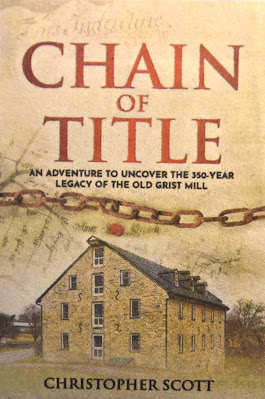
It was an ordinary day.  Reading about a retired engineer named Scott, who moved from New Jersey to a Lime Mill along the Pequea Creek near Willow Street, Pennsylvania.  It was seven years ago and he moved to the grist mill that had been built in 1846 by George and Susanna Lefevre, but had been abandoned and was in need of substantial repairs.  Scott was an engineer from New Jersey and now has a tale to tell about how he made the grist mill habitable. Seems that the people who owned the mill before he did, owned the land before the mill was built on it.  Scott tells his story in a new book, "Chain of Title: An Adventure to Uncover the 350-Year Legacy of the Old Grist Mill."  The self-described amateur historian describes his meticulous research concerning who owned the mill and when they owned it, in deep detail.  This is a primer about how to conduct such a complex investigation as much as a description of the researcher's findings.  In his mining of the mill's lore, Scott discovered several nuggets of new information.  He found that Quakers, not Mennonites, originally owned the land on which his mill was built.  And, he found the names of two new families to add to the Herrs, Kendigs and other "first settlers" of the Willow Street area.  Scott concentrated on primary documents.  He spent two and a half years searching through the archives of historical societies and libraries around the world.  His greatest discovery was not so far from home -- in Chester county.  Chester encompassed Lancaster County in 1703, when Amos Strettle purchased a 5,000 acre Penn grant from George Shoar.  Scott realized that Penn, Shoar and Strettle were Quakers.  So were the next three owners of the land before the property was subdivided and sold in 1731.  None of these men lived on the land.  So all of the early owners of the property on which Scott's mill was built were Quakers.  The settlers of the land immediately to the north are primarily Mennonites.  But many people think Mennonites owned all of the land, north and south.  "I shudder to think how it will be received when the truth is revealed that the lands here were not owned by the celebrated Mennonite settler Hans Herr, but by a Quaker," Scott writes.  Scott's dogged sears for original documentation also uncovered an old booklet at the Chester County Historic Society that named the settlers who'd been farming along the Pequea since 1710.  The names include Herrs, Kendigs, Meylins and others found on many lists of early Swiss, German and French refugees.  But the source Scott found, listed two more names of men who lived on the Strettle property to the south.  They are Henry Carpenter and Henry Haines.  The two men apparently arrived in Philadelphia before the Mennonites came here in 1710.  Scott says Carpenter and Haines are not known to be Mennonites.  Furthermore, he believes they were squatters who were forced to purchase their farms when the Quaker owner Thomas Hatton subdivided his property in 1731.  Quite a story of Quakers and squatters that began as a "simple" search for a chain of title to Scott's old grist mill.  And...so it goes.  It was another extraordinary day in the life of an ordinary guy.  

Saturday, August 10, 2024

Taking On Technology Story

It was an ordinary day.  Reading in my AARP magazine a story titled "AARP Takes On Technology." It read:  Many older Americans are thriving in a digital world.  But some are still uneasy with technology.  A new AARP survey finds that people 50-plus are about as likely a those under age 50 to own a smartphone, tablet or other device.  Yet nearly 2 out of 3 people age 50 and older do not believe technology is designed with people their age in mind.  AARP is taking on the challenge of eliminating the technology gap for older people.  Here's how.  HIGH SPEED INTERNET ACESS - For too many Americans, the high speed internet they need is out of reach.  AARP is fighting for laws that provide affordable internet service to Americans.  Successes include the Infrastructure Investment and Jobs Act, which will distribute $42.5 billion in federal spending to states to provide high-speed internet, and the Digital Equity Act,, which allocates $2.76 billion to expand digital devices in underserved communities.  CREATING NEW PRODUCTS - Since it began in 2021, the Age Tech Collaborative from AARP has worked with hundreds of start-ups that are developing products and services to help us age well.  So far, AARP has invested in roughly 75 of the companies.  The aim is not simply to see a financial return, but to provide older adults with modern, useful, and accessible products designed to help improve their daily lives.  INFORMATION AND EDUCATION - AARP has free information and support available for people who want to learn more about digital technology.  AARP's Personal Technology Resource Center, at aarp.org/tech, has news, tips, reviews and video to help both novices and savvy users get the most out of digital devices.  REFINING SKILLS - Older Adults Technology Services (OATS) from AARP is a charitable affiliate whose flagship program, Senior Planet from AARP, consists of people 60-plus who are building technology skills.  Senior Planet programs are offered free online and in person at Senior Planet locations in six states.  Learn more at senior planet.org.  FIGHTING TECH FRAUD - The AARP Fraud Watch Network can help people stay safer online.  Specialists with the AARP Fraud Watch Network Helpline can also provide support if you've encountered a scam or been a victim of identity fraud.  Find out more at aarp.org/fraudwatch.  Staying connected to the world is becoming more important all the time.  AARP is committed to helping you navigate the digital landscape.

The "Ready, Steady, Slow." Competitors move at glacial pace....win World Snail Racing Championships Story

It was an ordinary day.  Paris is currently home to many of the world's impressive athletes, including some of the fastest human beings on the planet.  Among the competitors gathering for the Olympic Games are runners who can knock out a marathon in just over two hours, 1 mile in close to a few minutes, and 100 meters in less than 10 seconds.  This month, the rural village of Congham, England, played host to a less likely group of athletes: dozens of garden snails.  They had gathered to compete in the World Snail Racing Championships, where the old record time for completing the 13.5-inch course is close to two minutes flat.  At that speed -- roughly 0.006 mph -- it would take the snails more than six day to travel 1 mile.  "It isn't the greatest spectator sport in the world," said Nicholas Dickinson, who organizes the race with fellow snail master Ian Haynes.  But the glacial pac of the gastropods is the product of Olympic-level exertion.  Most of a snail's soft body is composed of a sage, muscular foot.  The foot secretes a thin layer of mucus while eves of muscular contractions propel the animal forward.  It's a form of locomotion that requires 12 times as much energy as running.  Britain has a history of quirky competitions, such as bog snorkeling and worm charming and the snail race in Congham dates back to the 1960s, Dickinson aid.  "Snail racing is just another one of those wonderful British traditions that, I guess, we feel almost a duty to maintain." he said.  The race also offers an occasion to celebrate the common garden snail, "Cornu apersum", which is native to the Mediterranean, but has become so widespread globally that it is often considered a pest.  No previous snail racing experience is required.  Nor is a snail.  "Anyone who's just interested can hire one of our snails from our stable," Dickinson said.  This year's race took place on a gray, rainy day.  "It was a really awful British summer day,"  Haynes said.  But until the hail hit, at least, it was good gastropod weather; snails are sensitive to drying out and thrive in moist environments.  There were 85 snails, divided into eight heats, in contention for the title.  the racecourse was laid out on a piece of damp fabric draped over a table.  The snails began the race inside the smaller of two concentric circles in the center of the table; the winner was the first snail to traverse the 13.5-inch expanse and reach the outer circle.  Before each heat, Haynes gave the signal for the race to begin: "Ready, steady, slow!" he said.  And they were off, sort of.  Some snails appeared to lock in on the finish line, making steady, if not speedy, progress.  Others were quick off the starting blocks before opting to travel in circles.  A few tried to hitch a ride to the finish line by fastening themselves to the competitors ahead of them.  The snail masters dutifully detached these freeloaders.  "That's unfair racing tactics," Dickinson said.  "It's like Usain Bolt starting off the 100 meters with me saying, "I'm going to come on your back, Usain, and just jump off at the last 10 meters.'"  After two hours, the field had been narrowed to eight finalists, who faced off in the grand final.  In the final, Jeff, a big bruiser of a snail, took an early lead and never relinquished it.  "He just had his head out and kept going for it," Haynes said.  After 4 minutes, 5 seconds, it was official:  Jeff was the new world champion.  Jeff promptly left a slime trail across the base of his trainer's trophy.  Traditionally, the winning snail also receives a large head of lettuce, but this year, Dickinson had forgotten to buy any.  "I will have to rectify that," he said.  "I could be accused of not fulfilling my snail master duties."  He added:  "People I think, can't quite figure out whether Ian and I are for real.  Because we do take this very, very seriously.  But, we also recognize that it is slightly bonkers."  It was another extraordinary day in the life of  an ordinary guy.

Friday, August 9, 2024

The "Do You See What I See!...Is The Seashell Face Giving Us Guidance? Story

It was an ordinary day.  Sitting in my recliner watching the news on my wall-hung television in the retirement community known as Woodcrest Villas.  To my left, about 15 feet away, is an opening in the side wall of our living room that shows our window-enhanced porch.  Great view of the rear yard which also displays the surrounding villas to the rear of our villa.  On the divider between the porch and living room sits a very large conch shell that we brought home with us when we moved to Woodcrest Villas from our home on Harrington Drive.  We found the shell on one of our many visits to the island of St. Martin/Sint Maarten in the Caribbean.  On certain days when I look quickly at the shell I swear it is looking back at me.  If I study the shell for a few minutes I can see a pointy nose on the left side of the shell. Directly above the pointed nose is an eyebrow with an  eye sitting deep inside of it.  


Below the nose is the upper lip and bottom lip of the mouth of the face.  Below the upper lip is the opening of the mouth which is just slightly open.  The bottom lip juts out slightly and curves and ends with the pointed chin at the bottom in front of the neck.  The hairdo above the upper eye flares toward the top of the head which then heads toward the back of the head.  Some days I can stare at the shell and see nothing while other days I swear I can see the face of a person, whom I call Martin, with the pointed nose and hairdo that expands above the face.  I then begin to wonder...what is it trying to tell me?   Tomorrow I may take a look at the shell and see nothing except the large shell, while other days I swear someone is looking out the window on the porch at the neighbor's house.  How much of an imagination do you have at times.  Can you see what I see or am I crazy?  My guess is that my wife and I brought the image of the person home with us during one of our trips to St. Martin/Sint Marteen.  I love to stare at it some days, since it brings back all the memories of our many trips to our favorite island in the Caribbean....St. Martin/Sint Maarten (island is half Dutch and half French).  The only thing that I haven't been able to tell about the face is whether it is a male or a female.  I enjoy so much looking at the shell which brings back new memories each and every time I look at it.  My wife and I talk often about taking another trip back to St. Martin/Sint Maarten. but we fear that with our age, we might have physical problems while on the island and will not be able to handle it as needed.  One of these days we will flip a coin and let the coin give us the answer to our travels.  Life is short, but I haven't seen the edge of the cliff just yet.  Maybe that is telling me to take a chance and go back to our favorite island!  Should I hunt for the suitcases?  If only I knew for sure what to do!!  What do you think?  It was another extraordinary day in the life of an ordinary guy.  

The "Good News For Old Crabs" Story

It was an ordinary day.  Reading an article titled "Good News For Old Crabs."  The subhead read Group OKs synthetic alteranatives to valuable horseshoe blood.  The article was written by Philadelphia Inquirer columnist Frank Kummer.  The horseshoe crabs that clamber by the thousands each spring across Delaware Bay beaches in New Jersey trace back hundreds of millions of years to the age of dinosaurs.  While their numbers might look impressive to people who've witnessed the spectacle, horseshoe crabs are far below their modern peak, marked in 1999.   One of the reasons for the decline of the ancient species: Their highly prized blue blood is collected by the biomedical industry to support production of a clotting agent that helps detect endotoxins in people, helping make vaccines and other medications safe.  The  agent allows for quick detection of infectious bacteria in drugs and medical devices.  Conservationist groups aligned with the nonprofit Horseshoe Crab Recovery Coalition rejoiced Friday when a major scientific organization, U.S. Pharmacopeia, issued new guidelines that pave the way for wider use of synthetic alternatives to horseshoe crab blood for biomedical testing.  Good news for horseshoe crabs is also a big plus for the federally threatened red knot that feasts each spring on the eggs of the crabs which are not crustaceans but are closely related to spiders.  "A safe and expeditious transition from horseshoe crab blood to a synthetic alternative in the biomedical industry is an important step in protecting shorebirds, horseshoe crabs, and other wildlife," Bethany Kraft, senior director of coastal and marine resilience at the National Audubon Society, said in a statement by the coalition.  The Rockville, Maryland-based U.S. Pharmacopeia announced recently that it had approved including non-animal-derived reagents for endotoxin testing formally next year in the National Formulary, which includes thousands of standards for medicines.  The guidelines don't prohibit use of Limulus amebocyte lysate, the clotting agent derived from horseshoe crabs.  But, the addition gives pharmaceutical manufacturers the information needed to use synthetic chemical compounds.  Research has shown that up to 30% of horseshoe crabs tested can die as a result of the blood extraction, estimates the Horseshoe Crab Recovery Coalition, though specific numbers are hard to track.  The blood has been valued at $15,000 a quart.  It was another extraordinary day in the life of an ordinary guy.

The "Microchip Pioneer Who Faced Trans Discrimination Dies, 86" Story

It was an ordinary day. Reading about a woman named Lynn Conway who was a pioneer in the design of microchips that are at the heart of consumer electronics who overcame discrimination as a transgender person.  She recently died at the age of 86.  Her June 9 death was announced by the University of Michigan, where Conway was on the engineering faculty until she retired in 1998.  "She overcame so much, but she didn't spend her life being angry about the past," said Valeria Bertacco, computer science professor and U-M vice provost.  "She was always focused on the next innovation."  Conway is credited with developing a simpler method for designing microchips in the 1970s, along with Carver Mead of the California Institute of Technology, the university said.  "Chips used to be designed by drawing them with paper and pencil like an architect's blueprints in the pre-digital era," Bertacco said. "Conway's work developed algorithms that enabled our field to use software to arrange millions, and later billions, of transistors on a chip."  Conway joined IBM in 1964 after graduating with two degrees from Columbia University.  But IBM fired her after she disclosed in 1968 that she was undergoing a gender transition.  The company apologized in 2020 - more than 50 years later -  and awarded her a lifetime achievement award for her work.  Conway told The New York Times that the turnabout was unexpected and "stunning."  IBM recognized her death Friday.  "Lynn Conway broke down barriers for the trans community and pushed the limits of technology through revolutionary work that is still impacting our lives to this day," said Nickel LaMoreaux, IBM's chief Human Resources officer.  In a 2014 video posted on YouTube, Conway reflected on her transition, saying "there was hardly any knowledge in our society even about the existence of transgender identities" in the 1960s.  "I think a lot of that's really hit now because those parents who have transgender children are discovering...if they let the person blossom into who they need to be they often see just remarkable flourishing." Conway said.  The native of Mount Vernon, New York, had five U.S. patents.  Conway's career included work at Xerox, the National Science Foundation and the Defense Advanced Research Projects Agency, part of the U.S. Defense Department. She also had honorary degrees from many universities, including Princeton University.  Very interesting person!  It was another extraordinary day in the life of an ordinary guy.  

Thursday, August 8, 2024

A Visit From A Real Pro Story

It was an ordinary day.  Reading about over 20 Lancaster Newspaper reporters, photographers, artists and editors from LNP (Lancaster Newspapers) and the nearby Ephrata Review who have earned 30 Pennsylvania News media Associated Keystone Awards this year, including nine first-place honors.  Meanwhile, an LNP reporter earned a top national award for a portfolio of articles focusing on educating readers about topics tha affect their everyday lives.  The statewide awards recognized the news organization's enterprise reporting and editorial-writing, business reporting, features, sports coverage and photography.  "These statewide and national awards acknowledge the quality of journalism our reporters, photographers, editors and designers produce every day on LancasterOnline and in LNP," said Tom Murse, Vice President of journalism, WITF and executive editor, LNP/ LancasterOnline.  "I am incredibly grateful and proud that a panel of judges has, yet again, chosen to recognize their great work.  I have known Tom (actually Tom Jr.) and his father Tom for many years, since Tom Jr. went to the high school where I taught for 35 years.  I coached Tom Jrs. brother Jeff when he played baseball during middle and high school at Manheim Township.  Manheim Township School District has yielded many fine students over the years I taught there.  These statewide and national awards acknowledge the quality of journalism our reporters, photographers, editors and designers produce every day on LancaterOnline and in LNP," said Tom Jr. "I am incredibly grateful and proud that a panel of judges has, yet again, chosen to recognize their great work.  LNP picked up 15 awards in the Keystone Awards division that also includes Spotlight PA, The (Philadelphia) Inquirer, The Pittsburgh Post-Gazette and The Patriot-News.  The Ephrata Review picked up eight awards and Lititz Record. express picked up six in the weeklies categories.  I could fill the rest of this page with achievements from just about everyone whom works for LNP/LancasterOnline including the many fantastic photographers that work for the company.  While teaching high school at Manheim Township, I invited their photographers every year to visit my senior photography classes and talk about photo-journalism.  Several different photographer made trips to Manheim Township High School during the many years I asked if they could talk to my classes, and every single one did a fantastic job of presenting photo journalism to my classes.  Both male and female photographers always gave some of the best presentations to my classes anyone could expect.  And, I never have to remind my students to pay attention.  If only they were as quiet when I was talking to them during class time!  Just to show you the quality of photography that is exhibited in the local newspaper, I have included two of the photographs that were in the August 4 edition of the Sunday News.  I just love the work as well as the talks the photo journalists gave when they visited my classes years ago.  I couldn't have asked for a better presentation and I was always pleased with the behavior of my classes when the newspaper photographers arrived for their presentation. It was another extraordinary day in the life of an ordinary guy. 

"Through the Viewfinder: Storm Clouds" by Chris Knight won first-place
Feature Photo in the 2024 Keystone Professional Media Awards 

"Meeting of the Minds" by Chris Knight won first-place 
Sports Action in the 2024 Keystone Professional Media Awards


Lancaster Man Performs Magic Act During "America's Got Talent" Story

It was an ordinary day.  Reading about a Lancaster man who performed a magic trick for judges on "America's Got Talent" on an episode that recently aired.  Jonathan Burns, 42, performed a magic trick with judges Heidi Klum and Sofia Vergara on stage.   Burns graduated from nearby Millersville University in 2004.  "Lancaster, Pennsylvania is Amish country, so than't why I came out here to Hollywood," Burns said in an introduction before his audition.  "It's hard to go viral when most of the people you live around don't have the internet."  In his trick, Burns had Klum and Vergara each count out 10 cheese slices.  He then asked the two to hide the cheese in a secret location.  Klum chose her bosom, and Vergara did, too; afterward.  Burns' goal was to transfer two cheese slices from Klum's hiding spot without touching either of them.  Instead, he used a "magic wand."  When Klum took out the cheese slices from her bosom, she only had eight slices, Vergara had 12.  "First of all, I think that you are a great comedian, you're a magician, you've got a great personality, and it's exciting that we finally found Waldo," said judge Howie Mandel,  gesturing towards Burns' outfit, which featured a red-and-white striped shirt.  "I think your daughters are going to be proud of you," Mandel said.  "That was amazing!"  Klum and Vergara said the trick got better when they went onstage.  "I love that you brought something new to 'America's Got Talent'" Klum said.  "I think it's very memorable."  Judge Simon Cowell said that he liked Burns, but didn't know if it would win the competition.  So, he voted against Burns progressing to the next stage of auditions.  Mandel, Klum and Vergara voted to send him to the next round.  This was not Burns' first time on "America's Got Talent."  He performed a contortionist act while auditioning in 2019.  He has also been on other TV shows including "The Late Show With Donald Letterman," "The Jay Leno Show" and "The Late Late Show With James Corden."  You can visit Mr. Burns website if you care to at "heartburns.com."  It was another extraordinary day in the life of an ordinary guy.  

(Left-Right) Sofia Vergara, Jonathan Burns of Lancaster, PA, and Heidi Klum

Wednesday, August 7, 2024

The "Bringing Home The Bronze" Story

It was an ordinary day.  Opened my Saturday morning newspaper and there, on the front page of the sports section was a photo of Casey Kaufhold who was a nearby Conestoga Valley High School graduate whom I met many years ago.  


Casey teamed with Brady Ellison to finish 3rd in the mixed team event in the Summer Olympics Archery event.  I met Casey when she visited my Uncle's business along the Old Philadelphia Pike, BRW Fuel Co., Inc. many years ago when she was still in either Jr. High or early Sr. High School.  She used to visit BRW since they had a large open space between their business and the train tracks along the Old Philadelphia Pike.  My mom and dad had a garden plot next to BRW Inc. and we would visit from time to time to see my Uncle Bob and work in the neighboring garden.  Casey teamed with Brady to win the team bronze medal by beating India at the 2024 Summer Olympics in Paris.  Even years ago you could tell that Casey was going to be a success in her archery events.  Brady and Casey have been winning medals together for five years in the roles of mentor and student.  Kaufold, a local Conestoga Valley High School graduate was just 15 when she teamed with the veteran Ellison in 2019 to earn silver at a World Cup event and gold at the Pan-American Games.  Well, they did it once again, defeating Anika Bharat and Dhiraj Bommadevara of India 6-2 to claim Olympic bronze in the mixed team category this past Friday in Paris.  It's been a perfect pairing for Allison, 35 and Kaufhold, 20.  Ellison has touted Kaufhold's exceptional raw talent while Kaufhold has appreciated Ellison's skill and encouragement.  "He is my rock," Kaufhold said. "Any nerves I had, he talked me through every single moment.  I couldn't ask for a better mixed team partner.  He's brought so much wisdom into my archery.  I can't thank him enough for everything."  Thought Kaufhold became the first American woman to medal since the United States earned a team title in 1988, she expected a bit more in Paris.  She entered the Games ranked No. 1 in the world in the individual category, but failed to reach the semifinals.  She said that things turned out the say they did for a reason.  "When I walked off the stage yesterday (Thursday) feeling like I didn't perform to my fullest potential, I felt that there was still a place for me to do it here," she said.  I woke up today and felt like today's the day for a medal."  Ellison said that's the kind of resilience he's come to expect from his teammate.  "She was upset yesterday after the individuals, and to come out here and prove that's she's a champion -- she completely switched, shot great today and we came away with a medal," he said.  It just goes to show her mental toughness and her skill."  It is Elllison's fourth career medal in five Olympic trips.  He became the first American archer to win four medals and he still has a shot at an individual medal on Sunday.  Ellison said the rest of the world focuses on individual honors, but he enjoys winning team medals most because he get to share the monment.  He used Friday's result takes pressure off heading into Sunday.  "Going into the individual -- I've come away with a meal from here, and I'm just going to go shoot and see what happens," he aid.  "I don't have to push or anything now.  I'm an Olympic medalist again."  Kaufhold and Ellison, who qualified fourth, opened Friday with  6-0 victory over Uzbekistan's Ziyodakhon Abdusattorovan and Ziyodaknon Abdusattorova and Amirkhon Sadikov, winning 6-0.  In the quarterfinals, the Americans defeated Junya Nakonishi and Satsuma Noda of Japan 5-3.  That advanced them to th semifinals against Germany's Michelle Kroppen and foreign Unruh, which Kaufold and Ellison lost 5-3.  In the first set, Ellisson picked up two 10s and Kaufhold nailed one on the last shot for a 39-38 win.  The two state hot in the second, opening with back-to-back 10s.  But Kroppen and Unruh each hit 10s on their second series, and a 9-8 combo from the U.S. gave the Germans a 38-37 win.  Both sides were essentially even in the third set, eventually tying 37-37 to go to a potential winner-take-all fourth.  There, the Germans opened with a pair of 10s, while Kaufhod and Ellison only notched 8s.  Kroppen and Unruh clinched the match with a 9 and 10 to win 39-34.  In the bronze medal match, the U.S. duo turned in a 10 and a 9 each to take. the first set 38-37, as an opening 7 from Bharat derailed three 10s in a row of India.  Bharat again shot a 7 to start the second, and two 10s from Ellison was enough to push the U.S. to a 37-35 win.  India rebounded in the third, putting up a 10 and a 9 each for a 38-33 victory.  In the end, some slip-ups for India in the fourth set opened the door for Kaufhold and Ellison to linch the match and the medal.  They both shot 9s, with Kaufhold getting the emphatic final shot for the 37-35 win and then the 6-2 victory.  South Korea rolled past Germany 6-0 in the gold-medal match to win the category for the second straight Olympics.  Kim Woo-jin and Lim Sit-yeon already won gold medals in the team men's and women's events, respectively.  Kaufhold was competing in her second Olympics, after also qualifying in for the 2021 Games in Tokyo.  It was another extraordinary  day in the life of an ordinary guy.    

Tuesday, August 6, 2024

The "STEP BACK IN TIME"...I'M WITH YOU BILL" Story

It was an ordinary day.  Opened my morning paper to the "Living" section and there was a large photograph of local pianist Bill Horn.  Bill's repertoire tells the story of his decades-spanning career: "My Girl" by the Temptations, "Theme From New York, New York," by Frank Sinatra, and "Shake it Off," by Taylor Swift.  And, this year, the pianist and vocalist marked a major musical milestone: 70 year of performing.  At 85, Horn is not slowing down in his musical career.  

It's clear that he loves performing for his audiences at Huckleberry's Restaurant & Tavern at the Fulton Steamboat Inn on Lincoln Highway East, Lancaster Couty, Pennsylvania.  He plays solo on a digital piano that he programs to play a wide variety of instruments on the keyboard.  He can even accompany his singing with his own voice doing harmonies.  Bill appears every Friday and Saturday evening at Huckleberry's, where he's played for 16 years.  "The Fulton Steamboat and Huckleberry's Restaurant has offered live music for over a decade, and Bill has been the restaurant's primary entertainer throughout," says Stephen Sikking, Fulton Steamboat Inn co-owner.  "Our guests of all ages love his personality and range of music knowledge, not to mention his skill.  We look forward to many more years of entertaining our guests with live music with Bill as our cornerstone entertainer."  The more I read, the better I got to know Mr. Horn.  Bill tailors his show to a different crowd each and every night.  One night there may be a couple celebrating their 50th anniversary, which calls for a sentimental tune like "Can't Help Falling in Love."  Or, it might be a Sweet 16 birthday party where a Taylor Swift hit is the perfect selection. Maybe it's an engagement party when Celine Dion or Frankie Valli and The Four Seasons fits the bill.  Even kids can make requests for songs  like "Supercalifragilisticeexpialiocious" from "Mary Poppins."  While Horn is a solo performer, he occasionally has a special guest join him: his purple puppet Doo Bop helps perform "What a Wonderful World, "made famous by Louis Armstrong.  "Ask me to play just about anything, I have a repertoire of thousands of songs for birthdays, anniversaries and anything they would like to hear that might be their favorite.  Some people like to challenge me to see if I know songs from years past.  For the most part, I can accommodate them." Horn thinks for a moment and adds, "I have memorized all these songs, so I guess thats a good sign at my age for my memory.  Horn's love of music dates back to his teenage years.  In 1952, he took a bus from his home in Hazelton and headed to Philadelphia with a group of classmates to dance on the famed "American Bandstand" show on what was then WFIL-TV.  Two years later he launched his performance career at a dance studio when he entertained the audience by singing at intermission.  He is grateful to his wife of 65 years, Joan, who got him that first gig.  "She had a dance studio, and they needed a boys' quartet for a performance," Horn really.  "I got paid $5.  In 1954, that was a lot of money.  Back then, gas was 17 cents a gallon and the movies cost 12 cents.  Five dollars went a long way."  Even now, he is often called on to perform songs from the '50s.  He's quite comfortable stepping back in time to his early days when he backed up acts like Dion and The Belmonts, Frankie Avalon, Fabian, and Bobby Rydell at concerts in the Philadelphia area.  Even when he was in college at West Chester University, he continued to entertain at various shows and venues.  He earned his degree in music education and taught public school for nine years, spending many weekends and evenings performing.  He taught private music lessons too, just to make sure he had plenty to do.  He sponsored 14 music cruises on Holland America cruise lines and a few others.  He produced 12 recordings and toured the world playing the organ in Germany, The Netherlands, Wales, Great Britain and Singapore.  "Playing the organ gave me the opportunity to play the world-renowned Blackpool Tower Organ in the UK," says Horn, who represented the ARP Synthesizer Company and Hammond Organ Company.  Listening to Horn perform at Huckleberry's is a bit like time travel.  First stop might be the '60s with The Temptations and the Four Tops, followed by the free-spirited '70s with "Hotel California" by the Eagles.  His most popular song might be "(Theme From) New York, New York," which Frank Sinatra released with his famous recording of in the '80s.  As he wraps up that song, some members of the audience have been known to launch into a full chorus line kick a la the Rockets.  These days requests are most likely to be made for current songs by Taylor Swift, Bruno Mars or Beyoncé.  Chances are that Horn has the song in his repertoire.  He plays just about every genre of music, from standards to country tops, minus rap or heavy metal..  With all the songs he plays, he admits that his own personal favorite is Mel Tormé's "Here's That Rainy Day."  As he says, "It's not something many people know, but for me, it's the perfect song.  Those old standards like "As Time Goes By," "Autumn Leaves" and "My Funny Valentine" are the songs that are filled with memories for Horn.  "Those songs, that's real music, with melody harmony and great lyrics," Horn says.  "That's the king of music I love performing most of all."  They are among the classic standards that have made Horn a fixture in the Lancaster entertainment scene since 1968, as he performed at the Travelodge, Host Town, Host Corral and Seven Cousins in Park City, to name a few.  Many of the love songs have provided the soundtrack to his own romance with his wife Joan, who used to sing with him when he performed at the Host Corral.  They raised their two children in Wilmington, Delaware, before moving to Lancaster in 1972.  They now have two grandchildren and four great-grandchildren.  While Joan and music might be his true loves, he does have another passion: collecting antique and vintage cars.  His current sweetheart is a deep blue 1967 Bentley T1.  The Horns have also been involved in resuming greyhounds and have one greyhound who is "very, very fast," thus the fenced yard.  This year marks his 16th year at Huckelberry's and he's still going strong as he approaches his 86th birthday.  "When people ask me how long I plan to keep performing, I tell them as long as I am still vertical," he says.  "I think it keeps me young and people seem to enjoy it.  That's what matters most!  It was another extraordinary day in the life of an ordinary guy.  PS - Bill....I know exactly how you feel!!  LDub  

Monday, August 5, 2024

The "Mr. Urban Monical Was My Hero" Story

The following story brings back many memories of my college years at Millersville State Teacher's College in Millersville, Pennsylvania.  My favorite courses in the Industrial Arts Department were Photography I and II.  My teacher for both of those classes was Mr. Urban Monical.  With this information...you can read on... 

It was an ordinary day.  Reading about a photographer by the name of Benita VanWinkle who traveled the county to document vanishing theaters.  Her story is remarkable and brought back so many memories of my photography classes at Millersville.  She too was a student in photography that reminded me so much of myself.  Her story could have been mine!


For one of her first assignments in Photography I class in college, she chose to document an old cinema near my hometown of Largo, Florida.  The Carib was the heart of her community--a place of understanding, education and exposure to new ideas.  Two years after she had  photographed it, the Carib was torn down.  She started thinking about how closely our identities are tied to the places we grow up in.  That's how she started shooting other towns' old theaters.  This was in the '80s, when these places were just starting to disappear, often replaced by malls or parking lots.  In 1982, there were about 13,000 movie theaters around the country. By 2020, the were less than half that number.  She shot 940 theaters to date, during breaks from her job as a college professor of art.  Every time she goes to a new (old) theater, she gets to hear about its history from the locals.  Documenting these community spaces is her life's work, a never-ending passion project,  Even if these theaters are disappearing, there are still more than enough to last her a lifetime.  Her hope is that people will see her work and realize how important it is to have a community space for everyone, regardless of religion, identity or political views.  We need to preserve the kinds of spaces that bring people together, teach us to love one another in spite of our differences and anchor us to the places that raised us. -- As told to Julie Goldenberg.  Benita Van Winkle, 64, is an associate professor at High Point University in North Carolina. 


How Ben Franklin Invented The Modern Lending Library

It was an ordinary day.  Reading about how founding father Benjamin Franklin knew better than most, the benefits of self-education.  In 1727, he established the Philadelphia-based discussion group known as the Junto, which sought "mutual improvement" through intellectual dialogue.  Yet while Franklin enjoyed the Junto's spirited-and secret-debates on matters moral and scientific, he became convinced that the group needed an authoritative library to referee basic facts.  Books were rare and expensive in colonial America, but Franklin had an idea.  He conceived of a library with a subscription fee, the Library Company of Philadelphia, which he founded in 1731.  The Library Company allowed members-at first, largely male artisans of modest means-to purchase shares in the library at a low cost.  Members also built a sort of intellectual wealth with their shares, as they could be passed down from generation to generation.  Since Franklin wished to ensure access to useful books, he favored volumes in English that could be more widely understood.  The Library Company's catalog would respond to readers' fervent interests- and those readers kept multiplying: After early success, the Library company soon began allowing non-shareholders to borrow books too, requiring only a small fee as collateral.  This innovative structure quickly inspired imitators, and by 1800, there were more than 40 lending libraries throughout the United States.  During the same era in Britain, philanthropists donated books to libraries for community enrichment, but only among the stacks; these libraries did not generally circulate books.  In some instances, books were chained to bookshelves to prevent theft.  By 1771, as the Revolution neared, Franklin reflected in his autobiography on the lending library's crucial role in fostering democracy:  "These libraries have improved the general conversation of the Americans" and "made the common tradesman and farmers as intelligent as most gentlemen from other countries."  From the Revolutionary War until 1800, the Library Company served as the first de facto Library of Congress while the federal government was in Philadelphia.  Still supported by shareholders, the Library Company today stands as an independent research library, free and open to the public.  Some of its earliest holdings, such as Franklin's original copy of Logic, or, the "Art of Thinking" by Antoine Arnold and Pierre Nicole, are preserved in its vast, non-circulating collection.  Though the Library Company currently specializes in American History before 1900, its mission remains the same.  "The founders knew that democracies were inherently fragile and that the only way you could sustain a democracy was by having an educated populace," says Michael J. Barsanti, the director of the Library Company.  "That's one of our first, most important roles as an institution, and it's one that we still have today.  We are trying to remind people, using the Junto as our inspiration, that ...we learn best when we learn together."  It was another extraordinary day in the life of an ordinary guy.

Saturday, August 3, 2024

The "Oh! That Sweet Serenity" Story


It was an ordinary day.  Reading a story that appeared in my local daily newspaper titled "Sweet Serenity." Began with...A charming corner cottage in a car-free area of Mount Gretna sits frozen in time.  Time stopped here not a century ago, when the cottage was built.  The clock stopped this summer.  July 15....to be exact.  That Monday, work on new sturdy supports for the wrap-around porch stopped, along with all outdoor construction in the area.  It's quiet season in this Mount Gretna neighborhood.  Until September 1, power tools like leaf blowers are illegal.  The rules bring a unique deadline for construction in a community where many of the homes are more than 100 years old.  However, locals say the sound of silence is worth an inconvenience that lasts a few weeks.  For example, leaf blowers quickly do the dirty work that comes with living in wooded retreat.  During quiet session when the brooms come out, Ted Martin's porch chore takes longer.  Yet in that time, he finds himself chatting with neighbors as he sweeps. "I think that's a lot of the essence of the place," he says.  If the idea of quiet time seems overbearing or an odd rule from a bygone era, consider another neighborhood here just adopted its own quiet season.  Mount Gretna's modern history goes back to the 1800s, when trees became charcoal for local iron furnaces.  By the end of the 1800s, it became a place for arts, education, recreation and religion.  It's one of a few remaining Chautauqua communities in the country.  Programming in these four pillars continues today along with some of the traditions from the past.  It took a while for some of those traditions, like quiet time, to show up as rules.  When it was founded, it was a religious encampment." says Martin, a member of Camp meeting's board of managers.  "Most of the people who came, had a pretty good sense that, you were there for faith reasons, that Sunday was to be observed, that you were there for prayer."  The first record he found about noise comes from 1927 with a blanket ban of loud and boisterous conduct plus no playing pianos, Victrolas and other musical instruments after 10:30 p.m.  The code of conduct also has rules on bathing suits, alcohol and porch behavior, interesting enough for him to frame and hang on his own Mount Gretna porch.  Through the years, the noise rules add new technology like radios and quite hours shifts.  In 1985, quiet Sundays and a summer quiet season became the law and has stayed since then.  Over the years, new residents have moved in and have come to appreciate that period of quiet, to be contemplative, to be on your porch, to be with your neighbors and be away from noise," he says.   The time of quiet season, July 15-August 31, makes sense in a community that first gathered in summer for Bible festivals, church services and lectures, often outdoors.  Those summertime outdoor events continue.  Summer isn't the only quiet time in Gretna.  The winter is still, but the spring neighborhoods tend to come alive.  Families look forward to the awakening and activity that comes with prepping cottages for warm weather, but with quietness in mind.  Construction projects need to be scheduled around the quiet season.  When a new roof was needed on the tabernacle, it needed to be finished by Memorial Day to avoid possible leaks on visitors during warmer weather.  These quiet time rules apply in the Campmeeting neighborhood.  The board started by looking into rules on short-term rentals.  Noise rules made sense, especially in a tight neighborhood with lots of summer activities, most of which are outdoors or held in buildings without walls.  "It's to protect the ambiance, the culture, the spirit of the community."  A quiet session was enacted from Memorial Day through September 15 from 5 p.m. to 8 a.m. weekdays and all day Saturdays and Sundays.  One resident said they have a lot of respect for the history of Mount Gretna, especially Campmeeting with the quiet season.  "It preserves a bygone era and I think that doing something that preserves that history is wonderful and adds to the charm and uniqueness of the community."  Some interior work can still go on during quiet season. But, outdoor construction is on hold until September 1.  However, September 1 is on a Sunday this year....followed by Labor Day.  Therefore....on September 3, quiet season will be over and it is back to work again.  Living in Mount Gretna during the summer months can be a real treat.  Reminds one of "Times from the past when life was so much more simple."  It must have been like...."Oh! That Sweet Serenity."  "Oh!....for the 'Good Ole Days."  It was another extraordinary day in the life of an ordinary guy.     

Friday, August 2, 2024

The "A Bench Is A Bench Is A Bench......" Story

It was an ordinary day.  Reading about benches in Mr. Jack Brubaker's (The Scribbler)  Lancaster Newspaper's column. You know....something you can sit upon.  To me... a bench is a bench.  What else is there to it.  That is, until you begin to read about them and they tell you all the fancy, schmancy things about a bench.  Yeah...they suggest I look very closely at the bench so I can compare one bench with similar but subtly different benches.  And, until I realize that benches tell something about the people who made them and the people who sat upon them.  Guy by the name of Philip Zimmerman, a Lancaster-based museum and decorative arts consultant, has spent months studying the plain, unpainted benches at the Lancaster (Quaker) Friends Meetinghouse, 110 Tulane Terrace in East Hempfield Township.  He said, "This is a veritable museum of benches which were built in 1855.  "These benches have a lot of stories to tell, but we have to start listening."  This relatively "new" meetinghouse, constructed relatively late in the history of Quaker meetings, collected all of its benches from older meetinghouses, primarily in Chester and Delaware county, that no longer needed them.  As a result, Zimmerman says, Lancaster has the greatest variety of benches, and one of the oldest of any Quaker meeting houses.  He knows of no other meetinghouse that owns benches from such a wide area.   The specimens include seven different groups of benches and four single benches representing two centuries of history.  For a furniture historian, studying this collection is something like an art historian discovering a group of fine paintings by various artists that has never been cataloged.  Zimmerman wrote his Ph.D. dissertation on 18th century and early 19th century meetinghouses of all kinds in New Hamshire.  So when Lancaster Quakers asked him to examine local benches, he quickly took on the task, pro bono.  Zimmerman has found that the earliest of the benches (dating to the 1750s) are austere compared with the most recent (dating to about 1940).  Most have been altered, many after they were purchased in the 1950s, both to make repairs and for comfort.  Mr. Zimmerman has provided approximate dates of the original benches and has identified a pattern of woodworking that points to individual benches and has identified a pattern of woodworking that points to individual craftsmen from seven groups.  Like other early American church benches, these have long plank seats and backs  Unlike standard pews, these benches were not bolted to the floor.  They could be arranged and rearranged to suit the occasion.  Originally they were in rows, but today they form a square.  Most benches are made of tulip popular and yellow pine wood.  They are both beautiful as well as functional, with little ornamentation.  Some have graffiti as well as dates scratched into them.  An American eagle is cared into one of them.  A few of the benches have hinged backs, but that is rather rare.  There is much more to the benches than their beauty.  Each has a history to them.  Mr. Zimmerman has spoken to the Quaker congregations abut the benches and has written an essay about each of the benches.  Mrs. Zimmerman, a retired Franklin & Marshall College professor refers to her husband's obsession with the benches as "benching."  Neat idea and name for his passion which she must sometime patent!  It was another extraordinary day in the life of an ordinary guy.  PS - the following photos are taken from several Meeting Houses in Lancaster County...    


Thursday, August 1, 2024

The "You've Got To Love Those History Teachers" Story

It was an ordinary day.  Remembering back 50 plus years to when I enjoyed my photography classes that I took at Millersville State Teacher's College (now known as Millersville University).  For one of my first assignments as a photography student in college, I chose to document an old cinema near my hometown of Lancaster, Pennsylvania.  The "Capitol Theatre" was the heart of my community - a place of understanding, education and exposure for new ideas.  Two years after I'd photographed it, the "Capitol" was torn down.  I started thinking about how closely our identities are tied to the places we grow up in.  That's why I started shooting other towns' old theaters.  This was in the '70s and '80s, when these places were just starting to disappear, often replaced by malls or even parking lots.  In 1982, there were about 13,000 movie theaters around the country.  By 2020, there were less than half that number.  I've shot close to 20 theaters to date that were in driving distance of my home and that no longer exist.  Every time I go to a new (old) theater, I get to learn about its history from the locals.  Documenting these community spaces has become a hobby, a never-ending passion project.  Even if these theaters are disappearing, there are still more than enough to last me a lifetime.  My hope is that people will see my stories and realize how important it is to have a community space for everyone, regardless of religion, identity or political view.  We need to preserve the kinds of spaces that bring people together, teach us to love one another in spite of our differences and anchor us to the places that we knew when we were much younger.  History can't afford to disappear!  Where would all those history teachers find work?  It was another extraordinary day in the life of an ordinary guy.  

The "Headline Reads: Scientists Await Star's Explosion!" Story

It was an ordinary day.  Looking at an artist's illustration of a nova similar to T Coronae Borealis, or the Blaze Star which appeared in my Tuesday newspaper.  Every clear night for the last three weeks, Bob Stephens has pointed his home telescope at the same two stars in hopes of witnessing one of the most violent events in the universe - a nova explosion a hundred thousand times brighter than the sun.  The eruption has excited the interest of major observatories worldwide, and it promises to advance our understanding of turbulent binary star systems.  But, it might be an amateur astronomer who will sight the anticipated explosion first.  And why is that?  Well, it's just too costly to keep equipment focused on the same subject/subjects for months at a time.  "I think everyone will look at it while it happens, but sitting there just looking at it isn't going to make it happen," said Tom Meneghini, the director of telescope operations and executive director emeritus at the Mount Wilson Observatory.  The star is so far away that it takes 3,000 years for its light to reach the Earth, meaning the explosion occurred before the last of the Egyptians pyramids were built.  It will appear about as bright as the North Star of just a few days before fading into the darkness.  Once it's spotted, some of the most advanced observatories on Earth and in space will join in watching, including NASA's James Webb Space Telescope.  T. Coronae Borealis, also called the Blaze Star, is actually two stars - a hot, dense white dwarf, and a cooler red giant.  The dwarf star, which ran out of fuel long ago and collapsed to roughly the size of Earth, has been siphoning hydrogen gas from its larger neighbor for about a human lifetime.  This stolen gas has accumulated in a disk around the dwarf like a hot, messy version of Saturn's rings.  Soon, the disk will grow so heavy that it will become violent and unwieldy, and inevitably, explode like a thermonuclear bomb.  Neither star will be destroyed however, and the process repeats itself roughly every 80 years.  This time around, there's an army of enthusiasts ready to sound the alarm when the star goes nova.  Far from mere hobbyists, a number of these amateur observers have published their own scientific research.  Stephens even built his own observatory as an addition to his house in Rancho Cucamonga.  "The city thinks it's a sunroom," Stephens said.  After the inspector stopped by, he removed the screws securing the roof, allowing him to roll it off to reveal the clear sky. to his telescope.  Every night, he turns on the telescope and spends more than an hour taking data, which he later posts to an online community of amateur astronomers who monitor the star almost nonstop.  Estimates on when the nova will occur vary, but most astrophysicists agree it will happen before the end of the year, and likely by the end of August.  Are you ready for it??  I'm not sure what to type in this story to make it happen sooner.  If you see it before I have a chance to write about it....well, I'm not sure what to tell you to do.  Just enjoy it!!  I plan to!!!  It was another extraordinary day in the life of an ordinary guy.