Extraordinary Stories

1944 (1) Act of kindness (12) Acting (2) Adoption (4) Adventure (766) Advertisement (6) Africa (1) Aging (14) Agriculture (47) Airplanes (9) Alphabet (5) American Red Cross (1) Americana (116) Amish (43) Ancestry (5) Ancesty (2) Animals (43) Anniversary (4) Antigua (10) Antiques (14) Apron (1) architcture (1) Architecture (36) Art (175) Art? (8) Arts and Crafts (69) Athletics (6) Automobiles (40) Awards (7) Banking (2) Barn raising (2) Baseball (103) Basketball (3) Batik (1) Beaches (89) Becoming A Citizen (1) Bed & Breakfast (2) Bee Keeping (6) Beer & Breweries (2) Bikes (3) Birds (9) Birthdays (34) Blindness (1) Blogging (5) Bookbinding (5) Books (12) Boxing (2) Brother Steve (12) Buisiness (3) Business (5) Canals (1) Cancer (14) Candy (30) Caribbean Islands (9) Caribbean Villas (15) Cats (5) Caves (1) Census (1) Chesapeake Bay (61) Children (28) Chocolate (4) Christmas (57) Church Adventures (122) Cigars (1) Circus (3) Civil Rights (8) Civil War (6) Classic Cars (7) Climate Change (5) Clubs (1) Coin club (2) Coins (1) Collections (73) Comedy (3) Comic Books (5) Commercials (1) Comnservation (2) Conservation (41) Covered Bridges (3) Craftsmanship (12) Creamsicle the Cat (11) Crime (16) Crisis (312) Cruise Travel (6) Crying (1) Culture (4) Dancing (1) Danger (16) Daughter Brynn (58) Daughter-In-Law Barb (7) Death (5) Death and Dying (65) Destruction (2) Donuts (1) Downsizing (2) Dunking (5) Easter (3) Eavesdropping (1) Education (48) Energy (15) Entertainment (165) Entrepreneurial (62) Ephrata (1) Etchings (1) Eternal Life (4) Facebook (5) Factories (4) Fads (6) Family (261) Farming (37) Father (42) Father Time (68) Favorites (88) Firefighting (1) Flora and Fauna (28) Fond Memories (490) Food and Cooking (171) Food and Drink (111) Football (16) Forgetfullness (3) Former Students (10) Framing (30) Friends (359) Fruits and Vegetables (3) Fun (4) Fundraiser (6) Furniture (1) Games (7) Generations (3) Gifts (1) Gingerbread houses (1) Giving (8) Globes (1) Golf (3) Good Luck (2) Graduation (1) Grandkids (136) Grandparents (3) Grandview Heights (29) Great service (3) Growing Old (8) Growing Up (187) Guns (2) Handwriting (3) Hat Making (2) Hawaii (49) Health and Well Being (61) Health Care (4) Health Hazards (110) Heartbreak (7) Heroes (26) High School (142) History (777) HO Railroading (4) Hockey (4) Holidays (134) Home construction (7) Horses (2) Housing (3) Humorous (71) Hurricanes (1) Ice and Preservation (2) Ice Cream (8) Inventions (34) Islands (4) Italy (12) Jewelry (3) Job Related (62) Just Bloggin' (56) Just Wondering (19) Juvenile Diabetes (5) Labor (3) Lancaster County (542) Law Breakers (8) LDubs In-Laws (3) Lefties (1) Libraries (1) Life's Lessons (175) Lightning (1) Lists (72) Lititz (18) Locomotives (1) Lodging (1) Love (4) Magazines (2) Magic (1) Maps (2) Marching (2) Market (5) Medical (161) Memories (28) Middle School (3) Milk (2) Minorities (1) Money (3) Mother (54) Movies (6) Mt. Gretna (1) Music (118) My Brother (19) My Wife (260) Neighbors (7) New Year's Day (5) Newspapers (4) Nicknames (2) Nuisance (3) Obsolescence (5) Occupations (2) Old Age (1) oldies (1) Pain and Suffering (12) Panama Canal Cruise (13) Parish Resource Center (14) Patriotism (3) Penmanship (1) Pets and Animals (99) Photography (220) Pizza (1) Plastic (2) Playing Trains (2) Poetry (2) Politics (27) Polution (3) Postal Service (2) Predators (2) Presidents (11) Pride (4) Printing (81) Protesting (3) Public Service (65) Questionnaire (1) Quilts (1) Race relations (6) Rain (1) Reading (4) Records (2) Religion (10) Retirement (4) Revolutionary War (3) Robotics (1) Rock & Roll (4) Rodents (2) Saints (4) Sand (1) Scouting (2) Sex (1) Shakespeare (1) Shelling (2) Shopping (24) Simple Pleasures (122) Slavery (6) Small Towns (4) Smoking (1) Snickedoodle (1) Snow (1) Son Derek (27) Son Tad (33) Son-In-Law Dave (27) Soup (1) Spices and Herbs (1) Sports (139) Sports and collectibles (1) Spring Break (1) St. James (2) St. Martin/Sint Maarten (306) Stained Glass (3) Stone Harbor (4) Story-Telling (26) Stragers (2) Strangers (4) Strasburg Railroad (1) Stress (3) Stuff (4) Suicide (2) Sun (1) Surfing (1) Tattoos (4) Teaching (49) Technology (90) Television (6) Thanksgiving (2) The Arts (6) The Beach House (62) The Flag (1) The Future (5) The Shore (78) This and That (23) Timekeeping (7) Tools and Machines (25) Tours (2) Toys and Games (31) Track & Field (1) Tragedy (8) Trains (19) Transportation (18) Travel (16) Trees (2) Trending (2) TV Favorites (23) Underground Railroad (10) Unit of Measurement (1) USA (2) Vacation and Travel (545) Vehicles (80) Vison and Eyesight (2) War (14) Watches and Watchmaking (5) Weather (48) Weddings (3) White House (1) Wisdom (3) Yearbooks (12) York County (3)

Wednesday, March 16, 2016

The "Excited Bank Teller" Story

Forword:  The year was 1810 and our nation was on the brink of a second war with England.  Lancaster, Pennsylvania, my lifetime home was at the time the largest inland town in our young nation with 5,000 residents.  The town was a thriving agricultural community, but was beginning to grow commercially as well as gaining a manufacturing economy.  One thing that was missing in Lancaster was a bank.  
41 North Queen Street
So, on January 17, leading citizens formed Farmers Bank of Lancaster which was housed in a rented house at 41 North Queen Street in downtown Lancaster.  Three years later the British were setting fire to our new Capitol in Washington, D.C. and Lancaster's new bank was moving into its new home at the corner of Duke and King Streets.  It served the community well for the next 150 years until in 1963 the Farmers Bank and Lancaster County National Bank merged into Lancaster County Farmers National Bank.  Over the next seven years more banks from neighboring cities were consolidated into what was then known in 1970 as National Central Bank.  CoreStates Hamilton Bank was the successor to that consolidation and was formed in 1980.  Then in 1998 First Union Bank acquired CoreStates Hamilton.  That in turn became Wachovia Bank in 2001 and seven years later became Wells Fargo.


It was an ordinary day.  The year was 1950 and Mom and Dad were sitting with me at their bank in downtown Lancaster.  They had just opened a bank account for me so I could begin to save money for .... I'm not sure what!  But, they thought I should have a bank account to save whatever I could afford to put into the bank account. Maybe because they never had a bank account when they were young and they wanted something better for me.  I can still remember that little black ledger booklet that during every trip to the bank the teller would stamp with a rubber stamp and write in the amount that I brought to the bank to deposit.  I really don't ever remember withdrawing any money, but do remember making deposits into the account.  I have gone through quite a few changes of bank names and logos, but it is still the same bank to me.  The account now bears the name of both my wife and I, but it is still the same account I started in 1950.  Our debit cards today may say Wells Fargo on them and feature a stage coach pulled by six horses, but we are still making deposits and withdrawing money from that same account I started in 1950 when I was skinny, crew-cut six-year-old.   A few months ago I went to the MAC machine to withdraw some money and when I placed my card into the slot, a note appeared on the monitor of the machine.  It read: Congratulations for being a member of Wells Fargo for 66 years!  We value your business.  Wow, pretty neat!  Told my wife when I got home about the neat experience I had at the bank Drive-Thru.  But, that wasn't the end of it.  Today, I pulled into the Drive-Thru to deposit a check and after placing it in the plastic tube and sending it into the bank, the young male teller turned on my speaker and said, "Mr. Woods, thank you so much for being a customer with this bank for 66 years.  That's remarkable!  I wasn't even born when you opened up that account with the bank.  I see here you were six-years-old.  Pretty neat!!"  "Well, thank you!" I answered.  "And, is there anything else I can do for you today?" he questioned me.  "No, I think you did enough.  Thank you." I once again said.  His excitement was very noticeable.  I'm sure he doesn't get an extreme amount of septuagenarians making deposits at his window.  And, to have been a member of his bank for 66 years.  That had to be a shock to him.  To me ..... well, it's just neat to be able to drive a car through the Drive-Thru without running into the deposit unit. Now, I have to remember on every trip to the bank to remember to place that little tube back in the machine before I leave.  I'm getting too many of them at home!  It was another extraordinary day in the life of an ordinary guy.        

Tuesday, March 15, 2016

The "The Fabric Of Lancaster: Part II" Story

Recent photograph of Stehli Silk Mill in Rossmere, Lancaster County, PA
It was an ordinary day.  Just got back from a trip to the old neighbor- hood where Carol and I lived for 29 years.  We raised three children at our home on Janet Ave.  A block to our south was another street named Martha Ave. and about four or five blocks to the west on Martha stands what at one time was the 2nd largest silk mill in the entire world.  This vacant building represents an important chunk of Lancaster, Pennsylvania's industrial past.  
Old aerial view of Stehli Silk Mill.
It is on the Historic Preservation Trust of Lancaster County which means it will be hard to demolish anytime soon.  My mission today is to take a few photos of the beautiful building that still stands were it was built in 1897.  Stehli Silk Mill was built by Stehli Silk Corporation.  In the New York Times on October 23, 1897 was an article stating that: Robert Stehi of the firm of Stehli & Co. of Zurich, Switzerland, and Robert M. Bartow of New York, the American correspondent of the firm, are in New York and this afternoon closed a deal with the Board of Trade whereby the firm will at once establish a large silk industry in the United States.  
Old color postcard of the 1897 Stehli Silk Mill. 
Work on the erection of the new plant was to begin at once.  As soon as the building was ready for occupancy, 1,000 looms will be put in operation in the manufacture of silks.  The new industry will employ only American labor, and the plant will be the largest in the United States
.  Wasn't long before ground was broken on Martha Ave. which is in the Rossmere area of Manheim Township, Lancaster County.  Why build the 2nd largest silk mill in Lancaster, County?  
Interior shot of workers on the silk looms.
Reason #1 was that Lancaster is about halfway between Philadel- phia and New York and reason #2 was that Lancaster County is well known to have hard-working, loyal workers with a great work ethic.  The brick building that was built had 250,000 square feet of manufacturing space with over 2,500 windows.  The employees of the factory helped create the neighborhood surrounding the mill known as Rossmere.  Rent to live in one of the new homes at the time was $20.00 to $22.00 per month.  
Neighborhood houses with the Mill in the background.
When the building was in operation it created a few other jobs and occupations in Lancaster County.  Raising silkworms became a major industry with thousands of Mulberry trees being planted in Lancaster to help feed the large amount of silkworms that were imported from the far east.  Also, it was said that the company made parachutes here during the war and that was the reason they blackened so many windows in the factory.  
One of the any Art Deco patterns that Stehli
Silk MIll produced for clothing manufacturers.
Stehli Silk Mill was not only the largest silk manufacture in the United States, but was one of the country's premier manufacturers of silk dress fabric with design innovations in its Americana line of fabrics in 1925. In 1929 Stehli sold 14,000,000 yards of designer silk, enough for 5,000,000 dresses with a value of $25,000,000.  Eventually, in the early to mid-1950's, the textile industry began to use more synthetics, such as rayon and nylon, which finally led to the closing of the factory in 1954.  For some time the building was used for storage by Hubley Toys from Lancaster as well as RCA which had a plant a few blocks away.  They used the plant for storage at the height of color tube production.  
Another of my photos showing the rear of the silk mill.
About ten years ago a developer bought the property with plans to make upscale apartment units, but only recently did they put a new $1 million roof on the factory.  The windows need replaced, but that would cost an additoional $2.5 million and with no guarantee that they won't be broken by vandals, they probably won't get replaced soon.  As I walked around the building, I imagined what it must have looked like over 100 years ago.  What a grand old building it must have been in its heyday.  So sad to see its demise with broken windows, exposed rusted metal beams and a chain-link fence surrounding the entire property.  At least the Cotton Mills at the other end of town were restored and are still being used.  It was another extraordinary day in the life of an ordinary guy. 

Monday, March 14, 2016

The "The Fabric Of Lancaster: Part I" Story

This was Mill #2 of the Conestoga Steam Cotton Mill Complex.
Today it houses the Water Street Ministries for the homeless.
It was an ordinary day.  Standing in the 200 block of South Prince Street in Lancaster, Pennsyl- vania taking photos of both the east side and the west side of the block.  On one side sits the Water Street Ministries and on the other side sits the offices of the School District of Lancaster and the Carter and MacRae Elementary School.  The huge industrial style buildings were at one time filled with weavers instead of teachers, school children, administrators and homeless.  And, at one time the building on the west side was connected to the two buildings on the right with a double-decker overhead bridge at the second and third floor levels.  These three buildings were known as Mills #1, #2, and #3 and were the largest industrial complex in the city of Lancaster.  The Conestoga Steam Cotton Mill Complex was built between 1845 and 1910 and was one of the most important industries in the 19th century.  
Mill #1 which currently is Lancaster School District's Carter
and MacRae Elementary School. It stands on the east side
of Prince Street.
It was the first cotton mill in the United States to be powered by steam.  In the early 1840's steam boilers began to power steam engines which were used to power railroads and a variety of factories.  Before this new technology, water-powered mills were found throughout southeastern Pennsylvania.  A steam-power promoter, Charles James, from Rhode Island talked to a group of Lancaster businessmen who, in 1845, made a visit to inspect the steam powered factories in New England.  Wasn't long before they formed The Conestoga Steam Cotton Mill #1 and had Mr. James build a mill-complex with 6,000 spindles and 216 looms.  It took over a million bricks to build the mill.  When finished, it was the largest structure in the city of Lancaster.  
The building on the left was Mill #3 and is currently the
Administrative Offices of the School District of Lancaster.
Operations began in March of 1847 with a workforce of women who earned $1.25 per week.  By 1851 Mills #2 and #3 added 18,000 spindles and 550 looms under the name of John Farnum and Company which was based in Philadelphia.  The name Farnum is still well-known in Lancaster with a nearby street and public softball field bearing the name.  Four years later the company struggled and Mills #1 and #3 were sold at sheriff's sale to a Lancaster businessmen, but by 1862 Mr. Farnum had re-entered the scene and was sole owner of Mills #2 and #3. Then the Civil War proved to be a boon to the mills as they produced close to 80% of the tents, ground cloths, hospital sheets, wagon covers and tarps and 10% of the Navy's sail cloth.  By the 1880's Mr. Farnum's Conestoga Mills were Lancaster's largest employer with over 1,200 workers or 32% of the workforce.  
Just had to take a photo of Farnum Field.  In the distance
you can see the three Mills.  I have played on this field as
well as coached baseball on this field.  Many happy memories!
Then in the mid-1890's fabric production slowly moved to southern states due to cheaper labor and better access to cotton.  Mill #1 closed in 1895 and in 1910 was bought by Lorillard to be a tobacco company, but Mills #2 and #3 continued operations well into the 20th century.  These two remaining Mills were situated on the eastern edge of what was known as, and still is, Cabbage Hill.  The mills employed scores of German immigrants from the neighborhood which surrounded it in the early part of the 20th Century.  The equipment in the mills was technologically advanced for the time and the jobs were not overly physical with workers observing the machines as they spun, carded and wove the cotton into fabric.  Some were employed to maintain and repair the equipment.  The latest equipment had overhead shafts and pulleys with flat belts running down to looms on the factory floor.  The looms were six feet wide and covered much of the factory floor space as well as being extremely loud.  
The cupola of Mill #3 is seen as it seems aglow in the
blue sky behind it.  Beautiful rooflines add to the scene.
Those with lint allergies didn't last long.  In 1920 half of the wage-earners in the neighbor- hood worked at the mills where cotton was still king.  By now they were making $20 per week when an apartment rented for $12 per month.  Then the Depression of the 1930's hit and the mills cut back to one day a week with Farnum selling his interest in Conestoga Steam Cotton Mills to local investors and mill workers. By 1935 the plant was back to a 40 hour work week even though they were down to only 600 workers.  After WWII the mills changed ownership several times until closing in 1949 marking the end of the era of steam powered cotton mills in Lancaster.  Mill #2, after 100 years of production, was taken over by Water Street Rescue Mission, later named Water Street Ministries.  Mill #3 stood vacant until the Lancaster School District moved their District office into it.  Mill #1 is now the Carter and MacRae Elementary School.  The two-story bridge no longer connects the buildings on either side of Prince Street, but they are in beautiful shape.  Those who drive by the buildings would never guess that at one time they were the biggest industry in Lancaster City.  That is unless they had just read today's story.  It was another extraordinary day in the life of an ordinary guy. 

Sunday, March 13, 2016

The "A Call To The End Of Philosophical Reasons" Story

It was an ordinary day.  Reading a story about a local pediatrician who was telling about a 4-month-old infant whom she was caring for while working in New Hampshire.  The sick infant was brought to her with what they thought was a cold.  The parents were "highly educated", but had been told by a good friend that they should wait until she was older to get her immunized.  The infant developed whooping cough and a pneumococcal disease.  The poor child suffered a seizure and died.  And the saddest part of the story was that this all could have been prevented.  I realize that this took place in New Hampshire, but it could have been in Lancaster County, Pennsylvania, since state records show that parents opting not to have their children vaccinated because of philosophical reasons has risen 15% from last year.  15% from last year ..... you read that right!  
Most of those not vaccinated are in private schools, including schools with high Amish attendance.  Pennsyl- vania is in the top five states with the most children un-vaccinated for measles, mumps, and rubella.  Many parents give the reason that the vaccinations they are getting can give them the disease, but scientific facts prove that false.  By law, all Pennsylvania students in kindergarten through 12th grade must have a state-mandated set of immunizations before they come to school.  But, if the parent has a philosophical reason why they don't want to have those immunizations, all they have to do is write a one-line reason and sign it and their child can sit in a desk next to any child.  Pennsylvania is one of 20 states that still allows the exemption, but there are two bills right now in the state legislature that would nix that.  Only problem is the bills have not made it out of committee.  Same thing happened in California, but they did change their law and make no exemptions for philosophical reasons.  The vaccination rates have increased with no negative results and incidents of preventable diseases has decreased.  Parents who fail to, or refuse to, have their children immunized are putting their children at great risk as well as putting children who can't be immunized because of medical reasons, and school employees with weak immune systems, at risk.  The one vaccination that there are no philosophical exemptions for at the time is the tuberculosis treatment, since that has public health implications.  If a parent cares to put their own child at risk for a preventable disease, I guess that is their choice, but then they should be required to home-school them.  A state bill in Pennsylvania must be passed to help protect my grandchildren as well as your children and grandchildren.  And, it needs to be done soon!  It was another extraordinary day in the life if an ordinary guy.

Saturday, March 12, 2016

The "A Day On The Town With LDub and Friends" Story

It was an ordinary day.  Our friends from State College arrived early morning and we met at Park City Center in Lancaster, Pennsylvania to visit with Karen, our travel agent at Liberty Travel, to schedule our next adventure.  Jerry and I were to leave shortly after for our trip to nearby Strasburg, PA to visit an old friend of his who is in charge of the Strasburg Railroad.  Our mission was to run his miniature trains on his massive train layout.  Jerry announced that his friend had just called him and reported he had the flu, so our plans for the day had to be changed.  We talked about what the four of us would do and we came up with a plan to travel the five miles to Columbia, PA for a visit in some of the many antique shops that are in the little town along the Susquehanna River.  When I shop in antique stores, I do it with my camera, since I have so many antiques already in my home and don't desire to have anymore.  Matter of fact, I believe some of the antiques we saw today were at one time items I put on tables in my driveway when our neighborhood had a garage sale day.  Anyway, today's story is my shopping experience in a few of the stores we visited.  See if you might enjoy the same types of items that I do, or if some of these items might already be in your possession.  It was another extraordinary day in the life of an ordinary guy.

This metal canister at one time housed Fine Cut Cuban Cigars, but it was empty when I opened it.

This is a Marx toy train made in the 1940's.  The price tag said it gets hung up from a few dents, but otherwise runs great.  The owner was asking $100.
This vendor had quite a few Railroad Magazines which were for sale for $6 each.  They originally sold for  $.25.  Many of them dated back to the early 1900's.
Anyone remember HELPS and Doan's Pills?  The Doan's is said to be an anti-inflammatory drug, while Helps were for bad breath.  Both were empty and I don't know what the price for either one might have been. 
This was a tablet that you would mix with very hot water and sip.  It was to help with indigestion due to excess acid.
This was a really neat photograph showing the old Columbia to York covered bridge that was destroyed by a hurricane in 1896.  It is selling for $55. 
Carol and I have a friend who loves campaign buttons.  These three were if fair condition, but we had no idea if he might have them already. 
A large spool of 1/2" Blue Heart Manila Rope.  Great for anyone who has a house with a beach theme.  We passed on this since we already have more rope than we need. 
Now why would anyone shoot a bear, gut it, and have it end up in an antique shop?  Things that people do amaze me. 
Now, you can always use BINGO cards, right?  Sign said $2.00 per bundle, but most were loose.
And, who can't use a book on Modern Chinchilla Farming.  Bet it's been in the store for quite some time.  Good deal at $2.00 
How about three pigs and a frog.  
When I taught high school graphic arts my students set type for printing from these cases known as a California Job Case.  When we got rid of the hand-fed letterpresses, we also discarded the type case cabinets.  If only I had known …..!  They now bring anywhere from $15 to $50 a tray.  I did have half a dozen but gave them away for gifts.  Hang them on the wall and they make a great place to display a collection of small objects.  My mother had her thimbles on the one I gave to her.
This item is on my bucket list, but for some reason I just have never bought one. Figure I never want to empty my bucket and have to kick it!  Globes are fascinating to me.  Some, such as this one, are in relief to show where mountains and valleys may be in countries.  Here you can see that Christopher Columbus was traveling from 1454-1506.  May have to go back and get this one priced at $45.
This was part of a pin-ball machine at one time.  At least I think it was.  
An automatic cashier or coin dispenser.  You can find just about anything you might imagine at an antique store.
Tom Thumb Cash Register's are selling on eBay for anywhere from $2.99 to $65.00.  This one was $30.00 and in average shape 
One of the most unusual items I found in the store was this miniature replica of the boat from the movie"Jaws" which is being devoured by Jaws. 
This mask was sold for those working with or using ammonia I assume.  They had quite a few of them for sale.
This is a decanter that was really neat.  Would have been great for salad or cooking oil.  It's price was $20.
In Lancaster County, PA you will always find something related to the Amish.  In this case I found this pair of cast iron miniatures or collectibles.
This particular store had quite a few pieces of manufacturing machinery that was in good shape.  This is a machine for weaving cotton.  It cost $3,500.  They had six of them in case you might want to start your own mill.
This must have come from a church that perhaps had closed.  This statue of Christ on the cross would look good in your front yard at Easter.  It stood at least twelve feet high and was very heavy.  I have some really neat photos I took of it.
This is a medium sized tin that held Hershey Chocolates at one time.  The photo on it is the factory that Milton Hershey had when he first started making caramels and chocolate in Lancaster, PA.
Old typewriters fascinate me!  So neat how you could push a small key and have it swing a piece of metal onto the paper above it.  Inventors of pieces of equipment were amazing.
This is an empty can of soda that had a photo of Roberto Clemente on it with a small history of the Hall-Of-Fame baseball player.  Never saw anything like it.  Sold for $12.00.
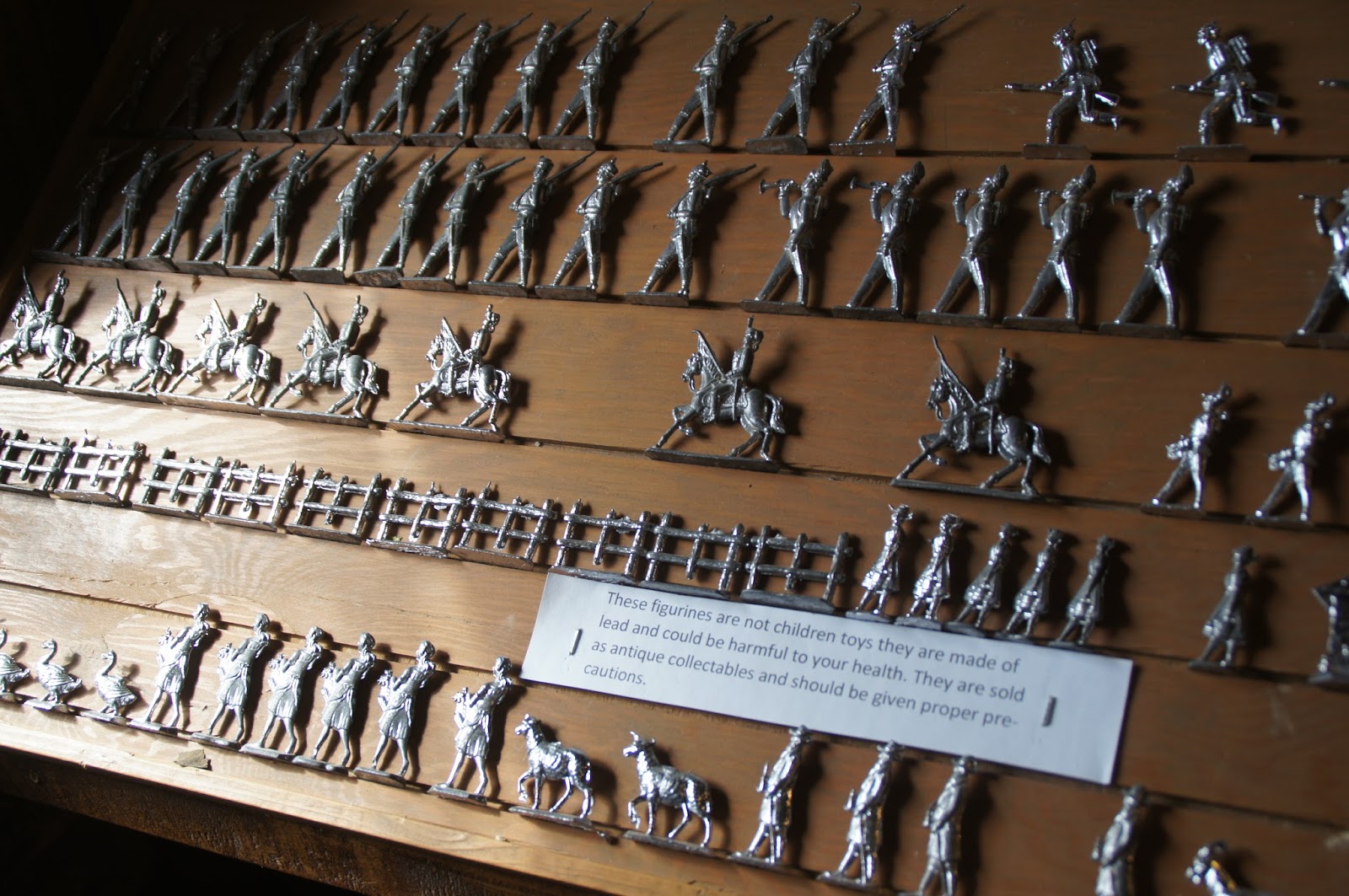
This photograph and the one to the bottom are both photos of lead cast miniature soldiers that at one time children played with.  I guess I'm luck to still be here since I had many die-cast toys made from lead when I was younger.  These were for sale in one of the antique stores.  They also had the molds pictured below.  Casting of real lead toys dates back to the early 1930's and was common for small home businesses to make these.  These molds came from a small operation in Columbia, PA.  The owner said someone saw the molds and asked the vendor if they wanted old lead pipes that he had just removed from his house.  He took them and the shelf of newly cast toys are the ones made from those lead pipes. 

Friday, March 11, 2016

The "Saving Of Trolley Car No. 236" Story

CTC Trolleys along Queen Street in Lancaster, Pennsylvania.
In the background can be seen the tall Greist Building.
It was an ordinary day.  Doing some research on transpor- tation in Lancaster County, Pennsyl- vania.  For most of my childhood, I lived less than a city block away from the Lancaster Train Station.  I made many visits to the station to watch the trains arrive and depart, stand on the platforms and talk to the engineer or conductor as trains would arrive and to slide down the shiny brass bannister from the lobby area to the ground level.  
Penn Square in the center of Lancaster, Pennsylvania.
This is the hub for the several routes of the CTC Trolleys.
Still get the urge to do the latter whenever I have the need to visit now.  But, the one thing I never did during my lifetime was ride the rails of the Conestoga Traction Company (CTC) trolleys as they made their rounds of their seven county routes in Lancaster.  
The removal of the trolley tracks took place July 14, 1947.
The removal of the trolley tracks in Lancaster city took place in 1947 when I was only three years old.  I may have rode the trolley with my parents during my early childhood, but I certainly don't remember back that far in history.  It was in 1899 that the CTC opened their seven routes that radiated spoke-like from the center of the city.  
An old photograph of the square shows the trolley on the left.
Routes to cities and towns with names such as Ephrata, Columbia, Marietta, Lititz, Manheim, Strasburg and Quarryville took riders on the electric-traction system on a trolley car much the size of a city bus today.  One of the most popular destination in the summer on the Lancaster City route was the ride to Rocky Springs Park where 20 cars would be assigned to the line at one time to handle the crowds of patrons going to the amusement park to the south of the city.  
One of the last routes to disappear was the
trip to Rocky Springs Amusement Park and
Roller Rink.  Here a motorman poses in front
of No. 236 at the Park in May of 1939.
This destination was the last to disappear when CTC finally stopped their trolley runs on September 21, 1947.  This coming summer will be 69 years since the trolley tracks in Lancaster were removed.  So what ever happened to all the old trolley cars that were in service for many years in Lancaster and surrounding town?  Some were donated to museums while the rest traveled to Rocky Springs where they were, one at a time, turned over on their sides and burned.  What a sight that must have been.  For some it was probably exciting while for others it must have been sad watching history disappear before their eyes.  
Removal of Car No. 236 to Landis Valley Farm Museum.
One of the old trolley cars was donated to Landis Valley Farm Museum and I did get to see it while on a visit to the museum in the late 1950s.  Car No. 236 is a diminutive Birney safety car that was built by J.G. Brill in 1926 at a cost to the city of Lancaster of $7,164.  It was taken to the Farm Museum where it was on display for many years.  
Car No. 236 as it appeared at Landis Valley.
It fell into disrepair because of weather and souvenir hunters and was examined by the Strasburg Railroad as something they might want to use at their Railroad Museum.  In 1985 an inspection was done on the trolley, but never taken to Strasburg for restoration.  
Car No. 236 as it is today in Manheim, Pennsylvania.
On May 7, 1990, Car No. 236 was moved from Landis Valley Farm Museum to the town of Manheim were it was completely resorted in a car barn erected just for the restoration.  Using mostly volunteers, Car No. 236 took over two years to restore.  Old track in front of the old Manheim Depot was torn up and new track was laid and trolley poles and wire erected.  On April 4, 1996, CTC Car No. 236 ran 150 feet from the barn to Charlotte Street in Manheim.  After 49 years, Car No. 236 came to life once again with a bright traction yellow livery which the car sported while running on the CTC line.  The ride is short, but if you care to take a ride on a trolley, head to Manheim, PA on selected dates and hop on Car No. 236.  It is the only operational Birney in the State of Pennsylvania.  The biggest reason for the demise of the trolley system in Lancaster was the automobile.  Need I write more?  It was another extraordinary day in the life of an ordinary guy.


No. 236 as it rolls down College Avenue and James Streets just out of the shop on June 24, 1936.  This was one of the better cars in the CTC fleet and therefore it was worth rebuilding at the time.
This is the Lititz trolley from Lancaster to Lititz, PA.
After CTC decided to stop service, the cars that remained were taken to Rocky Springs, pushed off the track and burned.
One of the cars after being set on fire.  Must have been disheartening to see this sight.
A trolley makes it way east on West King Street.  Notice the wagons along the left of the photograph.
The Conestoga Traction Company map of routes in Lancaster County.
Another scene from center city Lancaster.
This is Car No. 236 traveling across the Conestoga Creek Bridge on its very last run on September 22, 1947.  
This shows the restoration of Car No. 236 after it was taken to Manheim, PA.
Car No. 236 after it stops at Rocky Springs.
This is one of my favorite old photographs I was able to find of trolleys in Lancaster.  It is the Lititz CTC trolley as it crosses the Lititz Pike bridge about two blocks from my childhood home near the Lancaster Railroad Station.  The tracks were no longer on the bridge when I used it to walk to school at Brecht Elementary from 1950 to 1956.  The trolley is passing over the tracks of the Pennsylvania Railroad main line from Philadelphia to Harrisburg, PA
This trolley photo show the car traveling near Maple Grove which was a swimming pool and rollerskating rink to the west of Lancaster.
These two open air trolleys were used in the summer months to transport people to Rocky Springs to the amusement park and for swimming.
This very old, undated post card, shows a trolley as it heads around the Penn Square Monument in downtown Lancaster, PA.  It reads: Just had dinner. Had roast chicken and ice cream.  Good Lancaster County meal!
A booklet that was printed giving all the routes and times for arrival and departure of the trolleys.