Extraordinary Stories

1944 (1) Act of kindness (12) Acting (2) Adoption (4) Adventure (766) Advertisement (6) Africa (1) Aging (14) Agriculture (47) Airplanes (9) Alphabet (5) American Red Cross (1) Americana (116) Amish (43) Ancestry (5) Ancesty (2) Animals (43) Anniversary (4) Antigua (10) Antiques (14) Apron (1) architcture (1) Architecture (36) Art (175) Art? (8) Arts and Crafts (69) Athletics (6) Automobiles (40) Awards (7) Banking (2) Barn raising (2) Baseball (103) Basketball (3) Batik (1) Beaches (89) Becoming A Citizen (1) Bed & Breakfast (2) Bee Keeping (6) Beer & Breweries (2) Bikes (3) Birds (9) Birthdays (34) Blindness (1) Blogging (5) Bookbinding (5) Books (12) Boxing (2) Brother Steve (12) Buisiness (3) Business (5) Canals (1) Cancer (14) Candy (30) Caribbean Islands (9) Caribbean Villas (15) Cats (5) Caves (1) Census (1) Chesapeake Bay (61) Children (28) Chocolate (4) Christmas (57) Church Adventures (122) Cigars (1) Circus (3) Civil Rights (8) Civil War (6) Classic Cars (7) Climate Change (5) Clubs (1) Coin club (2) Coins (1) Collections (73) Comedy (3) Comic Books (5) Commercials (1) Comnservation (2) Conservation (41) Covered Bridges (3) Craftsmanship (12) Creamsicle the Cat (11) Crime (16) Crisis (312) Cruise Travel (6) Crying (1) Culture (4) Dancing (1) Danger (16) Daughter Brynn (58) Daughter-In-Law Barb (7) Death (5) Death and Dying (65) Destruction (2) Donuts (1) Downsizing (2) Dunking (5) Easter (3) Eavesdropping (1) Education (48) Energy (15) Entertainment (165) Entrepreneurial (62) Ephrata (1) Etchings (1) Eternal Life (4) Facebook (5) Factories (4) Fads (6) Family (261) Farming (37) Father (42) Father Time (68) Favorites (88) Firefighting (1) Flora and Fauna (28) Fond Memories (490) Food and Cooking (171) Food and Drink (111) Football (16) Forgetfullness (3) Former Students (10) Framing (30) Friends (359) Fruits and Vegetables (3) Fun (4) Fundraiser (6) Furniture (1) Games (7) Generations (3) Gifts (1) Gingerbread houses (1) Giving (8) Globes (1) Golf (3) Good Luck (2) Graduation (1) Grandkids (136) Grandparents (3) Grandview Heights (29) Great service (3) Growing Old (8) Growing Up (187) Guns (2) Handwriting (3) Hat Making (2) Hawaii (49) Health and Well Being (61) Health Care (4) Health Hazards (110) Heartbreak (7) Heroes (26) High School (142) History (777) HO Railroading (4) Hockey (4) Holidays (134) Home construction (7) Horses (2) Housing (3) Humorous (71) Hurricanes (1) Ice and Preservation (2) Ice Cream (8) Inventions (34) Islands (4) Italy (12) Jewelry (3) Job Related (62) Just Bloggin' (56) Just Wondering (19) Juvenile Diabetes (5) Labor (3) Lancaster County (542) Law Breakers (8) LDubs In-Laws (3) Lefties (1) Libraries (1) Life's Lessons (175) Lightning (1) Lists (72) Lititz (18) Locomotives (1) Lodging (1) Love (4) Magazines (2) Magic (1) Maps (2) Marching (2) Market (5) Medical (161) Memories (28) Middle School (3) Milk (2) Minorities (1) Money (3) Mother (54) Movies (6) Mt. Gretna (1) Music (118) My Brother (19) My Wife (260) Neighbors (7) New Year's Day (5) Newspapers (4) Nicknames (2) Nuisance (3) Obsolescence (5) Occupations (2) Old Age (1) oldies (1) Pain and Suffering (12) Panama Canal Cruise (13) Parish Resource Center (14) Patriotism (3) Penmanship (1) Pets and Animals (99) Photography (220) Pizza (1) Plastic (2) Playing Trains (2) Poetry (2) Politics (27) Polution (3) Postal Service (2) Predators (2) Presidents (11) Pride (4) Printing (81) Protesting (3) Public Service (65) Questionnaire (1) Quilts (1) Race relations (6) Rain (1) Reading (4) Records (2) Religion (10) Retirement (4) Revolutionary War (3) Robotics (1) Rock & Roll (4) Rodents (2) Saints (4) Sand (1) Scouting (2) Sex (1) Shakespeare (1) Shelling (2) Shopping (24) Simple Pleasures (122) Slavery (6) Small Towns (4) Smoking (1) Snickedoodle (1) Snow (1) Son Derek (27) Son Tad (33) Son-In-Law Dave (27) Soup (1) Spices and Herbs (1) Sports (139) Sports and collectibles (1) Spring Break (1) St. James (2) St. Martin/Sint Maarten (306) Stained Glass (3) Stone Harbor (4) Story-Telling (26) Stragers (2) Strangers (4) Strasburg Railroad (1) Stress (3) Stuff (4) Suicide (2) Sun (1) Surfing (1) Tattoos (4) Teaching (49) Technology (90) Television (6) Thanksgiving (2) The Arts (6) The Beach House (62) The Flag (1) The Future (5) The Shore (78) This and That (23) Timekeeping (7) Tools and Machines (25) Tours (2) Toys and Games (31) Track & Field (1) Tragedy (8) Trains (19) Transportation (18) Travel (16) Trees (2) Trending (2) TV Favorites (23) Underground Railroad (10) Unit of Measurement (1) USA (2) Vacation and Travel (545) Vehicles (80) Vison and Eyesight (2) War (14) Watches and Watchmaking (5) Weather (48) Weddings (3) White House (1) Wisdom (3) Yearbooks (12) York County (3)

Wednesday, April 20, 2016

The "A Rather Unique Undertaking At The Frame Shop" Story

It was an ordinary day.  Another day at Grebinger Gallery in the small town of Neffsville which is to the north of Lancaster, Pennsylvania.  Today's job was to mat and frame a Pennsylvania State Trooper's shirt which had his nameplate over his right pocket and his three colored award stripes over his left pocket.  On both sleeves were the Pennsylvania State Police patches that are worn by all policemen.  
Really neat uniform, but extremely hard to attach to the black suede mat which was my job.  The largest stock mats and glass we have are 32"X40" and the shirt was slightly larger than that when I tried to make sure the arm patches were shown.  I managed to drop the sleeves directly from the corner to display the patches.  The customer wanted us to display a special watch that I suppose had been presented to the trooper.  
Cutting the top two mats is done on the computerized mat cutter.
To do that I needed to have more depth than needed for just the shirt, so I place a second piece of black suede mat with a gold second mat and cut an opening for the shirt as well as the watch to show through.  Since there was too much black showing on either side of the watch, I added some gold stripes on either side.  The shirt was fastened by hand using fishing line so it wouldn't be seen.  I stitched the shirt at the collar as well as the top corners of the shirt.  
The top mat has been placed into the frame and I have added
the watch behind it with spacers for the shirt to be placed against.
I stitched the lapels of the shirt at the points and stitched the snap-on tie directly under the knot, in the center at the tie clasp and at the bottom into the button hole behind it.  To make sure the colored award stripes didn't move or bunch up, I placed a piece of mat board behind them and pushed the pins through the mat board before refastening them.  The large Pennsylvania State Police Trooper patches at the top of the sleeves were tough to attach because of the thickness of them.  The sleeves of the shirt tend to drop straight down instead of more to the side, but that was necessary in order to keep the price lower by using standard size glass and mat board.  
The final result with cardboard corners to protect
the edges of the frame.  There is some reflection
created by the lights in the gallery which will not
appear on the final framed piece.
The watch I placed over a thick piece of mat board to whitch I applied a piece of black suede.  The gold frame with the black suede really sets off the shirt and watch.  I'm sure the customer will love the job.  Total time to complete cutting and assembling the frame, sewing the shirt in place and preparing the watch as well as putting the glass into the frame and securing it, was about four hours.  Not sure what the cost was since I just handle the framing part of the job, but to the customer, I'm hoping it is priceless.  I love to frame jobs that take some thought and skill to complete.  Makes the time go very quickly while working.  It was another extraordinary day in the life of an ordinary guy.

Tuesday, April 19, 2016

The "The Cool Town With A History: Part III - Lititz Springs Park" Story

It was an ordinary day.  Taking a few photos of the lion that stands watch over the spring at Lititz Springs Park.  It was the Moravian Congregation in the town of Lititz that at one time held the title to the land on which the park was established in 1778 when Lititz was a Moravian Community.  
A plaque, as you enter the park, honors
Elmer Holmes Bobst for his generosity,
interest in human welfare, and love for
Lititz, his boyhood home. He made
possible the restoration and development
of this park.  Click to enlarge.
Today the park is under the management of the borough of Lititz.  The park in 1778 was under the control of the Aufseher Collegium or the Moravian Church.  At the time the park grounds were used for the musicians of the congregaton who were in the habit of indulging, late into the night, in merry making at the Big Spring.  At the time, a young Moravian musician by the name of Tobias Hirte, had laid out a special place for merriment and against the better judgement of the "closed" Moravian Church community, an acre of ground around the Big Spring was developed as a park (known at the time as a pleasure ground) by planting arbors and trees and laying out walks.  The arched stone bridge was built between 1800 and 1802.  From 1846 to 1856 the park was used by John Beck who had a boys school in Lititz.  Many of the trees that stand today were planted by his school boys.  The sandstone fonts and coping around the head of the spring were laid in 1856 by a committee of public-spirited men of the town.  The spring is considered one of the strongest in Pennsylvania.  At the far west end of the park is a lion's head, carved into the stone above the spring in 1857 by artist J. Augustus Beck.  In 1937 a band shell was constructed and dedicated in memory of Prof. Paul E. Beck, band and orchestra leader in the Lititz Public Schools.  Carol and I have visited the park on the Fourth of July for many years and listened to concerts held in the band shell.  As early as 1811 Fourth of July celebrations were held at the park and in 1843 the candle illumination ceremony was introduced when 400 candles were lit.  Today thousands of candles illuminate the stream leading from the Big Spring to Broad Street in downtown Lititz on July 4.  My photos will take you on a walking tour of the beautiful park as it is today.  It was an extraordinary day in the life of an ordinary guy.


This was the first entrance into Lititz Springs Park off of Broad Street, the main street running north to south through Lititz, PA.  The sign was made of wood with the word "Springs" arched over the top.  All of the old time black and white photos in this photo essay were taken by Robert "Sketch" Mearig who was born in Lititz in 1923, spent many days of his childhood playing in the park, served his country while in the Army during the Battle of the Bulge, was a Lititz mailman for 32 years and photographer of the Lititz Springs Park. 
This is the entrance as it appears today.  
This photo shows what was known as fern island as you entered the park.  Fern island, a small island to the left in the photo, was formed in the mid-1800s when a section of the stream flowing from the springs was dammed which created a small island that was planted with native ferns.  
The island still remains, but with fewer ferns than years ago.
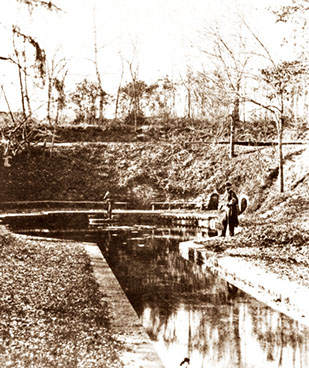
This is known as the Springs Head-End located at the far west endof the park.  It was in 1855 that the steep bank around the spring head was contoured.  Three springs were uncovered flowing from caves.  Water gracefully flows eastward and eventually becomes the Lititz Run Stream.  The clear limestone water was believed to heal rheumatism and other ailments.  
The Springs Head-End as it appears today.
On the wall to the right of the Springs Head-End is a lion's head that was carved into the stone in 1857 by Lititz native Julius Augustus Beck.  It is known as the icon of the Lititz Springs Park.  He chose as his model the world famous "Lion of Luerne" in Switzerland.  He had plans to include the shoulders and front paws to his sculpture, but the rock was too hard and ruined his chisels.  On April 26, 2005, someone destroyed most of his work.  It was determined that it couldn't be fixed so a full lion sculpture of granite, symbolic of the "Lion of Lucerne," was placed above the damaged sculpture on the wall. 
This old photograph shows the "Paul E. Beck Memorial Band Shell."  It was built in 1937 and named in honor of the maestro of the Beck Concert Band who enjoyed conducting patriotic scores.  The band shell is the centerpiece of entertainment in the park.  Carol and I have witnessed both July 4th Queen of Candles competition and rock and roll bands. 
My photo of the empty band shell....
... and my photo of Flamin' Dick and the Hot Rods in concert.
This is the Music Pavilion that was dedicated on July 4, 1906.  It was an eight-sided gazebo erected for Beck's Concert Band.  It was built in the area where the current concession stand is now located.
This is the present gazebo that was built in 2004 as a replica of the 1906 music pavilion.  This structure was dedicated in honor of William B. Oehme for his untiring efforts and support of the Lititz Springs Park.
The Round House was originally thought to have been erected as the grandstand on the gorunds of the Warwick Racing Track which was located to the northeast of Lititz.  It was taken down and moved to the park in the early 1880s.  It at first was used for special events, but now serves as a storage facility.
My photograph of the Round House.
This is known as the Arched Bridge which was made from sandstone from the Furnace HIlls in 1856.  The sandstone blocks were brought to the park by horse and cart and was used as coping around the Head-End of the Springs.  It was used to prevent the stream from overflowing and to contain the natural flow of the water.  The Bridge replaced the original stone bridge that was built in the late 1700s.  Today's bridge transports thousands each year as they stroll the grounds of Lititz Springs Park.  I made a trip across it today during my journey throughout the park.
Today's Arched Bridge.


Monday, April 18, 2016

The "The "The Cool Town With A History: Part II - A Tavern With A Tale To Tell" Story

The Forgotten Seasons Bed and Breakfast in Lititz, PA
It was an ordinary day.  Talking with Kathy who is the owner, along with her husband Jay, of the "Forgotten Seasons Bed and Breakfast" which is located to the north of Lititz, Pennsylvania.  They have been the owners of this historic building since 2008.  The story begins in the early 1730's when Jacob Huber (spelled by some as Hoober) settled on a tract of land in 1733 which was about seven miles to the north of the city of Lancaster, Pennsylvania.  
Entrance to the Bed and Breakfast.
Once on the land he build a log cabin measuring 18' x 20' on the property.  Then sometime between 1733 and 1735 he built a building next to the log cabin measuirng 47' x 32' to be used as a Tavern.  It wasn't until 1738 that he properly secured the land from John, Richard and Thomas Penn, William Penn's heirs.  The original indenture on sheepskin still exists, but I never got a chance to see it.   That Tavern still stands today and is the bed and breakfast of Kathy and Jay.  Jacob also helped in laying out two major roads that intersected an eighth of an mile from his newly built Tavern.  The roads were actually Native American trails which were fairly well established at the time to the north of Lancaster and was a trading route from Newport, Delaware to Lancaster County.  
Part of old Newport Road can be seen in front of the Bed and Breakfast. 
Newport Road was a 63 mile long road and brought goods from overseas.  That was the main reason that Jacob Huber built his Tavern in the first place.  In 1939 Jacob was commissioned by the County of Lancaster to survey and improve Newport Road, the road that ran past his Tavern, from Mt. Hope to Spring Garden.  
The Dutch door or door that has a top
and bottom that open separately or can
be fastened together and opened at one
time.  Notice the strap hinges.
The second road at the intersection ran north from Lancaster, along Queen Street (my childhood home was on Queen Street) to Tolpehocken, north of Newport Road.  Today State Route 501N follows that same path.  It was in December of 1742 that Count Zinzendorf, a Moravian missionary, traveled from Bethlehem along some of these same roads to Jacob Huber's Tavern where he assembled the local German farmers to share with them his vision of starting a church mission.  Jacob's neighbor to the south, George Kline, eventually donated his property to the Moravian Church in 1749 which went on to become the town of Lititz, Pennsylvania.  Around 1750 Jacob started a cast iron furnace a few miles to the north at what is now the intersection of Rt. 501 and Rt. 322.  He named it after his daughter Elizabeth.  
The old stairwell in the original Tavern.
Shortly Henry William Stiegel arrived from Cologne, Germany and began working for Mr. Huber.  Before long Stiegel and Elizabeth married.  Stiegel eventually became famous for glassmaking at the nearby town of Manheim.  My visit today is to learn about the building that became Huber's Tavern in 1738.  The main door to the Forgotten Seasons is a Dutch door, meaning it has two halves to it.  It has strap hinges on both halves of the door.  The building itself has walls that appear to be mainly stone and are close to 18" thick.  The Bed and Breakfast has a reception room, library, dining room and family room on the first floor.  The root cellar, with what appears to be a dumb waiter that goes to the first floor, is original. The original kitchen was in the root cellar and the dumb waiter transferred the food from cellar to 1st floor.  
In the root cellar I found a stone that was used to clean off
your boots before entering the Tavern.  It is dated 1793.
Inside I was greeted by a beautiful staircase that leads to the guest rooms on the second floor.  In the dining room is a built-in corner cupboard that still has its original hand-poured glass.  I was able to visit the root cellar and see the remnants of the dumb waiter as well as see where much of the food was prepared for the Tavern.  
The thickness of the walls can be seen
in this photo taken of this third floor window.
The ceiling was very close to my head, but at that time in history I assume there weren't too many people over six feet tall like me.  There was an exterior door from the cellar so food could be brought in without going through the dining room.   The air in the basement was cool and I found out later it remains cool year round.  The root cellar is about 30' x 12" or the size of the dining room and kitchen located above it.  I'm not sure what year an addition to the east side of the Tavern was added, but there is no cellar under it.  Kathy took me up to the third floor to see the very wide floor boards and the thick walls.  Headroom was adequate for standing and walking around.  I could see remnants of what used to be chimneys which had been removed years ago.  
The dining room of what is not the Bed and Breakfast.
You can see in this photo how low the door frame is.
I did notice a small noose hanging from a rafter, but didn't dare ask about it.  Kathy and Jay live in the part of the house that had been added years ago.  As I wandered throughout the Tavern, turned Bed and Breakfast, I thought of what it must have been like hundreds of years ago.  The size of the doorways was not more than six feet high and I found myself ducking to pass through them.  
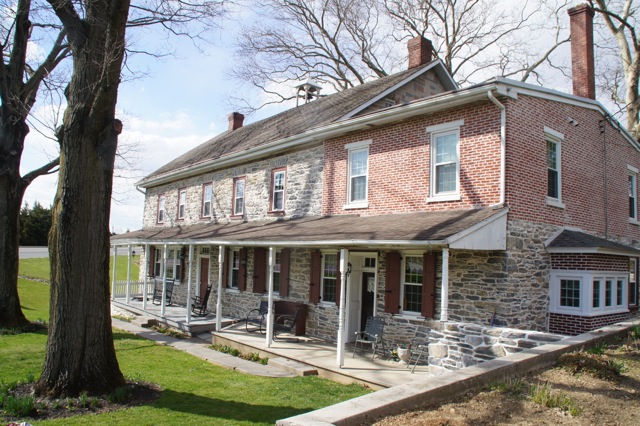
This side of the Bed and Breakfast faces the new Newport Road.
You can see in this photo where the eastern side of the building
was added to the original Jacob Huber Tavern.
My host today wore the traditional garb of the Menonnite faith and from what I read, most of the dozen or so owners of the building have been Mennonites.  Lancaster County is known for Amish and Mennonites, but then you have to throw in the Moravians of nearby Lititz who came when Zinzendorf set up his community on the Kline farm (another story in the future).  
This plaque is on the front of the original Tavern facing what
was originally Newport Road.  Click to read the plaque.
The exterior of the building is beautiful with stone that more than likely came from local quarries and wood trim from nearby forests.  My day was interesting to say the least and my appre- ciation for those who settled my home town grows more and more as I learn the history of the area.   As I told someone recently,  I have learned more history since I began writing this blog than my entire time in public school and college combined.  It was another extraordinary day in the life of an oridnary guy. 


This door is on the rear of the building.  The old door handle can tell many stories as to those that have crossed through it over the last 281 years,
This pole with a horse's head on it was used by patrons of the Tavern to tie their horse.

Sunday, April 17, 2016

The "The Cool Town With A History: Part I - The Oldest Pretzel Bakery in America" Story

Preface:  In 2013 a small town by the name of Lititz, Pennsylvania, just to the north of Lancaster was honored by being voted Budget Travel Magazine's America's Coolest Small Town.  At the time I wrote a story telling some of the highlights of the town, but since that time have made many more visits and discovered exactly why the town was given the honor.  The oldest pretzel bakery in the country, one of the earliest Moravian communities in the country and one of the neatest July 4th celebrations in the country all make Lititz a cool town.  The history of Lititz, which is more than 250 years old, is varied and extremely interesting.  Follow along during the next few weeks as I post stories that will give you an idea why Lititz was so honored in 2013.

Elma is explaining how to "twist" a pretzel.
It was an ordinary day.  Watching Elma, my tour guide today, as she shows me how to make a perfectly shaped pretzel.  I'm a guest today at the oldest pretzel factory in America, the Strugis Pretzel Factory which was started by Julius Sturgis in 1861 in the small town of Lititz which is a hop, skip and jump from the city of Lancaster, Pennsylvania.  The structure was actually built in 1784 and is one of the oldest buildings in the Moravian community started by Count Zinzendorf.  The home was built from stones dug in the street in front of it and timber from the surrounding forest.  The home had musket firing cellar windows to ward off Native American attacks, hand-crafted construction which included plank pegged floors, beautifully carved wooden panels on the staircase and heavy wooden doors on iron strap hinges.  
But enough about the place where I am standing.  Elma is in the midst of helping me shape my own pretzel to look as they did when they were first made.  
I found this stone on the side of the building at 219 E. Main St.
The very first pretzel was probably created in Europe when a reference was made by an Italian Monk in 610 A.D. in his diary that he had made a prestiola (an Italian word for "little reward") as a treat for children who learned their prayers.  The traditional unique twisted knot shape of that pretzel is thought to mimic either folded arms across the chest, the wings of angels or even the shape of the Holy Trinity.  
This shows how the dough was prepared.  The dough barrel, sitting to the left, was where the flour, water and yeast stock was mixed to a fairly stiff consistency and left to rise overnight.  The center unit is where the flour was stored and the little item on the right was where the yeast was kept.
It was also said that the Pilgrims introduced the pretzel in Cape Cod Bay in 1620, but it is more likely that the Pennsylvania Dutch population in Lancaster County, who called their creation a "brezel", made the first pretzels in the New World.  

Julius Stugis, founder of the bakery and the hard
crispy pretzel, in front of his winter home in Florida.
Their pretzels, which were soaked and boiled in a lye mixture before being baked, were what we would call a soft pretzel.  Legend has it that a hobo, who was riding a train behind Mr. Sturgis' bakery, asked for a job.  None was available but the hobo was none the less given nourishment.  He in turn gave Mr. Sturgis a recipe for making pretzels.  No one knows for sure if that was the actual recipe used by Mr. Sturgis, but it makes for a good story.  Julius began making pretzels in his bakery as an added product to sell.    
Workers twist pretzels and put them on boards to "proof" or rise, before taking them to the ovens.   
Then one day, the pretzels were left in the oven too long and when taken out later, the pretzel that we know today was born.  The new pretzels had a much longer shelf life which allowed them to be shipped throughout the area, increasing Julius' business.  
The pretzel ovens in front of me are the original ovens used to bake Sturgis pretzels.
The pretzel ovens in front of me, as I listen to Elma, were the original ovens used by the bakers before the turn of the century.  
This shows the baker using the "Peal" to place the pretzels in the oven.
A baker would use a long-handled "peal" to put the twisted pretzel dough into the ovens where it was fired to an intensity of 550 degrees.  
Another view of the bakers making pretzels.  The baker on the left is dipping pretzels in a cook pot filled with straw water and lye, which gives the pretzels their shiny brown coating.  The baker on the right is using the "Peal" to shovel pretzels into the oven.  The finished pretzels can be seen in the bin to the right.
They would bake for about 10 minutes to a golden brown, placed on trays and kiln dried in heated compartments above the ovens for about 2 1/2 hours.  This extra heating would remove excess moisture.  A baker would test a batch by breaking a pretzel and if it crackled when squeezed, it is said it was "talking back" and was OK'd.  The Sturgis family continues to mass produce pretzels today, but in a factory outside of nearby Reading, PA.  It was Tom Sturgis, great grandson of Julius. who moved the operation in 1936 to its location today in Reading.  As for my tour, my only disappointment was that I didn't get to bake the hand-formed pretzel I made.  The ovens no longer are fired in the location at 219 East Main Street in Lititz, Pennsylvania.  It was another extraordinary day in the life of an ordinary guy.

Plaque on the wall of the building.
What the building looks like today.

Saturday, April 16, 2016

The "A Rocky Springs Saturday Night" Story

It was an ordinary day.  Scrolling down through link after link on the Facebook page: Friends of Rocky Springs Amusement Park Lancaster PA.  Bringing back memories of past times when my parents would take me to the park to ride the rides or even ride down the Conestoga Creek in the "Lady Gay"; then as I got older, enjoying those same times with friends and family.  I have written a few stories in the past about the park, but after viewing the many new "old" photos of the park from the past, thought I would once again visit the park with you and show you what a great time I used to have while visiting Rocky Springs in Lancaster, Pennsylvania.  It was another extraordinary day in the life of an ordinary guy.


One of the few remaining remnants from the old Rocky Springs Amusement Park is the building pictured here.  It is now a Bed and Breakfast on the property once occupied by the great amusement park.
One other remnant is a pier that held the famous roller coaster.
This is a post card picture of the first roller coaster at Rocky Springs called the Figure 8.  It was built by T.M. Harton around 1905 and removed in 1917.  Next came the Figure 8, The Jack Rabbit designed by John Miller, The Wildcat designed by Herb Schmeck and built be The Philadelphia Toboggan Company, and finally the Wild Mouse.
This is the entrance to The Wildcat Roller Coaster.  The coaster had two gigantic hills that were close to a 90 degree drop.  You were held into your seat with a belt that you buckled yourself.
The first thing you saw when the ride started was this tunnel you entered.  Rather spooky at night since the tunnel wasn't lit.


This was the trolley that made the last run from the city of Lancaster, PA to Rocky Springs Park.  I never rode the trolley since it I was only 3 years old when it stopped running.
The Trolley station at Rocky Springs
The city of Lancaster had two open-air trolleys they would use to take people from the city to Rocky Springs during summer months.
Another photo showing the entrance into the park.
Tickets for the Carrousel ride in the park. Notice the price.
The Rocky Springs Carrousel was dismantled and taken to a park in the south.  It is now back in storage, awaiting a move to another location in Lancaster County.
The "Laff in the Dark" was a fun building, but the screeching of the laughters was at time scary.
What amusement park didn't have a whip which threw you around for a few minutes.
The Airplanes were also a popular ride at Rocky Springs.
One of my favorites was the Shooting Gallery.  Not sure what they used for ammo, but it may not be acceptable today.
I can remember when I visited with my Grandpap on South Prince Street in the city and I would go to Rocky Springs to swim with my Aunt Lois, who happened to be a year older than me.
And, my last photo is one showing protesters pushing for integration of Rocky Springs swimming pool.  Rocky Springs attempted to prevent blacks from swimming there by making it a Members Only pool.  What a shame that we all couldn't have a good time together. And now for a trip back in time with "A Rocky Springs Saturday Night by Bobbi Carmitchell ……..