|
| Taste buds on your tongue number approximately 9,000. |
Thursday, January 18, 2018
The "Are You Older Than Dirt?: Part II - Losing Your Senses" Story
It was an ordinary day. Just put my hearing aides in my ears and reached for my glasses on their usual place on the bathroom counter. Then I remembered that I don't wear glasses anymore. It's one of my five senses that have improved with age and the help of a recent surgery. Doesn't happen too many times in life that your senses of sight, hearing, touch, taste and smell, become better rather than worse. Seems that I have begun to notice a diminishing appetite which could be caused by my sense of smell.
I guess I could blame my aging taste buds, of which I have approxi- mately 9,000, but it's probably my nose which is the real culprit. When our bodies reach 40 to 50 years of age in women and 50 to 60 in men, our taste buds begin to diminish. The taste sensation of salty and sweet begin to suffer first and then bitter and sour follow. But, it is the change in the decrease of sensor cells in the nose that detect aromas that fuel the loss of taste. The decline in nerves that carry the signals to the brain and the reduction of mucous that is produced that affects smell and taste are the culprits. Food that I loved for years and years seems not as appetizing as it once was. I used to love mashed potatoes with every meal, but find I don't care for them anymore. Same goes for several vegetables I used to enjoy, but no longer care to eat. I have found that items I never liked I now enjoy more such as lettuce. But, my biggest problem is that I love sweets too much. Now that hasn't been affected by age, since I always loved cookies, cakes, ice cream, donuts, etc. Other things that can lead to a loss of appetite are dental issues, nasal polyps and neurologic diseases such as Alzheimer's and Parkinson's disease. I have tried to find an answer to my loss of appetite by reading and have found that smoking could be a big factor, but I don't smoke. Certain medicines such as beta blockers and angiotensin-converting enzyme inhibitors can affect our senses. I do have special meals my wife makes for me that certainly will not cause me to loose weight such as mac and cheese with spam and lots of tomato sauce on it as well as chicken pot pie which features large pieces of dough in it. But, my biggest problem is what I already stated...sugar. I could make dessert the main part of my meal every day. Matter-of-fact I have done that numerous times in the past couple of years. Cake or cookies dunked in hot chocolate or plain white milk is a great meal as well as apple dumplings with a thick dough and plenty of goo on it. And then there is a big banana split or big bowl of pudding with whipped cream on it for supper. But, you know...I have been eating all these desserts as a meal since I was a child and they never affected my appetite. Thank goodness for that! I guess I should be glad I don't have a big pouch to block my vision as I walk with my newly acquired eyesight. At times I forget I'm getting older than dirt and I may suffer from some loss of senses in the process. But, at least I'm still here to tell you about it. It was another extraordinay day in the life of an ordinary guy.


Wednesday, January 17, 2018
The "Are You Older Than Dirt?: Part I - Cancer Screening" Story
It was an ordinary day. Just left my urologist's office with some disturbing news. A little over 6 months ago, at the age of 72, I had Cryosurgery to remove the prostate cancer that I had. In my follow up visit a few months later I found that my PSA (prostate specific antigen or the guide that physicians use to predict prostate cancer) was 0.01. Near perfect! My follow up today wasn't what I was hoping for, since my PSA had risen to 0.09. My urologist felt it was elevated beyond what it should be for so close to the surgery. I must have blood drawn once again in 2 months to see if it is still elevated. A digital exam did show that my prostate is the size of 20 year old, but he was still cautious and thus a new test. Had I been 75 years old I may not have been able to have the test according to several medical groups that believe that the benefits are overshadowed by the harm the test and followup procedures that may be done could causse. Seems the general rule is that if you have an incurable disease and will die within the next 10 years, there is no need to be tested for prostate cancer. Perhaps since I have found that I already had prostate cancer, the rules may be changed so I can continue to be tested to make sure it doesn't return. After all, the test is no more than a simple blood test! Same thing goes for women and breast cancer. If you might be in your 80s and perhaps suffer from dementia, should you continue to be tested for breast cancer? And, if they find you have breast cancer, is it worthwhile to treat it with an invasive operation. Will the cost of the procedure allow you to live past the time you have left due to the dementia? And, just who should make the decision about your having these tests. As someone said to me, those that make these decisions must be part of a "Death Watch." My urologist told me that 70% of men in their 70s will more than likely have prostate cancer. Should he recommend that his older patients, say in their 80s, have the PSA test done to see if they may have prostate cancer when they more than likely have the disease, but will die from something else rather than prostate cancer. So, what should and can be done to determine the advantages vs. the disadvantages of cancer screening? My guest is the biggest determining factor will be the cost. The PSA test is very inexpensive, but if you add on the cost of more testing and then surgery and follow up visits, the cost is very high. Prostate cancer screening in men over 75 costs Medicare at least $145 million a year with no estimate on costs that may follow. Mammograms in this same age group cost Medicare more that $410 million a year. Growing old isn't cheap! But, I paid into the Medicare program for many, many years and if that were invested wisely, it should easily pay for those tests and following care. And, who should be the one to tell someone who has been told that starting in your 40s you should begin to be tested for certain diseases and all of a sudden, when they reach 75, you may no longer be tested, since your life is no longer important to the medical world. Well, I guess I'm lucky I'm not 75 yet or maybe my Medicare wouldn't pay for my tests. That is unless my government starts to change the rules on me. It was another extraordinary day in the life of an ordinary guy.
Tuesday, January 16, 2018
The "Big Boys Don't Cry" Story
It was an ordinary day. Wondering why I have a tendency to cry more often than not. Never used to be that way. Matter of fact, I very rarely ever cried, since it was thought that males just don't cry. And, why is that? I really don't remember crying when my father died at the age of 87. He had lived a very good life and I felt sad that he had passed, but tears weren't shed. I don't remember crying when my mother passed at the age of 90. She too had lived a fruitful life and was ready to see her savior. I was sad that she died, but really don't remember crying. I had been told, I think, that men just don't cry. Don't want to be called a sissy! Also thought that crying was a sign of weakness because "real" men don't cry! I'm sure I shed a few tears when my wife's parents died, but that was because I felt sorrow for my wife who lost both her mom and dad when they were both young. She cried, but she was supposed to do that, right ... she was a girl. I can actually remember a psychology course I had in college when I learned that Charles Darwin decided in 1872 that tears actually serve no purpose. Didn't remember anything else, but I at least remembered something from the course. Also remember learning that men don't cry since they don't grow up seeing other men cry. Never once saw my dad cry. Well, my wife and I recently lost one of our all-time favorite cats, Creamsicle. He was a stray that actually adopted us since one snowy evening he jumped the rear door snowdrift and headed into the house. Never left! When we took him to the vet, after suffering a few strokes, my wife, the female vet and myself all cried ... a whole bunch! No one looked at me funny or criticized me when the tears kept rolling down my cheeks. They were kind enough to offer a box of tissues. And, the crying continued quite often. Happened when I heard sad news on TV. Happened when I had to cancel an appointment I didn't want to miss. And then it struck me. I finally figured out why I was crying. It was the shots!! The shots I had to be given, since I had chosen to have Cryosurgery for my prostate cancer. The four shots of firmagon did it to me. Seems that the shots were given to me to help reduce the size of my prostate before the Cryosurgery. They were to reduce the amount of testosterone in my body. And, testosterone can actually reduce one's likelihood, or even ability, to cry. And ... that's one reason that males don't cry all the time. I would talk to my wife about something and all of a sudden begin to cry. I would read something in the newspaper and begin to cry. I finally went back to my urologist for a follow-up visit and talked to him about my crying. He told me it was a side effect of the firmagon as I had thought, and said it would take some time to be eliminated from my system. He gave me another appointment for six months later and told me I should stop the crying by them. He also told me there's nothing wrong if I cry anyway. Said I wasn't designed to swallow my emotions and when I suppress my tears it can be hazardous to my well-being. There is a relationship between stress-related illnesses and inadequate crying. Weeping is correlated with happiness and wealth. Countries where people cry the most tend to be more extroverted. He said that crying is my body's way of lubricating and cleaning my eyes. Do you cut onions and cry? Do you cry when walking into the wind? It's a reflex to protect the eyes. He then told me not to worry about crying. If the shots tend to make me more emotional, so what. Not the end of the world. And, it probably will do my eyes some good. Smiled at me and said I would be fine! I guess I'm not the first guy to begin to cry with age. Why worry about it. Won't do me any good anyway. Probably will just get me upset and that definitely will lead to crying. It was another extraordinary day in the life of an ordinary guy.
Monday, January 15, 2018
The "Who'd Of Thought?" Story
It was an ordinary day. Looking at my Google Earth website and being totally amazed at what you can view on the site. I found my home with a closeup of my car in the driveway. The entire site reminds me of a 3D map with true-to-life images. Actually, that's exactly what it is. Just to make sure, I "Googled" 3D maps of cities and towns and came up with page after page of sites to visit on my search of 3D maps.
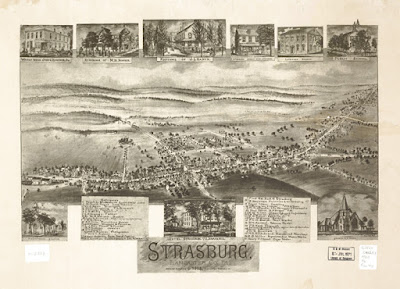
Then I came across something that really drew my attention. Maps of cities that looked like they were hand-drawn in 3D during the late nineteenth and early twentieth centuries. Wasn't long before I found one particular artist who drew what looked to be 3D maps by the name of Thaddeus Mortimer Fowler; known primarily as T.M. Fowler. What caught my attention about his hand-drawn maps was the fact that almost all the locations he drew were towns and cities in the state of Pennsylvania. "Googled" him and was astonished with his life's story.
T.M. was born in 1842 in Lowell, Massachusetts and ran away from home at the age of 15. Ended up in Buffalo, NY at the onset of the Civil War. He tried to join the Union Troops, but was rejected because of his age. Finally he talked his way into the service and two years later was wounded at the second Battle of Bull Run. In 1863 he was discharged, but followed the soldiers into battle selling his tintypes to them. He eventually moved to Madison, Wisconsin where he worked for his uncle John who was a photographer. Then in 1868 he met Albert Ruger who drew panoramic works of cities. Fowler eventually became Ruger's assistant and after learning all the necessary skills began to make them himself. He opened his own business in 1870. Over the next 50 or so years, T.M. drew panoramic maps with startling accuracy that only a very few artists had the patience and skill to do this work. These bird's-eye views of cities and towns were popular before aerial photography was possible. Fowler would pick a town or city and walk the streets making drawings, sometimes multiple drawings, of every house, building, and store in the area.
He would take notes as to the size and amount of windows, doors, stairwells, etc. in the structure as well as any architecturally significant features to the structure. More than half of his maps were of the state of Pennsylvania. During his career he made over 425 panoramic maps; 248 being of Pennsylvania. It was in 1922, while surveying the town of Middleton, New York for his next map, that he slipped on a patch of ice and died a few days later at the age of seventy-nine. He was buried in Riverside Cemetery in Trenton, New Jersey.
Toward the end of his career, when the airplane became popular, panoramic maps began to fade with the popularity of aerial photography. I love his maps and the unbelievable detail that he illustrates while drawing them. His artistic and mechanical skills are most impressive. While looking at his map of Millersville, PA I was able to pick out a few of the buildings around the original Millersville State Teachers College Old Main where I had classes as well as the building where I had lunch most days. What's strange is that the city of Lancaster is not one of his panoramics. I realize that Google Earth is truly amazing, but T.M. Fowler's panoramic maps are just as amazing; at least to me! It was another extraordinary day in the life of an ordinary guy. PS - I have only included maps made of locations within a few miles of my home in Lancaster, PA.



 |
| Panoramic map of Columbia, PA. Click to enlarge. |
 |
| T.M. Fowler |
 |
| This enlarged portion of one of his maps shows the incredible detail that he used in his work. Click to enlarge. |
 |
| Milersville, Pennsylvania |


 |


Sunday, January 14, 2018
The "The Banana Is Only The Start Of It!" Story
It was an ordinary day. Taking a ride along the east coast of the island of Barbados. Carol and I, along with traveling friends Jere and Just Sue, have made two trips to the island that is located in the southern Caribbean. Along the southeast coast of the island is the town known as Bathsheba which is just beautiful with huge rock formations directly offshore and row after row of banana plants along the opposite side of the road.
During our stays on Barbados we saw many banana plantations which were filled with bananas in all stages of growth. Bananas are plentiful in many of the Caribbean islands as well as the countries of Belize, Jamaica, Costa Rico, Dominican Republic, Honduras, Guadeloupe, Dominica, Martinique, Saint Lucia, Saint Vincent and the Grenadines, Grenada, Trinidad and Tobago, Nicaragua, Panama and Columbia. Bananas do best in areas where the temperatures range from 79 to 88 degrees.
Rainfall should average about 70 inches a year with the rainfall distributed throughout the year. Altitude must not exceed 980 feet and sheltered valleys that have little wind make perfect growing conditions for the plants that have shallow roots and can easily be uprooted. The banana industry is huge with some countries producing over 200 million tons in a single year. Raising bananas is a labor-intensive industry and in some cases rivaling the government as the next largest employer on the islands. In 1950 most bananas were exported from Central America by the American owned United Fruit Company. Guatemala was paid modest amounts of money by the company for large areas of land on which they grew bananas. Not only did they control the banana industry, they controlled transportation when they built the first railway in the country which was meant to be used to transport bananas. In 1950 the company's profits where twice the gross domestic product of the entire country of Guatemala. But...they did little to understand the biology of growing bananas. They had one variety...the Gros Michel. Bananas grown in this area of the World were Gros Michel. Cuttings from the best specimens were replanted and thus all bananas were genetically identical. The banana plantations of Central America in the 1950s were not only the largest collective organism alive at that time, but perhaps ever. True genius economically! As the plantations of bananas expanded across the American tropics, scientists wondered what would happen if a banana-attacking pathogen would arrive. Well, it happened! Panama disease (known as fusarium wilt) started to wipe out the banana plantations. Nearly all the plantations in Guatemala were devastated and then abandoned. The Gros Michel was in trouble. But, there was another variety known as the Cavendish, but it tasted different then the Gros Michel.
The Cavendish was not affected by the Panama disease and was planted in the fields abandoned due to the disease. It was soon exported to the United States along with a massive advertising campaign lauding the benefits of the new banana. And, boy did the people fall for it. They loved the new banana strain. If you were born after 1950 it is unlikely that you ever ate anything except the Cavendish. As expected, the Cavendish bananas are all genetically identical. In 1984 the United Fruit Company rebranded as Chiquita. And...guess what. Another pathogen has arrived. And...what I just wrote is true of many species of our crops. Many of the key species of fruits and vegetables are in trouble. We tend to experience pleasure when we eat our favorite foods and the more we feed ourselves the foods, the more we create a world dominated by just a few productive crops that could be threatened just because of their commonness. Many crops today are at risk from pests, pathogens and climate change. I for one love strawberries that are grown in Lancaster County during the spring of the year, but the season is only a month or so long. I long for these strawberries, but when I buy strawberries at the grocery store from other areas, I'm disappointed. Will scientists be able in the near future to come up with a diversity of crops that we will be able to enjoy at all times? They must solve the puzzle that we surely will face someday or our food sources may vanish. It was another extraordinary day in the life of an ordinary guy.
 |
| Driving the roads in Bathsheba. |
 |
| We passed many banana plants as we drove the roads in Bathsheba. |
 |
| The Cavendish banana which we buy today. But for how long? |
Saturday, January 13, 2018
The "And, A Haiku To You, Too!" Story
It was an ordinary day. The cover of my Sunday newspaper's 16-page letter-size magazine insert for January 7th is titled "Year in Review...The Haiku Edition." Ever hear of Haiku? Haiku is a short three-line poem that uses sensory language to capture a feeling or image. Haiku poetry was developed by Japanese poets. It is called Haiku since it was created in Japan and originally was called "haikai no ku" which means "light verse." Eventually it was simplified to Haiku. The poem can be inspired by nature, a moment of beauty or a poignant experience. If you care to try writing your own Haiku poem, start by brainstorming ideas for the poem. Then, write the poem with strong details and detailed imagery. Make sure you read your result over and over and listen to how it sounds when you read it out loud. I guess I should tell you that there is a word limit for your Haiku poem. 17 syllables make up a Haiku poem; 5 syllables in the first line, 7 syllables in the second line and 5 more syllables in the third line. Now, you noticed I didn't say words, but syllables, since some words are comprised of more than one syllables. The word "syllables" would have 3 syllables to it; "since" would have 1 syllable and "words" would have 1 syllable. Haiku poems are so short due to it being a simple message that captures a simple feeling and leaves further reflection or imagination up to the reader. Boy, if I only had taken a class in high school that featured Haiku, I may have become an English teacher instead of a Photography teacher. You can add extra words and syllables to your poem, but then you can't call it Haiku. Your three lines do not have to rhyme unless you want them to. Your Haiku poem may or may not have a title; it's up to you. There are a few guidelines or suggestions I can give you based on what I have learned about Haiku such as: read plenty of examples, make sure you follow the syllable structure, describe your subject with sensory detail, use concrete images and descriptions, try and write your Haiku poem in the present tense and end with a surprising last line. The last item I just suggested is my hardest one to follow with my own Haiku poems. The newspaper's magazine featured four pages of Haiku poems with a paragraph telling you how to send your own Haiku poem to the newspaper to have it published. Every weekly edition of the magazine insert features at least one Haiku with some weeks having a full page of poems. A few samples I have found that I enjoy are:
A bird flies sweetly
on paper wings. Telling all
of my love for you.
An octopus went
off to war. It's a good thing
that he was well-armed.
A wise man once asked,
"Why, pray tell, is the sand wet?"
Because the sea weed.
An afternoon breeze
expels cold air, along with
the fallen brown leaves.
I have tried to write a few for my story today. I started with an idea for each poem, attempted to describe my subject with sensory detail, use concrete images and descriptions and make sure each line had the proper amount of syllables; 5-7-5 for a total of 17. Hurrah, Haiku! Don't judge my Haiku too strongly until you try one yourself. Send one to me if you care. Here goes:
A bird flies sweetly
on paper wings. Telling all
of my love for you.
An octopus went
off to war. It's a good thing
that he was well-armed.
A wise man once asked,
"Why, pray tell, is the sand wet?"
Because the sea weed.
An afternoon breeze
expels cold air, along with
the fallen brown leaves.
I have tried to write a few for my story today. I started with an idea for each poem, attempted to describe my subject with sensory detail, use concrete images and descriptions and make sure each line had the proper amount of syllables; 5-7-5 for a total of 17. Hurrah, Haiku! Don't judge my Haiku too strongly until you try one yourself. Send one to me if you care. Here goes:
"Warmth" by LDub
The sun on my face
sheds light upon my cold brow
memories of warmth.
"Untitled" by LDub
A covering snow
blankets the earth with its cold
sleeping flowers dream.
"Awaken" by LDub
Your gentle soft kiss
warms my heart with summer dew
awakens my love.
"Your Thoughts" by LDub
Comments on my blog
welcome words that make me think
bringing thoughts of joy.
It was another extraordinary day in the life of an ordinary guy.
Friday, January 12, 2018
The "Road Apples & Other Crap" Story
It was an ordinary day. Just pulled into the garage at home and got out of the car. Then, it hit me! The smell of manure. If you live in Lancaster County, Pennsylvania, as I have done all my life, you are bound to have the experience of having horse manure on your tires at sometime in your life. Why? Because of the large Amish community in Lancaster County. Today there are over 25 different Amish, Mennonite and Brethren church groups in Lancaster County, all holding to slightly different traditions and their own interpretations of the Bible. The more traditional groups are called "old order." They do not permit electricity or telephones in their homes. Actually, Lancaster County has the world's largest Amish settlement, with over 35,000 people. And, they don't own motorized vehicles. They farm with four-legged animals as well as travel around the county with horse-drawn buggies, thus the large amount of manure or "road apples" on the county roads.
In Lancaster, and all of Pennsyl- vania, the Amish do not need to have a license plate on their buggies while all other living in the county need one. The Amish use the same roads that all others use, but pay no transportation fees such as the fee from the sale of license plates. The horses shoes as well as the metal bands around the wheels of their buggies do damage to the macadam and concrete roadways. And...the horses' poop lands on the road as they travel the roads of Lancaster County. Many have wondered for years and years why they can't pick up after themselves or have a leather shield on the rear of the horse that would do that for them. A few years ago the county census of farm animals found that there were over 16,000 horses in Lancaster County. That's a lot of poop on the roads! I realize that all aren't used to pull buggies, but many of them are. Someone recently wrote a letter to the editor of the local newspaper asking just that question. About 120 years ago everyone traveled by horse to where they were going and no one cleaned up after themselves. Now there are fewer that travel by horse and it seems there is no "legal" tradition for cleaning up after their horses. Actually, besides smelling awful, there is really no danger in horse manure.
The dung carries no parasites like dog and cat poop. So, the manure that results from horse travel really isn't dangerous; just smelly. There is one exception in the city of Lancaster where the mounted police will notify the city street's department when one of their horses poops on the street so they can come and clean it up. That is a different situation than Amish buggies on county roads. Many stores and establishments in the county have a place for buggies to be parked when the driver is shopping. At our local Costco store there is a covered parking area for the horses with a can and shovel to be used if needed. Do the Amish use the shovels? I have never seen one do so, but that doesn't mean they don't. As of now there are no laws that will compel Amish buggy drivers to clean up the poop. Will it ever happen? I can't see it happening, since I don't see it as a big problem. At least to me. Yeah, I had to pull my car out of the garage and wash off my wheel, but that's no big deal. I would rather have a few piles of dung on the road than all the trash that everyone else throws out their car windows. Now, you may be wondering if there are any laws or rules that the Amish must abide by while on the road.
You must be 14 or over to drive a buggy on a public roadway. Buggies do not have to have seat belts in them. Buggies do not need to be registered with the state or county and therefore do not need a license plate. The buggy driver is not required to have insurance, but if they have an accident are liable of the damages done to whatever they collide with in the accident. And, passengers in the buggy are not required to be seated, therefore they can stand on a running board or hang out the back of the buggy if they care to do so. Over the years there have been a few deaths due to buggy crashes in the county. I would much rather be in an automobile than a buggy in a crash. As I write this there is a bill in the state government that has been offered that would require Amish buggies to have license plates. Will it ever pass? My guess is NO! I for one wouldn't trust driving on the busy highways in Lancaster County. The least we can do is allow them to drive with the traffic without a license plate. It was another extraordinary day in the life of an ordinary guy.
 |
| Amish family in an open buggy. |
 |
| When a horse has to poop, they do so. If it just happens to be along a road, that's where it poops. |
 |
| Look safe to you? Me neither! |
Thursday, January 11, 2018
The "44" Story
 |
| One of Carol's favorite Christmas presents. |
 |
| This photo shows the actual cloth book binding. |
 |
| The author of the book with President Obama. |
 |
| One of Mr. Souza's earlier books featuring President Reagan. |
 |
| One of many famous images from the book. This photograph shows the President monitoring the mission in real time with his National Security team on May 1, 2011. |
 |
| Another favorite is this little 5-year-old that wanted to know if the President's hair felt like his. Pete managed to take the shot at the exact moment the boy felt his head. |
 |
| This is my favorite which shows the President in Rio de Janeiro standing in front of the statue atop Concovado Mountain known as Christ the Redemmer. Just a beautiful photo with just the right amount of mystery to it. |
Wednesday, January 10, 2018
The "Shared Memories From When I Became A Teenager" Story
It was an ordinary day. Talking with my granddaughters about being a teenager when I was growing up. Both of them have now become teenagers and are now part of a new era in their lifetime. On September 9, 1957 I turned 13 and became an official teenager. I was a gangly kid with a crewcut who loved baseball, cars, music, and raising guinea pigs. Oh yeah ... maybe girls, too. School was just something I had to do since ... well, that's what you were supposed to do. I was entering 7th grade (known as junior high back then) in the Manheim Township School District in Lancaster County, PA. I had a crush on a young neighborhood girl named Marilyn, but I'm not sure she even knew I existed. She probably didn't even know what a guinea pig was, either. But, there were plenty of other things for a teenager to do in 1957. Hard to believe that was six decades ago. Looking back on that year, I can let you know some of what was going on in my lifetime as well as in the world. So, here goes...
As you can see, 1957, my first year as a teenager, was very influential in how I grew up and saw the world. Wonder what my granddaughters will remember from the year they turned 13. It was another extraordinary day in the life of an ordinary guy.
- It was early in January that my dad brought home this really neat watch that was made a few miles from our house at Hamilton Watch Co. My dad worked as a jeweler as well as a watchmaker and he showed me the first battery-operated wristwatch. Little did I know that when I graduated from high school six years later that I would be the proud owner of one of those watches.
- In late January our country once again swore in it's President. Dwight D. Eisenhower was the first President that I have any remembrance of in my lifetime. I can remember him making visits to nearby Gettysburg where he and his wife would visit. Gettysburg is the only home that Dwight and Mamie ever owned and they later retired to the home which adjoined the Gettysburg Battlefield.
- How many of you can remember the Frisbee? It was on January 23rd of 1957 that Wham-O Company introduced the Frisbee.
- One of the greatest recording musicians in history, Elvis, had one of his biggest sellers in 1957 with Jailhouse Rock. Elvis was voted Artist of the Year and also had hits in All Shook Up, Teddy Bear and Too Much. The second best recording artist that year was Pat Boone with Love Letters in the Sand, April Love and Don't Forbid Me. Third place went to Buddy Holly with hits That'll Be the Day and Peggy Sue. That'll Be The Day was released on May 27th and featured Buddy Holly and The Crickets. The remaining artists in the top 10 were: Harry Belafonte (who?), Jerry Lee Lewis, Johnny Mathis, The Diamonds, Paul Anka, The Everly Brothers and Little Richard.
- I can still remember mom having a set of the new bowls that were patented in April of 1957. Remember the bowls you could "burp"? Known as Tupperware. It was modeled after a paint-can lid.
- It was on July 12 that the Surgeon General announced that smoking is linked to lung cancer. Duh! What took him so long. For some, 60 years hasn't been a long enough time to learn a lesson since there are still too many people who smoke. It killed both of my wife's parents.
- Being a car nut, I could hardly wait for the new cars to be introduced in 1957. I lived a block from a Lincoln/Mercury dealer, a Chrysler/Plymouth dealer and a Buick dealer. Each dealer would cover their windows with brown paper so no one could see in and place their new cars behind the paper. Naturally had to be done in the black of night so no one got to see it before he grand opening. On a day in September all dealers would take the paper down and introduce their new cars for the year. 1957 was the year that Ford Motor Company introduced the Edsel that had a grill that ran vertical rather than the traditional horizontal. Many hated it, but I thought it was cool. I must have been in the minority, since it didn't last long.
- On September 25 I can remember sitting in front of the TV with my parents as we watched the reporters telling us about federal troops who had to protect nine African-American students in Little Rock, Arkansas as they tried to integrate the formerly all-white Central High School.
- On October 1st our nation added a line on the nation's currency which now stated: "In God We Trust."
- Then on Tuesday, June 25th in 1957, a group of teenage boys in the suburbs of a Northern England port city known as "The Quarrymen" began to practice their primitive brew of homemade folk, blues-hillbilly and rock and roll in preparation to play at a church social. That was the start of what the world got to know as The Beatles. John, Paul, George and eventually Ringo changed the world forever. They became the love of the Baby Boomers. I was born two years to early to be a Baby Boomer, but I still loved the music of The Beatles.
- One of the biggest events of 1957 happened on August 5th when Dick Clark debuted one of the most popular nationally seen musical shows of my lifetime when American Bandstand began in Philadelphia, Pennsylvania. The show actually began five years earlier with another guy named Bob Horn, but was seen only in the Phila. area. I can still remember hustling off the school bus at Frey Lumber Yard so I could get home in time to turn Channel 6 on the TV and watch, in black and white naturally, American Bandstand. Every day he would say, "Hi, I'm Dick Clark. This is American Bandstand!" Eight iconic words I will never forget! The 90 minute show featured high school boys and girls who would dance to the most popular rock and roll songs of the day. And, since it was live from Philadelphia, many local singers would appear including Bobby Rydell, Frankie Avalon and Fabian. The show launched the career of these three guys and a few years ago I had the chance to see them together once again when Carol and I went to the American Music Theater in Lancaster for a concert featuring the three of them who are now known as "The Golden Boys." Frankie did most of the singing and his son was the drummer in the band that accompanied the three of them. Well, Bandstand featured guys who wore ties and jackets while the girls wore skirts with poodles on them and bobby socks and saddle shoes. I might have only been 13, but I loved the show. Watched it all through high school. And then, a few years after it started, another guy with the name of Chubby Checker (aka Ernie Evans) introduced the Twist on American Bandstand. Even I could do that dance. The show was broadcast from Philadelphia until 1964 when it went to Los Angeles and was a weekly show until it faded away in 1987. Many musicians played on the show over the years with Freddy "Boom Boom" Cannon making 110 appearances on the show. Can still remember when the guys and girls on the show rated new songs on the show. They would tell whether they liked the song or not and how well they could dance to it. Had my favorite girls that I liked to watch every day after school.
 |
| After reading my story, my wife's friend Marg made a collage to share with my story. |
As you can see, 1957, my first year as a teenager, was very influential in how I grew up and saw the world. Wonder what my granddaughters will remember from the year they turned 13. It was another extraordinary day in the life of an ordinary guy.
Tuesday, January 9, 2018
The "The Haunting Image Of Mary Dixon" Story
It was an ordinary day. Talking with friends at breakfast about the nearby Moravian Church and the buildings that make up the Moravian Church Square in Lititz, Pennsylvania.
One such building at one time served as a hospital during the Revolu- tionary War and was visited by George Washington. Another small building, the Corpse House, was built to hold the bodies and caskets of those parishioners of the church who died. The dead were not allowed inside the church proper and thus had to be placed in the Corpse House.
But, the one building that has always been my favorite was the Linden Hall Chapel which was built in 1885. There are many stories that are told about the chapel, but the one most interesting and haunting is about a young girl whose ghost still seems to wander around the chapel on a daily basis. Mary Dixon at one time was a student at Linden Hall which happens to be the oldest all-girls school in the country. Mary was born in 1863 in Bethlehem, Pennsylvania. At the age of 13 her mother died and her father entered her in Linden Hall. Six years later the music major returned home to be with her family. Wasn't long before she fell ill with tuberculosis and died. Her father, a wealthy businessman, decided to donate the funds to build a memorial chapel to honor his daughter Mary.
The $25,000 chapel, completed in 1885 was named the Mary Dixon Memorial Chapel. It is an example of high Victorian style architecture with a Germanic ambiance. Seems that Mary is still seen by the girls at the school walking through the chapel as well as the halls of the school. A few years ago the Vienna Boys Choir presented a concert in Lancaster for the benefit of the Parish Resource Center of Lancaster where my wife worked.
 Carol and I had the chance to usher the boys into the Mary Dixon Memorial Chapel where they were the guests of the Linden Hall girls choir. The girls sang a few songs for the boys and then the boys did the same for the girls. The voices echoed throughout the chapel and I'm sure Mary must have been thrilled with the music that was offered that day. There are other ghosts that seem to inhabit the nooks and crannies around the Moravian Church Square, but perhaps none as interesting as Mary. It was another extraordinary day in the life of an ordinary guy.
 |
| The Lancaster Coin Club featured a commemorative coin with Linden Hall Chapel on it's face. |
 |
| Exterior of the Mary Dixon Memorial Chapel. |
 |
| Signage in front of the chapel tells of he history. Click on images to enlarge. |

Monday, January 8, 2018
The "Art In A Sphere" Story
It was an ordinary day. Standing in front of our Christmas tree one last time before preparing to take it down and store it for next year. One last look at the many beautiful ornaments that Carol and I have accumulated over our 50 years of marriage. I have many favorites which I have shared with you before, but the ornaments that amaze me the most are the inside-painted glass ornaments that are usually come from the northeast of China. The ornaments have pictures and often calligraphy painted on the inside surface of the glass. These delightful scenes are only a few inches high and painted while manipulating the smallest brush imaginable through the neck of the ornament which in some instances is less than a half-inch across. The process of painting the ornaments can take from days to weeks to paint depending on the amount of detail and the amount of lettering involved.
All of our ornaments came in a silk-covered box that were padded to cushion the ornament while inside. Most ornaments we have are approximately three inches in diameter, but we do have a few larger and one that is cone-shaped. No two are going to be alike since they are individually hand-painted. For me it would be a real chore to paint an ornament scene on the outside of the sphere, but it boggles my mind how anyone can paint in reverse and have to think of what colors go on first as the progressive colors aren't seen from the outside except where there isn't already paint. The artists who paint these masterpieces must be very proud of their work, but my guess is they are paid next to nothing for their skills they possess. To be able to buy one of these ornaments for under $25 is amazing and at times I feel guilty paying that small amount, but if I don't buy it, the artist would more than likely not earn even the small amount they do get. Following are a sampling of the ornaments we have accumulated in the past and a brief description of the artwork on each one. It was another extraordinary day in the life of an ordinary guy.
 |
| Painting from the inside of the ornament. |
 |
| The Lighthouses of the Jersey Shore |
 |
| Bathing Beauties |
 |
| Aloha Hawaiian Dancers |
 |
| Chesapeake City, Maryland...The Bayard House |
 |
| Lighthouses of the Eastern Shore |
 |
| Tis the Season to be Jolly, Mon! Jimmy Buffet's Margaritaville |
 |
| Sanibel, Florida |
 |
| Nassau, Bahamas |
 |
| Jolly Ole St. Nick |
 |
| And my favorite, the cone-shaped Santa |
Sunday, January 7, 2018
The "The Future According To LDub: Part II - RFID" Story
It was an ordinary day. Wondering what it would be like to be able to go to the grocery store and with a swipe of my hand across their scanner pay my bill. Or stop to fill my car with gas and with a swipe of my hand across their card reader be able to dispense gas into my car. Or maybe heading to the bank to transfer money from my savings to checking account and being able to do it without getting out of my car with a swipe of my hand while at the drive-in. And, on the way home I could stop at McDonalds and buy a Big Mac meal with a swipe of my hand on their portable reader at the drive-in window. Kind of scary, isn't it. But then again, pretty neat to be able to do all my errands without having to pull out my wallet. About half a year ago in a town in Wisconsin about 50 employees in a tech company agreed to have RFID (radio frequency identification) chips placed in their hands.
These chips were approved by the Food and Drug Adminis- tration in 2004. The chip is about the size of a grain of rice and is placed between your thumb and forefinger. The employees were told that the chip is not GPS enabled and does not allow for the company to track workers and does not require a password. At the time the chips cost $300 each and were implanted by licensed piercers. The chips would be used to enter through security at the office, log into the company's computers and be able to buy a snack with a swipe of the hand. The chips are virtually unable to hacked into and the chip is not connected to the internet. So, are you surprised that about 80% of the employees opted to have the implants? We used to have hand-cranked phones before we had wall-mounted phones with rotary dials before we had cellular phones. I guess you do know that you can now be tracked everywhere you go by your iPhone. Very few people today don't have a cellular phone in their purse or pocket. So what's the big deal with having a chip stuck in your hand. In the 1950s hand-held external pacemakers were used to control the heart and were eventually embedded into the body. My dad had one for years to help regulate his heart rate. I'm positive he had no idea he could have been monitored or tracked if someone had wanted to do that. Pets have been implanted with a chip for years now to help find them if them become lost. Tests were done on dogs who had implanted chips to see if there were any medical hazards to the procedure. Some developed cancerous tumors at the injection site, but the chip itself did not allegedly cause cancer. So, you just knew humans would be next to get the chips. Do you really believe that the company in Wisconsin is not able to track their employees? And, so what if they do. What type of information could they gain from tracking them; where they shop or whom they visit or if they go to church or not. So long as the chips can't broadcast a visual signal to a monitor. Now, that would be scary. You know that RFID chips will probably be mandatory sometime in the future if you plan to buy a gun or certain types of narcotic medicines. The chip could be used when we have socialized medicine. Will the government be able to use your embedded chip to tax you or see what political party you belong to? Hey, the list could go on and on and on. Are you ready for it? If it happens in my life time I figure it will make it much easier to register at the hospital or maybe pay my bills. Oh, the advantages of technology. Yeah, but I still enjoy shifting gears in the car and talking on my landline telephone! It was another extraordinary day in the life of an ordinary guy.
 |
| Chips placed in your hands are the future for know! |
Saturday, January 6, 2018
The "So Do Not Fear, For I Am With You" Story
It was an ordinary day. My daughter-in-law Barbara just called to tell me that the young man who our family had supported in his battle with an advanced form of brain cancer has his photograph on the front page of the morning newspaper. It was about two months ago that Carol and I along with Barb, our son Derek and grandson Caden traveled to a church near Millersville, Pennsylvania for a big pasta supper. Great meal with a huge crowd. The event was to raise funds to help pay for the medical expenses of a young man by the name of Isaiah Shorter who is a freshman in high school. It was back in July of this past summer that Isaiah began experiencing painful and frequent headaches. He saw a specialist and three days later he had surgery to remove a malignant peripheral nerve sheath tumor. This type of cancer is very rare with no medical case studies on it. His surgeons removed 80% of the tumor and now Isaiah is the midst of a months-long chemotherapy treatment. Soon he will have another MRI to see if another surgery will be needed. Since Isaiah had played football for many years, on December 17th Isaiah and his family traveled to FedEx Field in Landover, Maryland to see the Washington Redskins play the Arizona Cardinals.
The Redskins are Isaiah's favorite NFL team so the excitement, atmosphere and burgandy and gold crowd helped to cheer him. He carried a sign a family member had made for him that read: Fighting Chemo. but Can't keep me from My Team. A security guard saw him standing in the seating area with his sign and grabbed him and took him down by the players as they were warming up. Nineteen Redskin players made their way over to talk to Isaiah before the game and signed his poster.
A picture of him holding the poster eventually went viral. The family enjoyed the game and when finally arriving home found a message on their home phone from one of the Redskin players who wanted to get in touch with Isaiah. Seems that Redskins linebacker Martrell Spaight was busy warming up and didn't see Isaiah's message until after the game. He was so moved that he reached out to try and find Isaiah. With the help of Isaiah's teachers and friends, Spaight was able to get in contact with Isaiah on Instagram.
Eventually the player talked to Isaiah's parents and learned the whole story. Wasn't long before he arrived at the Shorter home to visit with Isaiah and his family. Martrell, a fellow who is six feet tall, weighs 243 pounds and plays one of the most physically demanding sports, spent three hours at Isaiah's house where he talked football with Isaiah and his family. The visit was great for Isaiah in that anything that brings real joy to him can only be a positive factor and helps him look toward the future. His mother Nancy said that faith has helped Isaiah stay strong. Isaiah and Martrell really hit it off when they talked about Isaiah's wristbands which the Shorter family has shared with the community.
Inside the wristband is Isaiah's favorite Bible verse from the book of Isaiah which reads: "So do not fear, for I am with you; do not be dismayed, for I am your God." Powerful stuff for a young boy trying to beat a dreaded disease! And, then Martrell told Isaiah, "You aren't going to believe this," as he showed him a tattoo on his right arm that read: "So do not fear, for I am with you; do not be dismayed, for I am your God." Wow! And what made the visit even more memorable was the fact that Isaiah wasn't supposed to go to the game, since he was supposed to be having another surgery. His doctors decided at the last minute for more treatments instead of the surgery. It was just meant to be! A chance meeting may be what is the difference for both of these fine young men. It was another extraordinary day in the life of an ordinary guy.
PS - The road to recovery for Isaiah, as well as his family, will be long...and expensive. His parents luckily have medical insurance, but the costs still will be astronomical, with much not being covered. And, Isaiah is one of six children. If you care to, and can, contribute to help with his recovery, please check out his GoFundMe site and make a contribution. I'm sure he and his parents will be appreciative of our gifts. Thank You!
 |
| Isaiah holding the sign a family member made for him. |
 |
| Redskin player Martrell Spaight |
 |
| Photo of Martrell and Isaiah. |
 |
| The wristbands to help support Isaiah in his recovery. Inside them is his, as well as Martrell's favorite Bible verse. |
PS - The road to recovery for Isaiah, as well as his family, will be long...and expensive. His parents luckily have medical insurance, but the costs still will be astronomical, with much not being covered. And, Isaiah is one of six children. If you care to, and can, contribute to help with his recovery, please check out his GoFundMe site and make a contribution. I'm sure he and his parents will be appreciative of our gifts. Thank You!
Subscribe to:
Posts (Atom)