Extraordinary Stories

1944 (1) Act of kindness (12) Acting (2) Adoption (4) Adventure (766) Advertisement (6) Africa (1) Aging (14) Agriculture (47) Airplanes (9) Alphabet (5) American Red Cross (1) Americana (116) Amish (43) Ancestry (5) Ancesty (2) Animals (43) Anniversary (4) Antigua (10) Antiques (14) Apron (1) architcture (1) Architecture (36) Art (175) Art? (8) Arts and Crafts (69) Athletics (6) Automobiles (40) Awards (7) Banking (2) Barn raising (2) Baseball (103) Basketball (3) Batik (1) Beaches (89) Becoming A Citizen (1) Bed & Breakfast (2) Bee Keeping (6) Beer & Breweries (2) Bikes (3) Birds (9) Birthdays (34) Blindness (1) Blogging (5) Bookbinding (5) Books (12) Boxing (2) Brother Steve (12) Buisiness (3) Business (5) Canals (1) Cancer (14) Candy (30) Caribbean Islands (9) Caribbean Villas (15) Cats (5) Caves (1) Census (1) Chesapeake Bay (61) Children (28) Chocolate (4) Christmas (57) Church Adventures (122) Cigars (1) Circus (3) Civil Rights (8) Civil War (6) Classic Cars (7) Climate Change (5) Clubs (1) Coin club (2) Coins (1) Collections (73) Comedy (3) Comic Books (5) Commercials (1) Comnservation (2) Conservation (41) Covered Bridges (3) Craftsmanship (12) Creamsicle the Cat (11) Crime (16) Crisis (312) Cruise Travel (6) Crying (1) Culture (4) Dancing (1) Danger (16) Daughter Brynn (58) Daughter-In-Law Barb (7) Death (5) Death and Dying (65) Destruction (2) Donuts (1) Downsizing (2) Dunking (5) Easter (3) Eavesdropping (1) Education (48) Energy (15) Entertainment (165) Entrepreneurial (62) Ephrata (1) Etchings (1) Eternal Life (4) Facebook (5) Factories (4) Fads (6) Family (261) Farming (37) Father (42) Father Time (68) Favorites (88) Firefighting (1) Flora and Fauna (28) Fond Memories (490) Food and Cooking (171) Food and Drink (111) Football (16) Forgetfullness (3) Former Students (10) Framing (30) Friends (359) Fruits and Vegetables (3) Fun (4) Fundraiser (6) Furniture (1) Games (7) Generations (3) Gifts (1) Gingerbread houses (1) Giving (8) Globes (1) Golf (3) Good Luck (2) Graduation (1) Grandkids (136) Grandparents (3) Grandview Heights (29) Great service (3) Growing Old (8) Growing Up (187) Guns (2) Handwriting (3) Hat Making (2) Hawaii (49) Health and Well Being (61) Health Care (4) Health Hazards (110) Heartbreak (7) Heroes (26) High School (142) History (777) HO Railroading (4) Hockey (4) Holidays (134) Home construction (7) Horses (2) Housing (3) Humorous (71) Hurricanes (1) Ice and Preservation (2) Ice Cream (8) Inventions (34) Islands (4) Italy (12) Jewelry (3) Job Related (62) Just Bloggin' (56) Just Wondering (19) Juvenile Diabetes (5) Labor (3) Lancaster County (542) Law Breakers (8) LDubs In-Laws (3) Lefties (1) Libraries (1) Life's Lessons (175) Lightning (1) Lists (72) Lititz (18) Locomotives (1) Lodging (1) Love (4) Magazines (2) Magic (1) Maps (2) Marching (2) Market (5) Medical (161) Memories (28) Middle School (3) Milk (2) Minorities (1) Money (3) Mother (54) Movies (6) Mt. Gretna (1) Music (118) My Brother (19) My Wife (260) Neighbors (7) New Year's Day (5) Newspapers (4) Nicknames (2) Nuisance (3) Obsolescence (5) Occupations (2) Old Age (1) oldies (1) Pain and Suffering (12) Panama Canal Cruise (13) Parish Resource Center (14) Patriotism (3) Penmanship (1) Pets and Animals (99) Photography (220) Pizza (1) Plastic (2) Playing Trains (2) Poetry (2) Politics (27) Polution (3) Postal Service (2) Predators (2) Presidents (11) Pride (4) Printing (81) Protesting (3) Public Service (65) Questionnaire (1) Quilts (1) Race relations (6) Rain (1) Reading (4) Records (2) Religion (10) Retirement (4) Revolutionary War (3) Robotics (1) Rock & Roll (4) Rodents (2) Saints (4) Sand (1) Scouting (2) Sex (1) Shakespeare (1) Shelling (2) Shopping (24) Simple Pleasures (122) Slavery (6) Small Towns (4) Smoking (1) Snickedoodle (1) Snow (1) Son Derek (27) Son Tad (33) Son-In-Law Dave (27) Soup (1) Spices and Herbs (1) Sports (139) Sports and collectibles (1) Spring Break (1) St. James (2) St. Martin/Sint Maarten (306) Stained Glass (3) Stone Harbor (4) Story-Telling (26) Stragers (2) Strangers (4) Strasburg Railroad (1) Stress (3) Stuff (4) Suicide (2) Sun (1) Surfing (1) Tattoos (4) Teaching (49) Technology (90) Television (6) Thanksgiving (2) The Arts (6) The Beach House (62) The Flag (1) The Future (5) The Shore (78) This and That (23) Timekeeping (7) Tools and Machines (25) Tours (2) Toys and Games (31) Track & Field (1) Tragedy (8) Trains (19) Transportation (18) Travel (16) Trees (2) Trending (2) TV Favorites (23) Underground Railroad (10) Unit of Measurement (1) USA (2) Vacation and Travel (545) Vehicles (80) Vison and Eyesight (2) War (14) Watches and Watchmaking (5) Weather (48) Weddings (3) White House (1) Wisdom (3) Yearbooks (12) York County (3)

Wednesday, March 17, 2021

The "Good-Luck Charms Growing Right Under Your Feet" Story

It was an ordinary day.  Except for the fact that today is St. Patrick's Day.  So, exactly who is this guy we call St. Patrick and why did he wear green?  St. Partick was a nobleman who was born about 400 A.D. in Britain and kidnapped by Irish pirates at the age of 16.  He was born into a religious family, but became an atheist early in his life.  Eventually he changed and discovered his faith while enslaved in Ireland.  He spent the next 17 years as a slave until he was able to escape Ireland and returned to Great Britain.  After becoming a missionary he returned to Ireland so he could die in Ireland in order to make his mission successful.  Whether he died in Ireland is not known, but he did die on March 17.  In the United States, St. Patrick's Day was first celebrated with banquets at elite clubs in Boston, Philadelphia, New York, Charleston, S.C. and Savannah, Georgia.  New York hosted the first St. Patrick's Day parade in 1762 and by the mid-19th century parades were common in many cities.  As far as the shamrock, or three-leafed clover goes, St. Patrick was said to use it to explain the Christian Holy Trinity.  Only problem is that historians say there is no evidence that he ever did that.  People did wear shamrocks on their coats and closed the day by "downing the shamrock" by placing it in a glass of whiskey before drinking it.  Guinness seems to be the drink of choice on St. Patrick's Day.  On a typical day, Americans drink about 3 million pints of the Dublin-based beer while on St. Patrick's Day they will down 13 million pints of Guinness.  Now...as far as the Leprechaun...seems that today's leprechauns, which are rosy-cheeked little men in green attire, come from Irish folklore.  The first leprechaun was mentioned in the 8th century.  The name comes from "little body'.  As for what you should eat today...well corned beef and cabbage is actually more American than it is Irish.  Irish Americans in the 19th century were mostly poor and corned beef and cabbage was an affordable meal they could easily find.  Now, getting back to the clover.  You're going to need some luck if you hope to gather a few shamrocks since for every four-leaf clover, about 10,000 three-leaf clovers sprout.  But don't tell that to my wife, since she can be walking along a grassy area, tell me to wait a minute, and walk about five feet from her, lean over and pick up a four-leaf clover.

Carol found this five-leaf clover about a year ago.

 She gave our grandson, Caden, a small box of preserved four-leafed clovers for Christmas this year.  He usually keeps one in his back pocket when he plays baseball.  Probably the reason he is such a great player.  We recently paid a visit to his home to drop off some cookies and he reminded Carol that baseball season begins next week and he could use a "fresh" new clover so he doesn't have to ruin his collection she had given him at Christmas.  She told him that her favorite clover field is now in the process of having a new nome built on it and there is a fence around it.  May take a bit longer this year to find a few more for  him.  She does have a ways to go before she can come close to the world record for largest collection of four leaf clovers which is 111,060 discovered by a guy in, of all places, Cooper Landing, Alaska.  She is trying hard to catch the fellow since she is up to about 375 by now.  It was another extraordinary day in the life of an ordinary guy.  PS - HAPPY ST. PATRICK'S DAY!

Tuesday, March 16, 2021

The "Shredding A Lifetime" Story

 It was an ordinary day.  Just had my taxes finished for another year and decided it was time to go through all my old manilla folders and get rid of a few years of tax records.  I opened my bottom file cabinet drawer and examined file after file after file of tax records with the oldest being 1972; five years after Carol and I had gotten married.  Studied our finances from that year and wondered how Carol and I managed to survive those years, especially with a child.  

File after file of tax folders

Then I found a few tax records from my mother and father from the early 1960s which I had completed for them when they struggled to do it themselves.  I recently asked my tax consultant how many years of tax records I legally need to keep and he told me three was the minimum.  Well, I decided it was time to clean out the filing cabinet and drop the number of folders from umpteen to just half a dozen.  
Years worth of tax information

I did save my tax file from 1972 as well as my parents oldest tax file, but the remainder of the files I shredded.  You have any idea how long it took me to shred years and years of tax files?  Started about noon and by the time I was finished it was dark.  I really put my shredder to the test, filling 7 white plastic trash bags with the results of my shreading.  But, I must admit that the chore did have some fun moments as I saw how much I made in the early years of my teaching career and how much I made to coach rifle as well as be the advisor to the high school yearbook and complete the yearly printing needs of the high school where I taught.  I found records that showed the price and settlement dates of both our first home on Janet Ave. in Lancaster to our second home on Harrington Drive, about two miles from Janet Avenue.  The mortgage for our first home, a three story home in Grandview Heights, was $36,400!  Found an article telling the story of Nat Netscher, a graduate of Manheim Township High School where I also graduated from, who wrote a book about the district's different schools that existed from the late 1840s until 1947. He later wrote another book titled "From The Beginning" for which I took photographs as well as did the layout for the book. Another interesting find was the Marriage Certificate and small Holy Matrimony booklet from the wedding of my mother and father on March 27, 1943 at St. Paul's Methodist Church.  My dad was in the U.S. Army at the time and wore his dress uniform at the wedding.  So...what do you do with all this stuff?  Throw it out?  I remember back a dozen or so many years ago when I did the same thing of trying to get rid of the junk in my cabinets and drawers.  What did I do?  Well, I'm looking at the same stuff once again...so that should give you an idea as to what I did with the stuff.  This time I actually found a few other items that I didn't remember from my clean-up years ago.  
Old Bible from 1816

I found a New Testament Bible that was printed in Lancaster by J. Bailey and W. Dickerson that had a date of 1816 hand written on the inside cover showing when the person who owned the Bible must have purchased it.  The Bible's print date was M, D C C, X C I I I.  How good are you at determining what the print date might have been?  Then there was a couple of old newspapers; one carried the date of November 29, 1929 titled the Strathmoor Press while the other had a date of April 13, 1917 and titled The Free Press which was printed in Detroit.  
My postcard from church camp to my Mom and Dad in 1957.

Even found an old 2 Cent postcard I sent from Church Camp near Ephrata, PA to my parents at 929 N. Queen Street in Lancaster, Penna.  I sat and thought...what should I do with this stuff?  Came to the conclusion that there is no way I can get rid of any of this stuff.  Is it worth anything?  Probably not much, but it is HISTORY!  HISTORY that belongs to me.  I can't destroy it!  So, I put the stuff back in the same plastic cover where I found it and put it all back in the same drawer where I found it.  At least I did get rid of the many years of tax information that I have accumulated during our married life.  I'm glad that I opened enough space in my filling cabinet to hold the stuff I will accumulate in the next part of my lifetime.  It's only half a drawer, so I must be careful that I don't overdo my collecting or I will be in trouble once again.  It was another extraordinary day in the life of an ordinary guy.  

Monday, March 15, 2021

The "International Woman's Day At The Historic Strasburg Railroad" Story

It was an ordinary day.  Just got off the phone with my friend Jere who lives in State College, Pennsylvania with his wife Sue.  We have been calling weekly back and forth from Lancaster to State College for over 20 years, since we both retired from Manheim Township High School where Jere and I taught for many years until he was given the job of Grounds Superintendent.  Jere, Sue and I all graduated from the same high school, but Sue only arrived in her sophomore year at MTHS.  During the summer months, while Jere was still teaching Industrial Arts, he would work at the historic Strasburg Railroad as a fireman on one of their antique engines.  Tough job shoveling coal into the engine's firebox during the hot summer months in order to keep the train running, but it was a labor of love for Jere.  Jere and I grew up around trains since we each lived about a block from the Lancaster Train Station.  Today, right on the front page of the local newspaper, was a big photograph of a young woman doing the same chore as Jere used to do.  Next to the large photo was another slightly smaller photograph of another woman with her head out the window of the train's engine, smiling for the camera, as she maneuvered the engine on the tracks of the railyard.  Might not be a big thing to some of you, but for the Strasburg Railroad, these two women were the first females in the 189-year history of the Strasburg Railroad to do what at one time was thought to be a man's job.  What made it even more memorable for the two young women was the fact that it was International Woman's Day.  Andrea Biesecker was the engineer for the historic day while Shelley Hall was the fireman; perhaps that should be firewoman, on the train.

Firewoman Shelley Hall adds coal to he firebox.

 Hall shoveled coal into the firebox throughout the day while Biesecker made sure the tracks were clear of cows and other unwanted objects.  
Engineer Andrea and Firewoman Shelley

Andrea joined the Strasburg Railroad mechanical team in 2009 and is proud to be a part of history.  Shelley is a certified pressure vessel welder and the first female to fill that position.  They both think it is great that young girls can see women doing what at one time was considered only a man's job.  I have made many trips to the Railroad as well as the nearby Railroad Museum to visit and see some of what Jere and I saw many years before at the Lancaster Train Station.  Type in "Strasburg Railroad in the little white box at the top left of this blog to see what else I may have written about the Strasburg Railroad.  It was another extraordinary day in the life of an ordinary guy.  PS - Photos were taken by Robert Devonshire, Jr.

Sunday, March 14, 2021

The "SUCCESS AT LAST!! Story

 It was an ordinary day.  Day just like every other day.  Get up, check my email, then begin calling just about every site imaginable that offers Covid-19 vaccinations.  Sound familiar?  Well, if you keep it up, you will eventually be rewarded.  I promise you.  Happened to my wife, Carol, and myself.  We had spent close to a month trying to find a place to get one of the three vaccines that have been developed to help prevent us from getting the Covid-19 virus.  We registered with every health facility in Lancaster County as well as a few in other counties.  One day Carol was talking with her friend Debbie, whom she had worked with years ago, and found that she was scheduled for her shot in a few days.  Carol asked how she managed to get a position in line and Debbie told her a friend of hers from church decided to help people get the vaccine as a service to his community.  He would arise in the morning at 3:00 AM and begin to call to see what locations might have openings in the next few days.  Debbie was one of those people whom he helped.  She ended up giving our names to him and in a few days we received a call telling us where we could go to get the vaccine.  Only problem was we would have to travel about an hour in the morning headed in one direction for a shot for Carol and about the same distance and driving time later in the afternoon in the other direction for my shot.  We decided to give it a try and filled out the necessary forms for the shots.  Wasn't long before we had the necessary paperwork needed to receive our shots.  The following day Carol was talking with our daughter, Brynn, who lives in Maryland and told her of our upcoming shots.  Brynn wished us the best, but then told her mom that she had talked with the wife of one of the men she worked with who  knew a person in Lancaster who also makes arrangements for vaccinations for people.  Brynn said her friend would call this person to see if she could find us something better so we wouldn't have to drive so far.  Before long we got a call saying we could get the vaccine in Lancaster.  Ten minute drive and we could both head to the vaccination site at the same time.  We called and canceled our other shots to allow them to give our slots to another person and filled out the necessary paperwork and made ready for our ride down the road in Lancaster.  We were both scheduled for yesterday at 11:00 AM.  What a break!  Saturday and we arrived at the site near a hotel in the Amish Country.  

The line when we arrived was almost almost non-resistant.  It really was longer
then you see, but I didn't want to photograph those waiting for their shot.
          
Parked the car and stood outdoors in line for less than 10 minutes until our temperature was checked and we were ushered into a large indoor pavilion.  The vaccinations were sponsored by the NCS Pharmacy and the event was staffed by 80 volunteer workers from the South Asian Association of Lancaster.  
A poster on the rear of a chair tells the sponsor of this event.

As soon as we entered the pavilion we knew it was going to be a pleasant experience.  One line for registering and having our medical information checked and the next line to give us a card saying we had received the Pfizer EN6207 vaccine and finally the shot in the arm.  
After receiving a shot you had to be observed
15 minutes before you were allowed to leave.

Carol went first and then I sat in the chair, had a bandaid placed on my left arm and the needle placed right through the bandaide.  In a few seconds my nurse told me I was finished.  The entire event from entering the front door to sitting in a chair to be observed for 15 minutes took less than 10 minutes.  Very efficient and in a extremely professional manner.  
Timers were given to you after your shot that was set to 15 minutes.
After the time had expired you were free to leave.  The young woman who
was checking on me was a doctor at a local hospital who had
volunteered to help with the vaccinations at this site.  All these volunteers were true HEROES.

I will receive a note in the near future telling me when to return for the second shot which is needed when using the Pfizer vaccine.  What I feared beginning weeks ago was finally an extremely enjoyable experience, if you can have a needle stuck in your arm considered enjoyable.  We have postponed 3 vacations to the Caribbean since this all started about this time last year and finally...we are going to feel medically safe to take our trip to St. Martin.  Now I must email our friends on the island and tell them the good news.  Life Is Good!  Now, if only your vaccination experience can be as simple as mine was, you too will be safe once again.  It was another extraordinary day in the life of an ordinary guy. 

Saturday, March 13, 2021

The "What A Difference A Disease Makes!" Story

It was an ordinary day.  Reading more and more about the COVID-19 coronavirus and what group my wife and I will be in when it is time to receive our inoculation.  She and I both remember the many other large scale vaccination efforts such as those aimed at eradicating polio.  Polio struck the United States in the 1950s and 1960s when Carol and I were young children in elementary school.  Polio was an infectious disease caused by the poliovirus.  Outbreaks were common around the world, much like the coronavirus is today.  And, Lancaster wasn't immune from the disease.  We were told to constantly wash our hands, don't go swimming in local swimming pools and be vigilant about pest control.  At the time, polio was much like the COVID-19 in that over half of those who had the disease recovered easily with no lasting effects, while others ended up paralyzed or dead.  Back then we also awaited a vaccine to keep us from getting the polio virus.  It was back in February of 1955 that our local newspaper ran a front-page story speculating when the new vaccine, recently developed by scientist Jonas Salk, might arrive in Lancaster.  It was late in 1954 that over one million children around the country were inoculated with the vaccine as part of a trial program and wide distribution was expected sometime in the Spring of '55.  It wasn't until the end of March that the first doses of the vaccine arrived in Lancaster County.  

Parents were sent forms so they could request a vaccination for their children.  And, luckily, most parents returned the letter.  I was in elementary school at the time and I can remember standing in line at Brecht Elementary School to get my shot.  About 95% of my classmates also received an innoculation.  We weren't happy about it, but we all did it.  The virus was slowed down, but not totally eliminated.  Similar efforts in the early 1960's, involving the Sabin vaccine, further cut the numbers to between 100 and 200 cases a year nationally.  By 1979 the state of Pennsylvania had not seen any cases for years until a 22-year-old Amish woman in Franklin County was stricken with the disease in January.  Amish people throughout the state began to worry, since they didn't believe in vaccinations for their children.  Well, when the news came from Franklin County, Amish residents agreed to be vaccinated.  It was in May that Amish leaders gave permission to vaccinate. But, on May 25, a headline in the local paper told of the arrival once again of Polio.  A 34-year-old Old Order Mennointe man was stricken with Polio.  
Eventually the vaccine was given orally
It was the first case since 1963.  Pennsylvania officials urged all residents of Lancaster County to be vaccinated, and plans were under way to set up a series of free locations for the following weekend.  Over the next few days tens of thousands of county residents were vaccinated.  43% of eligible recipients were vaccinated.  The 1979 Pennsylvania outbreak was the last appearance of polio anywhere in the United States.  Now, if only we can prepare and inoculate the citizens of the United States as fast as it was done in the past, we might be able to slow down the COVID-19 virus with hopes of eliminating it totally in a few years.  If it was done before, we should know how to do it by now.  I'm ready!  Have a shot waiting for me this morning down the road in Lancaster, PA.   It was another extraordinary day in the life of an ordinary guy.

Friday, March 12, 2021

The "Memories That Will Last A Lifetime" Story

It was an ordinary day.  Just finished matting and framing the fifth jersey for the same customer at Grebinger Gallery in Neffsville, Pennsylvania.  I have worked part-time at the gallery since I retired from teaching in 1999.  The owner of the gallery, Keith, was a student of mine when I taught photography and graphic arts at Manheim Township High School.  Wasn't sure how it would work out when I first began working there, but it's been over 20 years now and I'm still there.  Over that time I have matted and framed many jerseys, but never more than 2 for any one customer.  The five jerseys I just framed were not only fun to do, but were jerseys from some of the best athletes in the world.  All the jerseys were autographed with additional information added by a few of the athletes.  I did jerseys for Brian Dawkins of the Philadelphia Eagles, "JuJu" Smith-Schuster of the Pittsburgh Steelers, Joel Embiid of the Philadelphia 76ers, Earvin "Magic" Johnson Jr. of the Los Angles Lakers and Barry Sanders of the Detroit Lions.  All were stars, or are now present stars, in their respective sports.  I could cover a few inches of space if I would attempt to tell the history of each athlete.  A few have already made their sport's Hall of Fame.  Brian Dawkins was inducted into the Professional Football Hall of Fame in 2018 and Barry Sanders was inducted into the Football Hall of Fame in 2004.  Earvin "Magic" Johnson was a three time National Basketball Association Most Valuable Player.  Each jersey was a bit different to work on with the basketball jersey the easiest one to do since there were no sleeves to sew in place.  The Smith-Schuster jersey was the toughest to do since the sleeves were hard to attach since the yellow band around them created a few problems.  Each jersey was placed in the same size frame, but the colored bottom piece of mat board and the double-top mats were different on each, since we attempted to use the teams colors the best we could.  All shirts had a piece of black 1/4" foam board between the front and back of the jersey.  I had to shape each depending on the shape of the shirt.   I used heavy thread of different colors to sew the shirts in place with a needle, but one was sewn with clear fishing line, since we didn't have the color of one of the shirts.  Time needed to do each job: about three hours, since I had to cut the framing material and glue each frame together, one at a time, since we have only one set of framer's vises.  It would take the glue about two hours to dry and then I would take it apart for the next frame.  After coming out of the vise I would drive metal wedges in the corners for more support.  Next, I would cut Museum level glass to fit and then cut the double mat for each job.  The mat was placed in the frame first and spacers lined the sides so I could get the depth needed to allow the shirt to be place in the frame.  Once in place, I drove framing wedges in place to hold the shirt in place.  A dust cover was added and then "Wall Buddies" were placed in the top two corners.  These are used, rather than wire, to hold the job on a wall.  They can support more weight and are safer to hold the large job on the wall. Price of each job: Priceless to the customer!  It was another extraordinary day in the life of an ordinary guy.  Check out the results:

Earvin "Magic" Johnson of the Los Angeles Lakers

Barry Sanders of the Detroit Lions

Brian Dawkins from the Philadelphia Eagles

"JuJu" Smith-Schuster from the Pittsburgh Steelers

Joel Embiid for the Philadelphia 76ers.

Thursday, March 11, 2021

The "Amazing Photographer Known As 'The Ansel Adams Of Florida'" Story

It was a ordinary day.  Reading a story in my latest AARP Magazine about a fellow named Clyde Butcher.  Clyde is a professional photographer who loves taking wilderness photographs of the Florida landscape; known to most as the Florida Everglades.  All began years ago after he graduated from California Polytechnic University in 1960 with a degree in architecture.  It was during his college career that he began presenting his architecture projects by taking photographs of his miniature-scale models instead of making drawings of them.  While visiting Yosemite National Park in 1963, he learned about the photography studies of Ansel Adams and realized that he could make more money in photography than he could in architecture.  By 1970 he left architecture for landscape photography.  He worked for Sears, Montgomery Ward and J.C. Penney, but found it to be very stressful.  To relieve some of the stress he moved onto a sailboat with his wife.  Clyde's love of boating and the TV program known as "Flipper" finally led him to explore Florida.  After his son was killed by a drunk driver, he retreated to the wilderness for solace and restoration.  He eventually became a black-and-white landscape photographer using large-format cameras.  In 1993 he purchased 14 acres in Big Cypress National Preserve in Southern Florida that was surrounded by over a million acres of wilderness. This is where he settled down and built his home and gallery.  

Mr. Clyde Butcher, The Ansel Adams of Florida!
Mr. Bucher's deep appreciation for the Everglades inspired him to work for the restoration and preservation of the environment.  In 1992, PBS aired a documentary about him.  He has gained the reputation as "The Ansel Adams of Florida" with his photographs of the fragile beauty of the swamps.  He says that millions of people live within a short drive of the everglades, but most never see their beauty.  "My wife and I made a few visits to Florida and on one journey we traveled into the Everglades of Florida.  
Lily Pads
Got to see a few gators as well as the charm and texture of the Everglades."  Today Clyde is an award-winning, black and white landscape photographer who captures on large-format film the transcendent, natural beauty of Florida's rapidly disappearing landscape, particularly the Everglades and Big Cypruss regions of Florida.  He works with 8"X10" and 12"X20" view cameras which gives tremendous detail to his photographs.  
Just Breathe In
Three books have been published featuring his life and his work as featured in numerous solo exhibitions.  His home and gallery are located on 13 acres in the middle of the million-acre Big Cypress National Preserve.  A little over three years ago he suffered a stroke.  He began to use a smaller digital camera, but still is able to get fantastic results in his 8 foot wide prints.  
Everglades Panorama
He tells that the Everglades are dramatic and beautiful, but he fears that global warming and sea-level rise are treats to it's existence.  Perhaps I should buy one of his prints before they are gone.    After reading the story about  Clyde Butcher in my AARP Magazine, I have begun a search for a print by Mr. Butcher.  Would make a great addition to my photographic collection.  It was another extraordinary day in the life of an ordinary guy.  

Wednesday, March 10, 2021

The "Love Conquers All!" Story

 It was an ordinary day.  Once again reading about love letters that had been found years after they had been written.  It was back in August of 2015 that I posted a story about a young girl who found 109 love letters at a vintage market in Chicago and paid $75 for the chance to read about the love affair between Miss Dasiy and John.  The letters were written between 1905 and 1910 and ended up in the marriage between Miss Daisy and John.  The couple ended up living in the city of Lancaster, Pennsylvania which is why Miss Steph Knudson notified our local newspaper and told her story about the love letters to one of the reporters at the newspaper that eventually led to the story in the newspaper.  I did a bit more searching and ended up talking with Steph about her "find" and also published a few stories on my blog.  Well, a few weeks ago another story made the news about an old barrel of love letters that had been found in a home on South Queen Street in downtown Lancaster.  Story goes back to 2004 when Alfredo Carrion Jr. bought a house on South Queen Street and was cleaning the third-floor attic.  It was there that he found an old barrel with letters from the 1940s and 1950s.  The letters were written by an American soldier in the Army who was stationed in Germany.  Mr. Carrion decided to read a few and found that the letter writer was sending letters to his wife.  Mr. Carrion said, "I noticed he was writing to his wife.  They're beautifully written; you could tell he was madly in love with his wife."  At the time, Mr. Carrion threw everything in the barrel away...but the letters.  He said, "I didn't have the heart to throw them away.  These belong to somebody, so maybe I could find who they belong to."  He spent the next 15 years trying to find whom they might have belonged to and where he could find them.  He scoured deeds to the house and asked neighbors.  He Googled the names on the letters.  Then this past January, while up in his third floor, he noticed the letters once again.  They were calling to him.  It has been 8 years since he last tried to find the owner of the letters.  He thought he should give it one last try.  He posted a photo of the stack of letters on Facebook asking if someone might be able to help him.  Then, a friend of a friend of a friend realized that he used to live beside the family of the man who wrote the letters.  Mr. Carrion got the name and found that "The 98 letters" were from Ray Sweigart to his wife Miriam.  Mr. Carrion's friend contacted the family for him and explained the situation.  

Ray Sweigart and his wife Miriam.
At first they weren't quite sure if it was legitimate or not, but they eventually believed that Mr. Carrion had a packet of love letters they never knew existed.  Mr. Carrion made a visit to Mr. Sweigart's daughter, Vicki Ellmaker, and granddaughter, Melanie Bachman.  They lived in nearby Columbia, PA.  The special delivery by Mr. Carrion was accompanied with a bouquet of flowers.  Mr. Carrion was invited into their home and when they saw the letters they had tears in their eyes.  Mr. Carrion said he was sorry it took so many years to find them, but the letters have now found a home.  He took a photo to put on his Facebook page to update his friends who were following the adventure online.  Melanie said, "Every letter starts with 'Dear Honey' and is signed with, 'May God bless you and keep you, love always, Ray.'"  Vicki's grandmother was the one who owned the house on South Queen Street.  The house had changed hands several times before Mr. Carrion bought it in 2004.  Those letters remained in that house for all these years and no one every threw they away.  Amazing!!  Melanie sent a text to thanking Mr. Carrion for faithfully hanging onto the letters and tracking down the owner.  And...what made the whole story even better was that Vicki is a retired postal employee of 30 years.  Ray and Miriam were married August 23, 1948 and were married for more than 50 years.  He was an intelligent officer in Germany during the war.  They had three children: Vicki, Keith and Craig.  Vicki is the only living child.  Ray worked at RCA in the TV department as well as teaching courses at Franklin & Marshall College.  Miriam died May 19, 1999 and Ray died December 3, 2016.  He kept a photograph of the love of his life next to his bed untill the day he died.  Vicki said, "He loved my Grandma so much."  Mr. Carrion is so glad he didn't give up trying to find the owner of the love letters.  "You could feel the appreciation, the love.  They were missing something.  I was missing something, too.  It felt like the letter made it home."  Amen.  It was another extraordinary day in the life of an ordinary guy.

Tuesday, March 9, 2021

The "Did You Ever Have Your Wisdom Teeth Extracted? Story

It was an ordinary day.  Watching America's Funniest Home Videos on TV and picking our favorites for the evening.  Not always the same videos that the show picks for viewers to choose from, but if they happen to have a youngster who has just had their wisdom teeth removed and are still under the influence of the anesthesia, those videos are always hilarious.  And, at times they win the weekly competition.  Do you remember when you had your wisdom teeth removed?  I don't, since I never had to have my wisdom teeth removed.  They are just like any other molar in your mouth which are necessary for crushing and grinding.  You usually get your first set of molars at the age of six and another set at the age of 12.  The final set, the wisdom teeth, usually appear between the ages of 18 and 21.  The more grinding teeth you have the easier it is to eat tough foods.  But, as humans evolved they began to cook their food making it softer and easier to chew, thus no need for crushing and grinding teeth.  So there was no need for three sets of molars.  In turn, human jaws became smaller, but they still had 3 sets of molars.  And...they all didn't fit in the space provided.  But, there was also another reason for humans to have wisdom teeth.  At one time people didn't have access to toothpaste and dentists to help keep the teeth healthy.  So, wisdom teeth grew in your mouth at the age when you may have needed teeth to replace those that became diseased and dropped out.  With modern diets and healthier dental hygiene, the wisdom teeth may no longer be needed in some mouths.  In that case they may become impacted and can cause medical problems such as tooth crowding, infections, jaw and ear pain, cysts and even cancer.  
So, in that case they need to be removed surgically.  Some dentists recommend removing wisdom teeth if they don't fully emerge just for the reasons I listed.  Some dentists believe it is better to remove wisdom teeth at a younger age, before the roots and bone are fully formed, and when recovery is generally faster after surgery.  That is why some young adults have them removed before the teeth can cause problems.  But, as I read more about wisdom teeth, I found that some people don't have wisdom teeth in the first place.  It may have to do with your heritage and ethnic groups.  Thousands of years ago, a random mutation arose which suppressed the formation of wisdom teeth, a trait that then spread and now accounts for the lack of wisdom teeth among some modern humans.  It is reported that 10 to 25 percent of Americans are missing the third set of molars.  Wow, all of a sudden I began to wonder if the gene mutation I have is the reason I never had my wisdom teeth removed.  Perhaps I didn't have them in the first place.  Marked that on my calendar to ask my dentist on my next visit.  But, the reason why those people who became stars on AFV is the anesthesia that "puts you to sleep" so you don't feel it when the dentist pulls those teeth from your mouth. Takes some time for it to flush out of your system and during that time you may make some very funny comments that you will not remember when you are finally free of the drugs that you were given to have your wisdom teeth removed.  And, those videos are usually my favorites.  It was another extraordinary day in the life of an ordinary guy.

Monday, March 8, 2021

The "Caribbean Connection With Alexander Hamilton" Story

It was an ordinary day.  Reading my daily online copy of The Caribbean Journal when I came upon a rather interesting article titled, "Alexander Hamilton's Forgotten Caribbean Island."  I assume that the majority of those reading this story recognize the name Alexander Hamilton who was an American statesman, politician, legal scholar, military commander, lawyer, banker and economist.  He also was one of the Founding Fathers of the United States.  
Alexander Hamilton
With that being said, Alexander Hamilton seems to have recently brought the Caribbean island of Nevis to the forefront a few years ago after the Broadway hit "Hamilton" opened.  Seems that Alexander Hamilton was born in Nevis and lived there until the age of nine.  He also spent a number of years living on the Caribbean island and United States territory, St. Croix, one of the US Virgin Islands.  The island of Nevis remains the core of his Caribbean legacy, but recent research also shows that the island of St. Eustatius, commonly known as Statia, was also part of Alexander's childhood.  The two islands are only 35 miles apart.  A local island historian, Walter Hellebrand, the director of the St. Eustatius Monuments organization, began a study of the records from the island at the Dutch National Archives in The Hague and found that James Hamilton, Alexander's father, along with his wife, Rachel Faucette, and their two sons were part of the island's history, at least in the years 1763, 1764 and 1766.  Mr. Hellebrand's study was called to a halt about a year ago when the COVID-19 virus struck the island.   It is now somewhat assumed that the Hamiltons lived on St. Eustatius for a few years.  At the time, Statia had a close relationship with the early United States and actually the island was the first to acknowledge American independence in saluting the American brig called the Andrew Doria.  Seems Alexander was born out of wedlock.  Another historian, Michael E. Newton, author of
Discovering Hamilton, said that Alexander's father fled from British St. Kitts to Dutch St. Eustatius to excape his debtors.  Alexander's mother had already served jail time on St. Croix for an extramarital affair.  But, on the island of St. Eustatius, it didn't seem to be that big a deal so the Hamiltons were attracted by the island's opportunities and anonymity.  And, St. Eustatius was a short flight from the much larger Sint Maarten.  Until Mr. Hellebrand is able to continue his studies, we really don't know how long Alexander Hamilton and his family resided in the Caribbean.  I did read about all the adventures Alexander had while being part of the United States Government. During my reading about Alexander's life, I came upon so many facts that I had never learned before about Alexander and what he was able to accomplish in his lifetime.  But, there was one incident I found most interesting.  It was Hamilton's duel with his nemesis Aaron Burr.  The duel began at dawn on July 11, 1804, along the West Bank of the Hudson River on a rocky ledge in Weehawken, New Jersey.  
The duel between Alexander Hamilton and Aaron Butt.

The duel happened very close to the duel that claimed the life of his son Philip in 1801.  Lots were cast for the choice of position and which "second" should start the duel.  Both were won by Hamilton's "second" who chose the upper edge of the ledge for Hamilton facing the city to the east, toward the rising sun.  The "seconds" measured the paces for Hamilton and Burr.  
The shot rang out and the Vice President had shot Hamilton, delivering what proved to be a fatal wound.  Hamilton's shot broke a tree branch directly above Burr's head.  Neither of the "seconds" could determine who fired first.  Burr's shot hit Hamilton in the lower abdomen above his right hip.  The bullet ricocheted off Hamilton's second or third rib, fracturing it and causing considerable damage to his internal organs.  The same surgeon who had tended Hamilton's son year's earlier tended to him, but Hamilton died 31 hours later on July 12, 1804.  Alexander Hamilton was buried in the Trinity Churchyard Cemetery in Manhattan, New York.  My wife and I have traveled many times in the past 20 years to various places in the Caribbean, but I had never heard the story about Alexander Hamilton being born on Nevis or living on any other island in the Caribbean.  But, perhaps most people living in the Caribbean may not have ever heard about it either.  No one living today was born at the time Alexander Hamilton would have lived there.  It was another extraordinary day in the life of an ordinary guy.


Sunday, March 7, 2021

The "Sleeping With The Strings To His Heart" Story

It was an ordinary day.  Reading in the "Arts" section of the local newspaper about a young man who lived in Dallas, Texas.  If you remember, Texas recently suffered through one of the coldest weeks in history.  Was below freezing for quite a few days and many people found their heating systems couldn't keep them warm during the cold spell.  One such person was Southern Methodist University music professor Aaron Boyd.  Aaron was a fabulous musician who played the violin.  During one cold spell he decided to take his favorite violin, a 1690 Matteo Goffriller Venician violin that was made in Venice.  Mr. Goffriller built the violin during the golden age for luthiers in Italy.  The French word "luthier" means an artisan who builds and repairs stringed instruments.  During the 16th and 17th centuries, the northern Italian cities of Brescia and Ceoa were hubs for the craft.  Dremona was home to Antonio Stradivari, whose instruments are coveted by musicians and collectors alike for their supposedly superior sound and resonance.  Mr. Boyd remembers seeing the instrument for the first time.  "It was love at first sight," he said.  He bought the violin at a violin shop in New York about 10 years ago.  The sales person took the violin from the safe and showed it to Mr. Boyd.  

Aaron Boyd with his violin.  Photo by Smiley Pool
(Don't you just love that name!)
After viewing the price tag, he realized it would take him at least six months to save for the violin.  His love affair with the violin finally came to fruition.  During the cold spells in Texas during mid-February, Mr. Boyd's home dropped into the 40s when they lost power for a few days.  He became alarmed since it is said that if violins are exposed to the cold, the wood can split, ruining the instruments.   He wasn't sure if it was cold enough or if the instrument would actually split, but he didn't want to take the chance.  So, he and his son slept with the instrument which was nestled in it's case under many blankets, next to them.  Goffriller is more famous for his cellos than his violins, but Mr. Boyd says his violins are just as good as his cellos.  Mr. Goffriller would have been Venice's foremost luthier when composer Antonio Vivaldi lived and worked in the city so Boyd wonders if his violin might have been involved in one of the premieres of Vivaldi's music, even the Four Seasons.  When Mr. Boyd needs his instrument cleaned or needs maintenance, he usually brings it to New York city due to the many excellent technicians in New York.  But, now all he is doing is trying to keep it warm and keeping its temperature and humidity at stable levels.  His final comment was..."That's how I ended up with the violin in bed."  Those who own instruments made by famous artists have a certain respect for those instruments and will do just about anything to protect its integrity.  And...Mr Boyd appreciates his fine instrument and realizes both its integrity and sentimental value.  It was another extraordinary day in the life of an ordinary guy.  

Saturday, March 6, 2021

The "Lancaster's New Hero" Story

 It was an ordinary day.  Trying to figure out where I could find one of the new 2020 commemoritive silver dollars that was recently minted.  The coin was designed by Christina Hess who was a graduate of nearby Warwick High School and is now the Chairwomen of the Illustration Department at the Pennsylvania College of Art & Design in downtown Lancaster, Pennsylvania.  Christina earned her BFA in illustration from the University of the Arts.  She has been working for over 20 years on visual storytelling for publication and private commissions.  She has received nominations and awards, including a silver award for self promotional work in Society of Illustrators West competition.  Her work was featured in the "Point of Vision" now at the Society of Illustrators, New York which celebrated women artists in the science fiction/fantasy genre.  She has an ongoing personal project, "Animals From History", which celebrates animals as historical personalities and features over 25 characters.  Her project has been featured on sites such as ABC News, Juxtapose, Mental Floss, Modern Met and Jezebel.  She recently was picked to design the 2020 United States Silver dollar commemorative coin which was to celebrate the ratification of the 19th Amendment which is the law that granted women the right to vote.  

The "head's" side of the new coin.

The head's side of the new coin features three women from three different eras.  The reverse side shows the year 2020 sliding into a ballot box decorated in an Art Deco style.  The coin as well as the framed printed designs are currently on display as part of the Pennsylvania College of Art & Design biannual faculty art exhibit.  It will be on display until the end of May.  The only problem is that the gallery is closed to the public at present.  Mr. Michael Molla, the President of the school tells about the powerful and enduring symbols engraved and stamped on coins and money and how they are truly everlasting, serving as moments of honor and pride while bringing us together as one undivided community.  Christina responded to the U.S. Mint's call for entries in 2019.  More than 350 artists applied and Christina was one of 27 artist selected for the program with her submission being chosen for the coin.  The coin will be a collector's item, but it was also approved as legal tender.  It actually is valued at $1, but as a collector's item, it retails for $75.  Christina was excited to be chosen and the fact that her designs were picked for both the front and rear was quite an honor.  The woman's suffrage silver dollar is larger than most coins, at about an inch and a half round.  It did allow for more detail in her design.  If you notice on the face of the coin, it features three women whom are all wearing hats from the era they represent.  One unusual note I read tells that one of the faces she took from a mug shot, since Christina thought she had such a great face.  She created 30 thumbnail sketches per coin side to help her work out her ideas before settling on the final illustrations.  Lancaster County can be proud that one of our own artists has the honor of claiming the right to designing the front and back of the latest United States coin.  Good job Christina!  I'm proud of you!  It was another extraordinary day in the life of an ordinary guy.

Friday, March 5, 2021

The "Never The Twain Shall Meet" Story

It was an ordinary day.  Reading my latest edition of "The Saturday Evening Post" which after all these years still comes in the mail every couple of months.  I can still remember looking at the drawings and photos and reading a few of the stories when I was a child and living at 929 North Queen Street in Lancaster, Pennsylvania.  My parents had subscribed to the magazine for many years.  The Saturday Evening Post was first published in 1821 in the same printing shop at 53 Market Street in Philadelphia where the Pennsylvania Gazette had been published in the 18th century.  It began as text densely packed into tight columns on both sides of the page.  It was up to the reader to visualize whatever was going on in the articles they read.  The Post's creative "look" was limited to a few different styles of typography.  It eventually began to add photographs as well as artwork from some of the best artists in the country.  It also began to enlist famous writers who contributed stories from time to time to the publication.  It was considered the first successful mass circulation magazine in the United States and remained in regular print production until 1969, when it briefly ceased circulation.  In 1971 a new owner remodeled the magazine to focus on health and medical breakthroughs. One writer whom I remember the best was Samuel Langhorne Clemens who you probably remember by his pen name of Mark Twain.  

Samuel Langhorne Clemens aka Mark Twain
Mark was an American writer, humorist, entrepreneur, publisher and lecturer.  He has been lauded as the "greatest Humorist the United States has produced.  William Faulkner called him "the father of American literature."  His stories in The Saturday Evening Post were fun to read, but his best novels included "The Adventures of Tom Sawyer (1876) and Adventures of Huckleberry Finn (1884) which was often called "The Great American Novel."  As I continued to type this story I thought it might be interesting to read a bit more about Mr. Clemens, so I Googled him.  What else would I do?  Page after page of stuff popped up and I knew I was perhaps going to be bored if I decided to read all of it, so I read a condensed version I found on one web site.  Mr. Clemens was born on November 30, 1835.  He was raised in Hannibal, Missouri which was the setting for his Tom Sawyer and Huck Finn books.  He worked as an apprentice with a printer and then worked as a typesetter, contributing articles to the newspaper of his older brother Orion Clemens.  As soon as I read that, I instantly knew why I liked the guy, since I taught graphic arts in high school for many years.  He later became a riverboat pilot on the Mississippi River before heading west to join his brother in Nevada.  He attempted to be a miner, but turned to journalism and wrote for the Virginia City Territorial Enterprise.  His humorous story, "The Celebrated Jumping Frog of Calaveras County," was published in 1865.  The story was based on a story he heard at Angels Hotel in Angels Camp, California.   His writing earned Twain a great deal of money, but he was a terrible investor and lost most of it.  He tried a few inventions such as the Paige Compositor, a mechanical typesetter that failed because of its complexity and imprecision.  He eventually managed to pay off his debts.  A few interesting facts I found about Samuel Clemens are:  (1) The Clemens family had 19 cats during his childhood with names such as Bambino, Satan, Sin, Sour Mash and Stray Kit.  (2) He tried out several pseudonyms such as Rambler, Josh and W. Epaminoddas Adrastus Blag before settling on Mark Twain which means "the second mark" which is a phrase used by Mississippi River steamboat crews to measure water depth.  (3) His first typewriter cost him $125 (1874) and could only type capital letters and he had to operate the carriage return with a foot pedal.  (4) He claimed to be the first person in New England to have a telephone for private use. (5) He was so well known that he once received a letter addressed "Mark Twain, God Knows Where." (6) In 1905 he spent the summer in Dublin, New Hampshire writing a book called "Three Thousand years Among the Microbes" and rented three kittens from a local farm to keep him company. He never finished the book.  (7) While lecturing at the Dublin Lake Club he noticed an audience member knitting a pair of socks which infuriated him so much he left the room.  The following year he lectured the same group and spoke for over 2 hours and received a standing ovation.  The woman who knitted the socks evidently didn't go to the talk.  (8) In 1907 he walked from his London hotel to a public bath across the street in his blue bathrobe and slippers.  And, (9) In America he often wore scarlet socks and all-white suits, which he called his "don'tcareadam suits."  Samuel Langhorne Clemens was born and died when a comet passed.  He explained it this way, "I came in with Halley's Comet in 1835.  It is coming again next year, 1910, and I expect to go out with it.  It will be the biggest disappointment of my life if I don't.  He died on April 21, 1910, two days after Halley's Comet had reached its point closest to the Sun.  

10 QUOTES BY MARK TWAIN...

“Providence protects children and idiots. I know because I have tested it.”

“Always do right. This will gratify some people and astonish the rest.”

“I think that I may say that an American has not seen the United States until he has seen Mardi Gras in New Orleans.”

“Cauliflower is nothing but cabbage with a college education.”

“Climate is what we expect, weather is what we get.”

“It used to be a good hotel, but that proves nothing. I used to be a good boy, for that matter.”

“Never put off till tomorrow what you can do the day after tomorrow.”

“Clothes make the man. Naked people have little or no influence on society.”

“Man is the only animal that blushes. Or needs to.”

“Humor is mankind’s greatest blessing.”


It was in 1873 that "The Saturday Evening Post" first published "Mark Twain's Narrow Escape."  He was a frequent contributor to the Post and his story told about the time he nearly got himself killed in a duel.  The same article was featured in the January/February 2021 issue of The Saturday Evening Post.  Only fitting that I write something about both the Post and Mark Twain.  It was another extraordinary day in the life of an ordinary guy.

Thursday, March 4, 2021

The "A Former Classmate Makes It Big...A Second Time?"

It was an ordinary day.  Reading a Sunday News column known as "The Scribbler" which features stories written by long time newspaper man Jack Brubaker.  One of his latest stories told of a young man named Josh Reynolds who had invented the Mood Ring in 1975.  Remember that guy?  I most certainly do since I graduated from Manheim Township High School a few years after he did as well as played on the school football team as a Freshman when Josh was the Senior star of the team.  

George (Josh) N. Reynolds as seen in the 1960 Manheim Township H.S. Yearbook.
We also went to St. James Episcopal Church at the same time that his family did.  I wrote a story about him on November 3, 2010 and told of his life and his new invention.  Well, "The Scribbler" told me today a few facts that I never knew before about Josh and his invention.  Seems that Josh had burned out as a Wall Street stockbroker in 1975 after graduation from Colgate University.  While living in New York City, he established the Stress Transformation Center and discovered, during one of his experiments, that chemically treated quartz stones that had been treated with a liquid crystal material would change color when your fingers would change temperature.  Your emotions are capable of changing the temperature of your hand, thus your fingers.  So when he inserted a temperature-sensitive quartz stone into a ring and placed it on his finger, it would change color based on the temperature of his fingers which was based on his emotions.  
The Mood Ring would change color based on your body temperature.

When his fingers were warm or hot, the stone would change to cobalt blue while fingers that were cold would change the stone's color to black.  He had invented the Mood Stone Ring!  This was all done while trying to relax the nervous system.  He then began to sell his rings, which he called a Mood Ring, at major department stores throughout the country.  His slogan ended up being..."the Mood Stone you can trust.  The Mood Stone reveals all!"  It ended up being one of the biggest commercial sensations of the 1970s.  Then along came many other manufacturers who stole his idea and made their own rings, but not before Josh had made a small fortune on the ring.  Well, he now believes that it is time for another go-around with the Mood Ring.  Josh reports that a brand new Mood Ring will be on the market in the near future.  They will sell online at first, then in stores.   This time he is pushing measuring stress by the color of the ring.  His new version is supposedly more sensitive and accurate and will be called the "TruMood".   Naturally, an app will help your ring communicate with your smartphone.  The ring will determine your mood and in turn you can tell "Alexa" to play a happy song or a sad song to make your emotional state what you want it to be.  Josh's new company which he as established for this venture is Mood Science Company.  Those that purchased his first go-around of rings are in their...well, senior years, I should say...and the next generation of buyers will discover his ring all over again.  With the COVID-19 pandemic still in full force, maybe - just maybe - this new Mood Ring can help those who wear it gain a more peaceful life.  I'm sure that Josh is hoping for that, also.  It was another extraordinary day in the life of an ordinary guy.

Wednesday, March 3, 2021

The "Native Americans And The Eel Weir" Story

 It was an ordinary day. Looking at a story in the local LNP newspaper titled "Submerged History".  Story tells about the many ancient eel weirs that still survive along the Susquehanna River in Pennsylvania.  The Susquehanna River is the United States' sixteenth largest river and is the largest river lying entirely in the United States that flows into the Atlantic Ocean.  The Susquehanna and it's hundreds of tributaries drain 27,510 square miles, an area nearly the size of South Carolina, spread over parts of the states of New York, Pennsylvania and Maryland.  It eventually drains into the Chesapeake Bay.  The summer of 2020 Carol and I took a "River Discovery Tour" that traveled on the Susquehanna River from Wrightsville south to the first hydroelectric plant.  We had a great time and learned quite a bit about the river.  One thing we never knew about the river until today's newspaper arrived was about the ancient eel weirs.  A weir is a barrier that runs across the width of a river that alters the flow characteristics of water and usually results in a change in the height of the river level.  They can be used to control the flow of water from outlets or lakes, ponds and reservoirs.  Well, it seems as if at one time Native Americans built a weir across the Susquehanna River at the mouth of the Mahoning Creek.  The sides, or walls, of the weir rise about 3 to 5 feet from the river bottom and are about an eight of a mile wide at the top of the "V".  

An eel weir seen when the water the water level is low.
It is near Selinsgrove in the 1950s to 60s.  Photo by Bill Simcox
It is also thought that a few of the weirs on the Susquehanna might have been built before the great pyramids of Egypt.  That belief came about after a wooden capture basket at the end of an eel weir in the state of Maine was carbon-dated to an origin of approximately 6,000 years ago.  And, it seems as if the Susquehanna is full of these eel weirs.  The story in the newspaper told of a young boy growing up on Bald Top Mountain above the Susquehanna River and looking down during low water times and seeing the mysterious "V" rising from the bottom.  Boy's name was Van Wagner and he eventually became a high school environmental science teacher.  This year, due to COVID-19, he had his classes checking satellite imagery of the Susquehanna to see if they could find the eel weirs.  They have discovered several dozen so far with all of the weirs near documented Native American sites.  A fishery biologist with the Susquehanna River Basin Commission agrees that there are probably hundreds of them still along the length of the river.  
An eel weir near Danville, PA which was built by Native Americans.
The eel was a primary source of food for Native Americans.  They would catch them in the weir, smoke and dry them so they could be eaten all winter long.  It was one of the most important sources of protein and calories for local Native Americans.  Along the Susquehanna near Harrisburg is Swatara Creek.  It got its name from a Native American word which means "where we feed on eels."  The small town of Shamokin, near two branches of the Susquehanna, means Eel Creek in Delaware Tribe language.  About a quarter of all freshwater fish in the Susquehanna are eel.  I can still remember going on vacation with my family along the Elk River in Maryland and catching eel that were said to have come from the Susquehanna River.  Mom would cook them in a frying pan.  Never could eat those things!  Looked and tasted awful...at least to me.  So, why did native Americans make these eel weirs with rocks?  Well, catching fish required very little effort and risk as compared to live animals what may be bigger than the native Americans.  Over time the Native Americans learned to operate their weirs in the fall when adult eels migrated down the Susquehanna.  The eel was on its way to spawn and die in the Atlantic Ocean's Sargasso Sea.  The eel is the only fish in the Susquehanna that spends its adult life in the river, then heads to the sea.  When Colonists arrived on the shores of North America, they took over the weirs and built more of them along the rivers.  Eel migration on the river was hindered when hydroelectric dams were constructed.  Recent years saw the federal government stepping up eel restoration efforts along the Susquehanna River.  So, if you ever fly over the Susquehanna river and look down and see a "V" in the water, it more than likely is an eel weir.  It was another extraordinary day in the life of an ordinary guy.

Tuesday, March 2, 2021

The "New Holland Machine: A Company Named After A Town" Story

 Preface:  My story today was written from a special supplement that was part of a newspaper article titled Lancaster Farming.  It tells a very brief history of New Holland Machine Company which began 125 years ago.  The story took 12 pages of typesetting to describe the business, but I have reduced it to less than one in order to keep your interest.  If I eliminated parts of the history, I apologize, but I believe you will still get the basic story of one of the world's largest and best known agricultural companies.  A company that grew up right her in Lancaster County a few miles from where I am typing this story today.

It was an ordinary day.  Sitting in my lounge chair reading a supplement to Lancaster, Pennsylvania's LNP newspaper.  The supplement is titled "125 Years, New Holland."  In 2020, New Holland Company celebrated 125 years of farming, ranching and building industries.  It was in 1895 that Abram Zimmerman opened a modest machine shop in a horse barn on New Holland's North Railroad Avenue.  Abe's claim to fame was an improved hit-and-miss gasoline engine.  Engines that existed at the time could be damaged when the coolant water expanded and froze on cold winter nights.  He added a coolant tank that had an open-topped trapezoidal shape similar to a watering trough.  In his engine, the water expanded harmlessly upward as it froze.  He turned his machine shop into a company that incorporated in 1903 with Zimmerman as the CEO.  He produced feed mills and rock crushers.  New Holland Machine had been born, named after the town in which Zimmerman lived.  The company began making everything from lawn mowers and conveyor belts to concrete mixers.  The company struggled during the depression and when it appeared futile, a new management group was formed to take over.  The group was led by J. Henry Fisher who had assembled three young men to work with him at A.M. Dellinger Co., a machinery manufacturer in Lancaster.  One recruit was Irl Daffin who had grown up on Maryland's Eastern Shore.  At the age of 14 he became his town's barber.  Another recruit was Raymond "Bucky" Buckwalter who farmed in nearby Warwick Township and was one of the first people to offer automobile leasing in Lancaster county.  Bucky then recruited his boyhood friend George Delp who had grown up on a tobacco farm on what is now Delp Road in Manheim Township.  The team of Fisher, Buckwalter, Daffin and Delp managed to secure the funding to buy a major stake in the company and keep it going.  They finally decided they needed a hot new product to increase the company's fortunes.  At the same time, Edwin Nolt, a mechanical innovator, had developed a smoothly working baler, but didn't have the necessary funding to begin a business.  

The first baler Ed Nolt designed
He eventually hooked up with the New Holland group.  At the time, WWII was being fought and all metal was needed for troop machinery.  This meant that all other companies were in the same position as New Holland, but by the end of the war New Holland was one of the world's 10 largest farm equipment companies.  But, they needed money for expansion.  Another group known as Sperry, who had made gyroscopes and sights for military bombers had a farm man as one of their leaders.  Mr. Sperry was impressed with New Holland and they joined forces in 1947.  In the 1940s the company had the slogan of "First in Grassland Farming" and was selling, testing and building equipment across the Unite States.  In 1964 New Holland had sales of $100 million.  The company eventually expanded to Canada, Belgium, Brazil and Japan and now has operations in most of the countries in the world.  What was neat was that a world-wide company was being managed from a small community in a farming area in Lancaster county, PA.  
The baler assembly line in the 1950s.
All those guys have now died, but Sperry New Holland is still around.  In 1980 they had sales of $1 billion.  But a farm crisis arrived about the same time and Ford ended up purchasing Sperry New Holland which made it one of the three largest farm machinery businesses in the world; right here in New Holland!  Six year later they became a subsidiary of the Italian conglomerate Fiat.  The company now has 64 manufacturing plants, a dozen research and developmental centers, and a workforce of more than 65,000 people across the globe.  The company's technology is far more advanced that it was 125 years ago, but what hasn't changed is that the company is still in the little town of New Holland which has a population a bit over 5,000.  And, there is still plenty of farmland nearby to test whatever they may try to make.  Generation after generation of workers fill the plant which still holds an annual gathering for present and past employees.  Last year it drew over 1,000 people.  
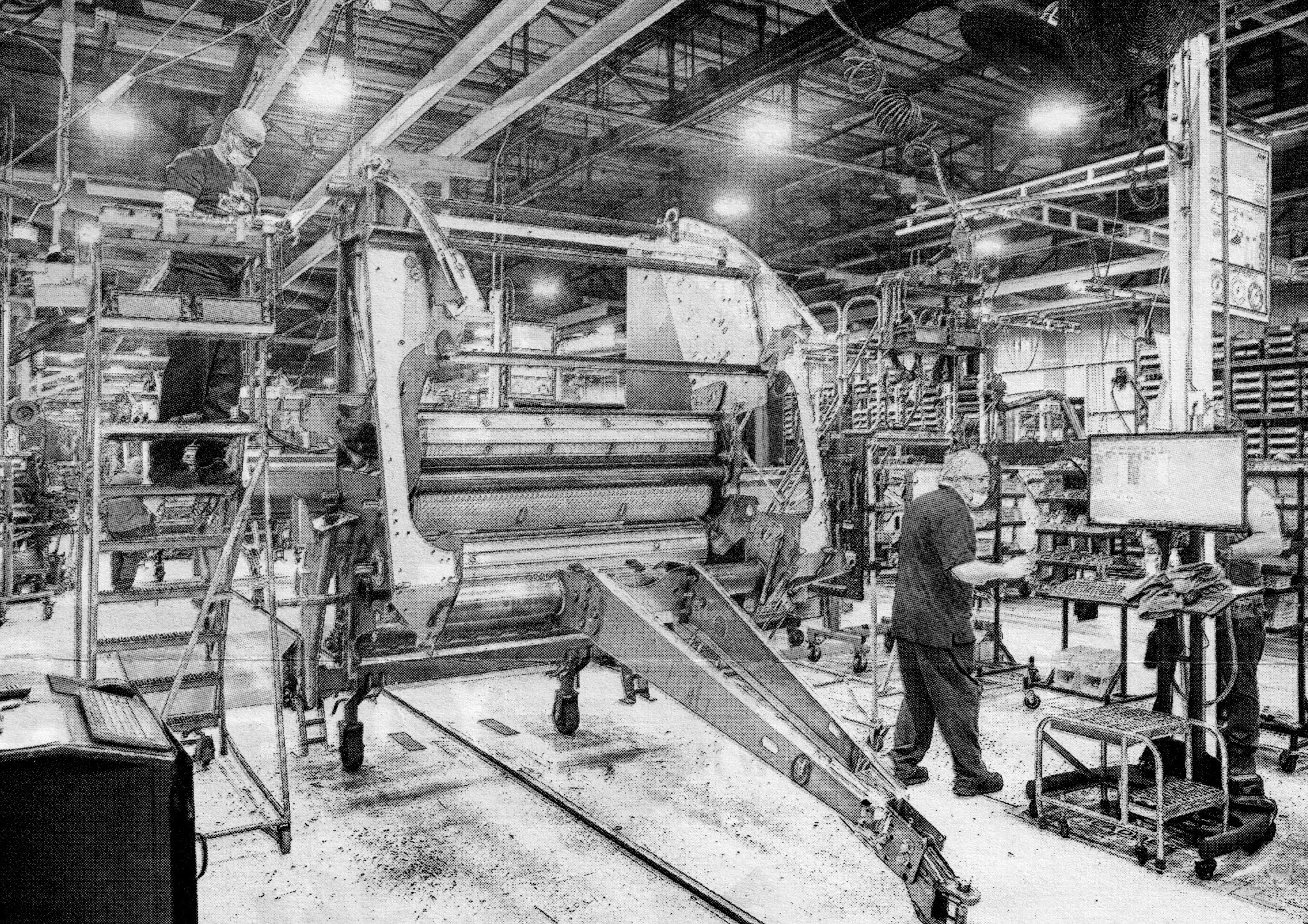
The baler line as seen today.
Even after 125 years, New Holland continues to look to the future of farming.  16 acres of hemp grew near the plant this year on their research farm.  They are now studying alternate fuels to run their equipment.  At New Holland, nothing could be more traditional than innovation. And, what's neat is I drive through New Holland quite a few times every year and am still amazed that we have perhaps one of the largest farm machinery companies in the world a few miles from my house.  And, just in case you didn't know... Lancaster County is known as the "Garden Spot of America."  It was another extraordinary day in the life of an ordinary guy.